

Ministry of Civil Affairs, NDRC, Ministry of Finance, and China Disabled Persons' Federation Designate 13 Pilot Regions for Community-Based Rental Services of Rehabilitation Assistive Devices
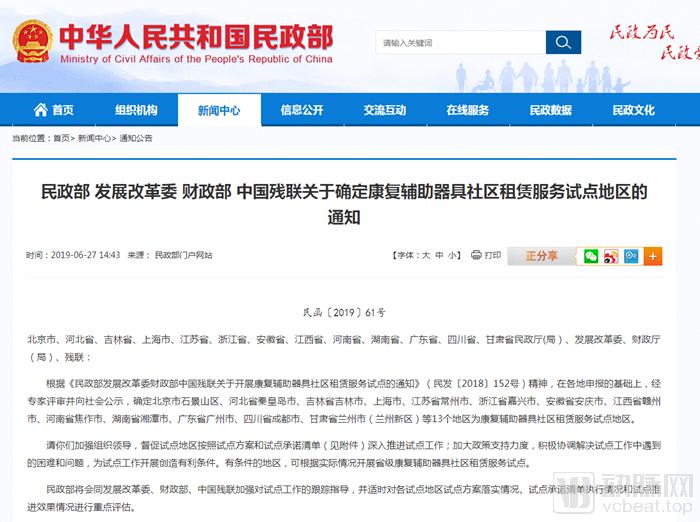
VCBeat (WeChat: vcbeat) reported that on June 27, the Ministry of Civil Affairs, the National Development and Reform Commission, the Ministry of Finance, and the China Disabled Persons’ Federation jointly issued the “Notice on Determining Pilot Regions for Community Rental Services of Rehabilitation Assistive Devices” (hereinafter referred to as the “Notice”).
The “Notice” states that, in accordance with the spirit of the “Notice of the Ministry of Civil Affairs, the National Development and Reform Commission, the Ministry of Finance, and the China Disabled Persons’ Federation on Launching Pilot Programs for Community-based Leasing Services of Rehabilitation Assistive Devices” (Min Fa [2018] No. 152), and on the basis of applications submitted by various localities, following expert review and public notification, the following 13 regions have been designated as pilot areas for community-based leasing services of rehabilitation assistive devices: Shijingshan District of Beijing Municipality; Qinhuangdao City, Hebei Province; Jilin City, Jilin Province; Shanghai Municipality; Changzhou City, Jiangsu Province; Jiaxing City, Zhejiang Province; Anqing City, Anhui Province; Ganzhou City, Jiangxi Province; Jiaozuo City, Henan Province; Xiangtan City, Hunan Province; Guangzhou City, Guangdong Province; Chengdu City, Sichuan Province; and Lanzhou City (Lanzhou New Area), Gansu Province.
The “Notice” emphasizes that all localities shall urge pilot areas to advance pilot work in depth in accordance with the pilot plans and the list of pilot commitments; strengthen policy support, proactively coordinate to address difficulties and challenges encountered in the pilot work, and create favorable conditions for the implementation of pilot initiatives. Where conditions permit, provinces may launch pilot programs for community-based leasing services of rehabilitation assistive devices, tailored to local circumstances.
The "Notice" states that the Ministry of Civil Affairs, in conjunction with the National Development and Reform Commission, the Ministry of Finance, and the China Disabled Persons' Federation, will strengthen follow-up guidance on the pilot initiatives and conduct targeted evaluations at appropriate intervals to assess the implementation of pilot programs in each pilot region, the fulfillment of commitments outlined in the pilot commitment lists, and the overall effectiveness of pilot advancement.
Please find the specific attachments below:
Pilot Commitment List of the People's Government of Shijingshan District, Beijing Municipality
I. Strengthen Organizational Leadership
1. Establish a Leading Group for the Pilot Project
2. Establish a meeting system for pilot projects and an inter-departmental joint conference mechanism
II. Strengthen Policy Support
1. Formulate and Issue the "Administrative Measures for Community Leasing Services of Pilot Rehabilitation Assistive Devices"
2. Formulate and issue the "Catalogue of Community Leasing Services for Pilot Rehabilitation Assistive Devices"
3. Formulate and issue the "Measures for the Admission of Suppliers of Community Leasing Services for Pilot Rehabilitation Assistive Devices"
4. Establish a Credibility Directory for Leasing Suppliers
III. Establishing a Service Network
1. Advance the construction and implementation of the City Rehabilitation Assistive Technology Demonstration Park
2. Operate a community-based shared leasing platform for rehabilitation assistive devices
3. Establish two offline flagship stores for the rental and display of rehabilitation assistive devices
4. Relying on community carriers such as community service centers, elderly care service stations, and Warm Homes, establish “store-in-store” rehabilitation assistive device rental services, with a coverage rate of no less than 60%.
Qinhuangdao Municipal People's Government Pilot Commitment List
I. Establishment of a Pilot Work Leadership Group
A leading group shall be established, with the principal official of the municipal government serving as the group leader, the official in charge of related areas as the deputy group leader, and heads of relevant departments and units—including the Municipal Civil Affairs Bureau, the Municipal Development and Reform Commission, the Municipal Finance Bureau, the Municipal Disabled Persons’ Federation, the Municipal Economic and Technological Development Zone, and the Guokang Qinhuangdao Research Institute—as members. The office of the leading group shall be housed within the Municipal Civil Affairs Bureau, with its principal official concurrently serving as the director of the office. This office shall be responsible for formulating policies and plans related to community-based leasing services for rehabilitation assistive devices, and for supervising and guiding relevant departments and units in the implementation of various assigned tasks.
II. Introduce a set of supportive policies
Formulate an implementation plan for the pilot program of community-based leasing services for rehabilitation assistive devices, along with an annual work plan for the pilot initiatives. Clearly define responsible departments, establish timelines and roadmaps, and incorporate these elements into government performance evaluations. Improve and refine preferential policies for enterprises engaged in the research and development, manufacturing, and leasing of rehabilitation assistive devices, as well as consumer support policies for assistive device leasing. Ensure the high-quality and efficient completion of pilot tasks, thereby developing replicable and scalable best practices.
III. Allocate a Special Fund
Building on the RMB 43.12 million in fiscal subsidies already allocated from 2017 to 2018, an additional approximately RMB 28 million in fiscal funds was earmarked in 2019 to support the development of the rehabilitation assistive device industry. Of this amount, RMB 4.06 million from the 2019 “Fukang Engineering Project” was designated for the procurement of assistive devices for distribution. During the pilot period, annual government-guided special funds were allocated to carry out pilot programs for the rental of rehabilitation assistive devices.
IV. Develop a Distinctive Leasing Model
Centering on “smart community leasing,” “convenient travel-and-stay leasing,” and “efficient medical leasing,” and leveraging industry-specific professional institutions and leading enterprises, we will build a scientific, efficient, and comprehensive leasing service system featuring organic interaction among “technology, production, allocation, service, and users,” and promptly summarize the Qinhuangdao experience to submit a summary report.
V. Establish a Leasing Service Network
During the pilot period, ensure that 60% of elderly care service centers across the city establish community rental service points for rehabilitation assistive devices, with the service network covering more than 50% of communities in the area. Meanwhile, develop the Guokang Qinhuangdao Medical-Nursing-Rehabilitation Elderly Care Center into a citywide demonstration base for the rental services of rehabilitation assistive devices.
VI. Establish a Quality Assurance System
Draft municipal quality standards and specifications for rehabilitation assistive device rental products and services, and establish a product traceability system. Meanwhile, leverage the National Quality Supervision and Inspection Center for Rehabilitation Assistive Devices and its Qinhuangdao Branch to construct a municipal quality supervision mechanism for rehabilitation assistive device rentals, conducting supervisory inspections of all stages of the rental process and product quality.
VII. Establish a Science Popularization Exhibition Hall
By utilizing part of the premises of the Civil Affairs Service Center, a Science Popularization and Exhibition Center for Rehabilitation Assistive Devices will be established to centrally showcase advanced rehabilitation assistive devices from both domestic and international sources. Meanwhile, leveraging the “China Rehabilitation Assistive Device Industry Innovation Conference,” promotional efforts will be conducted to highlight the city’s rehabilitation assistive device rental services, thereby enhancing their demonstrative impact.
VIII. Build a Talent Development Brand
Regularly invite renowned domestic and international industry experts to conduct training courses on the configuration and application of rehabilitation assistive devices and elderly care service technologies, thereby supplying the city with professional talent in management, scientific research, and services. Meanwhile, establish majors related to rehabilitation assistive devices and elderly care services at relevant colleges and universities in the city to accelerate the cultivation of specialized personnel.
IX. Introduce a Plan to Boost Consumer Spending Power
Formulate a municipal catalog of rehabilitation assistive devices available for lease. Provide rental subsidies for selected leasing services using public welfare funds from welfare lotteries. Encourage and support commercial insurance companies in developing innovative products to facilitate consumer spending on rehabilitation assistive device leasing services.
Jilin Municipal People's Government Pilot Commitment List
I. Strengthen Organizational Leadership
Establish a municipal leading group for the pilot program of community-based rental services for rehabilitation assistive devices, with the municipal government’s executive leader in charge serving as the group leader and the heads of relevant municipal departments as members, so as to effectively strengthen organizational leadership over the work related to community-based rental services for rehabilitation assistive devices.
II. Establish a Joint Conference System
Establish a joint conference system for the community leasing service of rehabilitative assistive devices, led by the Municipal Civil Affairs Bureau and comprising 12 municipal departments—including the Municipal Development and Reform Commission and the Municipal Finance Bureau—as member units. Clarify the respective responsibilities of each department, fully leverage their functional roles, foster synergistic collaboration, and jointly advance the initiative to ensure the smooth and orderly implementation of the pilot program.
III. Conduct Effective Publicity Work
Place high priority on publicity and public opinion guidance. Leverage various media outlets and diverse promotional methods to effectively promote community-based rental services for rehabilitation assistive devices. Intensify publicity and guidance efforts targeting key user groups, including the elderly, persons with disabilities, and individuals recovering from injuries or illnesses, so as to foster a strong atmosphere and favorable market consumption environment for the development of the community-based rental industry for rehabilitation assistive devices across the city.
IV. Strengthening Financial Support
Establish and improve a diversified funding mechanism to comprehensively guarantee the financial resources required for community rental services of rehabilitation assistive devices. By examining and surveying the implementation of funding guarantees for community rental services of rehabilitation assistive devices across China, formulate municipal funding guarantee measures.
V. Leverage Civil Society Organizations and Social Forces to Advance Pilot Programs
Attract private capital investment to fully participate in the rental services for rehabilitation assistive devices. By collecting data through daily services and integrating user needs, we aim to build a comprehensive service system covering the design, research and development, production, distribution, and after-sales support of assistive devices. The Community Rental Service Center for Rehabilitation Assistive Devices directly connects with community-based smart home care enterprises, intelligent call platforms, and medical assistive device manufacturers. This forms a service team led by large-scale service companies, supported by community home care service stations, and supplemented by other service providers, delivering “doorstep” rental services for rehabilitation assistive devices to clients.
VI. Strengthen Guidance for Pilot Projects
During the pilot construction and operation phase, we carefully referenced and drew upon experiences from other regions, strengthened the management and guidance of entities participating in the pilot projects, facilitated the establishment of rehabilitation assistive device rental service agencies, and set up shared service centers and reprocessing (cleaning and disinfection) centers for rehabilitation assistive devices. Strict adherence to operational standards was maintained to ensure that all rehabilitation assistive devices met quality requirements, thereby providing efficient and prompt services to elderly individuals, persons with disabilities, injured or ill patients, and other groups in need through a comprehensive and well-established service system.
Shanghai Municipal People's Government Pilot Commitment List
I. Strengthen Organizational Leadership
1. Relying on the Municipal Leading Group for the Construction of the Social Elderly Care Service System, add the task of piloting community rental services for rehabilitation assistive devices. The Leading Group is headed by the Vice Mayor in charge, with 16 relevant municipal government departments and units as well as the 16 district governments serving as member entities. The Office of the Leading Group is located within the Municipal Civil Affairs Bureau.
II. Strengthen Policy Support
2. Implement subsidies for the rental of rehabilitation assistive devices. The community-based rental service program for rehabilitation assistive devices shall be operated through socialized and project-based approaches. Elderly individuals aged 60 years or older with local household registration (hukou), as well as persons with disabilities under the age of 60, are eligible to apply for rental services; among them, designated target groups may apply for rental service subsidies.
3. Develop a catalog of rehabilitation assistive devices for lease, and determine the products available for lease and the leasing service providers through public tendering and other methods.
4. Study the payment system for rehabilitation assistive devices. Explore the use of municipal elderly care service subsidies for the rental of rehabilitation assistive devices. Support the integration of community-based rental services for basic rehabilitation assistive devices with the municipal elderly care service subsidy policy and the nursing subsidy policy for individuals with severe disabilities.
5. Explore the use of long-term care insurance and commercial insurance for rehabilitation assistive device rental services.
III. Increase Financial Investment
6. In 2019, a budget of RMB 4 million from the municipal-level welfare lottery public welfare fund was allocated for the pilot program of community leasing of rehabilitation assistive devices; in 2020, it is proposed to allocate RMB 6 million, ensuring that the total budget arrangement over the two years amounts to no less than RMB 10 million for the implementation of the pilot program on community leasing services for rehabilitation assistive devices.
IV. Improving Safeguard Measures
7. Service Point Assurance. Fully leverage resources such as municipal comprehensive community elderly care service centers, elderly care institutions, child welfare institutions, and disability welfare institutions to promote the establishment of physical and mobile service points for the rental of rehabilitation assistive devices in sub-districts, towns, and townships. In the first year, achieve coverage of the rehabilitation assistive device rental service network in 30% of the city’s sub-districts, towns, and townships; in the second year, expand coverage to over 50%, encompassing no fewer than 108 sub-districts, towns, and townships.
8. Leasing Services and Product Quality Assurance. In terms of service standards, two group standards were formulated and issued: the "Specification for Leasing Services of Rehabilitation Assistive Devices" and the "Hygiene and Safety Requirements for Leasing Rehabilitation Assistive Devices." Regarding product quality, research was conducted on product liability insurance in the field of rehabilitation assistive devices, and purchasing such insurance was made a mandatory condition for enterprises to win bids in project tenders.
9. Publicity and Support. Organize public welfare activities to bring rehabilitation assistive devices into communities; establish exhibition areas for rehabilitation assistive devices and rental experience zones at the China International Senior Care, Assistive Devices, and Rehabilitation Medical Expo; set up a science popularization exhibition hall for rehabilitation assistive devices within the “365 Exhibition Hall” of the China International Import Expo (CIIE) at the National Exhibition and Convention Center; and build an innovative brand experience and showcase center in Jing’an District, a central urban area, to guide consumers in meeting their rehabilitation assistive device configuration needs through community-based rental services.
Changzhou Municipal People's Government Pilot Commitment List
I. Strengthen Organizational Leadership
1. Incorporate the pilot work into the city’s comprehensive innovation pilot for the rehabilitation assistive device industry, fully leverage the role of the joint conference mechanism for the city’s comprehensive innovation pilot in this sector, and coordinate the implementation of pilot tasks in a holistic manner.
2. Establish a unified, standardized, and normalized process for the rental of rehabilitation assistive devices, regulating systems for service applications, configuration assessments, service delivery, cleaning and disinfection, and complaint handling and rights protection.
II. Emphasize Policy Guidance
3. Issued the "Implementation Opinions on Promoting Community Rental Services for Rehabilitation Assistive Devices in Changzhou City."
4. Subsidies shall be provided through government procurement of services for eligible individuals who rent basic rehabilitation assistive devices and meet the criteria for government assistance.
III. Steady Implementation
5. In 2019, 10 community rental service stations for rehabilitation assistive devices were established, covering 30% of communities; in 2020, the number of rental stations was increased to cover more than 50% of communities across the city.
6. Establish a city-level information platform for community leasing services of rehabilitation assistive devices, leveraging the existing elderly care service platform.
IV. Coordinated Investment Funding
7. In 2019, a proposed allocation of RMB 3 million was designated for community-based rental services of rehabilitation assistive devices.
8. In 2019, a planned allocation of 9 million yuan was designated for age-friendly home modifications.
V. Strengthening Service Support
9. Relying on the West Taihu Lake (Rehabilitation Assistive Devices) Industrial Park and leading enterprises to increase the research, development, and production of rehabilitation assistive devices.
10. Leverage the Changzhou Health and Elderly Care Talent Training Base to strengthen vocational skills training for personnel providing community leasing services of rehabilitation assistive devices.
VI. Strengthen Publicity and Promotion
11. Conduct extensive publicity and consultation for the community leasing services of rehabilitation assistive devices through multiple channels, including television, the internet, newspapers, self-media, and brochures.
12. Leverage the City Health and Elderly Care Product Exhibition Center to centrally showcase the categories and functions of rehabilitation assistive devices.
Jiaxing Municipal People's Government Pilot Commitment List
I. Strengthen Organizational Leadership
1. Establish a Leading Group for the Pilot Program of Community Rental Services for Rehabilitation Assistive Devices, with the Vice Mayor in charge serving as the group leader and heads of municipal departments—including the Civil Affairs Bureau, the Development and Reform Commission, the Finance Bureau, and the Disabled Persons’ Federation—as members.
2. An office shall be established under the leadership group, with its seat at the Municipal Civil Affairs Bureau.
II. Increase Financial Investment
Increase fiscal investment in the pilot program for community-based leasing services of rehabilitation assistive devices, with total investment expected to be no less than 19 million yuan:
1. Approximately RMB 5 million was allocated for the development of a community-based rental service network.
2. Elderly care service subsidy funds amount to approximately RMB 1 million.
3. The funding for the construction of a popular science exhibition hall for rehabilitation assistive devices is approximately RMB 6 million.
4. Approximately RMB 2 million was allocated for the development of the community-based rental service information system for rehabilitation assistive devices and the formulation of local standards.
5. Approximately RMB 5 million was invested in the long-term care insurance fund.
III. Improve the municipal long-term care insurance system and pilot the inclusion of community rental service fees for rehabilitation assistive devices in the project catalog.
IV. A community-based rental service network for rehabilitation assistive devices, covering both urban and rural areas and ensuring convenient access, shall be basically established, with rental services available in all urban and rural communities.
V. Guide social forces to establish professional institutions for community-based rental services of rehabilitation assistive devices, with each county (city, district) designating one regional entity as the primary provider of such community rental services.
VI. Formulate and publish catalogs of rehabilitation assistive device rental services by county (city, district).
VII. Establish a city-level information platform for the community rental services of rehabilitation assistive devices.
VIII. Establish standardized community-based leasing service models at the county (city, district) level, and regulate service procedures such as application and management for leasing services.
9. Formulate and release local standards for community rental services of rehabilitation assistive devices.
X. Each county (city, district) shall establish at least one science popularization exhibition hall for rehabilitation assistive devices, centrally showcasing the categories and functions of such devices.
Anqing Municipal People's Government Pilot Commitment List
I. Strengthen Leadership
1. Establish a “Municipal Leading Group for the Pilot Program of Community Rental Services for Rehabilitation Assistive Devices,” with the vice mayor in charge serving as the group leader and heads of relevant departments as members, to advance the pilot program of community rental services for rehabilitation assistive devices in the city.
2. Establish a collaborative mechanism for the pilot program of community-based rental services for rehabilitation assistive devices, and coordinate efforts across departments to jointly promote the development of the rehabilitation assistive device industry.
3. Establish an Expert Advisory Committee for the Pilot Program of Community-Based Rental Services for Rehabilitation Assistive Devices, and fully leverage the expertise of the committee to refine the top-level design of the city’s pilot program.
II. Increase Investment
In light of the implementation of rental services for elderly beneficiaries, persons with disabilities, and injured or ill patients, an annual financial subsidy of no less than RMB 1 million shall be granted to enterprises providing rehabilitative assistive device rental services and supporting logistics, recycling, maintenance, cleaning, and disinfection services.
III. Policy Support
1. Include the rental service of rehabilitation assistive devices in the key tasks of the city’s pilot reform for home- and community-based elderly care services. During the pilot period, provide rental venues free of charge to enterprises offering rehabilitation assistive device rental services.
2. Support rehabilitation assistive device rental service enterprises in providing services within their jurisdictional counties (cities).
3. All operational community-based home elderly care service stations shall comprehensively carry out the rental service of rehabilitation assistive devices.
IV. Incubated Enterprises
1. Cultivate manufacturers of rehabilitation assistive devices, encourage the establishment of R&D institutions for such devices, and actively support the development of rental service enterprises.
2. Accelerate the construction of the city’s rehabilitation assistive device demonstration, experience, and trading center to promote sales and application.
3. Cultivate professional talent in rehabilitation assistive devices through various methods, including on-the-job training, study visits and exchanges, and off-site internships.
V. Standardizing the Market
1. Establish a joint conference system for member units of the leading group to promote the healthy development of community-based rental services for rehabilitation assistive devices in the city.
2. Formulate the "Implementation Measures for Community Leasing Services of Rehabilitation Assistive Devices in Anqing City".
3. Formulate the "Management Specifications for Community Leasing Service Institutions of Rehabilitation Assistive Devices in Anqing City".
VI. Information Support
1. Enhance the service capabilities of the Municipal Elderly Care Information Center and build an “Internet + Leasing” service information platform.
2. Establish a statistical system primarily covering information on enterprises and institutions engaged in the production, research and development, sales, and leasing of rehabilitative assistive devices, as well as on service recipients, and improve the mechanisms for data collection and sharing by integrating statistical surveys, administrative records, and industry statistics.
VII. Publicity and Guidance
1. Strengthen publicity and guidance for users of rehabilitation assistive devices, including the elderly, persons with disabilities, and individuals with injuries or illnesses, through media channels such as the internet, television, and radio, so as to foster a favorable social environment for the development of rehabilitation assistive devices.
2. At appropriate times, establish role models, strengthen demonstration effects, and guide development through summary meetings, experience-sharing sessions, and other formats.
Ganzhou Municipal People's Government Pilot Commitment List
I. Strengthen Organizational Leadership
1. Establish a leading group for the pilot program of community-based rental services for rehabilitation assistive devices at the municipal level. The people’s governments of Zhanggong District and Dingnan County shall establish corresponding organizational and leadership structures. The leading group shall convene plenary meetings every six months and conduct quarterly coordination reviews of the pilot counties (districts).
2. Establish an assessment mechanism. Pilot counties (districts) shall formulate phased task lists on a semi-annual basis. The Leading Group Office shall define assessment indicators, conduct benchmarking, and regularly circulate bulletins on progress through methods such as on-site supervision, document review, and hearing reports.
II. Increase Financial Investment
1. Secure matching funds for the pilot program by securing upper-level financial appropriations, allocating special-purpose funds from local budgets, and attracting social capital.
2. Formulate measures for the use and management of pilot funds, specifying the scope of fund utilization and management methods, and incorporate the implementation status and execution progress of fund allocation in pilot counties (districts) into scheduling, supervision, and reporting mechanisms.
III. Strengthening Policy Support
1. Integrate existing policies supporting the development of the rehabilitation assistive device industry, and formulate specific implementation opinions to support the development of community rental services for rehabilitation assistive devices from aspects such as fiscal policy, investment and financing, and taxes and fees.
2. Include personnel involved in the community rental services for rehabilitation assistive devices within the scope of municipal preferential talent policies, and support qualified and capable training institutions in conducting knowledge and technical training.
IV. Improve Safeguard Measures
1. By integrating the implementation of the second batch of national pilot programs for home- and community-based elderly care service reforms with the national comprehensive innovation pilots for the rehabilitation assistive device industry, we will coordinate development and foster mutual promotion, thereby achieving shared and interconnected support policies and service models.
2. Integrate the municipal comprehensive information platform for elderly care services, add a community rental information module for rehabilitation assistive device products and services, and improve the product catalog and configuration guidelines for rehabilitation assistive devices.
3. Fully leverage various publicity channels and media formats to strengthen promotion and guidance for the community-based rental of rehabilitation assistive devices, thereby creating a favorable environment for the implementation of pilot programs.
Jiaozuo Municipal People's Government Pilot Commitment List
I. Strengthen Organizational Leadership
Establish a Municipal Leading Group for the Pilot Program of Community Leasing Services for Rehabilitation Assistive Devices, with the Deputy Mayor of the Municipal People’s Government serving as the group leader, the Deputy Secretary-General of the Municipal People’s Government and the Director of the Municipal Civil Affairs Bureau as deputy leaders, and heads of relevant departments—including the Deputy Director of the Municipal Development and Reform Commission, the Deputy Director of the Municipal Civil Affairs Bureau, the Deputy Director of the Municipal Finance Bureau, and the Vice Chairperson of the Municipal Disabled Persons’ Federation—as members, to comprehensively coordinate and advance the implementation of the pilot program.
II. Increase Financial Investment
Establish a diversified and multi-tiered consumer payment guarantee system tailored to the service needs of different population groups. Incorporate basic community rental services for rehabilitation assistive devices into government-purchased services, such as elderly care, disability assistance, or welfare services. Ensure adequate matching funds in accordance with the progress of pilot implementation.
III. Improve Policy Support
1. Formulate the "Implementation Measures for the Rental of Rehabilitation Assistive Devices in Jiaozuo City," including: target service recipients, service procedures, service standards, and division of responsibilities among member units.
2. Establish a classified subsidy policy for service recipients, providing 100% subsidy to urban and rural individuals under state support and registered persons with severe disabilities who have service needs; 80% subsidy to special elderly groups with service needs, including elderly persons with severe disabilities, elderly veterans without family support, individuals receiving subsistence allowances, low-income elderly persons of advanced age or living alone, elderly persons facing difficulties due to the loss of their only child, having only one child, or being part of a two-daughter family under family planning policies, provincial-level or higher model workers, and elderly persons in financial hardship; 30% subsidy to other elderly persons and persons with disabilities who have service needs; and 10% subsidy to injured or ill persons who have service needs.
IV. Cultivating Market Entities
In accordance with the guidelines of civil affairs departments at all levels, rehabilitation assistive device service centers shall be established at the municipal, county, and township levels. With community day-care centers and rural happiness homes serving as terminal service points, a comprehensive service system shall be formed to centrally carry out the distribution, disinfection, maintenance, upkeep, and recycling of assistive devices.
V. Standardize Service Practices
1. Implement government procurement and centralized bidding.
2. Strengthen market supervision to ensure the traceability of assistive device quality.
3. To safeguard the legitimate rights and interests of service recipients, complaints and rights protection claims can be filed via 12349.
VI. Strengthening Service Support
1. Each county shall assign 2–3 public welfare job personnel to be exclusively responsible for the disinfection, maintenance, and repair of assistive devices.
2. Promote the implementation of talent development programs for the rehabilitation assistive devices industry by conducting relevant training at higher and vocational education institutions, such as the Second Affiliated Hospital of Henan Polytechnic University, Jiaozuo University, and Jiaozuo Technician College, to build a talent reserve for the research and development, manufacturing, and service sectors of the rehabilitation assistive devices industry.
VII. Vigorous Promotion and Publicity
Special promotional columns have been launched on channels such as Jiaozuo Radio and Television Station, Jiaozuo Daily, the municipal government website, and the “Jiaozuo Elderly Care” WeChat official account to promote rental services and provide instructions on the use, rental procedures, and access channels for rehabilitative assistive devices. Dedicated areas have been established in day care centers and rural happiness homes for product displays, video demonstrations, and on-site experiential trials.
VIII. Safeguard Measures
1. Incorporate this work into the “Five-in-One” comprehensive inspection framework of the Municipal Party Committee and Municipal People’s Government, implement target-based responsibility management, ensure implementation according to the scheduled timeline, and maintain coordinated efforts across municipal, county, and township levels.
2. Establish a coordination mechanism for the pilot program of community-based rental services for rehabilitation assistive devices, led by the municipal government and involving participating departments and units such as the Municipal Civil Affairs Bureau, Municipal Finance Bureau, Municipal Development and Reform Commission, and Municipal Disabled Persons’ Federation, to promptly study and resolve major issues arising during implementation and form a strong synergistic force to advance the pilot program.
3. Clarify the division of responsibilities. All relevant entities shall cooperate closely, perform their respective duties, strengthen inspection and guidance over the management and use of support funds for the pilot program on community leasing services for rehabilitation assistive devices, and consciously accept supervision from supervisory and audit departments as well as from the public.
Xiangtan Municipal People's Government Pilot Commitment List
I. Strengthen Organizational Leadership
Establish a Leading Group for the Pilot Program of Community Leasing of Rehabilitation Assistive Devices. Establish a joint conference system led by the Municipal Civil Affairs Bureau, with participation from the Municipal Health Commission, the Municipal Development and Reform Commission, the Municipal Finance Bureau, the Municipal Disabled Persons’ Federation, and the Municipal Quality Supervision Bureau.
II. Increase Financial Investment
1. Allocate special funds to establish community-based rehabilitation therapy rooms and launch public welfare programs such as the rental of assistive devices for elderly individuals in financial hardship; increase investment in training to support the professional development of personnel providing assistive device services. Integrate funding by coordinating existing project funds from the Municipal Civil Affairs Bureau and the Municipal Disabled Persons’ Federation, along with social donations, to ensure an effective supply of rehabilitation assistive devices.
2. Strengthen demonstration and leadership in urban and rural areas. Select 30 communities from the city’s 116 as urban demonstration sites, and 50 villages from the city’s 763 as rural demonstration sites. The pilot program will run for one year, after which it will be rolled out comprehensively based on the lessons learned.
3. Mobilize social forces to participate. Priority should be given to guiding manufacturers and service providers of rehabilitation assistive devices to engage in community-based rental services, with government support and guidance provided through subsidies and service procurement, thereby enabling social entities to play a primary role in community rental services.
4. Promote the development of the market-based rental sector through public-welfare rental initiatives; in 2019, a pilot project was launched in urban districts to provide public-welfare rentals of rehabilitative assistive devices to 200 elderly individuals in financial hardship.
5. Establish a municipal information database for the community rental services of rehabilitation assistive devices. Implement dynamic management and conduct regular monitoring and analysis to ensure real-time updates and timely responsiveness of the rehabilitation assistive device service information database.
III. Provide Policy Support
1. Issued policy support documents such as the “Pilot Program for Community-Based Rental Services of Rehabilitation Assistive Devices in Xiangtan City.”
2. Establish service standards, service procedures, assessment methods, and performance evaluation criteria for the community rental of rehabilitation assistive devices; regulate market practices in rental services; strengthen service supervision; and develop comprehensive implementation guidelines covering assessment, fitting, disinfection and cleaning, maintenance and repair, and training.
Guangzhou Municipal People's Government Pilot Commitment List
I. Strengthening Organizational Leadership
Establish a working mechanism characterized by government leadership, departmental assistance, and social participation. A pilot work leading group shall be established, with a responsible official from the municipal people’s government serving as the group leader, and responsible officials from relevant departments—including the Municipal Civil Affairs Bureau, the Municipal Disabled Persons’ Federation, the Municipal Development and Reform Commission, the Municipal Finance Bureau, the Municipal Health Commission, the Municipal Human Resources and Social Security Bureau, the Municipal Market Supervision Administration, and the Municipal Healthcare Security Administration—as members. A joint conference system shall be implemented to coordinate and advance the pilot work, promptly study and resolve key and challenging issues, and foster a collaborative work environment featuring shared responsibility and comprehensive promotion.
II. Strengthening Financial Support
First, increase fiscal investment by incorporating pilot program funding into the annual departmental budget and the Welfare Lottery Public Welfare Fund work plan in accordance with relevant regulations and procedures. Second, mobilize social resources and charitable funds to participate, support commercial insurance companies and financial institutions in developing innovative products, and promote consumption of community rental services for rehabilitation assistive devices through mechanisms such as public venture philanthropy, thereby establishing a diversified investment framework that integrates fiscal funds, social capital, and charitable contributions. Third, continue to strengthen the provision of assistive devices for persons with disabilities; in accordance with municipal regulations on assistive device provisioning, implement a policy under which the first set of devices is provided free of charge, while 60% of the cost of the second set is subsidized by government fiscal funds.
III. Strengthen Venue Staffing Support
Guide entities such as Xingguang Elderly Home, Community Home-based Comprehensive Elderly Care Service Centers, Kangyuan Vocational Rehabilitation Stations, Community Health Service Centers, and Social Work Service Stations—as well as institutions serving disabled seniors and persons with disabilities, healthcare providers, and urban and rural community service agencies—to provide premises for the service outlets of community rental service providers of rehabilitative assistive devices. Strengthen grassroots service capacity for specialized initiatives, including the community rental of rehabilitative assistive devices, through measures such as government procurement of services.
IV. Strengthen Market Cultivation
First, conduct comprehensive surveys. Ascertain the regional distribution, age structure, classification levels, and service needs of key rehabilitation service recipients in the city (persons with disabilities, elderly individuals with functional impairments, and patients with injuries or illnesses). Establish a scientific assessment mechanism for rental demand to provide professional recommendations on the rental of rehabilitative assistive devices for these individuals. Second, cultivate market entities. Guide and encourage specialized institutions for rehabilitative assistive device configuration services, as well as enterprises engaged in production, R&D, and sales, to launch community-based rental services. Explore the establishment of technical service centers of a certain scale to centrally carry out cleaning, disinfection, maintenance, repair, and configuration assessment of rehabilitative assistive devices.
V. Building a Service Network
First, integrate existing resources to establish a community-based rental service network for rehabilitation assistive devices that covers both urban and rural areas, is convenient and accessible, ensures precise matching, features multi-location outlets, adopts diverse operational models, and provides multi-tiered services. Second, explore and apply a service model combining online and offline channels, and support enterprises in the community rental of rehabilitation assistive devices to extensively expand their service outlets.
VI. Strengthen Promotion and Publicity
First, establish a science popularization exhibition hall for rehabilitation assistive devices to centrally display their categories and functions. Second, extensively carry out publicity and consultation activities through multiple channels, including news media reports, WeChat platforms, distribution of brochures, and on-site events, to guide consumers in meeting their needs for rehabilitation assistive device configuration through community rental services, thereby enhancing social awareness and recognition.
VII. Strengthen Supervision and Management
First, establish a market entry and exit mechanism for community-based rental service providers of rehabilitation assistive devices. Clearly define operational requirements for each stage of service delivery, including service applications, needs assessments, catalogs of rentable products, management of rental prices and deposits, service provision, cleaning and disinfection, and complaint handling and rights protection. This will create a regulatory framework with clear market rules and robust safeguards for user rights. Second, establish a mechanism for specialized inspections and supervision. Conduct random checks on at least 30% of community-based rehabilitation assistive device rental service enterprises annually, publicly report any identified issues, and urge corrective actions to standardize service practices.
VIII. Advance in an Orderly Manner by Following Steps
The pilot program will be advanced in three phases. The first is the overall deployment phase (2019), which involves establishing a leading group, conducting comprehensive surveys, formulating implementation plans, and issuing supporting documents. The second is the full-scale promotion phase (2020), focusing on establishing and improving the service network and rolling out the pilot program across the board. The third is the experience summarization phase (first half of 2021), aimed at summarizing pilot experiences, promoting them citywide, and generating comprehensive effects in service innovation and policy optimization.
Chengdu Municipal People's Government Pilot Commitment List
I. Strengthen Organizational Leadership
Establish a leadership and promotion group for the pilot program of community leasing services for rehabilitation assistive devices, led by the municipal government official in charge, with the Municipal Civil Affairs Bureau taking the lead and relevant municipal departments providing support. The office of the leadership group shall be located in the Social Affairs Division of the Municipal Civil Affairs Bureau. The director of the office shall be concurrently held by the official in charge of the Municipal Civil Affairs Bureau, and the deputy director shall be concurrently held by the head of the Social Affairs Division. The office shall be responsible for the day-to-day operations of the pilot program, organizing the formulation of relevant policies, studying and resolving related issues, and promoting the implementation of the pilot work.
II. Exploring Diversified Capital Investment
Incorporate the pilot initiatives into the fiscal budgets at both the municipal and district/county levels, explore the establishment of a fiscal subsidy system for community-based rental services of rehabilitation assistive devices, and support the advancement of these pilot programs. Utilize the portion of welfare lottery public funds retained at the municipal level to support rental service enterprises in exploring and implementing community-based rental service models. Encourage social funding from charitable organizations, the Red Cross, and other entities to support the development of community-based rental services for rehabilitation assistive devices.
III. Leveraging Idle Resources to Support Rental Services
Encourage the use of idle public resources by rehabilitation assistive device rental service enterprises free of charge or at low cost. Encourage all districts (cities) and counties to collaborate with rental service enterprises to utilize idle public infrastructure in jointly creating “experience centers” for rehabilitation assistive devices. Encourage community-based rehabilitation facilities for persons with disabilities, day care centers, and other public resources where conditions permit to partner with rental service enterprises, establishing community rental service stations through measures such as functional expansion and equipment addition.
IV. Exploring Informationized Leasing Services
Explore the establishment of a “one-click, integrated, and comprehensive” rental service model. Leveraging Chengdu’s “Tianfu Citizen Cloud,” develop an information system with complete functionalities, convenient pickup and return, easy payment, standardized management, and integrated data to conduct online rental services, thereby providing convenient services for special groups such as the elderly, people with disabilities, and patients with injuries or illnesses.
V. Strengthen the Cultivation of Talent in Leasing Services
Cultivate professional talents by leveraging universities, R&D enterprises, and training institutions based in Chengdu; develop service-oriented personnel through community colleges, schools for social organizations, and the Chengdu No. 2 Social Welfare Institute; and establish a team of evaluators for the community-based rental services of rehabilitation assistive devices, drawing on experts from Chengdu-based universities and professionals specializing in the production and management of such devices, to conduct regular assessments of these community rental services.
VI. Exploring the Establishment of a Management System for Leasing Services
Explore the establishment of a management system for rental services, and formulate standards for service applications, configuration assessments, service delivery, cleaning and disinfection, and complaint handling and rights protection. Establish and improve regulatory systems for the rental service process and product quality, set up channels for safe services, product quality assurance, and complaint resolution, develop local standards for supervision and management as well as rental services, and explore the implementation of a product traceability system. Foster the development of self-regulatory industry organizations, establish industry self-governance regulations, and leverage industry self-discipline and standards to regulate the market.
VII. Strengthen Publicity for Community Rental Services
Strengthen publicity for comprehensive “experience centers” and community rental service stations to enable more members of the public to understand the basic functions of rehabilitation assistive devices and become proficient in their use, thereby extending the benefits of these devices to a broader population of older adults, persons with disabilities, and individuals recovering from injuries or illnesses. Adopt engaging and accessible approaches to disseminate information about the municipal party committee and government’s people-centered policies, as well as the details and procedures for rehabilitation assistive device rental services, thereby encouraging widespread adoption among those in need.
Lanzhou New Area Administrative Committee Pilot Commitment List
I. Establish a pilot work leading group, with the principal leader of the Management Committee serving as the group leader, the leader in charge as the deputy group leader, and the principal heads of relevant units—including the Municipal Civil Affairs Bureau, the Municipal Development and Reform Commission, and the Municipal Finance Bureau—as members. The group shall promptly study and resolve key and difficult issues encountered during the advancement of the pilot program, so as to promote a working dynamic characterized by joint management, clear assignment of responsibilities, and comprehensive implementation.
II. Annually allocate special funds of no less than RMB 2 million from the fiscal budget at the corresponding level and welfare lottery public welfare funds to support the pilot program for community-based rental services of rehabilitation assistive devices.
3. In 2019, the rental service network for rehabilitation assistive devices covered 90% of established urban communities; in 2020, the service network covered more than 80% of urban and rural communities.
IV. Establish standards for the community leasing of assistive devices, clarify work requirements for each service stage, and promote the standardized development of community leasing services for assistive devices.
V. Introduce a subsidy system for the community-based rental of rehabilitation assistive devices, and promote the widespread adoption of such services among urban and rural elderly persons, persons with disabilities, key priority care recipients, and individuals receiving basic civil affairs social assistance.
VI. Conduct one specialized training session on knowledge of rehabilitative assistive devices annually for community leaders and staff undertaking pilot tasks.
VII. Select at least one community in the new district to establish a science popularization exhibition hall for rehabilitation assistive devices.
VIII. Relying on the Gansu Provincial Resource Center for Assistive Devices for Persons with Disabilities, establish a Community Technical Service Center for the Leasing and Recycling of Assistive Devices.
Note: Due to the extensive content, please refer directly to the official website of the Ministry of Civil Affairs:http://www.mca.gov.cn/article/xw/tzgg/201906/20190600018016.shtml