

Bangbang Robotics Files IPO Prospectus to Empower Millions with Mobility Disabilities Through Assistive Robots

Robooter
Smart Assistant Mobile Robot Developer
“Because they are disabled, their lives were folded away by the shroud of fate before they had even begun to unfold.” In Moss Will Not Fade, Yuan Ling thus describes the miners who were paralyzed in bed after being injured in coal mine accidents in Shanxi Province. He portrays an injured miner as having “his place in life fixed to the bed in this earthen house.” Despair, marginalization, and inability to care for oneself—the living conditions of people with disabilities are always moving. Li Jianguo, founder of Robooter, has a cousin who was also disabled due to injuries sustained in a Shanxi coal mine accident. As a youth, Li Jianguo witnessed his cousin’s vitality ebb away while confined to bed, much like watching a vibrant flower gradually wither. Beyond heartache, he felt an impulse to help it bloom again.
Later, Li Jianguo enrolled at Harbin Institute of Technology. While collaborating with peers on robotics ventures, he resolutely chose to focus on medical rehabilitation. In July 2015, the first-generation Robooter was developed. In 2016, Bangbang Robot (Shanghai) Co., Ltd. was officially established. In 2017, after seven internal iterations, Robooter launched the “Walker” for the market. Subsequently, in October 2018, incorporating comprehensive market feedback, Robooter enhanced battery endurance and refined speed control precision based on its previous model. By installing pressure-sensing sensors on the footrests, the company introduced the “Robooter Smart Assistive Mobility Robot,” truly delivering a “Smart+” convenient transfer solution.
The population that Robooter aims to assist is substantial and cannot be overlooked. In China, countless individuals lose their ability to walk due to paralysis caused by stroke, cerebral palsy, or accidents. According to statistics, there are approximately 5.3 million people with spinal cord injuries and over 6 million patients with cerebral palsy in China each year. Among the nearly 300 million elderly population, 20% suffer from mobility impairments.
Yet more terrifying than the accident itself is their state of survival.
Compared with countries with advanced rehabilitation medicine, such as the United States, China faces a significant shortage of both rehabilitation institutions and professionals. There are only 11,000 rehabilitation therapists in China, whereas the United States has more than 200,000. The number of rehabilitation clinics in China is merely 50 to 60, while in the United States, there are approximately 30,000 to 70,000. In terms of caregiving personnel, China has a shortfall of up to 7 million caregivers.
The substantial shortage of human resources requires a “robotics revolution” to fill the gap. According to the International Federation of Robotics, approximately 20,000 robots designed for aging populations—including medical robots, assistive devices for people with disabilities, and exoskeleton robots—were sold in 2018. This figure accounts for less than 5% of industrial robot sales, indicating significant untapped market potential.
Exoskeleton robots, a “cutting-edge technology,” are highly anticipated for their potential to restore human mobility, with numerous companies in China and abroad actively entering this field. However, after deliberation, Robooter’s core team has decided not to pursue exoskeleton robots as its current R&D focus.
Wang Qiuyang, co-founder of Robooter, told VCBeat: “We have always firmly believed that technology can bring people a better life, and advanced technological achievements should serve people, especially those with disabilities. What we aim to create is a product that truly brings hope to individuals with lower-limb disabilities and assists them in various aspects of their daily lives.”
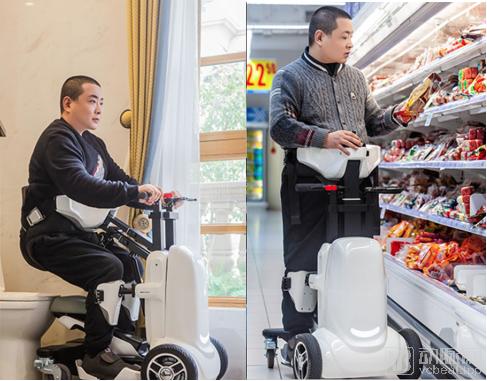
The Robooter requires no assistance, allowing individuals with disabilities and the elderly to don it independently. With the support of the Robooter, users can stand upright, exercise, move around, and manage toileting autonomously. The device can also be controlled via the Banghui APP. Multiple components of the Robooter, including the swing arms, height, and seat, are adjustable to accommodate individual user needs. Additionally, the Robooter features user-centric functions such as one-touch emergency alerts to designated contacts and social sharing capabilities.
Wang Qiuyang stated, “Moving forward, Robooter will strive to optimize its products in two directions. First, we aim to improve cost-effectiveness to make our products more affordable for a broader audience. Second, regarding the target population, we hope that future products will not only cater to individuals with disabilities but also serve a wider range of people with limited mobility.”
Shortly after its market launch, Robooter’s products attracted a wave of imitators. In response, Wang Qiuyang stated, “Imitation is a form of market recognition and encouragement for Robooter and the Robooter scooter. We dare not relax in the slightest. Meanwhile, leveraging our product’s proprietary technological barriers, we are confident that while others may imitate us, they will not be able to surpass us.”
These technical barriers are primarily manifested in three aspects. First, in product design: while competing products can mimic the physical form, they struggle to match the smoothness of operation and ergonomic design.
Secondly, in terms of product innovation philosophy, Robooter’s team has maintained close collaboration with people with disabilities, rehabilitation institutions, and hospitals throughout the research and development process, ensuring that product functionality is designed based on in-depth user needs.
Third, in terms of continuous innovation and R&D capabilities, Robooter can achieve rapid product iteration and optimization.
Currently, Robooter has accumulated a network of over 100 hospital-facing distributors and is collaborating with the University of Melbourne on rehabilitation research projects to promote the establishment of new rehabilitation standards.
In terms of distribution channels, Robooter currently aims to penetrate the individual consumer market by promoting its products through three main channels: e-commerce platforms, distributors, and work-injury/disability federations or charitable organizations.
In the future, Robooter aims to provide a comprehensive suite of mobility solutions. Li Jianguo believes that the development of robotics will unfold in three stages. The first stage involves achieving intelligent mobility. In the second stage, new materials science will be integrated with biomedicine to deliver more tailored services to users. The third stage entails the convergence of brain–computer interfaces and biopharmaceuticals, incorporating advanced chips and novel materials. This integration will not only enhance and supplement users’ physical capabilities but also help restore lost functions—a goal that aligns with Robooter’s mission.
In terms of user feedback, the majority of users have responded positively to Robooter. Wang Qiuyang told VCBeat about a scene that has always left a deep impression on her: “When users use Robooter for the first time and stand up with its assistance, their eyes typically reveal an initial sense of panic and fear. Having been unable to stand for so long, their immediate reaction upon rising is often one of apprehension. After three to five seconds, I see them smiling through tears, exclaiming, ‘It feels so good to stand up again; it’s wonderful to be able to stand once more.’ For ordinary people, standing is a mundane daily activity, but for these users, it is a profound emotional experience.”
It is understood that Robooter completed its Pre-A round of financing in 2018. Currently, Robooter is also undergoing external fundraising.