

NMPA's 2018 Drug Review Report Highlights Approval of 106 New Drugs
Recently, the National Medical Products Administration (NMPA) released the "2018 Annual Drug Evaluation Report." The Center for Drug Evaluation (CDE) under the NMPA has carried out a series of initiatives to encourage innovation in drug research and development, improve drug quality, and ensure that medicines are safe, effective, and accessible to the public. The report indicates that significant progress was made in reforming China’s drug review and approval system in 2018, with a markedly accelerated pace of new drug approvals. VCBeat New Medicine (WeChat ID: biobeat1) has summarized the key priorities of the NMPA’s drug evaluation work in 2018 based on the report. In 2018, the CDE accepted registration applications for 264 Class 1 innovative drugs, and approved 106 new drugs (including New Drug Applications [NDAs] and Investigational New Drugs [INDs] granted direct production approval), calculated by drug variety.
I. Acceptance of Drug Registration Applications
In 2018, the Center for Drug Evaluation (CDE) accepted a total of 7,336 new registration applications, among which 5,574 required technical review and 1,762 were subject to direct administrative approval. Compared with 2017, the volume of registration applications requiring technical review accepted by the CDE in 2018 increased significantly (a 47% increase from 2017). Moreover, the number of accepted registration applications for traditional Chinese medicines, chemical drugs, and biological products all saw substantial growth, increasing by 30%, 50%, and 42%, respectively, compared with 2017.
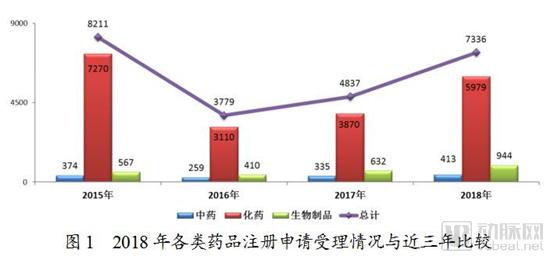
In 2018, the Center for Drug Evaluation (CDE) accepted registration applications for a total of 264 Class 1 innovative drugs.(Involving 533 acceptance numbers; for chemical drugs, the number of varieties is calculated by active ingredient, while for traditional Chinese medicines and biological products, it is calculated by generic drug name; the same applies below), representing a 21% increase compared to 2017. Among these, 239 varieties of Investigational New Drug (IND) applications for Class 1 innovative drugs were accepted, a 15% increase from 2017; 25 varieties of New Drug Applications (NDA) for Class 1 innovative drugs were accepted, a 150% increase from 2017.
1. Acceptance Status of Chemical Drug Registration Applications
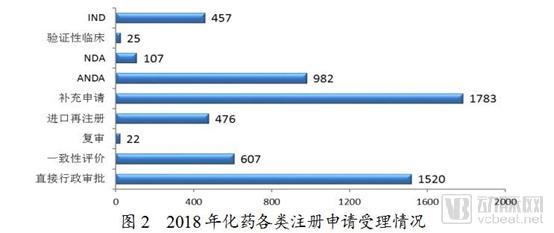
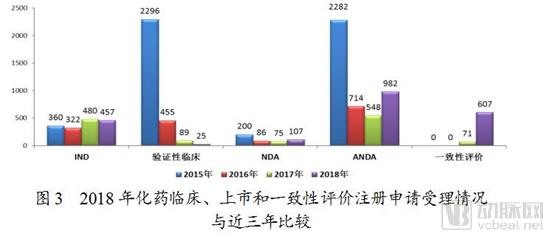
The Center for Drug Evaluation (CDE) accepted a total of 5,979 applications for chemical drug registration. Among these, 107 New Drug Applications (NDAs) were accepted, representing a 43% increase compared to 2017; additionally, 982 Abbreviated New Drug Applications (ANDAs) for generic drugs were accepted, marking a 79% increase from 2017. Details on the acceptance of various types of chemical drug registration applications are shown in Figure 2. A comparison of the acceptance of chemical drug clinical trial, marketing authorization, and consistency evaluation registration applications in 2018 with those of the previous three years is presented in Figure 3.
1) Acceptance Status of Innovative Drugs
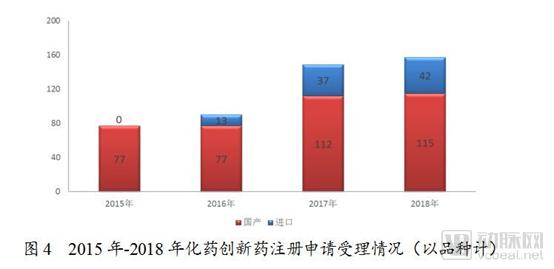
The Center for Drug Evaluation (CDE) accepted registration applications for 157 varieties of Class 1 innovative chemical drugs, representing a slight overall increase compared to 2017. Among these, 16 varieties were New Drug Applications (NDAs) for innovative drugs, marking a twofold increase from 2017. Of the 157 registration applications for innovative chemical drugs accepted in 2018, 115 varieties were domestically produced, while 42 varieties were imported. For details on the acceptance of registration applications for innovative drugs from 2015 to 2018, see Figure 4.
2) Indications for Investigational New Drug (IND) Applications of Chemical Drugs
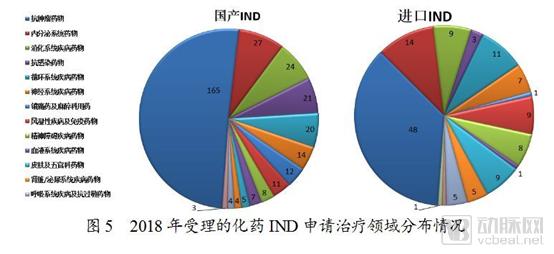
The Center for Drug Evaluation (CDE) accepted 457 Investigational New Drug (IND) applications for chemical drugs, including 325 IND applications for domestically produced chemical drugs and 132 IND applications for imported drugs. The indications for IND applications of domestically produced chemical drugs were primarily concentrated in the fields of oncology, the endocrine system, and the digestive system. The indications for imported IND applications were mainly focused on oncology, the endocrine system, and the circulatory system. For detailed distribution by therapeutic area, see Figure 5.
2. Status of Acceptance of Traditional Chinese Medicine Registration Applications
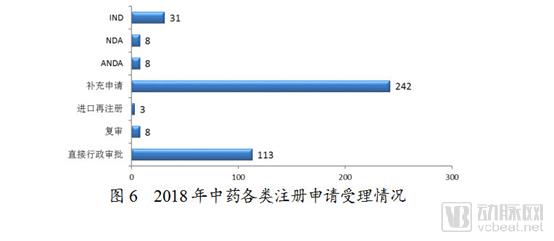
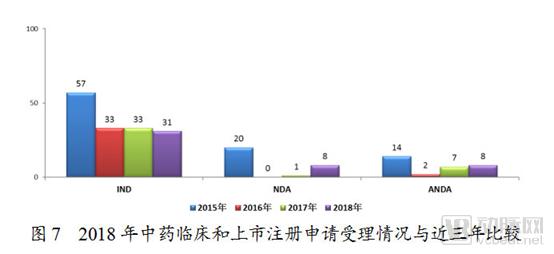
The Center for Drug Evaluation accepted 413 traditional Chinese medicine (TCM) registration applications, including 31 Investigational New Drug (IND) applications, 8 New Drug Applications (NDA), and 8 Abbreviated New Drug Applications (ANDA). For details on the acceptance of various types of TCM registration applications, see Figure 6. For a comparison of the acceptance of TCM clinical and marketing authorization registration applications in 2018 with those in the previous three years, see Figure 7.
(1) Acceptance Status of New Traditional Chinese Medicine Drugs
The Center for Drug Evaluation (CDE) accepted 39 registration applications for new traditional Chinese medicine (TCM) drugs (Categories 1–6), including 8 new drug applications (NDAs) for TCM products (covering 8 distinct varieties), representing a sevenfold increase compared to 2017; and 31 investigational new drug (IND) applications for TCM products (covering 29 distinct varieties), among which 2 were IND applications for Class 1 innovative TCM drugs (covering 1 variety).
(2) Indications for Investigational New Drug (IND) Applications of Traditional Chinese Medicine
The Center for Drug Evaluation accepted 31 Investigational New Drug (IND) applications for traditional Chinese medicine, with the primary therapeutic areas being digestive, cardiovascular, respiratory, and neuropsychiatric disorders, accounting for 65% of all IND applications for traditional Chinese medicine.
3. Acceptance of Biological Product Registration Applications
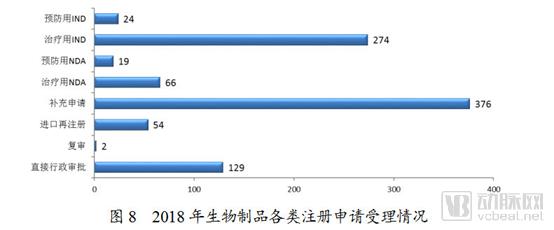
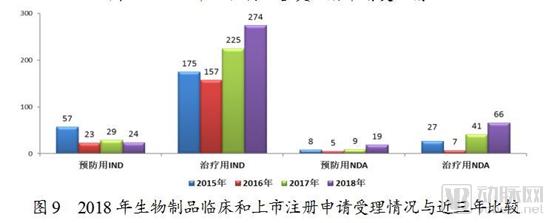
The Center for Drug Evaluation accepted 944 registration applications for biological products, including 298 Investigational New Drug (IND) applications and 85 New Drug Applications (NDA), representing a 70% increase compared to 2017. For details on the acceptance of various types of registration applications for biological products, see Figure 8. For a comparison of the acceptance of clinical and marketing registration applications for biological products in 2018 with those of the previous three years, see Figure 9.
(1) Acceptance Status of Innovative Class 1 Biological Products
The Center for Drug Evaluation (CDE) accepted 123 registration applications for innovative Class I biological products (including 6 preventive biological products and 117 therapeutic biological products), representing a 62% increase compared to 2017. Among these, 11 New Drug Applications (NDAs) for Class I biological products were accepted (including 2 preventive biological products and 9 therapeutic biological products, covering a total of 9 product varieties), marking a 4.5-fold increase compared to 2017; 112 Investigational New Drug (IND) applications for Class I biological products were accepted (including 4 preventive biological products and 108 therapeutic biological products, covering a total of 97 product varieties), representing a 51% increase compared to 2017.
(2) Indications for Clinical Trial Applications of Class 1 Innovative Therapeutic Biological Products
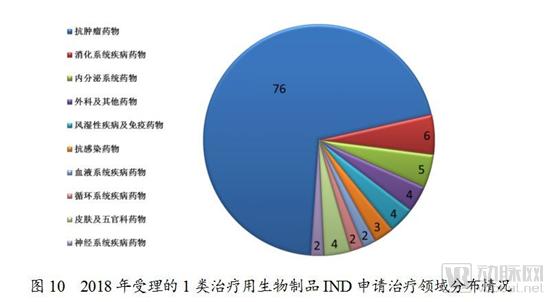
The Center for Drug Evaluation (CDE) accepted 108 Investigational New Drug (IND) applications for Class 1 therapeutic biological products (covering 93 distinct agents). Indications were primarily concentrated in the field of oncology, accounting for 70% of all IND applications for Class 1 therapeutic biological products. For detailed distribution by therapeutic area, see Figure 10.
II. Completion Status of Review and Approval for Drug Registration Applications
By the end of 2018, the Center for Drug Evaluation (CDE) achieved a timeliness rate of over 90% in the review and approval of registration applications for traditional Chinese medicines, chemical drugs, and biological products, thereby basically fulfilling the work target set forth in Document No. 44 to complete approvals within the prescribed timeframes by 2018. Throughout the year, a total of 9,796 registration applications were reviewed and approved, including 7,988 applications requiring technical review (comprising 4,052 administrative approval tasks that also required technical review) and 1,808 applications subject to direct administrative approval.
In 2018, the Center for Drug Evaluation (CDE) approved 106 new drugs (including NDAs and INDs granted direct production approval) (counted by drug variety)., including two new traditional Chinese medicine compound formulations—Guanhuangmu Granules and Jinrong Granules—as well as nine Class 1 innovative drugs and 67 imported original research drugs. All Class 1 innovative drugs are independently developed in China, predominantly comprising anticancer and antiviral agents. These include six new chemical molecular entities: Fruquintinib Capsules, Roxadustat Capsules, Pyrotinib Maleate Tablets, Anlotinib Hydrochloride Capsules, Danoprevir Sodium Tablets, and Albuvirtide for Injection; two anti-PD-1 monoclonal antibodies: Toripalimab Injection and Sintilimab Injection; and Recombinant Cytokine Gene-Derived Protein for Injection.
Key drug products approved by the Center for Drug Evaluation in 2018 include:
Antineoplastic Drugs:
1. Fruquintinib capsules, a domestically produced small-molecule multi-target anti-angiogenic drug with independent intellectual property rights, are indicated for the treatment of advanced colorectal cancer that has progressed following fluoropyrimidine- and platinum-based chemotherapy, providing an improved therapeutic option for patients with advanced colorectal cancer.
2. Anlotinib Hydrochloride Capsules, a domestically developed small-molecule multi-target anti-angiogenic drug with independent intellectual property rights, are indicated for the treatment of advanced non-small cell lung cancer (NSCLC) that has progressed or relapsed after failure of two prior systemic chemotherapy regimens. This medication provides a new therapeutic option for patients with advanced lung cancer.
3. Pyrotinib Maleate Tablets, a domestically produced small-molecule tyrosine kinase inhibitor targeting the human epidermal growth factor receptor 2 (HER-2) with independent intellectual property rights, are indicated for the treatment of HER-2-positive metastatic breast cancer, addressing the urgent clinical needs of patients with HER-2-positive advanced breast cancer.
4. Toripalimab Injection, the first domestically developed novel anti-tumor drug with independent intellectual property rights in China, is an anti-PD-1 monoclonal antibody indicated for the treatment of unresectable or metastatic melanoma in patients who have failed prior systemic therapy. This medication addresses the urgent clinical needs of patients with advanced melanoma.
5. Sintilimab Injection is a novel anti-tumor drug, an anti-PD-1 monoclonal antibody with independent intellectual property rights. It is the first domestically produced agent approved for the treatment of relapsed or refractory classical Hodgkin's lymphoma in patients who have undergone at least two lines of systemic chemotherapy. Currently, similar products available globally include Nivolumab Injection and Pembrolizumab Injection. In China, these agents are approved for the treatment of non-small cell lung cancer and melanoma, but not yet for lymphoma. This medication addresses the clinical needs of domestic patients.
6. Pembrolizumab injection, a novel anti-tumor agent and anti-PD-1 monoclonal antibody, is indicated for the treatment of unresectable or metastatic melanoma after failure of first-line therapy, providing a new therapeutic option for patients with advanced melanoma.
7. Nivolumab Injection, the first novel anti-tumor drug and anti-PD-1 monoclonal antibody in China, is indicated for the treatment of metastatic non-small cell lung cancer (NSCLC) with disease progression following platinum-based chemotherapy, providing a superior therapeutic option for patients with advanced lung cancer.
8. Alectinib Hydrochloride Capsules, a second-generation small-molecule ALK inhibitor, are indicated for the treatment of metastatic non-small cell lung cancer (NSCLC) positive for ALK fusion genes. Compared with existing standard therapies, this drug demonstrates significant survival benefits, increasing progression-free survival from 11 months to 34.8 months, thereby providing a breakthrough therapeutic option for patients with advanced ALK-positive lung cancer.
Anti-infective Drugs:
9. Sofosbuvir/Velpatasvir Tablets, the first domestically available third-generation pan-genotypic oral fixed-dose combination for the direct treatment of chronic hepatitis C virus (HCV) infection, are indicated for the treatment of HCV genotypes 1–6, mixed genotypes, and unknown genotypes, achieving cure rates as high as 98%. This medication has been included in the National Essential Medicines List, providing a powerful tool for China’s efforts to completely eliminate chronic hepatitis C.
10. Ledipasvir and Sofosbuvir Tablets, a second-generation oral fixed-dose combination for direct antiviral therapy against HCV infection, exhibit broad-spectrum activity against hepatitis C virus and are indicated for the treatment of HCV genotypes 1, 4, 5, and 6. This medication provides additional curative opportunities for patients with chronic hepatitis C in China.
11. Danoprevir Sodium Tablets, the first domestically developed oral anti-HCV agent with independent intellectual property rights, are indicated for use in combination with other drugs to treat treatment-naïve, non-cirrhotic chronic hepatitis C genotype 1. This product fills a domestic gap in this field, reduces medication costs, and improves drug accessibility for HCV patients.
12. Albuvirtide for Injection, the first domestically developed anti-HIV drug with independent intellectual property rights, is indicated for use in combination with other agents to treat human immunodeficiency virus type 1 (HIV-1) infection in patients who have previously received antiretroviral therapy. Its market launch fills a gap in this field in China, providing HIV/AIDS patients with a new, safe, and effective treatment option.
13. Posaconazole enteric-coated tablets, an imidazole antifungal agent, are indicated for the prophylaxis of increased risk of invasive aspergillosis and candidiasis due to severe immunodeficiency in patients aged 13 years and older. Currently, deep fungal infections have become a leading cause of death among patients with compromised immune systems, such as those with cancer, undergoing hematopoietic stem cell transplantation, or living with HIV/AIDS. This medication provides a new option for the prevention and treatment of deep fungal infections.
Cardiovascular System Drugs:
14. Edoxaban Tosylate Tablets, a novel anticoagulant, are indicated for the prevention of stroke and systemic embolism in patients with non-valvular atrial fibrillation who have one or more risk factors, as well as for the treatment of deep vein thrombosis and pulmonary embolism and the prevention of their recurrence. Compared with existing therapies, this medication reduces the risk of bleeding, offering a superior treatment option for the aforementioned patients.
15. Evolocumab Injection, the first monoclonal antibody in China for homozygous familial hypercholesterolemia (HoFH), a rare genetic disorder, is indicated for use in conjunction with diet therapy and other medications to treat HoFH and reduce low-density lipoprotein cholesterol (LDL-C). As existing lipid-lowering therapies often fail to effectively lower LDL-C, this drug provides a new therapeutic option for patients with dyslipidemia who have an inadequate response to or intolerance of conventional treatments.
16. Selexipag tablets, the first oral prostacyclin-class drug for pulmonary arterial hypertension (PAH) in China, are indicated for the treatment of PAH to delay disease progression and reduce the risk of PAH-related hospitalization. Currently, PAH remains a life-threatening condition with few specific therapeutic options available in China. Compared with similar drugs, this product offers advantages in terms of administration and tolerability, addressing the urgent clinical needs of patients with pulmonary arterial hypertension. Hematologic agents:
17. Eculizumab injection, a specific antibody against complement protein C5, is indicated for the treatment of the rare diseases paroxysmal nocturnal hemoglobinuria (PNH) and atypical hemolytic uremic syndrome (aHUS). As the only drug approved globally for treating PNH-associated hemolysis, it has brought about breakthrough changes in saving the lives of patients with aHUS. Classified as a clinically urgent product, it holds significant importance for improving the survival outcomes of patients with PNH and aHUS in China.
18. Roxadustat capsules, the world’s first approved domestically produced hypoxia-inducible factor prolyl hydroxylase (HIF-PH) inhibitor with independent intellectual property rights, are indicated for the treatment of anemia caused by chronic kidney disease in patients undergoing dialysis. This medication features a novel mechanism of action and offers clinical advantages over existing conventional therapies, including oral administration, improved iron utilization, and elimination of the need for intravenous iron supplementation.
Nervous System Drugs:
19. Lacosamide Tablets, a novel antiepileptic drug, are indicated for adjunctive therapy of partial-onset seizures in patients with epilepsy aged 16 years and older. Compared with traditional antiepileptic drugs, this product features favorable tolerability, high efficacy, and fewer adverse reactions, thereby meeting the clinical needs of patients with epilepsy.
20. Teriflunomide Tablets, a novel oral immunomodulator that inhibits T-cell proliferation, are indicated for the treatment of relapsing forms of multiple sclerosis (MS). Multiple sclerosis is a lifelong, chronic, progressive autoimmune rare disease that causes functional impairment of the central nervous system. Compared with conventional therapeutic agents, this medication demonstrates favorable tolerability, offering an improved treatment option for patients with multiple sclerosis.
Prophylactic Biological Products (Vaccines):
21. The 9-valent human papillomavirus vaccine (Saccharomyces cerevisiae) is indicated for the prevention of cervical cancer, precancerous lesions, atypical lesions, and persistent infections caused by the HPV types included in the vaccine. This product meets the clinical demand for the 9-valent HPV vaccine among Chinese women. Currently, all HPV vaccine brands marketed globally are available in China, better addressing the diverse public needs for vaccination and providing a new and effective means for cervical cancer prevention. New Traditional Chinese Medicine Drugs:
22. Guanhuangmu Granules, a novel traditional Chinese medicine (TCM) compound formulation, is indicated for the treatment of menopausal syndrome with liver-kidney yin deficiency syndrome. Compared with currently marketed TCM products, this drug demonstrates certain clinical advantages in efficacy, such as improvement in scores on the modified Kupperman Index, thereby providing a safer and more effective therapeutic option for female patients with menopausal syndrome.
23. Jinrong Granules, a novel traditional Chinese medicine (TCM) compound formulation, is indicated for the treatment of mammary gland hyperplasia characterized by the TCM syndrome of phlegm and blood stasis interconnection with Chong and Ren vessel disharmony. This product provides a safe and effective therapeutic option for patients with mammary gland hyperplasia corresponding to this specific TCM syndrome pattern, holding positive significance for meeting patient needs and improving clinical accessibility.
Medications for Major Public Health Emergencies:
24. Quadrivalent Influenza Vaccine (Split Virion), the first domestically approved vaccine in China for the prevention of influenza caused by relevant influenza virus types. The large number of influenza cases during the 2017–2018 flu season underscored the importance of this vaccine, and its market launch provided assurance for vaccination efforts during the 2018–2019 flu season.
25. Oral Live Attenuated Poliovirus Vaccine (Types I and III) (Human Diploid Cell), indicated for the prevention of poliomyelitis caused by poliovirus types I and III. Following the nationwide discontinuation of the trivalent oral polio vaccine in China, there has been a significant shortage of the bivalent oral polio vaccine used in sequential vaccination with inactivated polio vaccine (IPV). The approval and market launch of this product provide strong support for the smooth implementation of China’s national immunization program against poliomyelitis.