

Baidu AI Developer Conference Unveils the Future of Intelligent Healthcare
The Baidu AI Developer Conference, themed “Industrial Intelligence,” has once again placed Baidu at the year’s peak.
Baidu has partnered with Geely to develop a new automotive ecosystem leveraging technologies such as the Internet of Things (IoT) and autonomous driving; collaborated with Huawei to bridge the gap between deep learning frameworks and chips by integrating Baidu’s PaddlePaddle deep learning platform with Huawei’s Kirin chips, thereby reshaping the next generation of AI; joined forces with Intel to co-develop the Nervana Neural Network Processor for training; and launched the Baidu Honghu far-field voice interaction chip...
Each of the aforementioned initiatives has the potential to reshape industries, yet they bear little relevance to healthcare. Indeed, “healthcare” was a relatively subdued topic at this year’s main forum. Does this indicate that Baidu does not prioritize healthcare? The answer is no.
As early as April 2018, the AI Innovation Business Unit, affiliated with Baidu’s AIG Group (Artificial Intelligence Group), was established. In June of the same year, the unit began exploring AI applications in medical imaging, a journey that has now spanned over a year.
At the 2018 Baidu World Conference, CEO Robin Li publicly discussed Baidu’s progress in “AI + Healthcare” and launched the Baidu AI Fundus Screening All-in-One Machine.
To date, medical products powered by Baidu Brain have gradually taken shape. Leveraging AI technology, Baidu has built an AI-powered Smart Healthcare Middle Platform, which serves as the core for providing five major technical solutions to healthcare institutions: Clinical Decision Support System (CDSS), Fundus Image Analysis System, Healthcare Big Data Solutions, Intelligent Pre-consultation Assistant, and Chronic Disease Management. This comprehensive suite of AI products, covering the entire healthcare service workflow, constitutes the core of Baidu Brain’s healthcare initiatives and is designed to address the imbalance between the supply and demand of medical resources across different regions.
Overall, the development pace of these five systems is uneven, with Baidu Health currently focusing its core efforts on two major systems: CDSS and fundus image analysis.
Baidu CDSS is committed to becoming a professional and accurate medical assistant that primary care physicians can access at any time during their work. It has been reported that the system currently covers 27 clinical departments and more than 4,000 diseases. For common conditions, the top-three disease recommendation accuracy rate reaches as high as 95%. These results are generated through evidence-based algorithms, ensuring interpretability and providing physicians with a reliable basis for clinical decision-making.
Behind the algorithm lies extensive data accumulation. Huang Yan told VCBeat, “The CDSS is powered by Baidu’s years of accumulated capabilities in natural language processing and knowledge graphs. The knowledge graph incorporates a vast amount of authoritative medical textbooks, the latest clinical guidelines, and training data derived from nearly ten million real-world medical records from Tier III Grade A hospitals.” To ensure the security of these data, Baidu has implemented the highest level of healthcare data security measures, managing data usage through dedicated computing resources, data encryption and de-identification, and confidential-level processes.
These regulatory measures enable Baidu CDSS to meet the security certification requirements of regulatory authorities at all levels, providing effective security safeguards for medical data.
“Baidu’s CDSS is evolving toward disease-specific specialization and platform-based integration, supporting the entire clinical care process across multiple diseases and departments. It conducts in-depth research in areas such as disease risk prediction, complication prediction, and single-disease quality control, with the aim of benefiting more patients,” said Huang Yan, looking to the future.
Next, consider the fundus image analysis system. This system can screen for various conditions, including diabetic retinopathy, glaucoma, and age-related macular degeneration, with an accuracy rate exceeding 94%.
In practice, after a patient undergoes fundus photography, Baidu’s system can generate a comprehensive fundus risk report in just 10 seconds. According to Baidu representatives, based on its evidence-based medicine framework, the system’s results can elucidate the screening principles of the fundus image analysis system.
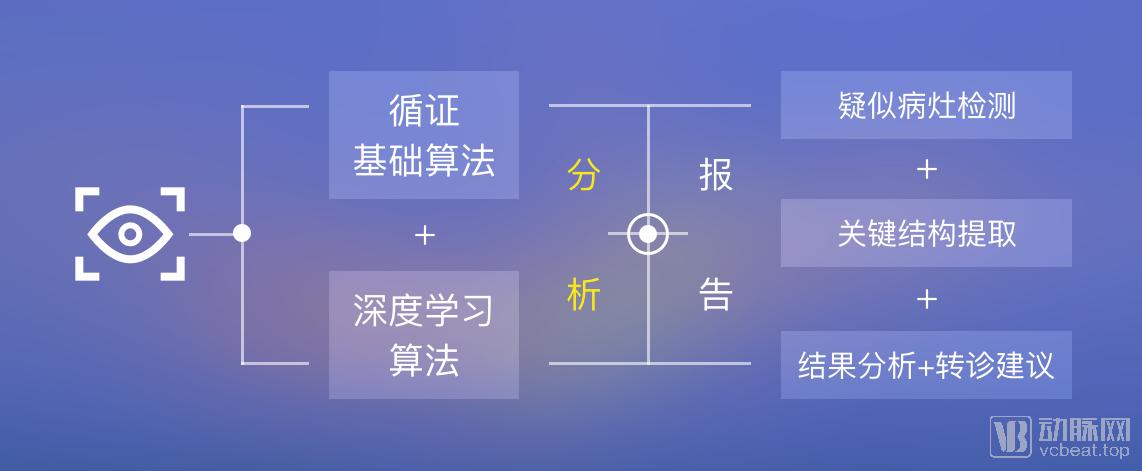
Screening Principle of Fundus Image Analysis System
At this stage, the two inescapable keywords for medical AI products are “collaboration” and “implementation.” The partnership with the Pinggu District Health Commission represents a significant achievement by Baidu Brain in implementing its AI + healthcare technologies.
On July 4, at the Baidu Brain Open Ecosystem Forum of the 2019 Baidu AI Developer Conference, Baidu Brain and the Health Commission of Pinggu District, Beijing, held a signing ceremony to formalize their partnership. Over the past six months, Baidu Brain has brought its leading AI-powered intelligent medical services to 18 community health service centers in Pinggu District. Moving forward, both parties will continue to deepen their collaboration, comprehensively optimize the healthcare experience for both patients and providers, and promote equitable and accessible medical services.
To help primary care physicians improve their diagnostic and treatment capabilities, Baidu Brain has customized a Clinical Decision Support System (CDSS) for Pinggu District, comprising six modules: assisted consultation, assisted diagnosis, treatment plan recommendation, rational drug use, similar case retrieval, and knowledge query.
Among these modules, the assisted consultation module enables primary care physicians to emulate expert clinical reasoning, guiding them to conduct detailed inquiries into the attributes of each patient symptom. The generated consultation data can be directly stored in the database via point-and-click selection, thereby enhancing the efficiency and quality of medical record documentation.
The auxiliary diagnosis module can help physicians infer diagnostic results based on various attributes of symptoms in patients’ medical records, thereby preventing misdiagnosis and missed diagnoses. Meanwhile, the rational medication system comprehensively evaluates the appropriateness of current prescriptions by analyzing multiple factors, including patient information, past medical history, and prior medication use. It provides timely alerts for inappropriate prescribing practices, helping to avoid medical errors and significantly improving the medication management capabilities of primary care physicians.
In terms of capacity building, misdiagnoses are unavoidable among primary care physicians due to their insufficient clinical experience; furthermore, given their remote locations, these physicians incur high costs when seeking to acquire professional knowledge anytime and anywhere.
This system effectively meets the learning needs of primary care physicians. Leveraging Baidu Brain’s medical knowledge graph, it enables them to access the latest medical information through its knowledge base. Furthermore, by studying typical case records, they can deepen their understanding and analysis of clinical conditions, thereby reinforcing their professional skills.
“After six months of operation, community hospitals have generally reported that the system has been significantly helpful. It offers professional and comprehensive support during consultations, provides valuable insights for differential diagnosis, and recommends optimized medication regimens,” said Jin Daqing, Director of the Pinggu District Health Commission, in an interview. “We have great confidence in Baidu’s technological capabilities. We believe that our collaboration will deepen in the near future, facilitating the better implementation of tiered diagnosis and treatment, and leveraging technology to help alleviate or even resolve healthcare challenges in grassroots areas.”
According to VCBeat, Baidu CDSS has served 200 primary care physicians in Pinggu District, achieving 100% coverage of hospital-based physicians in the area. The system is invoked more than 100,000 times per month, driving an overall improvement in the diagnostic and treatment capabilities of local primary care physicians. Nationwide, Baidu CDSS has been deployed in 25 regions across 13 provinces and municipalities, serving more than 10,000 physicians.
In addition, Baidu has achieved significant results in the field of ophthalmology. Last year, Baidu initiated a scientific research collaboration with the Zhongshan Ophthalmic Center of Sun Yat-sen University, deploying its fundus image analysis system to more than ten primary healthcare hospitals in Zhaoqing, Guangdong Province. As of May this year, the system had screened 3,080 individuals in Zhaoqing, identifying 557 patients with fundus diseases. Currently, Baidu’s comprehensive AI medical technology solutions have been implemented in impoverished counties across various regions, leveraging AI to help grassroots populations detect risks of blindness at an early stage.
At the conference, Baidu Brain became the undisputed focal point.
The booth at the 2019 Baidu AI Developer Conference highlighted the significance of Baidu Brain: with twice the floor space of other booths, a steady stream of visitors, and a rich array of AI products such as the EdgeBox edge computing device and the Baidu AI Market, it emerged as the centerpiece of Baidu’s ecosystem.
From underlying voice chip technology to independently developed open-source deep learning frameworks and platforms, and further to cognitive-layer NLP and computer vision, Baidu can provide AI empowerment at every level. In Baidu’s terminology, this is an ecosystem architecture that advances in three stages: “build it,” “sell it,” and “scale it.”
Leveraging these technologies, into which medical scenarios might Baidu expand in the future? We infer two possible directions from this.
First are the five major modules currently being implemented by Baidu Brain. With its experience in Clinical Decision Support Systems (CDSS), Baidu may have greater potential to enter the field of hospital informatization. Moreover, there is substantial demand for quality control of hospital medical records, which awaits empowerment through natural language processing technologies.
Next, in the field of medical imaging: once fundus image analysis systems reach maturity, will Baidu, like Tencent or other startups, establish an independent ecosystem for its imaging products? Only time will tell.
Second is the AI assistant business. At the main forum, Robin Li and Pan Weidong, Vice President of Shanghai Pudong Development Bank, jointly introduced a “super employee” called the “Financial Digital Human,” co-developed by both parties. This product will serve as an intelligent assistant for customer service and financial advisory roles. Although staff indicated that the product is currently limited to the financial sector, actions by domestic startups suggest that e-commerce platforms based on mini-programs also have demand for such AI products.
Taking the collaboration between Baidu and Wyeth, as mentioned by Robin Li in his speech, as an example, Baidu is fully capable of leveraging natural language processing (NLP) and voice interaction technologies—even possessing its own voice interaction chips—to create precise user profiles for Wyeth’s maternal and infant customer base. This enables the provision of accurate and efficient customer service, as well as targeted product marketing. Companies similar to Wyeth are widely distributed across the consumer health sector, a field that harbors substantial market potential.
By leveraging voice interaction technology, Baidu can also expand into indoor medical scenarios such as operating rooms, which impose stringent requirements on voice technology. In China, companies like Unisound and iFlytek’s Xiaoyi have made significant investments in this area.
In these scenarios, physicians need to leverage speech technology to complete assigned tasks and data entry tasks, which also falls within Baidu’s capabilities. However, to penetrate this sector, Baidu must first prepare for hospital informatization, while the corresponding speech-based data entry tools also present a significant barrier.
To this day, we can no longer view Baidu through the lens of “a search engine company”; its future may lie in becoming a smart hardware company, a solutions provider, or even an automotive company. So, can it become a healthcare company?
It may still be too early to discuss this issue. However, within the conceptual framework of “Tech for Social Good,” healthcare is an area that Baidu cannot overlook.
“Baidu has always held a vision: no matter how complex or advanced AI technology becomes, we hope that everyone can benefit from it equally. Health and well-being are universal rights; everyone should be able to leverage AI technology to safeguard their health.” This was Robin Li’s vision at the 2018 Baidu World Conference.
Baidu’s advantages lie in its existing artificial intelligence ecosystem and massive traffic volume. While these factors do not enable Baidu to immediately deliver mature AI products, they do allow the company to rapidly advance AI development and create distinctive artificial intelligence offerings.
We do not know how many resources Baidu will devote to medical technology serving primary care, nor can we predict the scale it may achieve in the future. However, given Baidu’s AI foundation, it is possible for the company to catch up and even surpass incumbents in the healthcare industry.
So, when will medical products take center stage on Baidu? It will likely take some more time.