

China Releases First National List of 20 Monitored Drugs for Rational Use, Impacting Major Pharma Companies
On July 1, the National Health Commission and the National Administration of Traditional Chinese Medicine jointly issued the “Notice on Printing and Distributing the First Batch of the National Key Monitoring List for Rational Drug Use (Chemical Drugs and Biological Products)” (hereinafter referred to as the “List”), which includes 20 drugs placed under key monitoring for rational use. (See the list in the figure below.)
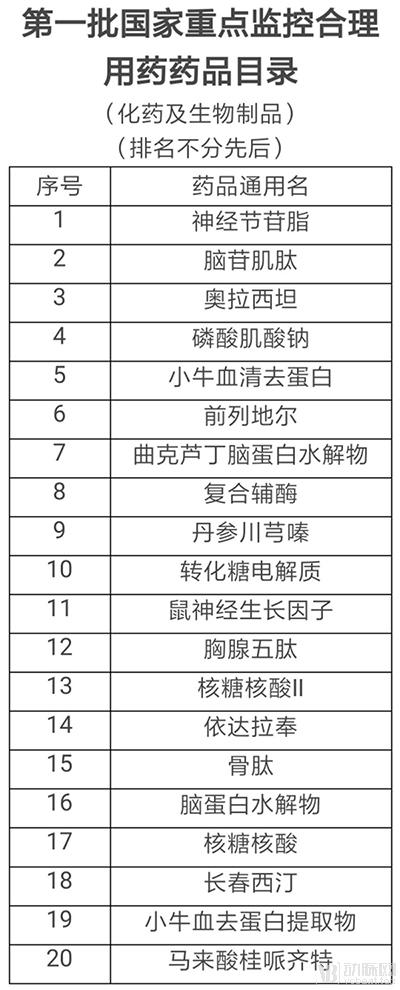
List of 20 Drugs (Bureau of Medical Administration and Medical Services)
Among these 20 drugs, those for treating nervous system diseases account for the largest proportion, totaling 11. The remaining nine drugs cover digestive system diseases, circulatory system diseases, rheumatic and immune-related diseases, among others. Furthermore, oxiracetam, a drug used to treat nervous system disorders, is the top-selling product among the 20, with an annual sales revenue of RMB 1.49 billion.
In terms of drug categories, none of these 20 medications involve traditional Chinese medicine; nine are chemical drugs, and 11 are biological products. Listed companies covered in this Catalog include Harbin Pharmaceutical Group (alprostadil, thymopentin), SL Pharma (compound coenzyme), Conba Bio-Pharm (tanshinone and ligustrazine hydrochloride), HiteBio (mouse nerve growth factor), as well as Livzon Pharmaceutical Group, Beijing Vantone Biotech, and Staidson Biopharma.
It is worth noting that in this notice, the National Health Commission and the National Administration of Traditional Chinese Medicine also issued relevant directives on rational drug use at the provincial level. VCBeat (WeChat ID: vcbeat) has summarized several key instructions from the National Health Commission and the National Administration of Traditional Chinese Medicine to provincial-level authorities based on this notice.
I. Each province shall formulate a list of drugs for rational use, on the basis of which each medical institution shall develop its own drug formulary.
Article 1 of the Notice explicitly states that provincial-level health administrative departments, in conjunction with traditional Chinese medicine authorities, shall formulate provincial key monitoring directories for rational drug use based on the National Directory. Medical institutions at all levels and of all types shall then develop their own institutional key monitoring directories for rational drug use based on the provincial directories.
II. Clinical use of drugs included in the catalog will be subject to key monitoring, and non-compliant prescribing practices will be “rectified.”
The Catalogue stipulates that all provinces must establish stringent drug management systems and strengthen whole-process management of the clinical application of drugs listed therein. It further requires clear specification of the conditions for the clinical use of these drugs and mandates that physicians strictly adhere to relevant medication guidelines. For instances of irrational drug use, measures such as public ranking notifications, deadlines for rectification, and removal from the institution’s drug supply catalogue shall be implemented.
III. Medications not included in the formulary shall be managed in accordance with relevant regulations. Prescriptions of traditional Chinese medicine (TCM) decoctions and proprietary Chinese medicines by physicians must meet the following conditions:
The notice also sets forth specific requirements for drugs not included in the catalog. Physicians shall strictly comply with relevant regulations, such as the Measures for the Administration of Prescriptions, and ensure rational drug use in accordance with the drug package inserts. Regarding physician categories authorized to prescribe traditional Chinese medicine (TCM) decoctions and proprietary Chinese medicines, TCM physicians may prescribe these agents in compliance with standards such as the Guiding Principles for Clinical Application of Proprietary Chinese Medicines. Physicians of other categories who wish to prescribe TCM decoctions or proprietary Chinese medicines must meet at least one of the following conditions:
1. Obtain a degree or diploma in Traditional Chinese Medicine, Integrated Traditional Chinese and Western Medicine, or Ethnic Medicine from an institution recognized by the educational administrative department at the provincial level or above.
2. Complete a Western medicine-to-TCM training program recognized by the provincial-level administrative department of traditional Chinese medicine, with a duration of no less than two years (totaling at least 850 instructional hours), and obtain the corresponding certificate.
3. Have completed at least three years of apprenticeship in Traditional Chinese Medicine and obtained the Certificate of Completion of Apprenticeship in Traditional Medicine, in accordance with the relevant provisions of the Measures for the Assessment and Examination of Physician Qualifications for Apprentices of Traditional Medicine and Individuals with Demonstrated Expertise.
IV. Improve the drug monitoring system and add “assessment items” for medical institutions and their persons in charge
The Catalogue requires health administrative departments at all levels, traditional Chinese medicine authorities, and medical institutions to establish comprehensive systems for monitoring clinical drug use and issuing alerts for abnormal usage patterns. Clinical use of drugs listed in the Catalogue will be included in the performance evaluations of medical institutions and their principal responsible persons. For drugs not included in the Catalogue, routine monitoring of clinical use must be properly implemented.
The National List of Auxiliary Medications, long anticipated by the market, has finally been implemented. The release of this “List” helps standardize the use of included medications and accelerate the structural adjustment of medical insurance expenditures. Meanwhile, it creates market space for innovative therapeutic drugs and high-quality generic drugs, thereby enhancing the concentration of China’s pharmaceutical industry.