

Aijun Technology Files for IPO with Heartfelt Intelligent Rehabilitation and Care Robots Targeting China's Aging Population
Rehabilitation nursing robots, as a significant branch of medical robotics, have become a research hotspot in the international robotics field, with studies spanning rehabilitation medicine, biomechanics, mechanics, and computer science. Currently, numerous domestic enterprises are entering this sector, aiming to capture a share of the rehabilitation robot market.
Innovation knows no bounds, nor does it adhere to a fixed timeline; stories of latecomers surpassing early movers unfold constantly. In the intelligent rehabilitation robotics market, Zhongshan Aijun Technology caught up with its peers within just one year, even surging to the forefront of the industry.
In July 2019, Aijun Technology, a company just one year old, developed an intelligent rehabilitation and nursing robot named “Xirui Mingyi.” Designed specifically for individuals with mobility impairments—such as those with paralysis, lower-limb amputations, or leg and foot difficulties caused by chronic diseases—the robot provides daily care and rehabilitation therapy services. At that time, Xiao Guangming, the founder of Aijun Technology, had just celebrated his 51st birthday. When asked why he chose to embark on entrepreneurship at the age of fifty, Xiao told VCBeat (WeChat ID: vcbeat), “My father-in-law’s physical condition limited his mobility. Unable to provide round-the-clock personal care, I developed this intelligent rehabilitation and nursing robot as a gesture of filial piety.”
The Elderly Care Market Holds Significant Potential, with Rehabilitation Robots Becoming a Vehicle for Filial Piety
“By directly and precisely addressing the real-world needs of home-based elderly care and nursing through intelligent rehabilitation care robots, we ensure that patients’ families can afford and effectively utilize these solutions, thereby alleviating their financial and psychological burdens.” Xiao Guangming told VCBeat that reducing the burden on families is the direction for resolving pain points in the home-based elderly care and nursing industry. He arrived at this strategic focus after conducting a thorough analysis of the industry background.
The latest report, “Growth and Shortage: The Status of Elderly Care Talent Development in China in 2017,” released by the China Philanthropy Research Institute at Beijing Normal University, shows that by the end of 2016, the number of people aged 60 and above in China had reached 230 million. The next 20–30 years will be a period of accelerated aging, with the elderly population growing rapidly at an annual rate of 3%. It is projected that by 2030, the elderly population will account for approximately 25% of the total population. Among them, individuals with disabilities (including those who are fully or partially disabled) constitute 18.3% of the total elderly population.
On November 27, 2018, the blue book titled “Research Report on China’s Disability Affairs (2018)” was officially released. The report stated that the number of people with disabilities in China currently exceeds 85 million. It is estimated that by the end of 2018, the total number of people with disabilities in China reached 85.02 million, accounting for 6.34% of the national population. The accelerating pace of population aging is exacerbating the rise in disability prevalence. It is projected that by 2050, the disability rate in China will reach 11.31%, and the total number of people with disabilities will amount to 165 million. This substantial population size will pose increasingly severe challenges to China’s medical security system, public health system, and social security system.
In October 2016, the State Council issued the "Several Opinions on Accelerating the Development of the Rehabilitation Assistive Devices Industry," listing elderly care equipment and the rehabilitation assistive devices industry as one of the key sectors for national development. Xiao Guangming stated that, driven by numerous policies, the springtime of China's elderly care equipment industry has arrived. Facing a senior population of nearly 250 million, the elderly care industry boasts broad market prospects. However, China's elderly care sector is currently grappling with a comprehensive "labor shortage." Data shows that even based on the general standard caregiving ratio of 1:3 for the fully disabled population, the shortfall in elderly care nursing talent in China has reached a staggering 5 million. There is also a significant lack of other types of specialized service professionals.
“In addition to the acute shortage of caregivers, a major pain point in the elderly care market, outdated and simplistic medical devices also pose a significant challenge,” said Xiao Guangming. “During the two years I spent caring for my father-in-law, I observed that the rehabilitation equipment used in many nursing homes in China lags considerably behind international standards. This not only fails to provide optimal care for the elderly but also results in substantial waste of economic resources.”
Driven by personal experience and guided by the philosophy of helping individuals with mobility impairments lead healthier lives, Xiao Guangming conceived the idea of establishing a technology company specializing in rehabilitation and nursing medical devices. To address the critical market pain point of severe shortage of caregiving personnel, Xiao Guangming founded Aijun Intelligent Technology in Zhongshan, Guangdong, in March 2018. As an inventor, he leveraged his portfolio of 26 national patent applications (12 of which have been granted) to develop intelligent robotic products, and invited like-minded professionals to join the company through equity transfers to participate jointly in product research and development. Through the dedicated efforts of the entire team, the Xirui Mingyi Intelligent Rehabilitation and Nursing Robot was successfully developed.
Personalized Intelligent Rehabilitation Robot
The Xirui Mingyi Intelligent Rehabilitation Robot is a nursing device designed to alleviate the heavy and repetitive workload of caregivers. Featuring a modular design, it allows for the adjustment of functional modules to meet diverse customer needs and the customization of parameters based on different elderly care and nursing scenarios, thereby accommodating varied personalized requirements.
Xiao Guangming introduced that the Xirui Mingyi intelligent rehabilitation robot can rotate 360 degrees and move flexibly, maximizing the patient's range of motion. It can also adjust corresponding parameters based on the mobility level of the patient's limbs. If a patient is unable to move their limbs freely, caregivers can adjust the amplitude parameters at the robot's handles, allowing the patient to lie prone on the device, operating on the same principle as a piggyback carry.
Furthermore, rehabilitation and nursing robots are equipped with Internet of Things (IoT) capabilities, enabling the configuration, acquisition, and analysis of relevant data via mobile phone applications. This plays a significant role in establishing large-scale databases of physiological and psychological parameters for specific populations. These robots can automatically measure body weight, record and transmit data, and perform real-time analysis of patients’ physical conditions. Additionally, they feature functions such as recording and storing the number of device rotations, guiding patients through upper limb exercises, automatic path planning, and autonomous navigation to charging stations for recharging.
Notably, the Xirui Mingyi Intelligent Rehabilitation and Nursing Robot is equipped with an infrared positioning system. Once caregivers install the compatible infrared positioning modules on facilities and equipment frequently used by patients, the robot can interface with them through infrared recognition and positioning systems, thereby accurately transporting patients to their desired destinations.
Complementary Products Enhance Efficacy: 1 + 1 > 2
Xiao Guangming stated that patients with limited mobility often require the coordinated efforts of multiple caregivers, which not only increases their workload and leads to inefficient use of caregiving resources but also imposes a greater financial burden on families. Furthermore, many existing devices on the market are complex to don, adding to the burden on patients. “My goal is to develop an intelligent rehabilitation and nursing robot that is ‘user-friendly for patients and affordable for families.’”
To simplify caregiving and promote healthier lives for patients, Aijun Technology has precisely developed a suite of products based on intelligent rehabilitation and nursing robots. These products are tailored to various application scenarios, including institutional elderly care, home-based elderly care, hospital nursing, and other public spaces (such as subway stations, airports, and shopping malls), enabling individuals with special needs to independently perform activities such as toileting, bathing, herbal steaming, and rehabilitation training. Additionally, the company has secured patents for portable, pocket-sized POCT (Point-of-Care Testing) devices.
These include cabin seats that can automatically move into a movable seated fumigation capsule; bathing assistance devices; smart pillboxes with remote data transmission and voice reminder functions; patient transfer devices that facilitate turning over and changing bed sheets; and waist-and-leg rehabilitation exercise machines for exercising the hands, legs, and waist of the elderly.
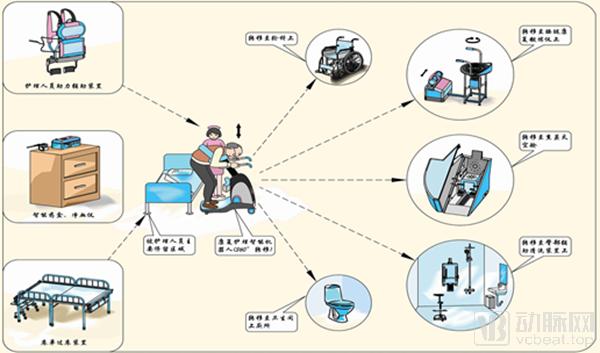
Smart Rehabilitation Robot with Supporting Medical Device Products (Image provided by the interviewee)
In addition to rehabilitation products for patients, Aijun Technology has specifically developed a device called the “Bionic Assistive Support Device” for caregivers. It is well known that caregivers frequently perform repetitive lifting, carrying, and transferring movements when caring for elderly individuals with lower-limb paralysis or mobility impairments, which can lead to injuries in the lumbar muscles, spine, and cervical vertebrae. The Bionic Assistive Support Device is a power-assist solution truly designed around the unique work characteristics of caregivers, protecting their physical well-being. It helps reduce back and waist strain during patient handling, enables self-protection, and allows caregivers to safely manage heavier loads.
Xiao Guangming revealed to VCBeat that the company’s products have now reached maturity. The current objective is to initiate external financing and bring the Xirui Mingyi Intelligent Rehabilitation Nursing Robot to market, with the aim of capturing a larger market share and expanding its customer base.