

Kanghu Home: Transforming China's Caregiving Industry with Its 'No-Family-Companion' Model as It Positions to Become China's AMN
“Dedicated Care, Professional Service” is the service philosophy of Kanghu Home and also the service standard for its nursing staff.
Kanghu Home, founded in 2014 and headquartered in Beijing, is the largest medical care institution in northern China in terms of coverage. With in-hospital care as its core business and a training school as its foundation, the company leverages a systematic training management system to provide professional medical caregivers for hospitals, nursing homes, rehabilitation centers, and home-based care settings. By extending services from within hospitals to outside facilities and expanding from offline to online channels, it has established a comprehensive health network dedicated to the supply of professional medical caregiving personnel.
As of now, Kanghu Zhijia employs over 5,000 caregivers, maintains deep collaborations with nearly 200 hospitals, covers operations in more than 18 provinces, operates over 20 training bases, and trains more than 30,000 individuals annually. Notably, since its establishment three years ago, Kanghu Zhijia has achieved a compound annual growth rate (CAGR) of 135% in revenue, far exceeding the industry average.
To gain a deeper understanding of the development trajectory and business model of Kanghu Zhijia, a reporter from VCBeat (WeChat ID: vcbeat) conducted an exclusive interview with Zhang Yanjiang, Chairman and General Manager of Kanghu Zhijia.
In 2014, Zhang Yanjiang’s mother was hospitalized in Beijing, during which time he hired a caregiver. “I felt that although caregivers in Beijing were relatively professional, there was still room for improvement.” At the time, as the youngest regional director at CSPC NBP Pharmaceutical, he sensed a business opportunity.
Subsequently, Zhang Yanjiang leveraged his network in the pharmaceutical and healthcare industry to conduct a survey of the national in-hospital patient caregiver market. He found that only a few domestic caregiver companies had achieved significant scale, with operations distributed across Beijing, Shanghai, Fujian, Guangzhou, and other regions. The remaining enterprises were regional in nature, with annual revenues failing to exceed RMB 100 million.
The nursing care market is categorized into three tiers based on care complexity: medical-grade, intermediate-care, and non-intermediate-care; and into two types based on care setting: institutional and home-based. Currently, medical-grade care, which requires specialized procedures, is primarily delivered by nurses. However, due to the current shortage of nurses in China, the medical-grade nursing care market remains largely underserved. Intermediate-care services vary by setting: they are provided by care aides in hospitals and institutions, while in home settings, they constitute intermediate home care. Non-intermediate-care refers to traditional personal care and daily living assistance.
Care at the intermediate level offers greater scalability. Zhang Yanjiang stated that his aim is to pursue vertical specialization based on patient care, while extending horizontally outward with hospitals serving as the referral hub. “We currently cannot see the ceiling of the elderly care market, whereas the capacity of the in-hospital nursing sector alone is limited.”
At the outset of his entrepreneurial journey, Zhang Yanjiang had already gained a clear understanding of the market. He recognized that focusing solely on caregiving services would fail to create synergistic advantages, while directly entering the elderly care sector would likely lead to failure before reaching maturity. Therefore, he devised a “three-step strategy” for his company, “China Kanghu.”
In Zhang Yanjiang’s three-step plan, the first step is to become the largest caregiver enterprise in northern China. The second step is to transform into China’s AMN (the largest provider of comprehensive in-hospital human resources solutions in the United States, with annual revenue of $10 billion, supplying hospitals with professional workers, technicians, nursing staff, and physicians with specialized skills on a long-term or temporary basis). The third step is to pursue development in the elderly care industry.
In advancing the first phase, Kanghu Zhijia has established a training school and designed systematic training curricula to cultivate caregivers of various types and levels, thereby addressing the differentiated needs of patients. It is reported that Kanghu Zhijia also provides specialized training for nursing assistants tailored to specific departments and patient conditions, enabling them to collaborate with physicians in treatment plans and facilitate patients’ rapid recovery.
In terms of caregiver management, Kanghu Home adopts a robust management model, with its core managerial capabilities reflected in everything from institutional frameworks to corporate culture. Kanghu Home implements standardized policies and operational procedures, coupled with a rigorous quality control mechanism that enables timely identification and resolution of issues, thereby preventing their escalation or normalization.
In addition to meeting societal demands for caregivers, Kanghu Zhijia places special emphasis on the well-being and sense of value of its caregiving staff. By establishing its own brand, Kanghu Zhijia enhances caregivers’ sense of belonging and professional identity, thereby reducing staff turnover. Furthermore, to address caregivers’ needs for skill development, Kanghu Zhijia has implemented a tiered promotion system that provides opportunities for learning and professional growth.
As of 2018, Kanghu Zhijia had completed its first phase, operating 200 hospital projects within the core regions of North and Northeast China.
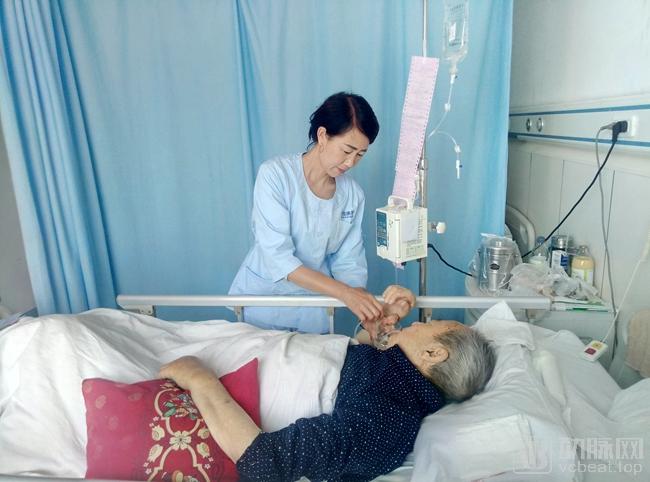
Kanghu Home Caregiver Nursing Chart (Image source: Provided by the enterprise)
Currently, Kanghu Zhijia is gradually evolving and iterating from a single-business model to value-added services, transforming into China’s AMN by launching the “Rehabilitation Care Specialist” and “Unaccompanied Ward” projects.
In Zhang Yanjiang’s view, nursing care will become increasingly specialized, with a cohort of outstanding caregivers gradually emerging from the broader workforce and being trained as rehabilitation therapists. The “Rehabilitation Care Specialist” program enhances Kanghu Zhijia’s medical credentials, strengthens its influence within hospitals, and boosts corporate profitability.
The core principle of unaccompanied wards is that once patients are admitted to the ward, all medical, nursing, and daily living services are provided by healthcare professionals and certified nursing assistants, eliminating the need for family accompaniment or allowing family members to be present without assuming caregiving responsibilities. With professional caregivers managing multiple patients simultaneously, the cost of unaccompanied wards is lower than that of traditional one-on-one family caregiving, making this model a future trend in hospital care. In response to the increasing caregiving burden on the only-child generation and the financial constraints faced by elderly consumers, Kanghu Zhijia has launched the “Unaccompanied Ward” project as a comprehensive management solution.
With the streamlining of hospital staffing and the reduction in the number of nurses, many “non-essential” nursing tasks are being outsourced. In “family-free wards,” the services provided by patient care assistants are more specialized, ensuring that professionals handle tasks aligned with their expertise. For instance, a caregiver skilled in chest physiotherapy for sputum clearance may be assigned to perform this procedure across several wards. The “family-free ward” model not only transforms the traditionally noisy environment of conventional wards but also enhances overall management efficiency, as uncontrolled visitor flow can disrupt logistical operations.
According to VCBeat, over 15% of traditional projects have been converted into “companion-free care” programs within six months, significantly boosting Zhang Yanjiang’s confidence. He plans to reduce the revenue share from traditional projects to below 30% within three years.
In addition, Kanghu Home is actively exploring derivative businesses, such as nursing product bundles, à la carte services, patient navigation and triage guidance, and nurse labor dispatch, to create additional profit growth drivers.
“In China, whether doctors and nurses or patients, people generally regard nursing assistants as basic, relatively low-level service personnel, reflecting an insufficient appreciation for the nursing profession in their minds,” sighed Zhang Yanjiang.
During the specific implementation of the “Rehabilitation Therapist” and “Companion-Free Ward” projects at Kanghu Zhijia, many people adopted a skeptical attitude. However, in reality, patients have the most contact not with doctors, but with the primary nurses in the wards and the hired nursing assistants, with the latter providing 24-hour close-care support.
If professional services and scientific nursing care are available around the clock, it will be more beneficial to patients’ recovery. In Zhang Yanjiang’s view, caregiver services represent the most intimate form of person-to-person care and are the most trustworthy. This trust has become the cornerstone for introducing caregiver services into hospitals and spawning a range of derivative business opportunities.
In this context, a single enterprise or a few hospitals alone cannot change the public’s entrenched perceptions of care aides. Zhang Yanjiang concluded by stating that Kanghu Zhijia is more inclined to join forces with like-minded partners to drive transformation across the entire care aide industry. By delivering solid, high-quality services, raising professional standards for care aides, and shaping their professional image, the goal is to enable care aides to serve as true assistants to medical staff and as supportive companions to patients, thereby earning societal respect.
“Meituan has over 300,000 riders, and JD.com has nearly 200,000 delivery personnel. If a business system can accommodate more than 100,000 self-employed individuals serving a vast market, it is bound to become a great enterprise. The elderly care sector, part of the trillion-dollar health and wellness industry, presents immense opportunities. Kanghu Zhijia aims to reach a workforce of 100,000 self-employed caregivers within five years,” Zhang Yanjiang concluded. “No matter how challenging or exhausting it may be, we must persevere. Our goal is to build a trustworthy enterprise in the caregiving industry, ensuring that our nursing staff also reap the benefits of this reliability.”