

Deepwise AI Announces IPO Filing for Its 3D Deep Learning-Based Non-Invasive EGFR Mutation Prediction System in Lung Adenocarcinoma
In July 2019, the international journal Cancer Medicine featured a cover article presenting the latest collaborative research findings from Diannei (Shanghai) Biotechnology Co., Ltd., Huadong Hospital Affiliated to Fudan University, Shanghai Jiao Tong University, and other institutions. Titled “Automatic Prediction of EGFR Mutation Status in Lung Adenocarcinoma Based on 3D Deep Learning,” the study demonstrated that the prediction accuracy surpassed that of traditional radiomics.
Automated Prediction of EGFR Mutation Status in Lung Adenocarcinoma Based on 3D Deep Learning: Predictive Accuracy Surpasses Traditional Radiomics
Lung cancer is the leading cause of tumor-related mortality. Among lung cancer patients, 80% have non-small cell lung cancer (NSCLC), with adenocarcinoma being the most common histological subtype. Over the past few decades, genome-based targeted therapies directed against driver genes—such as the tyrosine kinase inhibitors (TKIs) gefitinib, which targets specific epidermal growth factor receptor (EGFR) mutations, and crizotinib, a TKI targeting the ALK gene—have become an indispensable component of precision medicine for lung cancer.
However, patients with lung cancer who lack EGFR mutations or are not ALK-positive derive no clinical benefit from targeted therapy; in some cases, it may even lead to shortened progression-free survival (PFS) and unnecessary medical expenditures. Therefore, the driver gene status must be clearly determined before selecting targeted agents. Furthermore, resistance and disease progression may occur during EGFR TKI treatment due to the emergence of the EGFR T790M mutation. Consequently, dynamic monitoring of relevant genetic mutation statuses is required to adjust therapeutic regimens.
Mutation testing of samples obtained via biopsy or surgical resection is the standard method for determining EGFR mutation types. However, challenges such as the invasiveness of sampling, the need for repeated sampling to monitor treatment, poor DNA quality, tumor heterogeneity, patient bed turnover time, and testing costs have limited the adoption of molecular testing and, to some extent, hindered the widespread implementation of precision medicine for lung cancer in clinical practice.
Tumor phenotypes arise from specific genotypes; therefore, predicting genotypes by identifying specific phenotypes is a potentially viable approach. Previous studies have shown that specific radiomics features are associated with EGFR mutation types [10,11]. However, traditional radiomics faces numerous challenges, such as heavy reliance on manual operations in processes like detection, segmentation, and feature extraction, which is time-consuming and labor-intensive, and low reproducibility among different readers.
In recent years, deep learning, represented by deep convolutional neural networks, has demonstrated remarkable superiority in medical image computing, significantly reducing the need for manual intervention. Previously, Diannei (Shanghai) Biotechnology Co., Ltd., in collaboration with Huadong Hospital Affiliated to Fudan University and the SJTU-UCLA Joint Research Center for Machine Perception and Reasoning at Shanghai Jiao Tong University, successfully demonstrated the effectiveness and efficacy of 3D deep learning in predicting the invasiveness of lung adenocarcinoma, achieving an accuracy rate of up to 88%.
Inspired by this, Diannei Technology once again collaborated with Li Ming and Hua Yanqing’s team at Huadong Hospital, the SJTU-UCLA Joint Research Center for Machine Perception and Inference at Shanghai Jiao Tong University, Shanghai Tenth People’s Hospital, and Tongji Hospital of Tongji University to explore the potential of 3D deep learning in predicting EGFR mutations based on CT imaging. The findings were recently published in Cancer Medicine (IF=3.2) in the article titled “Toward automatic prediction of EGFR mutation status in pulmonary adenocarcinoma with 3D deep learning.” Professor Li Ming and Professor Hua Yanqing from Huadong Hospital served as co-corresponding authors, while Zhao Wei from Huadong Hospital and Yang Jiancheng from Shanghai Jiao Tong University were co-first authors.
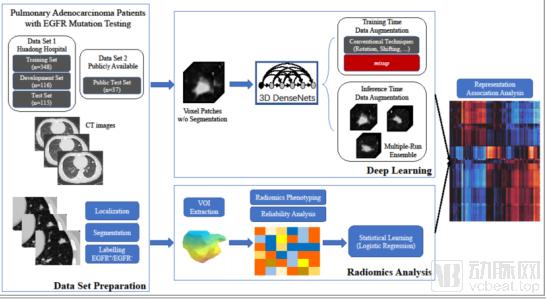
Research Process
The imaging data for this study were sourced from the CT database of Huadong Hospital (the HdH database, comprising 579 cases, including 348 in the training set, 116 in the development set, and 115 in the test set). To evaluate the generalizability of the developed model, 37 pulmonary nodule cases were selected from the independent public cancer imaging archive, The Cancer Imaging Archive (TCIA), to serve as an additional test set. All cases underwent manual localization, segmentation, and annotation of EGFR mutation/wild-type status.
The 3D DenseNets deep learning method was trained using the training set, and the powerful data augmentation technique mixup was employed to enhance regularization. The fitting was completed through a supervised end-to-end learning model. Meanwhile, traditional radiomics analysis was performed on all imaging data, and pairwise correlation coefficients were calculated to analyze the association between the two approaches in comparison with 3D deep learning.
The results demonstrated that 3D deep learning significantly outperformed traditional radiomics methods in predicting EGFR mutation status (P=0.021). The AUCs of the 3D deep learning model on the HdH database test set and the public test set were 75.8% and 75.0%, respectively (Table 1). More importantly, unlike traditional radiomics, which requires time-consuming and labor-intensive manual segmentation of regions of interest, 3D deep learning showed good concordance between its identified regions of interest and the actual pulmonary nodule lesions.
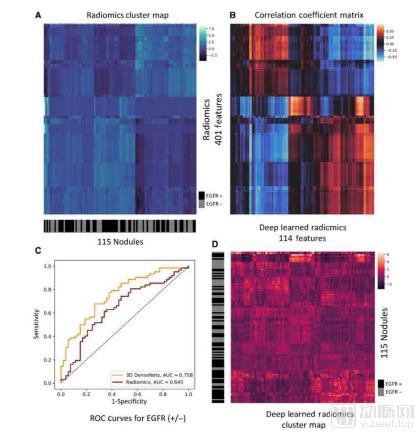
The researchers analyzed 401 traditional radiomics features extracted manually (Figure A) and 114 deep learning radiomics features extracted from 3D DenseNets (Figure C). They found that the features derived from the 3D deep learning method were more representative than those obtained through manual extraction, resulting in superior clustering analysis outcomes. For the first time, a matrix-based approach was employed to further compare deep learning features with traditional radiomics features (Figure B). The analysis revealed a strong correlation between deep learning features and traditional imaging characteristics. In terms of classification performance based on ROC curves, deep learning features demonstrated higher sensitivity and specificity. This indicates that deep learning, through enhanced radiomics, can deliver robust predictive performance in terms of robustness, compactness, and expressiveness.
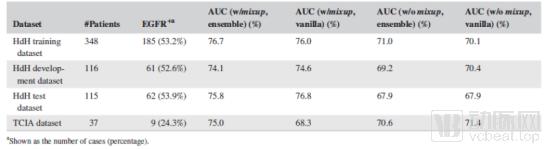
Summary of Predictive Performance of Deep Learning Systems Across Databases
The deep learning framework developed by the researchers enables non-invasive, automated prediction of EGFR mutation status in lung adenocarcinoma, thereby assisting clinical treatment decisions by identifying patients likely to benefit from EGFR-targeted therapy. The development process incorporated recent advances in deeply supervised learning, such as dense connections and Mixup techniques, significantly reducing risks like overfitting. As this method eliminates the need for meticulous segmentation of pulmonary nodules, it is highly labor-efficient. Furthermore, due to the enhanced characteristics of the adopted learning algorithms, it is expected to deliver more robust performance.
The researchers stated that further validation of the findings is needed in the future. For instance, while EGFR mutations in this study were detected using ARMS-PCR, future studies should validate these results using samples with next-generation sequencing (NGS) data for EGFR mutations. Additionally, the current model incorporates only CT imaging information; future work should integrate more comprehensive clinical data, such as pathology, blood test results, and proteomics.
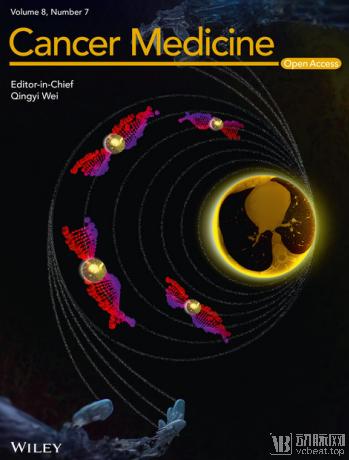
July 2019 Issue of Cancer Medicine Cover