

Elekta: 47 Years Sharpening the 'Gamma Knife' – A Legend in Radiosurgery with Over 50% Penetration in China's Top Hospitals
In the field of medical technology, there has long been a legend surrounding a “knife.” Before the advent of this “knife,” the treatment of neurosurgical diseases required craniotomy to remove necrotic lesions. Due to the high risks, slow recovery, and propensity for causing brain injury associated with craniotomy, this procedure has remained highly controversial within the medical community.
The emergence of this “knife” has replaced craniotomy, fundamentally revolutionizing the treatment of brain diseases.
In fact, this "knife" is not a knife in the true sense, but a medical device that uses gamma rays to treat various tumors and brain diseases, known as the Gamma Knife.
The hallmark of the Gamma Knife is its ability to precisely ablate necrotic lesions without direct contact with the body, akin to striking a target through a barrier. Following Gamma Knife treatment, the boundary between necrotic and healthy tissue is sharply demarcated, resembling a clean surgical incision. As a novel non-invasive therapeutic modality, the Gamma Knife has been hailed as a “revolutionary breakthrough in medical history” and a “milestone in neurosurgery.” Any discussion of the Gamma Knife inevitably brings up Lars Leksell and Elekta.
Lars Leksell was a renowned Swedish neurosurgeon who independently developed the Gamma Knife and stereotactic systems, leveraging these two historic inventions to found Elekta.
Founded in 1972, Elekta is a global leader in non-invasive neurosurgery and radiotherapy technologies, second only to Varian in the field of radiotherapy.
As a giant committed to meticulous operations, Elekta’s success offers valuable lessons for similar enterprises:
1. In terms of development history, Elekta’s successive leaders have continuously adapted to market changes and demands, always staying at the forefront of technology by successively integrating advanced technologies such as computing and artificial intelligence into its products.
2. In terms of product R&D, influenced by founder Lars Leksell, Elekta has remained committed to innovation. Through years of research and development, it has established a diversified product portfolio comprising stereotactic radiosurgery systems, linear accelerators, brachytherapy products, and oncology information management software.
3. In terms of market strategy, Elekta has demonstrated keen insight. It was among the first to enter the Chinese market at the dawn of China’s reform and opening-up, establishing a Chinese subsidiary and implementing a localization strategy that enabled it to capture the majority of China’s high-end market.
VCBeat (WeChat ID: vcbeat) seeks to interpret, from the aforementioned perspectives, how Elekta became a pioneer in the field of radiation therapy and what lessons Chinese enterprises can draw from its experience.
From the Age of Cold Weapons to the Era of Radiotherapy
In 1907, Lars Leksell was born in Sweden. In 1930, he obtained his Bachelor of Medicine degree from the Karolinska Institute in Sweden and began systematic studies in neurosurgery.
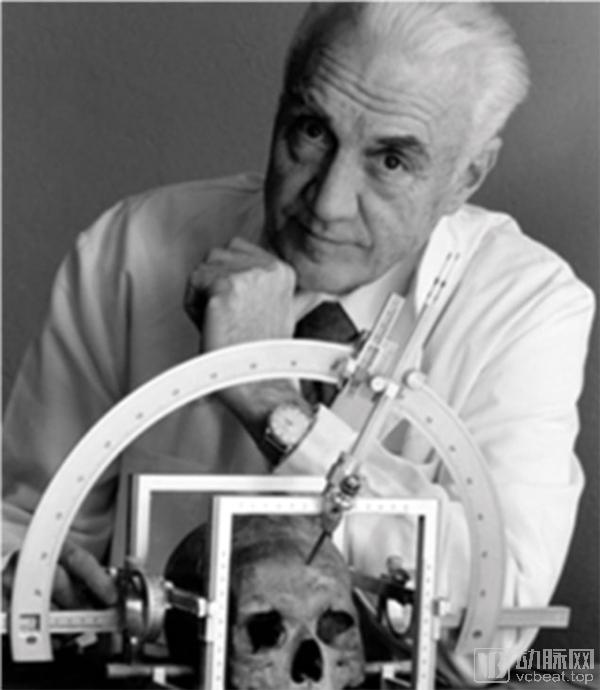
Lars Leksell (Image from the Elekta official website)
In the ensuing decades, Lars Leksell remained deeply engaged in neurosurgery and invented the stereotactic frame for the brain, which was used to diagnose and treat certain intracranial diseases, thereby reducing damage to brain tissue associated with craniotomy.
Although this instrument had significant limitations and was applicable to only a few diseases, Lars Leksell remained deeply encouraged.
Lars Leksell further envisioned that if invisible radiation were used to replace surgical instruments for cranial surgery under stereotactic guidance, the ideal of non-invasive, bloodless surgery could be achieved without a scalpel. Thus, he proposed the concept of Stereotactic Radiosurgery (SRS).
Since then, Lars Leksell has been working tirelessly to develop stereotactic radiosurgery equipment.
Lars Leksell was the first to attempt treating functional brain disorders by focusing X-rays from various angles onto intracranial targets. However, this study failed due to the low energy and insufficient penetrating power of X-rays.
Subsequently, Lars Leksell switched to using a cyclotron for experiments. Although the energy and penetration depth of the cyclotron met the requirements of stereotactic radiosurgery, its complex operation, high cost, and bulky equipment made it unsuitable for routine clinical use. Ultimately, this trial was discontinued.
After numerous setbacks, Lars Leksell’s research finally reached a turning point. By chance, he learned about cobalt-60.
As a radioactive metallic element, cobalt-60 decays to produce gamma rays. The simultaneous focusing of multiple gamma rays can kill cancer cells, a principle analogous to using a magnifying glass to focus sunlight to kill ants. Lars Leksell decided to use cobalt-60 as the radiation source.
In 1967, Lars Leksell successfully developed the world’s first Gamma Knife using Cobalt-60. Offering advantages such as being bloodless, minimally invasive, short in treatment duration, and highly effective, the Gamma Knife achieved legendary status in the field of radiotherapy upon its introduction.
With the Gamma Knife, neurosurgical procedures can be performed without craniotomy, using gamma rays to deliver treatment. This also marks the evolution of neurosurgery from the “cold weapon” era reliant on scalpels into the age of radiation therapy.
Soon, the first Gamma Knife was installed at Sophiahemmet Hospital in Stockholm, the capital of Sweden, primarily for the treatment of functional brain disorders such as Parkinson’s disease.
In the following years, the extensive applications of Gamma Knife were continuously explored, and it was gradually adopted in the field of oncology.
Elekta on the Offensive
To bring the Gamma Knife to a broader market, Lars Leksell and his son Laurent Leksell founded Elekta in 1972.
At its inception, the Gamma Knife was Elekta’s sole business. Over the following decade, Elekta focused on improving and optimizing the Gamma Knife.
In 1975, Elekta developed the second-generation Gamma Knife. The number of cobalt-60 sources was increased from 179 to 201, the collimator design was changed from disc-shaped to hemispherical, and two additional collimator helmets with 8 mm and 14 mm apertures were introduced. These modifications enhanced the Gamma Knife’s suitability for tumor treatment.
Subsequently, the third-generation Gamma Knife was introduced in 1984. Equipped with four collimator helmet sizes (4 mm, 8 mm, 14 mm, and 18 mm), it meets the needs of various clinical treatments. Additionally, Elekta integrated a computer system into the Gamma Knife, streamlining operational procedures and enhancing lesion localization accuracy, thereby better accommodating the treatment of intracranial lesions varying in location, size, and shape.
In 1886, Elekta reached a major turning point in its development. Laurent Leksell, the son of Lars Leksell, succeeded as President and Chief Executive Officer of Elekta.
Laurent Leksell believed that with the advancement of medical technology, relying solely on the Gamma Knife would eventually lead to the company’s obsolescence. He decided to use acquisitions as a strategic entry point to comprehensively expand into the fields of radiation therapy and oncology.
In 1997, Elekta acquired Philips’ radiation therapy division. This acquisition not only provided Elekta with Philips’ linear accelerators and stereotactic radiotherapy systems but also granted it the long-sought-after international marketing influence.
To enter the magnetoencephalography (MEG) market, Elekta acquired Neuromag, a developer of MEG technology, in 2003, and launched the Elekta Neuromag MEG system to provide real-time mapping of brain activity. Over the years, this product has undergone continuous updates and iterations, becoming one of Elekta’s key offerings.
To accelerate the development of information systems for radiation therapy, medical oncology, and related clinical trials, Elekta acquired IMPAC Medical Systems, a cancer management software company, for $250 million in January 2005.
Following the acquisition, Elekta successfully established connections with more than 3,000 hospitals and cancer centers worldwide and launched the Elekta Impac software, which was one of the most advanced information tools and treatment systems available at the time.
Under the leadership of Laurent Leksell, Elekta has transformed from a small research company into a global leader in advanced medical technology and clinical solutions, with its product portfolio evolving from a single standout offering to a diverse and comprehensive range.
On May 1, 2005, Tomas Puusepp succeeded Laurent Leksell as President and Chief Executive Officer of Elekta, overseeing global product sales, marketing, and services. He joined Elekta in 1988 and brings 22 years of senior management experience in the international medical technology market.
From that point on, under the leadership of Tomas Puusepp, Elekta continued to ride the wind and waves.
In 2006, Elekta launched Perfexion, a breakthrough technology that significantly improved the precision and accuracy of radiation therapy.
In 2015, Elekta launched its latest generation Gamma Knife product, Icon, marking another milestone advancement in the company’s Gamma Knife technology.
With the advent of the era of intelligent digital transformation, Elekta launched its smart radiotherapy solutions in 2018. Looking ahead, artificial intelligence will be the primary direction of Elekta’s development.
For many years, the story of Lars Leksell, the founder of Elekta, who remained undeterred despite repeated failures and ultimately invented the Gamma Knife, has been widely celebrated. Leksell’s innovative spirit is deeply ingrained in Elekta’s corporate DNA. Currently, Elekta boasts a portfolio of flagship products, including MOSAIQ, Elekta Unity, Icon, and Perfexion.
Based on the specific applications of Elekta’s products, they can be categorized into two segments: oncology radiotherapy software products and radiation therapy products.
Oncology Radiotherapy Software Product
Since acquiring cancer management software company IMPAC Medical Systems in 2005, Elekta has made oncology information management one of its corporate priorities, continuously expanding its presence in the oncology information systems market.
In 2008, the first patient was treated using Monaco, Elekta’s radiotherapy treatment planning system. A year later, Monaco received FDA approval.
Monaco is designed for precise tumor radiotherapy, with a calculation speed four times faster than traditional radiotherapy software, dedicated to providing physicians with high-quality stereotactic treatment plans. Additionally, to ensure the accuracy of dose calculations, Monaco employs the Monte Carlo dose algorithm, the industry gold standard. To better protect organs at risk, the system applies biological optimization simultaneously to both the target volume and organs at risk.
Elekta’s MOSAIQ oncology information management system, launched in 2009, is the flagship product of its radiotherapy portfolio. For five consecutive years following its release, it was rated by the research firm KLAS as an industry “Leader” and “Best in KLAS.”
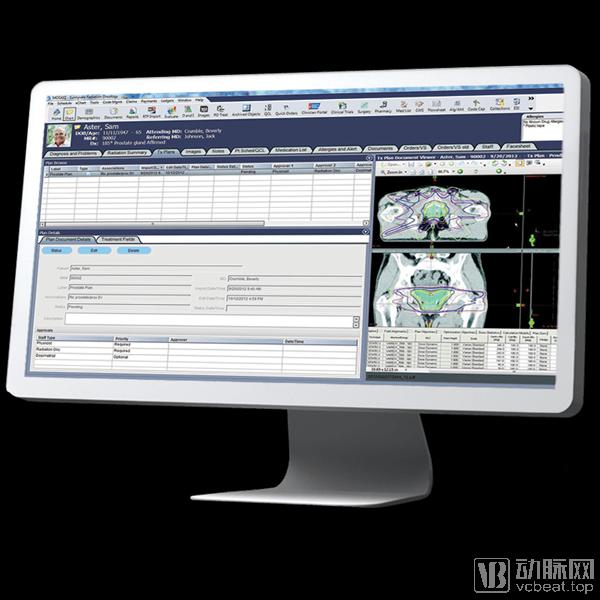
MOSAIQ Oncology Information Management System (Image from the official website)
MOSAIQ is dedicated to enhancing the overall efficiency of chemotherapy and radiotherapy workflows through its oncology information management system. From initial diagnosis and tumor staging, through treatment planning and delivery, to follow-up and survival rate analysis, MOSAIQ assists clients in optimizing the entire process. At its core, MOSAIQ is built on an Electronic Medical Record (EMR) system, which serves as the foundation for information exchange among healthcare professionals throughout the course of oncology treatment.
MOSAIQ is an image-enabled oncology information management software that integrates all business functions, such as resource scheduling, financial management, and report management and analysis. It is also the only information-sharing platform in the industry capable of integrating all devices within a radiation therapy center.
Radiotherapy Products
Currently, Elekta’s radiotherapy products are categorized into five segments: linear accelerators, stereotactic radiosurgery, neurosurgery, and brachytherapy.
The Gamma Knife is Elekta’s flagship product for stereotactic radiosurgery. Since the introduction of the Gamma Knife in 1967, Elekta has remained dedicated to innovating this technology.
In 2006, Elekta’s groundbreaking Gamma Knife product, Perfexion, was launched.
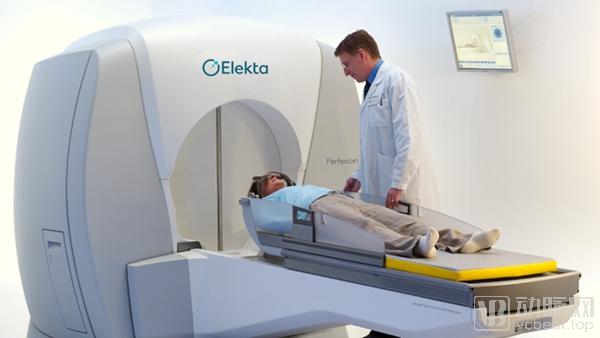
Perfexion (Image from Elekta’s official website)
Perfexion is the flagship Gamma Knife system for stereotactic radiosurgery, capable of integrating magnetic resonance imaging (MRI), computed tomography (CT), and angiographic images to achieve a target accuracy of 0.1 mm. Its innovative system design overcomes limitations related to lesion location and cranial anatomy, significantly expanding the treatment envelope and shaping the future of stereotactic radiosurgery.
To date, Perfexion remains one of the most mature and widely used devices in the field of stereotactic radiosurgery.
Building on the Perfexion platform, Elekta introduced innovative technologies such as built-in integrated imaging and non-invasive mask-based fixation, developing its latest generation Gamma Knife product, Icon, which was officially launched in 2015.
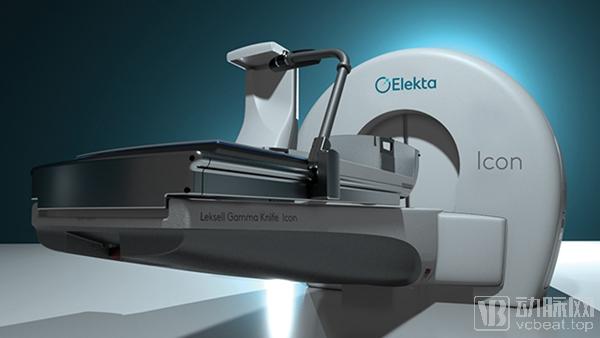
The Latest Generation Gamma Knife Product: Icon (Image from Elekta’s Official Website)
Icon represents the highest standard of precision in modern stereotactic radiosurgery. Its innovative frameless positioning system, online dose control, and newly added fractionated treatment capabilities enable the treatment of larger-volume brain tumors. Furthermore, Icon expands the indications for Gamma Knife surgery, allowing for the treatment of conditions such as meningiomas, brain metastases, and pediatric medulloblastomas, thereby maximizing the fulfillment of patients’ individualized treatment needs.
Icon has obtained the CFDA registration certificate. In March 2019, the first Icon unit in mainland China was installed at Shanghai Gamma Hospital.
In January 2018, Elekta launched the world’s first high-field magnetic resonance radiotherapy system, the Elekta Unity. By integrating magnetic resonance imaging (MRI) and linear accelerator technologies—traditionally considered incompatible—into a single platform, the system garnered significant attention from the industry upon its release.
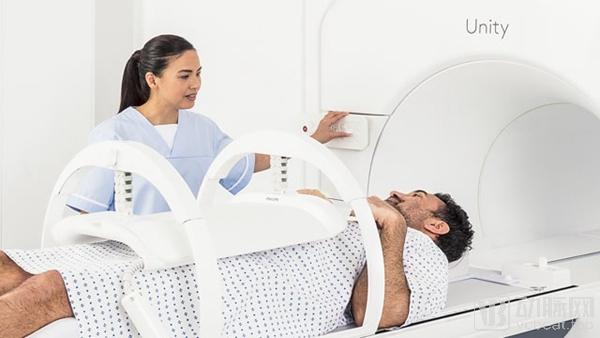
Elekta Unity (Image from Elekta's official website)
Elekta Unity integrates a state-of-the-art radiotherapy accelerator, a 1.5T high-field diagnostic-grade magnetic resonance (MR) system, and an online adaptive radiotherapy workflow software suite. It enables real-time acquisition of high-quality MR images of tumors and surrounding normal tissues during treatment, facilitates online adjustment of treatment plans, and allows for evaluation of treatment outcomes, thereby transforming the entire paradigm and workflow of tumor radiotherapy.
Currently, Elekta Unity has obtained registration testing approval from China’s drug regulatory authorities.
In Elekta’s market landscape, the Chinese market holds a significant position.
As early as 1982, Elekta launched its China initiative. At that time, competition in the overseas radiotherapy market was becoming increasingly fierce. Taking advantage of the intense rivalry between its main competitors, Varian and Accuray, in the United States, Elekta’s radiotherapy products quietly crossed the ocean and arrived in China.
At that time, China was in the midst of its reform and opening-up policy, generating substantial demand for foreign products. Meanwhile, radiation therapy in China was still in its nascent stage. Elekta successfully entered the Chinese radiotherapy market ahead of its competitors, capturing the high-end segment.
In the 1990s, Elekta began implementing a localization strategy for its subsidiaries, establishing the Shanghai Gamma Knife Hospital in 1992 and the Huashan Hospital Neurosurgery Group Hospital Gamma Branch in April 2000. In 2004, Elekta (China) was established, marking a significant step forward in Elekta’s market and product localization strategy.
To strengthen its position in the Chinese market, Elekta acquired an 80% stake in the Beijing Medical Equipment Institute (BMEI) in 2006. Currently, BMEI has become a key product supply center for Elekta, and its independently developed Compact medical electron linear accelerator system is widely used in hospitals both domestically and internationally.
For 30 years, Elekta has been quietly cultivating its presence in China. In 2017, China became Elekta’s second-largest manufacturing base for radiotherapy equipment outside Europe, with products sold globally.
Currently, among the radiotherapy equipment in China’s top 50 hospitals, Elekta holds a market share of over 50%, making it the industry-recognized leader in radiotherapy. In the high-end brachytherapy systems market in China, Elekta’s market share exceeds 70%.
Gong Anming, President of Elekta China, stated that Elekta plans to establish Elekta China Co., Ltd. in Shanghai and relocate more production lines from Europe to China.
Since entering the Chinese market, Elekta has remained a dominant force in China’s radiotherapy equipment sector. Meanwhile, independent research and development of radiotherapy equipment in China is also underway. The Gamma Knife represents the first radiotherapy device in which China achieved a technological breakthrough.
In 1993, China imported its first Gamma Knife.
This Gamma Knife, manufactured by Elekta, was priced at $3 million. At that time, the average monthly wage for an ordinary worker in China was only around 150 yuan.
The high price has spurred the drive for China’s independent development of Gamma Knife systems.
Three years later, the Chinese company Ourui launched the first independently developed head Gamma Knife. This head Gamma Knife was the first product in China’s medical device industry to receive FDA approval.
In 1998, Aowei developed the first domestically produced body Gamma Knife.
Aowei’s Gamma Knife employs a proprietary isocentric rotational focusing technology. During treatment, the Cobalt-60 radioactive sources rotate to deliver radiation, which is guided by collimators and precisely converges at the center of the sphere to form a focal point. The lesion receives a continuous high-dose gamma ray exposure, enabling single-session, lethal destruction of the target, while surrounding healthy tissues are exposed to only minimal radiation.
Data show that in 2018, there were 308 Gamma Knife units across China, with domestically produced models accounting for nearly 90%. The Gamma Knife’s pioneering achievement in independent innovation and localization within the medical device sector was driven by Chinese companies possessing core technologies, such as Ourui.
However, domestically produced Gamma Knife systems have long been confined to the mid- and low-end markets. In recent years, they have gradually begun to penetrate the high-end market.
In April 2019, the renowned U.S. hospital Methodist University Hospital in Memphis introduced the Infini Cranial Gamma Knife, developed by the Chinese company Masep. Prior to this, the hospital had exclusively used Gamma Knives manufactured by Elekta.
The order from Methodist University Hospital in Memphis has opened a door for domestically produced Gamma Knife systems to enter the high-end market. In the following months, Masep successively received orders for its Gamma Knife devices from renowned Grade 3A hospitals in China: in May, Hebei Provincial Hospital of Traditional Chinese Medicine announced the bid-winning result for Masep’s Gamma Knife equipment; in June, the Affiliated Traditional Chinese Medicine Hospital of Southwest Medical University introduced Masep’s Gamma Knife system.
Masep was founded in Shenzhen in 1997. In the field of Gamma Knife technology, Masep possesses multiple core technologies, key technologies, and independent intellectual property rights. Its latest Infini Head Gamma Knife features proprietary rotating focus and on-off valve designs, which effectively increase the dose delivered to the target while reducing the ratio of surface absorbed dose to target absorbed dose, thereby protecting normal tissues and organs.
To date, Masep’s products have obtained certifications from China’s CFDA, the U.S. FDA, and the EU CE, among others. The products have been exported to countries including Vietnam, Turkey, Morocco, El Salvador, and the United States, with nearly 100 units installed worldwide.
After 26 years of development, domestically produced Gamma Knife systems have not only achieved independent research and development but are also gradually transitioning from import to export and from the low- to mid-end market to the high-end market.
China’s radiotherapy market still faces a significant demand gap. In 2018, Gong Anming, President of Elekta China, stated that there were only slightly more than 2,000 medical linear accelerators in China, whereas the World Health Organization recommends at least 4,000 units. Compared with the market penetration in Europe and the United States, China would require nearly 8,000 accelerators, indicating substantial growth potential for the future market size.
Chinese companies are catching up fast, and of course, Elekta cannot remain indifferent.
In June 2019, Sukhveer Singh was appointed President of Oncology Information Management at Elekta, where he was responsible for developing personalized healthcare solutions based on big data and cloud computing.
Elekta has prioritized digital healthcare in its strategic planning to drive the development of its precision radiation therapy strategy. New narratives are emerging in the future radiotherapy market.