

Yunjia Health Files for IPO: Simplifying Doctor-Patient Connections Through Collaboration with DingTalk to Empower Primary Hospitals in 'Internet Plus' Transformation
It is quite troublesome for patients to visit hospitals. How can the connection between “patients” and “medical care” be simplified? This is the question Yunjia Health is contemplating.
“We have always looked forward to the day when we could enter the healthcare industry,” Ma Yuefei, head of Yunjia Health, told VCBeat (WeChat ID: vcbeat). Yunjia Health is a wholly-owned subsidiary of Hangzhou Yunting Data Technology Co., Ltd. (hereinafter referred to as “Yunting Data”). Yunting Data has been committed to the industrialization of cloud computing and big data, and oversees two wholly-owned subsidiaries: Hangzhou Yunjia Cloud Computing Co., Ltd. (hereinafter referred to as “Yunjia Cloud Computing”) and Hangzhou Yunjia Health Management Co., Ltd. (hereinafter referred to as “Yunjia Health”). The former has already become a leader in the smart justice industry.
For businesspeople, staying within familiar industries offers more stable revenue streams. However, the founding team of Yunjia recognized the limitations ordinary citizens face in accessing high-quality medical resources. Leveraging its cloud computing and big data capabilities accumulated in the judicial sector, Yunjia officially entered the smart healthcare industry in 2018. Yunjia Health commenced formal operations in mid-2018, establishing from the outset a core mission: to enable public access to premium medical resources and simplify the connection between patients and healthcare providers.
“Data connectivity.” Ma Yuefei, the person in charge, responded in this manner. “Our foundation lies in establishing connections between data. If there is no connectivity or interoperability among data, the connection between people and healthcare can never be established.”
Step 1: Establish a Basic Framework for Simple Patient-Provider Connections
In terms of data connectivity, the healthcare market faces numerous challenges. Currently, data silos persist across most medical institutions, with some even lacking internal data interoperability. Furthermore, the absence of a unified standard for medical data formats has led to significant fragmentation and inconsistency. Without shared and interoperable data, how can we possibly establish the “Future Hospital,” which is fundamentally built on data?
The first initiative undertaken by the Yunjia Health team was to establish a dedicated data team responsible for consolidating relevant data from various medical institutions and creating a unified cloud-based data platform, thereby enabling true interoperability and connectivity of data.
“Data is a factor of production; without producers, data holds no value.” With data in hand, how can production be realized? This is the second issue that Yunjia Health aims to address.
Yunjia Health’s second team, the Application Team, was established in response to this need. As the producers, they build various application platforms on top of the data infrastructure, including internet hospitals and future clinics, to help hospitals and physicians leverage these data resources effectively for timely and accurate patient consultations.
With data connectivity and data applications in place, Yunjia Health also aims to help hospitals optimize their operations. This was the original intent behind establishing the third team—the Internet Operations Team. “What Yunjia Health seeks to do is to assist primary-care hospitals in building internet hospitals while helping them operate these platforms effectively, thereby increasing outpatient visits.”
Step 2: Pinpoint Market Pain Points and Pursue the “Rural Areas Encircling Cities” Strategic Approach
In China, there is a shortage of tertiary hospitals, while secondary hospitals are ubiquitous. The public naturally has greater exposure to the vast number of secondary hospitals; however, these institutions suffer from various deficiencies that hinder patient retention. In summary, there are three primary pain points: inadequate physician competence, substandard pharmaceuticals, and outdated medical equipment.
Yunjia Health has targeted these secondary hospitals to initiate its strategy of “connecting people with healthcare.”
From a hospital-level perspective, Yunjia Health’s data connectivity can address the issue of inadequate hospital capabilities. Leveraging the convenience brought by internet-based services and data sharing, Yunjia Health’s Internet Hospital enables patients to “bring” high-quality physicians to their fingertips, allowing them to schedule consultations with doctors across China from home and conduct online medical inquiries and diagnoses.
If pharmaceuticals alone prove insufficient, Yunjia Health proposes a “Digital Medical Consortium” solution that interconnects currently independent healthcare institutions, enabling integrated management of human resources, finances, materials, medical services, education, and research within the consortium. By unifying all drug formularies, required medications can be directly sourced within the consortium, thereby resolving the issue seamlessly.
If the equipment is not viable, particularly in hospitals located in remote counties and districts with sparse populations, equipping each hospital with a large-scale medical device would likely result in low utilization rates, leading to definite financial losses for the hospitals.
Yunjia Health leverages data connectivity to “link” these remote, small-scale medical facilities. By ensuring that each county or district has at least one device and establishing a unified appointment system, patients can directly book access to relevant medical equipment online. This approach eliminates the difficulty of accessing large-scale medical devices due to remote locations and significantly improves the utilization rate of equipment resources.
Yunjia Health refers to this strategy of starting its deployment from secondary hospitals as the “rural areas encircling cities” strategy. By prioritizing the connection between patients and healthcare providers at primary care institutions, this approach aligns with the company’s original mission established at its inception: to help the general public access high-quality medical resources.
Step 3: Achieve online-offline integration to ensure the safe implementation of ideas
I hope to see Yunjia Health not only serve patients but also support physicians.
Ma Yuefei stated, “Yunjia Health no longer requires physicians to maintain separate schedules for the internet hospital. Instead, it has adopted an integrated online-offline model, whereby physicians attend to patients from whichever channel—online or offline—their assigned appointment slot falls under. Physicians are no longer required to distinguish between days designated for online duty and those for offline duty.”
While improving physician efficiency, another issue consistently plagues the majority of stakeholders in the healthcare industry: Once vendors obtain medical data from hospitals, can patient data security be guaranteed? In the United States, clear legislation stipulates that patients own their medical data and that their privacy rights must not be infringed. In China, however, relevant legislation has yet to be established.
In this broader context, if Yunjia Health aims to become a healthcare service provider trusted by its audience, it cannot bypass the challenge of data issues. Ma Yuefei stated, “Ownership of medical data can only belong to hospitals or patients; it can never belong to information service providers. Currently, some business models in the digital health industry are distorted, with information vendors obtaining data from hospitals, then integrating and reselling it back to hospitals while charging interface fees. Yunjia Health will absolutely not charge any interface fees.”
He added, “We are a health management service provider, not an IT vendor. The data we organize, restructure, and integrate all belong to our clients. Clients can store and encrypt their medical data on their own; if they choose to store it with Yunjia Health, we also provide specialized encryption algorithms to help them securely encrypt and store their data.”
“From the very first day Yunjia Health was established, we had a clear plan: Yunjia would not develop a standalone app,” Ma Yuefei told reporters. Few people today are willing to download new apps, as nearly everyone already has one essential app—WeChat. Without requiring users to download any additional apps, patients can simply scan a QR code via the WeChat mini-program to instantly access all the features of the internet hospital built by Yunjia Health.
Currently, chronic diseases are the most common conditions consulted in internet hospitals, with the majority of chronic disease patients being over 50 years old. For this demographic, the small font sizes used on many internet hospital platforms are not user-friendly. If elderly individuals struggle to read the text, how can they be expected to further engage with these emerging digital healthcare services?
Yunjia Health has also taken note of this issue. Therefore, when developing the user interface for its internet hospital, Yunjia Health incorporated a simple design feature: two-finger zoom for the UI. This seemingly minor yet human-centered enhancement enables elderly users to access and utilize the internet hospital more easily and conveniently.
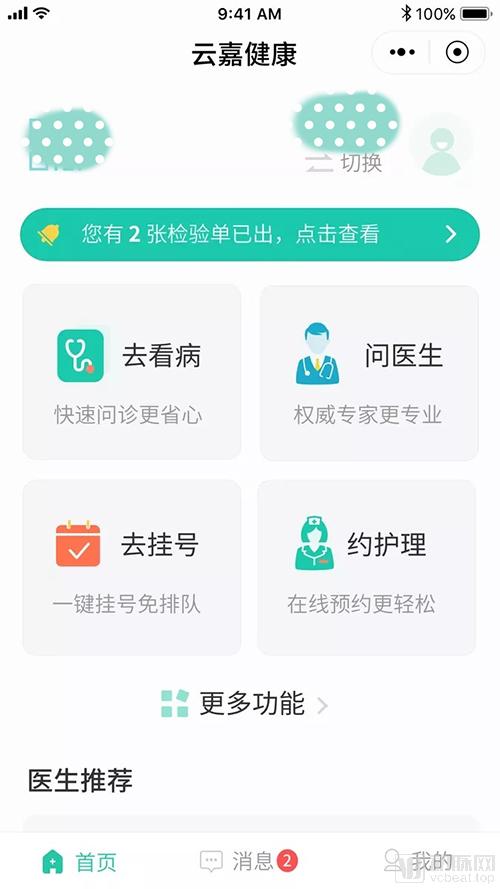
Yunjia Health Internet Hospital Interface (Image provided by the company)
Among the current users of Yunjia Internet Hospital, it is precisely this group of elderly patients with chronic diseases that exhibits the highest usage rate.
Having resolved the user-side access issue, the hospital side also needs to become “simple.” Yunjia Health partnered with DingTalk in 2018. “I believe DingTalk is the most convenient entry point for hospitals. If our own product suite is targeted at internal hospital use, DingTalk serves as the optimal platform,” said Ma Yuefei. “Currently, we have helped numerous hospitals implement various management solutions and improved doctors’ work efficiency. Through the DingTalk platform, doctors can promptly and effectively access the backend of internet hospitals, ensuring they do not miss any patient consultations.”
“With the robust support of Alibaba, I believe that Yunjia Health’s impact on the healthcare industry will become increasingly pronounced. On this track, Yunjia Health will continue to move forward alongside DingTalk. The future blueprint of healthcare that lies ahead is something worth anticipating for everyone in the medical industry.”