

Karima Shabbah Brings Global Drug Commercialization Center to China to Accelerate Biotech Innovation

GDCC
Global Drug Commercialization Center
As the former President of the Canadian Drug Research and Development Centre (CDRD) and current Chief Executive Officer of the Global Drug Commercialization Center (GDCC), Ms. Karima Shaba (hereinafter referred to as “Ms. Shaba”) is attending the Tianfu International High-End Dialogue on Biopharmaceutical Commercialization (hereinafter referred to as the “Dialogue”) for the second time. The Dialogue is jointly organized by GDCC and GF Securities, with strong support from the Sichuan Provincial People’s Government and relevant departments.
GDCC is dedicated to selecting breakthrough and innovative technology projects from around the world, accelerating their R&D and commercialization in China.
Ms. Shaba told a reporter from VCBeat New Medicine that the establishment of a China branch by GDCC to introduce overseas enterprises into the Chinese market was no accident. “Over the past two decades, I have closely monitored developments in the life sciences sector in Brazil, China, and selected countries in Africa and North America. I have observed that China has gradually emerged as a global leader in the consolidation and upgrading of the innovative biotechnology industry. Three years ago, I conceived the idea of introducing globally innovative biotechnology ventures into China for commercialization,” said Ms. Shaba.
In 1988, Ms. Shaba came to Canada for the first time, serving as the Director of Marketing and Business Development for Sanofi’s multinational operations in the country. Under her leadership, two first-in-class novel drugs were successfully advanced from research and development to market launch. Six years later, Ms. Shaba returned to her homeland, Kenya, Africa—a place teeming with wildness and vitality, where zebras gallop across the plains and flocks of flamingos gather in abundance.
After returning to her hometown, Ms. Shaba founded her second biotechnology company. However, her peaceful life was disrupted one day seven years later. “We experienced a terrifying home invasion; seven armed robbers broke into our house,” Ms. Shaba recalled. During that period, she began to hesitate about whether to leave her hometown. It was not until she read The Alchemist by the renowned Brazilian author Paulo Coelho that a line from the novel solidified her decision to depart. “When you want something, all the universe conspires in helping you to achieve it,” Ms. Shaba stated.
Converting scientific research into products has long been Ms. Shaba’s goal, and it is precisely her passion for and persistence in this objective that have enabled her to go further and further on her path in the life sciences field.
In 2002, Ms. Shaba arrived in Vancouver, the capital of Canada, to serve as Chief Operating Officer and Vice President of Medsurge Medical, a medical device company, helping it go public. In 2005, Ms. Shaba became President of LifeSciences BC, a non-profit, non-governmental industry association that brings together scientists, investors, innovative enterprises, and government officials in the life sciences community by regularly hosting investor summits, presenting the “LifeSciences BC Awards of the Year,” and organizing other signature life sciences industry events, thereby promoting investment and collaboration in the life sciences sector.
Under the leadership of Ms. Shaba, LifeSciences BC has achieved remarkable success in fostering business development between the life sciences industry and the research community, securing over $1 billion in funding for biotechnology companies in British Columbia, Canada.
At that time, during an event hosted by LifeSciences BC, Ms. Shaba met several scientists from the University of British Columbia who were also considering establishing a professional organization to conduct drug development and commercialization activities. This marked the inception of Canada’s national organization for drug development and commercialization, the Centre for Drug Research and Development (CDRD). In 2007, with support from the federal government, the CDRD was established in British Columbia.
CDRD’s role in scientific and technological translation extends beyond merely providing financing to enterprises; it also advances innovative technologies by fostering collaboration among academia, industry, investors, and patient communities. CDRD provides innovative technology companies with infrastructure, expertise from its team of scientists, and the funding necessary for project translation.
In 2010, Ms. Shaba joined CDRD. Two years later, she was appointed as CEO of CDRD. During her tenure at CDRD, Ms. Shaba established a series of national and international alliances with partners across Canada and in 12 countries on five continents, through strategies such as corporate spin-offs and mergers and acquisitions, positioning CDRD as a world-leading center for preclinical translational research and commercialization.
From Kenya to Vancouver, Ms. Shaba has spent decades advancing product development from concept to commercialization as a biotechnology and operations executive, managing company products as an entrepreneur, and driving scientific translation as a leader in the life sciences industry. Upholding her belief in translating science into products, she has leveraged her extensive experience in biotechnology and medical device operations to expand her network of investors and scientists in the life sciences field, ultimately achieving the goal of accelerating the commercialization of research technologies through CDRD. In 2016, Ms. Shaba was honored with the “Most Influential Business Woman” award in Vancouver.

Ms. Karima Shaba
But Ms. Shaba’s journey in translating scientific research into practical applications has not stopped. Decades of commercialization experience have given her profound insights into this process. “Successful translation of scientific research typically involves several key elements. The first is having research or academic institutions equipped with innovative talent. However, it is not enough to merely transform scientific discoveries into innovative technologies, and then into products, solutions, or next-generation innovative therapies.”
Ms. Shaba added, “Secondly, incubators for innovative technologies are needed to provide infrastructure and policy support for business development, fostering a favorable ecosystem such as industrial agglomeration effects. Finally, business accelerators are required to introduce talent with commercial acumen, strategic partners, and the funding necessary for enterprises at various stages, from early-stage R&D to the later-stage market launch of products.”
In Canada, the CDRD has all the essential elements in place for the translation of innovative technologies. Consequently, Ms. Shaba has cast her gaze farther afield, targeting emerging markets in the global life sciences sector with the aim of sharing her expertise in technology translation worldwide. GDCC has opened up new horizons for Ms. Shaba’s journey in innovation translation. She believes that the overseas translation of innovative projects requires breaking down cultural barriers and setting aside prejudices, while also leveraging interdisciplinary collaboration and the synergy of diverse cultures to drive progress.
“Vancouver has a population of 2.4 million, including 400,000 Chinese individuals,” said Ms. Shaba. Among these 400,000 Chinese residents are colleagues and partners who share her belief in scientific research translation, as well as many young people filled with desire and passion for innovation.
In Chengdu, Sichuan Province, through exchanges with the government and investment institutions, as well as her team’s research, Ms. Shaba discovered that Chengdu boasts an inclusive culture for welcoming overseas enterprises and robust infrastructure supporting the scientific research industry. The Tianfu International Bio City, established in Chengdu, has created an industrial clustering effect by gathering biopharmaceutical companies, thereby driving the development of the biotechnology sector in Chengdu and even across Sichuan Province. The large patient population at West China Hospital of Sichuan University also provides support for clinical trials. Furthermore, the government is making every effort to promote innovative development in science and technology.
“Everything indicates that Chengdu, Sichuan has a robust ecosystem for the translation of scientific research into practical applications. Therefore, two years ago, I collaborated with colleagues in North America and Canada, leveraging various resources from the GDCC Science and Business Committee, to establish the GDCC China Center in Chengdu, accelerating the localization and commercialization of global innovative technologies in China,” said Ms. Shaba.
In 2017, GDCC established its first overseas sub-center in Chengdu, Sichuan, introducing select overseas projects to China. Although Ms. Shaba boasts a wealth of successful cases in scientific research translation, establishing the GDCC China Sub-Center to accelerate technology incubation and corporate commercialization was insufficient for ensuring the successful localization and commercialization of overseas enterprises in China. “It is particularly crucial to grasp global innovation technology trends and rigorously screen companies for introduction into China,” stated Ms. Shaba.
At the dialogue session, Dr. Zafrila Avnur, Chief Scientist at GDCC, laid out GDCC’s perspective on global biotechnology trends.
Dr. Zafirah Avnur believes that startup investors should focus on the following four key areas: immuno-oncology and immunology, artificial intelligence, machine learning and big data in healthcare, rare diseases, and healthcare informatization. The field of immuno-oncology and immunology has witnessed rapid development in recent years, giving rise to three emerging subfields:
1. Cell Therapy. Currently, cell therapies led by CAR-T have become widely recognized.
2. Microbiome Therapy. Studies have found that different microbiota exert distinct molecular mechanisms in tumor immunotherapy, thereby holding the potential to target cancer cells and enhance the efficacy of immunotherapy.
3. Drug Delivery. Drugs targeting cancer cells are often unstable; therefore, specific carriers are required to deliver the drugs to the target cells. Studies have shown that polymer nanoparticles encapsulating drugs can achieve targeted delivery of anticancer agents in vivo.
Regarding project screening for introduction into China, Ms. Shaba also presented GDCC’s unique perspective:
1. Whether the enterprise possesses disruptive technology, with a priority given to therapeutic rather than supportive biotechnology projects;
2. Prioritize platform-based projects, which are not targeted at a specific disease but can be combined with various therapeutic modalities;
3. Whether the company possesses top-tier scientists and a seasoned commercialization team;
4. Whether the final products of innovative technologies have sufficient medical market demand in China.
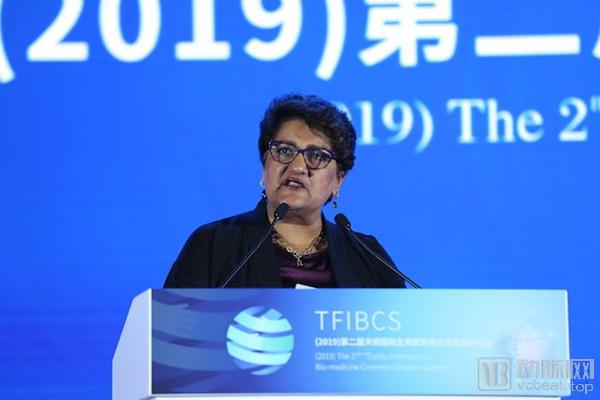
Ms. Shaba Attends Dialogue Session
To date, GDCC has launched six overseas projects in Chengdu, Sichuan, and expects to launch another four to five projects within this year. For Ms. Shaba, introducing overseas enterprises to China is not only a continuation of her journey in translating scientific research into practical applications but also a new starting point. At the beginning of the dialogue session, Ms. Shaba expressed her expectations as follows: “I believe that China will become a global leader in the biotechnology industry in the future. I hope to combine innovative technologies from China and the rest of the world to create a synergistic force, jointly building an effective and sustainable new ecosystem in Chengdu.”