

Professional Medical Science Communication Enters Golden Age as Tencent Yidian Triples User Base in One Year

Tencent
Internet Comprehensive Service Provider
Recently, Tencent Yidian, Tencent’s professional medical science popularization platform, released data showing that its monthly active users had grown by more than 300% over the past year as of June 2019. The platform has established collaborations with over one hundred renowned hospitals and more than 1,000 experts across China, including over 80 academicians from the Chinese Academy of Sciences and the Chinese Academy of Engineering, as well as leading figures in their respective disciplines. Distinguished experts serving as advisory specialists for Tencent Yidian include Zhong Nanshan, an academician of the Chinese Academy of Engineering and a renowned specialist in respiratory diseases; Chen Xiangmei, an academician of the Chinese Academy of Engineering and President of the Nephrologist Branch of the Chinese Medical Doctor Association; Dong Jiahong, an academician of the Chinese Academy of Engineering and Dean of the School of Clinical Medicine at Tsinghua University; Han Jisheng, an academician of the Chinese Academy of Sciences and pioneer of pain medicine in China; Huo Yong, Chairman of the Cardiology Branch of the Chinese Medical Association; and Guo Jun, Deputy Secretary-General of the Chinese Society of Clinical Oncology (CSCO) and Vice President of Peking University Cancer Hospital.
Tencent Yidian, officially launched in 2018, integrates professional medical knowledge from physicians with rich media formats such as text, animations, and videos. By leveraging online social networking, big data, and artificial intelligence technologies to precisely match user needs and scenarios, it ensures that users have access to desirable, useful, and actionable medical information throughout the entire healthcare continuum—including prevention, diagnosis, treatment, and rehabilitation—thereby enhancing their self-health management capabilities and health literacy. To guarantee the authority of its content, Tencent Yidian has entered into a strategic partnership with WebMD, securing exclusive Chinese-language rights for over 60,000 medical articles globally.
As a pioneer of professional medical science popularization on the Chinese internet, the rapid growth in Tencent Yidian’s user base also signifies that professional medical science popularization, propelled by “Intelligence+,” has entered a fast lane of development and is increasingly becoming an effective supplement to the front-end segments of the broader healthcare system.
“Specialization, depth, and usability are becoming the direction for the development of online medical science popularization. In terms of professionalism, since healthcare is closely related to everyone’s life, medical science popularization should prioritize rigor and precision. The ‘content-spinning’ style of popularization compiled by online editors urgently needs to be replaced by ‘physician-authored’ content. Furthermore, merely providing superficial knowledge such as ‘what disease usually causes these symptoms’ or ‘how to treat common illnesses’ is no longer sufficient in an increasingly aging society. The public requires more systematic and structured medical knowledge graphs covering serious conditions, such as mid-to-late stage tumors, and chronic diseases. At the same time, medical science popularization must break down cognitive barriers, employing richer methods to transform professional knowledge into a health assistant that is understandable and practical for ordinary users,” said Zhang Meng, Vice President of Tencent Healthcare.
Every Article Is a “Piece of Embroidery”
“Every article we publish is a work of meticulous craftsmanship by experts.” Zhang Meng’s words conveyed his respect for medical professionals who are dedicated to science communication.
Health is closely linked to everyone, which has led to an abundance of medical information on the internet. However, “rewritten” popular science articles about medicine—relying on clickbait headlines, cobbled together by editors, and lacking proper review—have become widespread. Tencent, with its massive traffic and content pool, holds a natural advantage if it were to adopt an “assembly-line” approach to content production. Yet, when it comes to serious medical education, Tencent has chosen the “clumsy” method of producing every component in-house, putting in the “hard work.”
All 40,000+ articles in the Tencent Medical Classic content library are meticulously reviewed and authored word-for-word by medical experts. In key disease areas, national academic leaders personally organize frontline specialists to collaborate on compilation, thereby ensuring the completeness of the entire medical knowledge system, the currency of information, and alignment with clinical practice in China.
Taking tumor-related articles as an example, the average time required to compile each entry is approximately two and a half months. During this period, the editorial and review team consults 5 to 10 authoritative medical journals, searches at least two specialized medical databases for verification, conducts interviews with leading physicians specializing in the relevant diseases, and collaborates with top-tier medical experts and institutions in China for joint compilation and review.
Every piece of medical science popularization content from Tencent Medical Encyclopedia undergoes content planning tailored to clinical scenarios, cross-review and verification by medical experts, and periodic re-evaluation in line with the latest advancements in each medical discipline.
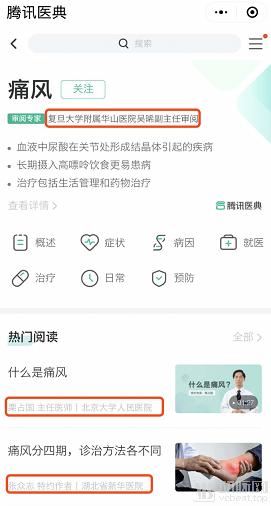
Figure: Each signature represents a physician’s venture, serving as a guarantee of content quality backed by their academic reputation.
“Medical science popularization should not be static, but dynamic. It should not consist of vague generalities; rather, it should provide targeted and precise knowledge tailored to variations in disease conditions and therapeutic advancements,” said Zhang Meng. In addition to professionally producing content, Tencent Medical Dictionary has also pioneered an original framework for the systematization of medical science popularization knowledge.
Across multiple domains, including 17 types of cancer, Tencent Medical Encyclopedia has built knowledge trees that cover the entire diagnosis and treatment pathway for individual diseases. In-depth articles, expert videos, frequently asked questions, and updates on the latest global therapies are integrated into each stage, from symptom recognition and initial diagnosis to treatment options and lifestyle management. For lung cancer, for example, medical information is tailored according to histological subtype and disease stage, enabling time-, condition-, and even person-specific content delivery for the same disease. This approach leverages science communication to empower users to make informed health decisions at every stage.
The launch of in-depth medical science popularization has been widely welcomed. Compared with daily health information content, Tencent Medical Dictionary users have shown particularly outstanding performance in article clicks and dwell time under disease categories such as breast cancer and Alzheimer's disease. In the past year, the growth rate of heavy users who read multiple times and have high dwell time has reached 12 times, far exceeding the 3 times growth of ordinary users.
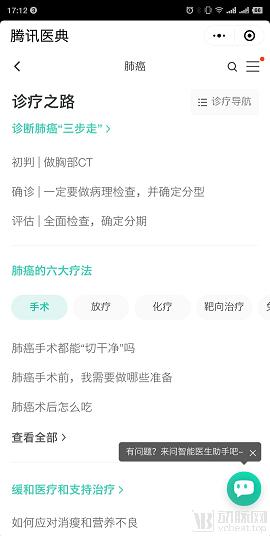
Figure: Tencent Medical Encyclopedia’s knowledge tree has achieved precise, subtype- and stage-specific health education in fields such as cancer.
Make Hardcore Knowledge Easy to Search and Understand
For Tencent Medical Encyclopedia, delivering high-quality content alone is not sufficient; it is equally important to enable users to access professional medical knowledge more conveniently. To this end, Tencent Medical Encyclopedia leverages 3D visualization technology to render complex medical concepts in an intuitive and easily understandable format, and has launched an intelligent Q&A assistant that supports voice search to help users perform quick and precise searches.
“The doctor recommended a breast biopsy, but I have no idea what that entails. Other patients described it as terrifying, mentioning something being extracted, and I have no clue whether it would harm my body. So, I’m too afraid to go through with it.” Such uncertainty and herd mentality are common in patients’ medical decision-making. How can complex disease-related knowledge be made more accessible and relatable to users? In addition to using text-and-image formats such as comics and videos, Tencent Medical Dictionary has pioneered the application of 3D human body visualization models for patient-oriented health education in China. By visually presenting organs, internal structures, and cellular levels, it helps patients develop an intuitive understanding of disease mechanisms and treatment principles. In the future, Tencent Medical Dictionary will further explore cutting-edge technologies such as medical image reconstruction and surgical procedure simulation.
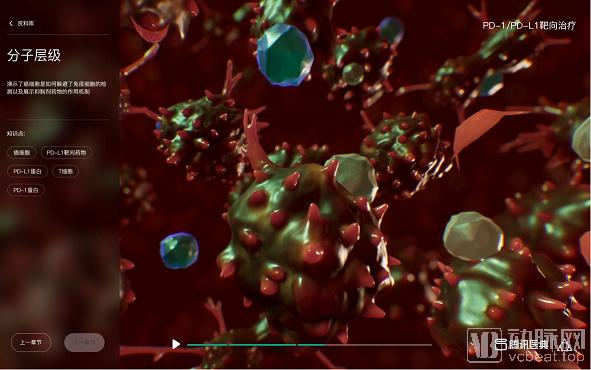
Figure: Medical Classic demonstrates the basic principles of targeted therapy in 3D
The high level of specialization in medicine creates cognitive barriers, making it difficult for users to find the information they need. On one hand, many users struggle to accurately and specifically describe their health concerns. On the other hand, most existing search platforms rely on keyword matching and lack the ability to discern users’ true intent, often resulting in irrelevant answers.
To bridge the “last mile” in users’ access to health information, Tencent Medical Dictionary has applied artificial intelligence technology to medical science popularization and launched intelligent Q&A assistants for conditions such as lung cancer and breast cancer. By leveraging deep semantic analysis and information extraction techniques, it has built a medical Q&A knowledge base. Furthermore, using natural language processing and deep learning technologies, the system accurately identifies user intent through voice interaction, guides users to provide additional relevant information via follow-up questions, and delivers precise answers.
For example, on the lung cancer topic page, when a user asks, “How to treat positive genetic test results,” the intelligent Q&A assistant provides information on types of gene mutations in lung cancer patients and further probes by asking, “Which specific gene tested positive?” It then delivers a tailored response based on the user’s reply. Additionally, the intelligent Q&A assistant includes highly relevant content alongside its response to improve the efficiency of information retrieval for users.
To make professional medical science popularization readily accessible across various scenarios, Tencent Medical Dictionary has extended its reach beyond its dedicated app and mini-program to integrate with information platforms such as WeChat Search and QQ Browser, enabling users to access expert opinions at the very first point of contact when seeking health-related information.
While gaining recognition among general users, Tencent Medical Dictionary is also earning the trust of an increasing number of professional institutions. Many authoritative hospitals have integrated Tencent Medical Dictionary’s content into their patient education platforms. For instance, the ovarian cancer science popularization initiatives at Fudan University Shanghai Cancer Center, the colorectal cancer education programs at Sun Yat-sen University Cancer Center, and the lung cancer awareness collaborations with Guangdong Provincial People’s Hospital all utilize content from Tencent Medical Dictionary. Additionally, the “Anzhen Heart Failure Home” official WeChat account of Beijing Anzhen Hospital, Capital Medical University, and the official WeChat account of Guangxi Maternal and Child Health Hospital have both partnered with Tencent Medical Dictionary as their platform for science popularization.
In the past, medical science popularization was merely a win-win scenario for platforms and physicians’ personal brands. The deepening collaboration between Tencent Medical Dictionary and an increasing number of hospitals signifies a new pathway for medical science popularization that fosters a triple-win outcome for platforms, physicians, and healthcare institutions. The integration of internet-based medical science popularization platforms into healthcare institutions not only helps hospitals improve the efficiency of patient education but also highlights the social value of physicians engaged in science communication.
The establishment of Tencent Medical Dictionary in 2018 marked the rise of professional internet-based medical knowledge services in China. The sustained growth over the past year has also demonstrated the public’s strong demand for scientific and rational medical knowledge. As more partners and followers enter this field, online medical science popularization will continue to evolve toward more diversified scenarios and deeper, more specialized domains.