

Tianji Health Files IPO Prospectus: Powering Rational Drug Use with Prescription Pre-Review Technology Delivering Results in 0.03 Seconds
“All medicines carry some degree of toxicity.” This old adage aptly captures the dual nature of pharmaceuticals. When used appropriately, medications serve as therapeutic tools; when misused, they become causative factors in disease.
In recent years, rational drug use has been elevated to a position of increasing importance. Driven by policy initiatives, hospital demands, and advancements in healthcare informatization, a growing number of enterprises have identified opportunities in the niche sector of rational drug use. Tianji Health Medical Technology Co., Ltd. (hereinafter referred to as “Tianji Health”) entered the market for prescription review for rational drug use precisely within this context.
To promote the rational use of medications in clinical practice, the "Specifications for Prescription Review in Medical Institutions," implemented in June 2018, explicitly requires that all prescriptions must pass review before proceeding to the pricing, charging, and dispensing stages; prescriptions that have not passed review shall not be charged or dispensed. Pharmacists are the primary individuals responsible for prescription review. Pharmacists shall conduct a item-by-item review of all content within the prescription.
“The Specifications” also state that medical institutions may utilize relevant information systems to assist pharmacists in conducting prescription reviews. For irrational prescriptions identified by the information systems, as well as those that cannot be reviewed by the systems, manual review by pharmacists shall be conducted.
At this time, Tianji Health has launched related products, becoming an assistant for hospitals in the management of rational drug use.
Tianji Health was established in late 2011. As a controlling subsidiary of Realcan Pharmaceutical Group Co., Ltd. (hereinafter referred to as “Realcan Pharmaceutical”), an A-share listed company and comprehensive healthcare service provider, Tianji Health constitutes a vital component of the group’s medical informatization segment. Since its inception, Tianji Health has acquired several companies, including Jinan Tongbang and Suzhou Dingcheng, to incubate its medical informatization business, with a particular focus on prescription review.
Wang Long serves as Vice President of Ruikang Pharmaceutical Group, where he oversees the group’s informatization division and manages Tianji Health. “The incubation of Tianji Health represents a strategic initiative for the group,” Wang told VCBeat (WeChat ID: vcbeat). As Ruikang is primarily engaged in pharmaceutical distribution, evolving policies and market dynamics necessitate providing hospitals with a broader range of services, with rational medication management emerging as a major trend.
In 2016, after team refinement and technological accumulation, Tianji Health officially began the research and development of its rational drug use software. The software was launched in February 2017.
Wang Long introduced that Tianji Health’s Rational Medication Software, which contains tens of millions of pharmaceutical knowledge entries, is an intelligent prescription review tool that integrates pharmacists’ expertise and pharmaceutical rules based on principles such as incompatibility contraindications and drug-drug interactions.
In terms of rule configuration, to integrate universal standards with hospital-specific requirements, the software categorizes its knowledge base and rule engine into four tiers: Tier 1, the Basic Database, ensures medication compliance; Tier 2, the Customizable Rule Library, allows hospitals to define rules based on actual clinical medication practices; Tier 3, the Refined Rule Library, establishes rules tailored to the medication needs of individual departments; and Tier 4, the Multidimensional Rule Library, implements distinct rules addressing the different medication requirements of outpatient, emergency, and inpatient populations.
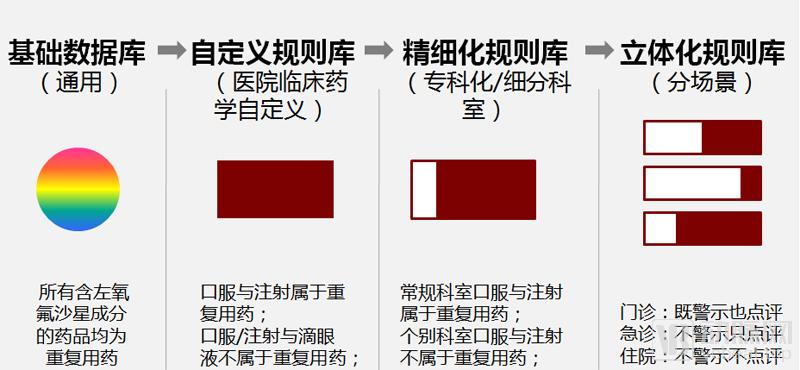
Four-Tier Knowledge Base and Rule Base for Rational Drug Use Software, Source: Tianji Health
“Post-prescription reviews primarily target non-compliant prescriptions, but by that time, the prescriptions have already been issued. It is more meaningful to ensure compliance before prescriptions are formally issued,” said Wang Long. Tianji Health has technically resolved the issue of pre-prescription review, implementing a “two-review, two-interception” audit process.
First-Level, First-Line Interception: After a physician submits a prescription, the rational drug use software embedded in the physician workstation rapidly reviews it. If the prescription is deemed inappropriate, the high-speed intelligent audit engine can provide feedback on the review results within 0.03 seconds. If the physician accepts the audit alerts, they may return to the prescribing interface to modify the prescription. For prescriptions that are severely inappropriate or in serious violation of institutional policies, the system can directly block them, preventing physicians from issuing such prescriptions.
Second-Level Interception: If the physician disagrees with the system alert, they may choose to proceed with submitting the prescription. In this case, the reviewing pharmacist will simultaneously receive the flagged prescription for manual review. The pharmacist can view the prescription and the system’s audit results, and immediately communicate online with the prescribing physician. Based on the outcome of this communication, the pharmacist may either approve or intercept the problematic prescription. The waiting time for the physician to receive a response from the pharmacist can be configured in the system rules; if no pharmacist responds to the flagged prescription within the specified timeframe, the prescription will be successfully submitted from the physician’s end.
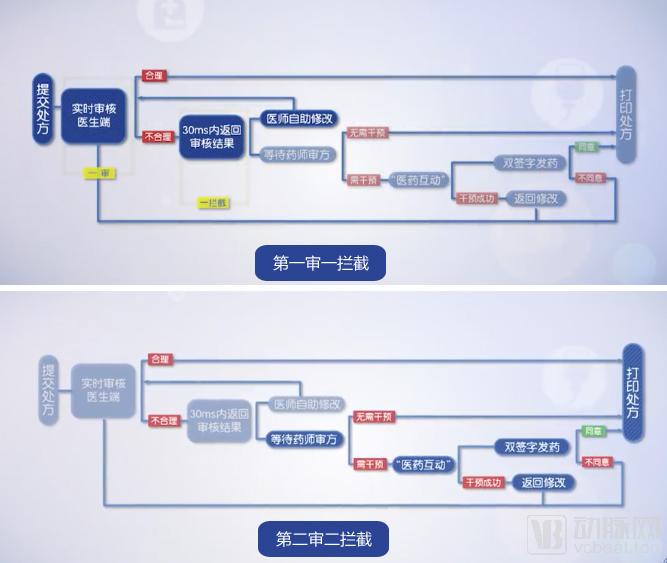
“Two Reviews and Two Interceptions” of Rational Drug Use Software, Source: Tianji Health
In addition to the advantages of the aforementioned rule configurations and review processes, the Tianji Health Rational Drug Use Software also features the following characteristics:
Supports cross-departmental, cross-prescription, and joint review. When a physician writes a prescription, the system can conduct a rationality review of combined medication by comparing the drugs prescribed for the current diagnosis with those prescribed by other physicians in previous departments, providing real-time alerts for irrational drug use.
Full-Sample Prescription Review. It innovatively achieves comprehensive prescription review without affecting the daily operations of the hospital’s HIS and rational drug use systems. When conducting reviews, pharmacists need only apply various combined filter conditions to retrieve 100,000 prescriptions within 10 seconds, significantly improving the efficiency of prescription review.
Low pop-up frequency, high accuracy of pop-up alerts, and strong practicality. On one hand, physicians’ routine workflows are not frequently interrupted; on the other hand, physicians have a high level of trust in pop-up alerts and are more willing to return to modify prescriptions.
Furthermore, rational drug use software can facilitate the transformation and innovation of hospital service workflows by implementing a "prescription review first, payment second, and dispensing last" model. This approach optimizes pharmaceutical care processes, reduces the burden of repetitive visits for patients, and enhances patient satisfaction while serving hospitals.
Since its launch, Tianji Health’s Rational Drug Use Software has been adopted by several large hospitals with daily outpatient volumes exceeding 10,000 visits, including Shanghai Changzheng Hospital and Shanghai Xinhua Hospital, providing them with comprehensive pre-prescription review services across all outpatient departments. Wang Long detailed the product’s achievements to date, stating, “Currently, we have covered more than 100 Grade A tertiary hospitals in China, including six of the top ten hospitals.”
Tianji Health is headquartered in the Fenglin Life Science Park in Xuhui District, Shanghai, with offices in Beijing, Wuhan, Jinan, and Suzhou to promptly respond to customer needs.
Regarding product planning, Wang Long stated that as the current focus is primarily on hospital-specific customization, future efforts—beyond routine knowledge base updates—must enhance adaptability to enable greater modularity and generalizability, thereby reducing development costs.
Having gained extensive operational experience across a large number of hospitals, Tianji Health has extended this expertise to healthcare security regulatory authorities.
In May this year, the Healthcare Security Work Conference in Weihai City, Shandong Province, pointed out that the "Internet + Healthcare" model should be leveraged to achieve resource sharing in stages and build an electronic prescription circulation platform featuring a shared and multi-win ecosystem. Strengthen agreement management by linking performance compliance and the assessment of healthcare providers enrolled in medical insurance with medical insurance indicators. Advance intelligent monitoring by coordinating the development and deployment of information systems for intelligent surveillance, management of medical insurance-enrolled physicians, big data analytics, and biometric identification.
In June, Tianji Health signed an agreement with the Weihai Municipal Healthcare Security Administration to build a regional platform for healthcare insurance audit and supervision. The system will conduct audits on rational drug use and appropriate clinical practices, encompassing pre-event and intra-event audits at the hospital level, as well as post-event audits by the Healthcare Security Administration. “The platform will integrate with the management software of all hospitals in the region, enabling the Healthcare Security Administration to dynamically and real-time audit hospital prescriptions and medical orders. Unreasonable or non-compliant prescriptions will be promptly flagged, warned against, or blocked to achieve the goal of controlling healthcare insurance costs. Furthermore, based on the audit results regarding prescription rationality and compliance, assessments and rankings can be conducted for insured physicians and hospitals,” introduced Wang Long. The project is currently in the preliminary stages of requirements alignment and functional planning, with implementation expected in the second half of the year. The project also serves as an exploration into establishing the prerequisites for prescription circulation.
In addition to maximizing the value of Tianji Health’s rational drug-use software, Realcan Medicine is also making further attempts in other areas of healthcare informatization.
Pharmacist 360: A mutual assistance and sharing platform for pharmacists that provides a suite of tools and services tailored to their professional needs. Leveraging its pharmaceutical expertise, it also delivers comprehensive data services and medication consultation to patients and pharmacies. With the product now fully developed, it serves not only individual consumers but also partners with e-pharmacy platforms to handle prescription verification tasks.
Peihe Commercial Insurance Claims Platform: Leveraging its independently developed E-Health claims system and robust online platform, it provides insurance companies with comprehensive end-to-end claims services. The platform already offers mature products and has accumulated a user base of nearly 20 million commercial insurance customers.
With the above business layout, Realcan Medicine currently owns multiple medical informatics companies and ultimately aims to explore the establishment of a closed-loop management and service system for rational drug use, covering the stages of “clinical application, procurement and supply, payment and claims, and disease management.”