

Fourier Intelligence Secures Tens of Millions in Series B Funding Led by Guozhong Venture Capital
Fourier
Intelligent Robot Developer
Recently, VCBeat (WeChat ID: vcbeat) learned that Fourier Intelligence, a benchmark enterprise in the field of rehabilitation robotics, has completed a Series B financing round worth tens of millions of yuan. The round was led by China State Development & Investment Corp. (Guozhong Venture Capital), with follow-on investments from IDG Capital, Volcanic Stone Capital, and others.
“This round of financing will be used for the research and development of rehabilitation robot technologies, expansion of our product lines, and channel development, thereby deepening our competitive moat. Meanwhile, we will use rehabilitation robots as an entry point to continuously build ourselves into an intelligent rehabilitation ecosystem company,” said Gu Jie, CEO of Fourier Intelligence.
Since its establishment in July 2015, Fourier Intelligence has completed multiple rounds of financing over the past four years, with investors including Zhangjiang Sci-Tech Investment, Jingxu Venture Capital, and Qianhai Fund of Funds. Why has it consistently attracted favor from the capital market? Pang Changwei, Investment Director at China Ventures (Guozhong Venture Capital), the lead investor in this round, highlighted several key factors. He stated, “Rehabilitation is already a substantial market. Frontier technologies such as robotics and artificial intelligence are iterating rapidly, making intelligent upgrading in the rehabilitation sector an inevitable trend. The Fourier Intelligence team boasts strong R&D capabilities and a global perspective, along with profound understanding and unique insights into the industry. By conducting cross-border R&D, manufacturing products in China, and selling them globally, the company has quickly become a leading enterprise in the sector. We believe that the Fourier Intelligence team will continue to develop more high-quality technologies and products, thereby driving the development of the entire rehabilitation industry.”
In-Depth Strategic Layout: From a Single Product to Standardized Solutions for the Smart Rehabilitation Hub
For a sci-tech innovation enterprise, technological R&D and the capability to commercialize and achieve mass production are two critical engines driving rapid corporate growth. Fourier Intelligence has demonstrated particularly commendable performance in both areas.
Since the official market launch of its first upper-limb rehabilitation robot based on force feedback technology, the Fourier M2, on December 2, 2016, Fourier Intelligence has advanced steadily, successively introducing a range of major independently developed products, including lower-limb exoskeleton robots, ankle rehabilitation robots, and intelligent electric training vehicles.
Gu Jie stated, “We have adopted a platform-based design with independently developed core modules, integrating artificial intelligence technology to build a new intelligent rehabilitation platform. This significantly enhances rehabilitation efficiency, making traditional rehabilitation training quantifiable in terms of data and more personalized and precise. We also hope that different product development teams will join Fourier in the future to jointly build an intelligent rehabilitation ecosystem platform.”
Generally speaking, enterprises that achieve significant scale and strength excel in strategic planning. They not only maintain tight control over factors such as technology, products, and teams but also continuously innovate and optimize their business models to identify broader pathways for development. Fourier Intelligence has mastered this approach; while expanding its product portfolio, it has continuously refined its upstream and downstream industrial chains, establishing a comprehensive standardized solution for the Intelligent Rehabilitation Port.
At the launch event for the world’s first open exoskeleton robot platform (EXOPS) on January 21 earlier this year, Gu Jie unveiled their comprehensive solution for an intelligent robot system designed for a rehabilitation center in Dubai. In this rehabilitation hospital, dozens of rehabilitation robots work simultaneously and efficiently in coordination to provide diverse training regimens tailored to different patients. This setup enables the entire rehabilitation center to meet the simultaneous training needs of dozens of patients with only a small number of therapists.
Currently, the Smart Rehabilitation Port solution has been implemented in multiple leading rehabilitation centers. Leveraging advanced technologies such as intelligent interaction and artificial intelligence integrated into smart rehabilitation robots, it liberates therapists from repetitive tasks; for instance, a single Fourier M2 upper-limb rehabilitation robot is estimated to save therapists one million repetitive motions annually. It also facilitates interaction between individuals with functional impairments and medical rehabilitation institutions, enabling physicians to more accurately monitor patients’ rehabilitation progress and driving rehabilitative therapy toward greater informatization, standardization, and intelligence.
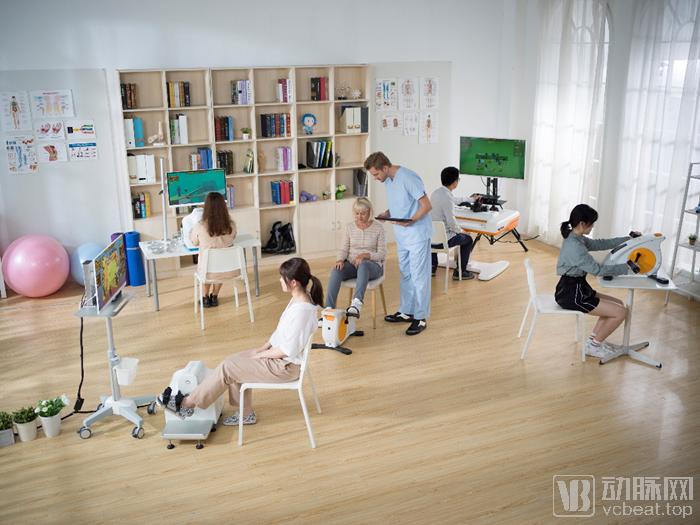
Rehabilitation Port Solution. Image source: Provided by the company
It is reported that Fourier Intelligence primarily serves two major groups. The first comprises individuals with functional impairments caused by disease or injury, including patients with neurological injuries resulting in upper and lower limb dysfunction—such as stroke, spinal cord injury, multiple sclerosis, and pediatric cerebral palsy—as well as patients with musculoskeletal injuries, such as joint fractures and ligament strains, who require range-of-motion, muscle strength, and proprioception training. The second group consists of the elderly, for whom the company provides comprehensive exercises targeting cognition, joint mobility, strength, and coordination to prevent and delay functional decline. Its goal is to deploy rehabilitation robots in hundreds of thousands of hospitals and tens of millions of patient households, thereby improving healthcare service efficiency and enhancing users’ quality of life.
Regarding market layout strategies, Gu Jie, the leader of Fourier Intelligence, has a very clear line of reasoning:Build a multi-tiered market, including the hospital market, community market, home care market, and overseas market。
“Fourier Intelligence will not merely be a technology-driven company, but rather a provider of intelligent rehabilitation platform solutions. This strategic shift has significantly expanded the market’s growth potential,” said Gu Jie. Furthermore, during its development, the company has successively received honors such as Ernst & Young Fudan’s “2017 China’s Most Promising Enterprise” and “Best Healthcare Startup.”
Horizontal Globalization Strategy: Expanding into More Than 10 Countries Worldwide
In addition to excelling along the vertical industry chain, Fourier Intelligence has also achieved remarkable results in its horizontal global strategic layout. The company has not only established a subsidiary in Singapore, attracting numerous high-caliber international talents, but also expanded its commercial footprint to more than ten countries and regions worldwide, with its business covering over 500 hospitals and rehabilitation institutions. It is currently the first and only rehabilitation robotics company in China to export its products in bulk to Europe and the United States, as well as the first domestic company in this sector to obtain full regulatory approvals, including U.S. FDA registration, EU CE marking, China NMPA (formerly CFDA) approval, and Australian TGA certification.

Fourier Intelligence’s products have obtained registration and certification from the U.S. FDA, the EU CE, and China’s CFDA.
Image source: Provided by the company
As its products and services expand globally, Fourier Intelligence has maintained an open, collaborative, and win-win mindset, actively seeking global partners to jointly grow the rehabilitation industry. It has established joint laboratories with the Shirley Ryan AbilityLab (ranked No. 1 in the U.S.) and the University of Melbourne in Australia, and engages in deep industry-academia-research-application collaborations with leading medical institutions both domestically and internationally.
Furthermore, leveraging its leading advantages and strengths in exoskeleton robotics—a cutting-edge “black technology”—Fourier Intelligence has partnered with the University of Melbourne and National Instruments (NI) to jointly launch EXOPS, the world’s only open platform for exoskeletons and intelligent robots, dedicated to accelerating the practical deployment of intelligent robotics technologies. By capitalizing on its technological prowess and strong reputation, Fourier Intelligence continues to enhance its brand awareness and influence globally.
Gu Jie pointed out, “Every one of our products stems from a comprehensive consideration of customer value and product value. Intelligent rehabilitation robots will not only become standard equipment for rehabilitation institutions but also achieve widespread adoption in hundreds of millions of households requiring rehabilitation services, much like smartphones. We will remain rooted in China while keeping a global perspective, integrating high-quality resources both domestically and internationally to develop and launch more internationally leading rehabilitation robots. This will benefit a broader user base and help build a more diversified intelligent rehabilitation platform.”