

SenAI Intelligence Showcases Core Technologies at ISTH 2019 in Melbourne, Drawing Global Expert Attention

SYNYI AI
Provider of Comprehensive Solutions for Medical Big Data
Abstract:An academic paper on statin therapy for acute coronary syndrome (ACS), authored by SYNYI·AI, was accepted by the Annual Congress of the International Society on Thrombosis and Haemostasis (ISTH 2019), where Dr. Zhao Hongxin from SYNYI·AI delivered an academic presentation. This study marks the first time that research outcomes from the National Pilot Project for the Construction of the National Health and Medical Big Data Center and Industrial Park (Fuzhou) have been published in the international academic community and received recognition since the project’s launch.
The 27th Congress of the International Society on Thrombosis and Haemostasis (ISTH 2019) was held in Melbourne, Australia, from July 6 to 10, 2019. The International Society on Thrombosis and Haemostasis (ISTH) is a global non-profit membership organization founded in 1954. It was initially named the International Committee on Thrombosis and Haemostasis and was officially renamed to its current title in 1969.
The mission of the ISTH is to advance awareness, prevention, diagnosis, and treatment of thrombotic and bleeding disorders, including platelet function and its regulation, mechanisms of thrombosis, fibrinolysis, and thrombolysis, as well as emerging areas such as thromboembolic diseases. Since its inception, the ISTH has evolved into the world’s leading professional organization in the field of thrombosis and hemostasis, with over 5,000 members across 98 countries and regions worldwide.
The ISTH Annual Congress is the most influential international event in the field of thrombosis and haemostasis, bringing together thousands of world-leading experts in thrombosis, haemostasis, and vascular biology to showcase the latest research findings, exchange recent disciplinary advances, and jointly discuss the latest clinical applications for improving patient care, thereby promoting comprehensive understanding, prevention, diagnosis, and treatment of thrombotic and bleeding disorders.
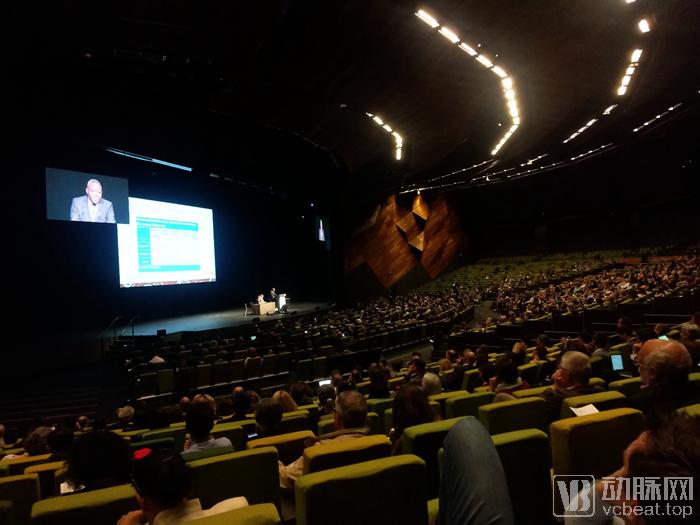
At this conference, Dr. Zhao Hongxin from the Real-World Study Team at SYNYI·AI presented an overview of statin therapy for patients with acute coronary syndrome (ACS) in China: “The Chinese Expert Consensus on Intensive Statin Therapy for Patients with Acute Coronary Syndrome recommends that ACS patients initiate statin therapy actively and as early as possible. However, the proportion of Chinese ACS patients receiving statin therapy, particularly intensive statin therapy, remains generally low. We reported on the current status and trends of statin use among Chinese ACS patients, clinical outcomes associated with various statin regimens, and influencing factors, leveraging big data to present research findings that closely reflect real-world clinical practice.”
International experts attending the conference expressed strong interest in the research findings and highly commended the progress made in recent years in China’s health and medical big data infrastructure, as well as the scientific output of Chinese scholars. China’s large population base and vast data volume, coupled with the year-on-year improvement in hospital data quality, create highly favorable conditions for conducting patient-centered clinical research.
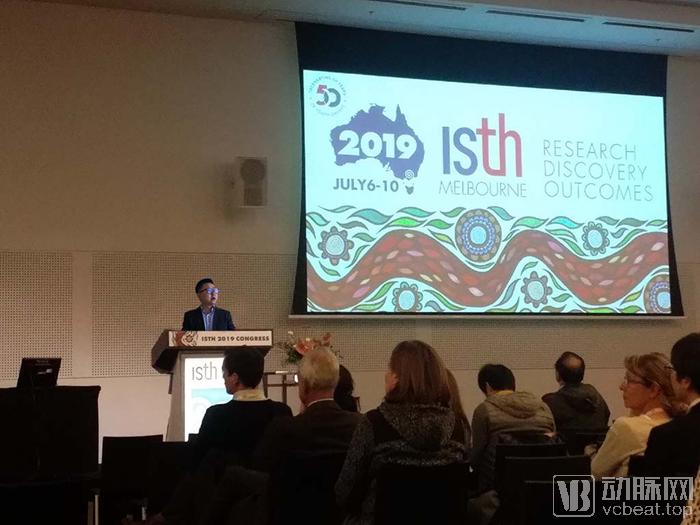
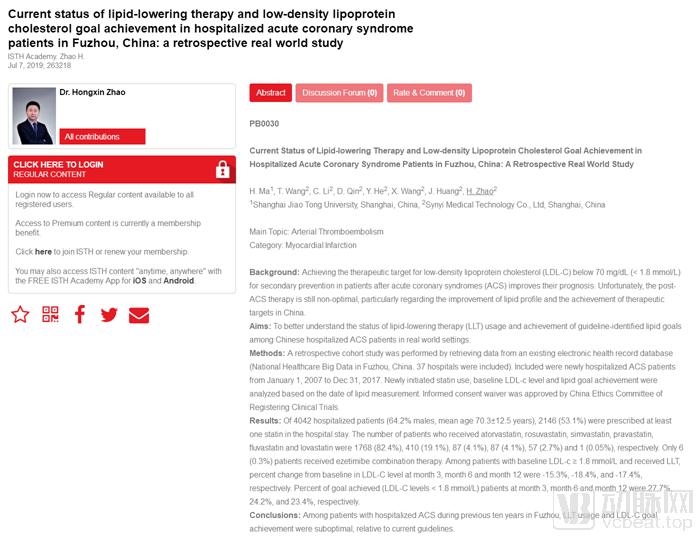
The treatment pathways for Chinese patients urgently require support from real-world evidence. This study innovatively utilizes regional health and medical big data as its research foundation. Regional health and medical data represent one of the most precise methods for investigating local medical treatment practices, objectively reflecting trends in changes to treatment pathways in recent years. Reportedly, these research findings mark the first international publication in this field since the launch of the National Pilot Project for the Construction of National Health and Medical Big Data Centers and Industrial Parks (Fuzhou). They also constitute the first scientific research outcome independently conducted by Chinese scholars on the National Health and Medical Big Data Platform, while strictly adhering to data security requirements.
“The greatest challenge of this project lies in conducting research and translation while strictly adhering to data security requirements,” said Ma Handong, Vice President of SYNYI·AI. “Government authorities and hospitals in China are placing increasing emphasis on the security and compliant use of healthcare data, and the security standards for the National Health and Medical Big Data Platform project represent the highest in the industry. All data used in this study underwent rigorous de-identification and application controls. We firmly believe that the industry must progress steadily along a regulated path, and we hope that the release of these findings will serve as a typical case of compliant healthcare data application.”
In recent years, with the continuous improvement of infrastructure for domestic hospital, regional, and national health and medical big data platforms, research based on real-world clinical data has entered a period of fruitful outcomes. However, the path from raw data to applied results remains highly convoluted.
It is reported that for the Fuzhou Project of National Health and Medical Big Data alone, SYNYI·AI deployed dozens of engineers on-site for several months to carry out foundational data governance. Before final data application, raw electronic medical record (EMR) data must be integrated at the patient level and semantically standardized using a common data model, and then transformed into a structured database through artificial intelligence algorithms. Each step of data governance determines the efficiency and accuracy of future data applications. Due to this reality, many health and medical data projects lacking sufficient investment in foundational data governance fail to achieve final “turnkey” delivery.
“Many people jump on the bandwagon, and many identify problems, but few are willing to roll up their sleeves and do the hard work required to see it through to the end,” introduced Ma Handong. “When assessing the value of big data, one must not focus solely on the scale of the data but, more importantly, on the output. Raw big data must undergo the most professional processing to generate value. We hope that through our efforts, more clinical data can be revitalized and create value.”
As a leading enterprise in China’s medical artificial intelligence sector, SYNYI·AI excels in medical natural language processing and data mining technologies, creatively applying AI to regional clinical data governance. In terms of data standardization, it maps non-standard domestic clinical data to international standard ontologies. While ensuring scientific rigor, it supports rapid queries across medical institutions and at varying levels of granularity. Regarding data structuring, SYNYI·AI’s specialized natural language information extraction engine extracts hidden critical information from unstructured medical records, thereby expanding the available dimensions of clinical data.
Meanwhile, SYNYI·AI has also collaborated with other institutions to integrate more heterogeneous data sources, thereby creating a comprehensive big database for healthcare and medicine. It is reported that this year, SYNYI·AI, in partnership with universities and hospitals, has published several papers in peer-reviewed journals such as *J Pediatr*. In the second half of the year, it will also present a series of important research findings at major conferences including ISPE, IDF, and AHA.