

Evergauge Scientific: The Tesla of Biomass Spectrometry Revolutionizing the Industry with Innovative CE-MS Technology
Just as a skyscraper cannot be built without a solid foundation, the development of the biotechnology industry is inseparable from the application of mass spectrometry. “Mass spectrometry is one of the best tools for humans to uncover the fundamental basis of life functions and understand the mechanisms of complex diseases,” said Dr. Xia Qiangwei, founder of Evergauge Science and Technology, highlighting the pivotal role of mass spectrometry in the life sciences sector.
When discussing mass spectrometry, Dr. Xia Qiangwei’s passion for the technology stems from his desire to understand the material basis of life. During his undergraduate studies in the Special Class for the Gifted Young at the University of Science and Technology of China, he resolved to dedicate his career to the life sciences. This seed of passion was sown early, awaiting its bloom and fruition throughout his long academic journey.
During his doctoral studies at the University of Washington in Seattle, Dr. Xia Qiang conducted research on the application of mass spectrometry to quantitative proteomics, performing in-depth whole-proteome mass spectrometry quantification during the nascent stage of the proteomics industry. In his postdoctoral phase, Dr. Xia expanded his mass spectrometry research from quantitative proteomics in microorganisms to investigating protein phosphorylation levels in human brain tissues of patients with Alzheimer’s disease using mass spectrometry. He subsequently joined a world-leading laboratory specializing in high-resolution mass spectrometry technology, where he engaged in frontline research and development of both mass spectrometry hardware and software.
Dr. Xia Qiang summarized his academic journey in one sentence: “Using mass spectrometry techniques and omics thinking from the macroscopic world to study biological phenomena in the microscopic world.”

Dr. Xia Qiangwei, Founder of Evergauge
From studying microbes to examining human brain tissue, and later, as Dr. Xia Qiang developed high-resolution mass spectrometry platform technologies at Regeneron Pharmaceuticals, a series of research efforts centered on mass spectrometry led him to an increasingly profound realization that current bio-mass spectrometry technologies remain far from large-scale clinical application.
Currently, biopharmaceutical technologies based on recombinant proteins are advancing rapidly, with monoclonal antibody drugs and next-generation biologics emerging in abundance. Consequently, there is an increasingly strong demand for separation techniques in the life sciences, particularly in the fields of proteomics and metabolomics. To further advance biomedical and clinical molecular diagnostic research, foundational mass spectrometry technology must undergo comprehensive improvements in trace sample analysis, high-efficiency protein separation, multi-omics analysis, reagent consumption, novel separation modes, automation levels, instrument operational costs, and scalability. This implies that separation technologies preceding mass spectrometry need to experience a fundamental technological shift from traditional mechanical pump-driven liquid chromatography to advanced electrically driven capillary electrophoresis. “This is akin to the transition from conventional internal combustion engine vehicles to electric vehicles. Evergauge Science and Technology is the Tesla of the mass spectrometry field,” added Dr. Xia.
Globally, the leading enterprises in the field of large-scale analytical instruments have development histories ranging from three to four decades to as long as half a century. If Chinese companies aim to foster the growth of the mass spectrometry industry, can they afford to wait for such an extended period? Dr. Xia Qiangwei has also pondered this question. He stated, “We cannot wait half a century to see broader applications of mass spectrometry technology. What I seek is an accelerated model that can drive the overall advancement of mass spectrometry technology, leveraging collective efforts to jointly promote the development of the mass spectrometry industry.”
In 2018, Dr. Xia Qiang returned to China and founded Shenzhen Evergauge Science and Technology Co., Ltd. (hereinafter referred to as “Evergauge”). The company’s name embodies the motto “Following the Path of Mass Spectrometry to Reach the Frontiers of Life,” reflecting its vision of leveraging mass spectrometry technology to elucidate the principles of life, enable early disease diagnosis, and ultimately save lives in the near future.
The founding team of Evergauge Science and Technology consists of seasoned industry experts in biomolecular mass spectrometry applications, mass spectrometry ion source design, capillary electrophoresis, mass spectrometry instrument hardware, and mechanical engineering.
Among them, the Head of Mass Spectrometry Complete Systems at Evergauge Science and Technology previously developed ion source equipment that sold nearly 1,000 units worldwide before joining Evergauge in 2017 to lead the development of next-generation ion sources and mass spectrometers. The Mass Spectrometry Project Manager at Evergauge has been engaged in mass spectrometry research since his doctoral studies and previously joined NASA to participate in the development of capillary electrophoresis-mass spectrometry (CE-MS) coupled instruments. Currently, Evergauge’s Senior Mechanical Designer for mass spectrometry has over 25 years of experience in developing analytical instruments, with extensive expertise in designing autosamplers and capillary electrophoresis systems.
Currently, Evergauge Science and Technology owns two wholly-owned subsidiaries in the United States: CMP Mass Spectrometry Technology Company and Electrophoresis Mass Spectrometry Technology Company (EMAST). Additionally, the company has multiple subsidiaries in cities such as Shenzhen and Beijing, including Beijing Spectrum Source Biotechnology Co., Ltd., located in Changping, Beijing.
Mass spectrometers are classified as analytical and testing instruments; in principle, a mass spectrometer is an instrument that measures the mass-to-charge ratio of charged ions. Current mass spectrometry techniques rely on front-end separation systems, and the integration of such systems with mass spectrometers has become an industry standard. In hyphenated mass spectrometry systems, the common technical approaches include gas chromatography-mass spectrometry (GC-MS), liquid chromatography-mass spectrometry (LC-MS), and capillary electrophoresis-mass spectrometry (CE-MS), the latter being the focus of Evergauge Science and Technology.
Each of the three technologies has its own advantages, but the first two originated in the last century and may be “inadequate” when confronted with the ever-emerging biotechnologies of today. For instance, significant limitations may arise during the characterization and analysis of biological macromolecule drugs, leading to issues such as insufficient separation efficiency.
Capillary electrophoresis coupled with mass spectrometry (CE-MS) offers distinct advantages for the intact molecular analysis of water-soluble and polar small-molecule metabolites, as well as large-molecule proteins. In numerous cutting-edge fields—such as charge heterogeneity analysis of biopharmaceuticals, intact protein proteomics, comprehensive metabolomic profiling, and protein complex research—CE-MS demonstrates significant benefits over other methods, including minimal sample injection volume, high separation efficiency, reduced analytical bias attributable to separation techniques, and superior sensitivity.
Evergauge Science and Technology possesses world-leading capillary electrophoresis-mass spectrometry (CE-MS) technology. Its primary offerings include capillary electrophoresis instruments coupled with mass spectrometry, ion sources for CE-MS systems, and related consumables such as separation capillaries and electrospray emitter needles.
Currently, there are nearly 80,000 electrospray ionization mass spectrometers installed globally, with approximately 15,000 new units added annually, reflecting a steady year-on-year growth. The EMASS-II CE-MS coupled ion source and the ECE-001 capillary electrophoresis system, marketed by Evergauge Science and Technology, will remain compatible with mass spectrometers from other manufacturers. This means they can be interfaced with all mainstream electrospray ionization mass spectrometers currently available on the market.
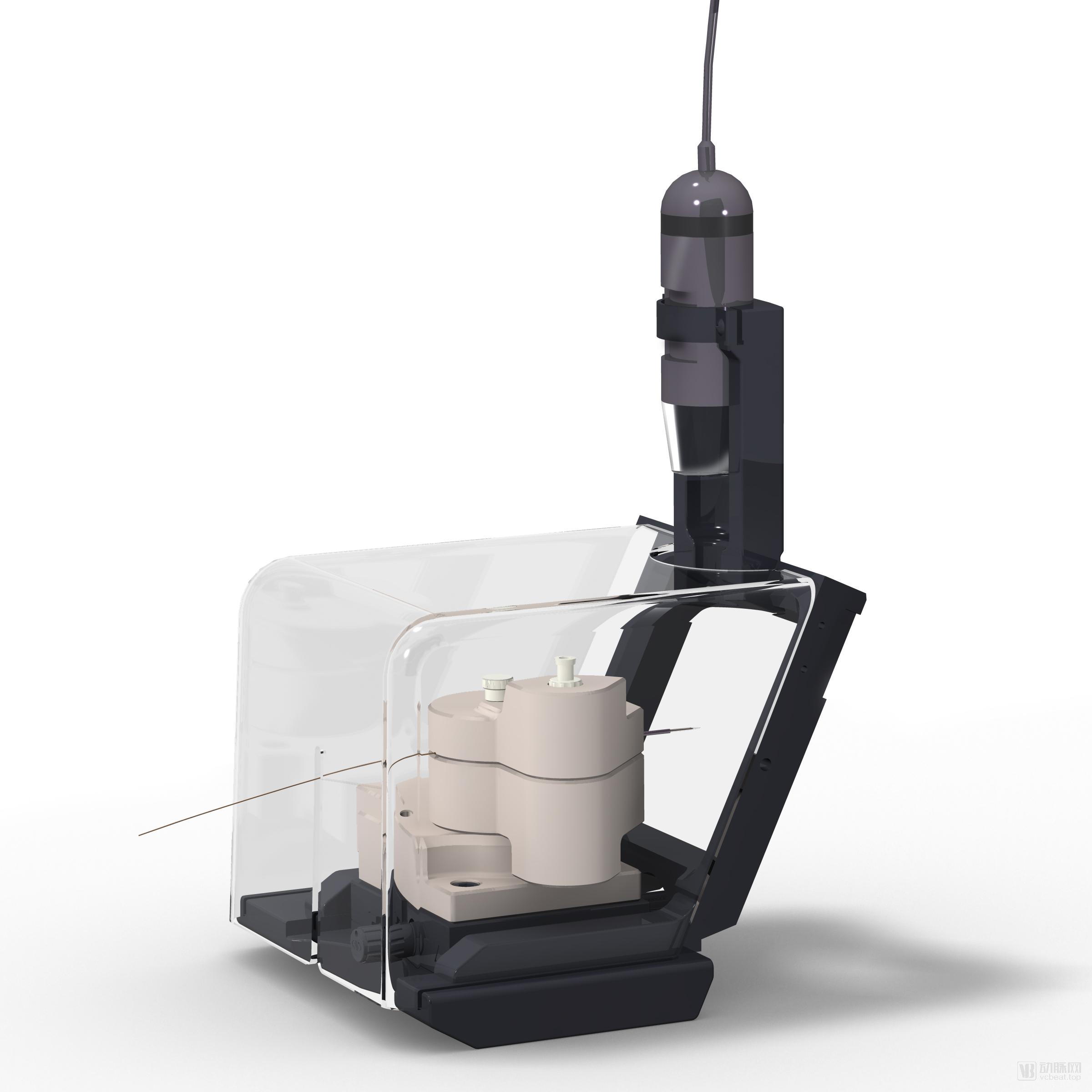
EMASS-II CE-MS Ion Source (Image provided by the company)
It is worth noting that the CE-MS coupled ion source adopted by Evergauge Science and Technology utilizes a coupling method based on ultra-low flow rate coaxial sheath liquid.
How Important Is Sheath Fluid?In the context of quality analysis for biopharmaceuticals, capillary isoelectric focusing (CIEF) electrophoresis is a critical method for the characterization and quality assessment of protein therapeutics. Currently, most quantitative analyses rely on ultraviolet (UV) absorption detection, known as CIEF-UV. However, this approach has significant limitations and risks. While UV absorption enables quantification, it does not allow for direct identification of the components within acidic and basic peaks via mass spectrometry (MS). These unidentified components may include allergens, which can directly compromise drug safety. In the absence of sheath fluid supplementation, proteins separated by isoelectric focusing cannot be adequately acidified, thereby failing to generate sufficient response signals for mass spectrometric detection.
Evergauge Science and Technology’s sheath flow liquid velocity is highly compatible with the capillary electrophoresis flow rate. Based on this optimal design, Evergauge has fundamentally resolved the stability issues associated with coupling capillary electrophoresis to mass spectrometry. Furthermore, sensitivity is ensured, as the sheath flow liquid effectively enhances electrospray ionization efficiency in the CE-MS interface.
Dr. Xia Qiang told reporters, “By optimizing the sheath fluid, many mass spectrometry signals in biopharmaceuticals can be enhanced by up to 100-fold. I firmly believe that the CIEF-MS method we have developed for analyzing and detecting charge heterogeneity in biologics will become a new industry standard. From this perspective, Evergauge Science and Technology’s CE-MS products will have a profound impact on the global biopharmaceutical industry.”
Currently, Evergauge’s representative clients include global leading biopharmaceutical and life sciences analytical instrument companies such as Amgen, Bristol-Myers Squibb, Regeneron Pharmaceuticals, Seattle Genetics, and Thermo Fisher Scientific. Its subsidiary, US-based CMP Mass Spectrometry Technology, Inc., signed a global co-marketing agreement for CE-MS with Agilent Technologies in 2018, providing the most advanced CE-MS technology platform to biopharmaceutical and life sciences users worldwide.
Dr. Xia Qiang stated, “Evergauge’s long-term development goal is to become an industry representative in the field of mass spectrometry in China and even worldwide. The company’s long-term development strategy will focus on multiple areas, including biopharmaceuticals, life science research, and clinical molecular diagnostics.”
Evergauge Science and Technology, established less than a year ago, secured joint investment from Miracle Light Fund and Mint Angel Fund at its inception. The funds from this financing round were allocated to building the team for developing complete mass spectrometry systems, advancing the development and iteration of mass spectrometry products, and exploring clinical molecular diagnostic applications of these products.
Zhao Weiwen, a partner at Miracle Light Fund, stated, “Evergauge Science and Technology possesses the world’s most advanced capillary electrophoresis-mass spectrometry (CE-MS) technology. It has breakthroughly resolved the global challenge of balancing electrospray stability with detection sensitivity in traditional CE-MS systems, significantly expanding the application scope of mass spectrometry. This provides more efficient and diverse solutions for fields such as biomacromolecular drug analysis, small-molecule metabolite analysis, and liquid biopsy. Currently, Evergauge’s CE-MS technology has gained recognition from Agilent, a global leader in mass spectrometry, and has achieved successful collaborative applications with Thermo Fisher Scientific. This represents one of the few instances where a Chinese mass spectrometry enterprise has taken a global lead over its European and American counterparts. We are highly optimistic about its application potential.”
After nearly a year of development, the company has successfully completed the design of the complete CE-TOF mass spectrometry system and is currently manufacturing core components and conducting final assembly.
Meanwhile, the company has recently initiated its next round of financing. The funds are planned to be used to advance the company’s CE-TOF products to the stage of mass production, further expand the clinical application scenarios of the company’s CE-MS technology, and strengthen market education and user base expansion for CE-MS in China.