

Encompass Health: A 35-Year Journey of Resilience and Reinvention in U.S. Post-Acute Care
In the healthcare sector, there is a well-known service provider in the United States that was founded in the 1980s, has undergone three name changes, and experienced one financial crisis. When the company’s survival was at stake, the board of directors even directly removed the CEO in an effort to save it. This legendary company is now Encompass Health, the largest acute care service provider in the United States.
Encompass Health, formerly known as HealthSouth, is one of the largest healthcare chains in the United States. The company primarily provides two types of services: inpatient rehabilitation and home health care. Home health care is further divided into home health services and hospice care.
In the first quarter of 2019, Encompass Health’s rehabilitation hospital business generated $634 million in revenue, while its home health care business generated $215 million.
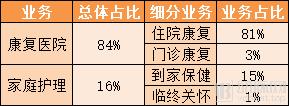
Revenue Breakdown by Business Segment for Encompass Health
Currently, the CEO of Encompass Health is Mark J. Tarr, the company’s fourth CEO, who joined Encompass Health at the end of 2016. Prior to this, the company’s first CEO was its founder, Richard M. Scrushy, who was later imprisoned due to an accounting scandal. During the accounting scandal, Robert P. May was appointed as interim CEO, becoming the company’s second CEO. The third CEO was Jay Grinney, who retired in early 2017 and received a severance package of $11.7 million.
In addition to three CEO changes, “Encompass Health” also marks the company’s fourth name. The legendary journey of Encompass Health still deserves a detailed account.
Born (1980s): Listed within two years, generating over 100 million yuan in annual revenue
In 1984, in Alabama, USA, 32-year-old Richard M. Scrushy was employed by the renowned healthcare company Lifemark. However, he left Lifemark to establish Amcare—originally named Encompass Health—after his strategic proposal to “develop a chain of outpatient diagnostic and rehabilitation health clinics” was not implemented by the company.
With an initial capital of over $50,000, Richard M. Scrushy opened the first chain hospital in Little Rock, Arkansas. Later, with the addition of partners and support from Citicorp venture capital funds, Scrushy renamed Amcare to “HealthSouth Rehabilitation Corporation” in the second year, which was the predecessor of the well-known HealthSouth Corporation.
Southern Health & Rehabilitation Corporation opened its second chain hospital in Birmingham, which later became the headquarters of Encompass Health. In the same year, 1986, two years after the establishment of Southern Health & Rehabilitation Corporation, the company went public on NASDAQ. Following the IPO, Southern Health & Rehabilitation Corporation expanded its business into sports medicine and workers' compensation, doubling its revenue and achieving nearly $100 million in asset income.
By 1988, Southern Health Rehabilitation Company was again listed on the New York Stock Exchange under the ticker symbol “HRC”.
Growth (1990s): Rapid Expansion, with Extensive Mergers and Acquisitions Laying the Groundwork for Future Risks
Following its listing on the New York Stock Exchange, the company embarked on a nationwide expansion across the United States. By 1990, Southern Health and Rehabilitation Company operated 50 hospital chains nationwide, achieving annual revenues exceeding $400 million in 1992.
In 1993, Southern Health & Rehabilitation Corporation embarked on its first acquisition, spending $300 million to acquire 28 chain hospitals and 45 outpatient rehabilitation facilities from National Medical Enterprise. This acquisition doubled the company’s annual revenue once again, reaching $1 billion, and established it as the largest provider of rehabilitation care in the United States at that time.
Perhaps having tasted the “sweet rewards” of acquisitions for the first time, Southern Health & Rehabilitation Company embarked on an expansion strategy with acquisitions as its long-term goal, much like a “greedy snake.” In 1994, it acquired its competitor ReLife for $180 million. In January 1995, it purchased Surgical Health Corporation for $155 million, thereby gaining access to the surgical center industry chain. That same February, it acquired all of Novacare’s rehabilitation hospitals for $215 million. In 1996, it entered the diagnostics sector by acquiring Health Images. In 1997, it acquired Horizon/CMS for $1.8 billion and later divested it in parts for $1.15 billion. In 1999, it acquired most of the surgical business assets of Columbia/HCA, further expanding its footprint.
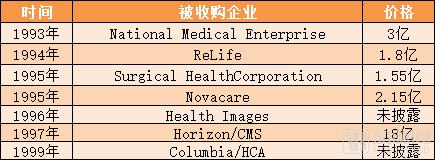
Acquisition List of HealthSouth in the 1990s
Through a series of rapid acquisitions and expansions, Southern Health Rehabilitation Company appeared to have reached the pinnacle of its corporate success. At that time, the company operated more than 2,000 medical institutions across the United States, the United Kingdom, Australia, and other countries, employed over 50,000 physicians worldwide, and handled more than 120,000 patient visits daily. Richard M. Scrushy also became the third-highest-paid CEO in the United States at the time.
During this period, HealthSouth Rehabilitation Corporation underwent its third name change. In 1995, the company’s name was simplified from “HealthSouth Rehabilitation Corporation” to “HealthSouth Corporation,” better reflecting its diversified presence in the healthcare sector.
Turning Point (Late 20th Century to Early 21st Century): The $2.7 Billion Accounting Scandal, Company Faces Potential Liquidation
In fact, as early as 1989, an employee of the audit department at HealthSouth Corporation raised concerns about the company’s financial practices. After being terminated, he disclosed to the media that he had engaged in improper accounting treatments during his tenure to help the company meet certain financial targets. However, this incident occurred during HealthSouth’s second year of listing on the New York Stock Exchange, a period when the company was experiencing rapid growth. Consequently, these allegations made little impact and were largely ignored.
In 1991, Medicare accused hospitals under HealthSouth Corporation of illegally inflating outpatient and inpatient charges. However, it was not until 1998, when Medicare revised its reimbursement methodology, that HealthSouth’s “fraudulent accounting practices” came to light.
At the time, as Medicare revised its reimbursement methods for healthcare funds, Richard M. Scrushy asserted emphatically that HealthSouth Corporation would remain unaffected. However, the company’s annual profits plummeted by 93% that same year, sparking external skepticism. Consequently, Medicare launched an in-depth investigation into HealthSouth and uncovered widespread abuse of Medicare policies by the company.
Gilded on the outside, rotten on the inside. As Medicare intensified its investigation into HealthSouth Corporation, it exposed to the public numerous malpractices, including poor service quality, lack of formal treatment plans for patients, and some therapists practicing without proper licensure.
In March 2003, the U.S. Securities and Exchange Commission filed a civil lawsuit against Scrushy and HealthSouth Corporation, alleging that the company had fabricated at least $2.7 billion in profits between 1996 and 2002. In the same year, the Federal Bureau of Investigation launched a criminal investigation into the matter. In 2005, Richard M. Scrushy was sentenced in Montgomery to 6 years and 10 months in prison, followed by 3 years of probation, and ordered to pay $267,000 in restitution for charges including filing false corporate reports and mail fraud.
Rebirth (2000s): Ousting the CEO for Self-Rescue, Corporate Restructuring Erases Traces of the Previous Century
The Founder Received the Punishment They Deserved; What Path Should the Remaining Company Take?
In 2003, HealthSouth Corporation convened an emergency board meeting, terminated Richard M. Scrushy from all positions, and appointed Robert P. May as Interim CEO and Bill Owens as Chief Financial Officer. At the time, the company faced the imminent repayment of $344 million in principal on maturing convertible bonds. Following the advice of its lender, JPMorgan Chase, the board engaged Alvarez & Marsal, a professional third-party firm, as restructuring advisors and appointed Bryan Marsal as Chief Restructuring Officer.
By the end of 2003, HealthSouth Corporation had undergone substantial financial restructuring, barely avoiding bankruptcy liquidation. After basic order was restored within the company, HealthSouth became reluctant to discuss any matters concerning its founder, Richard M. Scrushy, seeking to erase his name from the company’s legacy entirely. The executive offices on the fifth floor, which had been off-limits during his tenure, are now open to all employees.
On May 10, 2004, Jay Grinney was appointed by the Board of Directors as the permanent Chief Executive Officer of HealthSouth Corporation. The company gradually began to move forward, aiming to restore its normal filing status with the U.S. Securities and Exchange Commission (SEC). In 2007, HealthSouth sold 600 outpatient centers to its competitor Select Medical for $245 million; sold 139 outpatient surgery centers and three surgical hospitals to TPG for $920 million; and sold its diagnostic healthcare business line to Gores Group for $47.5 million.
The Journey (2010s): Rebranded as Encompass Health, Steadily Advancing Amidst Turbulence
A decade after the accounting scandal, new CEO Jay Grinney finally led HealthSouth out of the shadows and back onto a normal trajectory. Also in 2014, ten years later, HealthSouth announced the $750 million acquisition of home care provider Encompass Home Health.
Following the merger, HealthSouth found that the public was unaware of the connection between Encompass Home Health and HealthSouth. The company decided to adopt a unified name, rebranding as “Encompass Health” and changing its stock ticker symbol from “HLS” to “EHC,” effective January 2, 2018.
Mark J. Tarr, current CEO of Encompass Health, stated: “The renaming of Encompass Health is the result of a year-long study aimed at helping the company enhance its value and become a leading brand-driven healthcare company.”
From 2017 to 2019, the company invested approximately $25 million to $30 million in its rebranding initiative. The launch of the “Encompass Health” brand will update the name and logo on signage at hospitals and agencies, as well as on other brand assets.
Judging by the three key metrics of patient admissions, revenue, and number of hospitals, Encompass Health has emerged as a leader in its sector across the United States. In 2017, Encompass Health recorded over 170 billion patient visits, with annual revenue exceeding $3 billion and average revenue per hospital surpassing $120 million. These figures continue to grow rapidly.
Currently, Encompass Health’s market capitalization has exceeded $6 billion, while its competitor Select Medical Holdings is valued at only one-third of that figure. Over the 35 years since its founding in 1984, Encompass Health has undergone three name changes and CEO transitions. After weathering significant turbulence, the company, though no longer enjoying the peak prominence it once held, continues to move forward steadily on a path of healthy development.