

Peking University Launches 'Wisdom Eye' International Ocular Fundus Image AI Recognition Competition
VCBeat (WeChat ID: vcbeat) has learned that on July 13, the ODIR 2019·Peking University “Smart Eye” International Fundus Image Intelligent Recognition Competition was officially launched at the main forum of the 2nd Beijing Health and Medical Big Data Forum.
The Beijing Health and Medical Big Data Forum was hosted by Peking University and organized by the National Institute of Health and Medical Big Data at Peking University. Over the course of the two-day agenda, more than 1,000 experts, scholars, and corporate representatives from various sectors engaged in in-depth discussions on the development needs, technical challenges, and practical applications of health and medical big data in China. Centered on the theme “A New Engine for Health and Medical Big Data: Openness, Sharing, Cooperation, and Win-Win Outcomes,” participants offered insights and recommendations to advance the application and development of health and medical big data in China, jointly envisioning its future.
According to the introduction, the ODIR 2019 · Peking University “Smart Eye” International Fundus Image Intelligent Recognition Competition was hosted by Peking University, co-organized by the National Institute of Health and Medical Big Data at Peking University and the Institute for Artificial Intelligence at Peking University, with support from the Advanced Institute of Information Technology at Peking University, the China Association of Medical Equipment, and the Chinese Society of Microcirculation. ShangGong YiXin provided technical support.
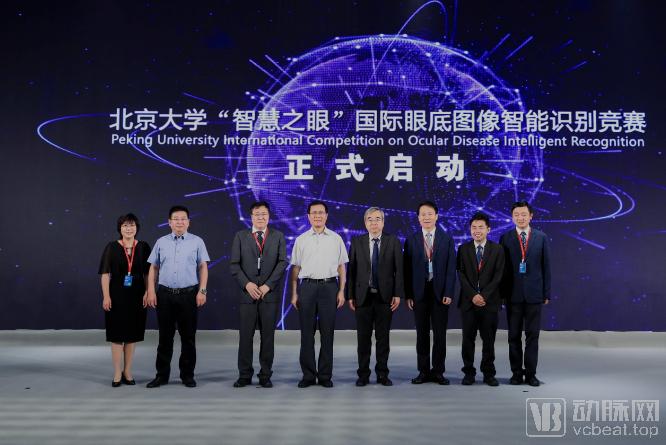
Competition Launch Photo
Academician Zhan Qimin, Executive Vice President of Peking University, Director of the Health Science Center of Peking University, and Dean of the National Institute of Health and Medical Big Data at Peking University; Jin Xiaotao, President of the Chinese Society of Health Information and Health Care Big Data and Dean of the National Institute of Health and Medical Big Data at Peking University; Mao Qunan, Director of the Department of Planning Development and Informatization of the National Health Commission; Zhou Gongwei, Deputy Director of the Statistical Information Center of the National Health Commission and Deputy Director of the Ningxia Health Commission; Wang Ningli, President of Beijing Tongren Hospital; Sun Zilin, Deputy Dean of the Clinical Medical College of Southeast University; Xiao Yuan, Deputy Director of the Health Science Center of Peking University; Zhu Shumei, Deputy Secretary of the Party Committee of the Health Science Center of Peking University; and others jointly launched the initiative.
In his opening remarks, Academician Zhan Qimin, Chairman of the Competition Organizing Committee, noted that the National Institute of Health and Medical Big Data at Peking University and the Institute for Artificial Intelligence at Peking University have been committed to promoting and advancing the development of health and medical big data as well as medical artificial intelligence. On this occasion, Peking University, in collaboration with multiple institutions, jointly organized this competition with the aim of fostering the global integration, interaction, and development of artificial intelligence and medicine by bringing together outstanding talents dedicated to AI research and practice in the medical field.
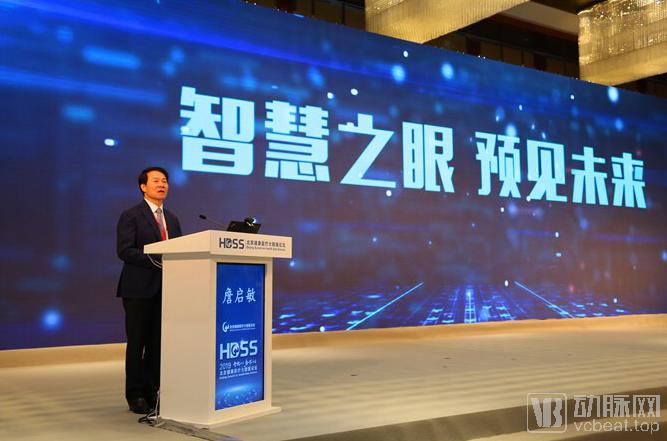
Photo of Professor Zhan's Address
Currently, a new round of scientific and technological revolution and industrial transformation is unfolding. The development of artificial intelligence is becoming a key direction for industrial growth and an important component of our national science and technology strategy.
In the field of medicine, pathological changes in retinal microvasculature can lead to severe fundus diseases and even blindness. Meanwhile, the retina serves as a window for observing the systemic microcirculation system and is closely associated with hypertension, renal diseases, and cardiovascular and cerebrovascular diseases, thereby indicating the risk of developing cardiovascular and cerebrovascular conditions. Fundus images can clearly reflect alterations in retinal microvasculature, making them a crucial tool for the prevention and treatment of fundus lesions and for predicting cardiovascular and cerebrovascular diseases.
AI-based recognition of fundus images can significantly enhance the efficiency of preventing and treating fundus diseases, as well as predicting cardiovascular and cerebrovascular diseases. Given the relative ease of acquiring fundus images, intelligent recognition of these images has become one of the most mature applications of artificial intelligence.
It is understood that the ODIR 2019 Peking University “Smart Eye” International Intelligent Retinal Image Recognition Competition was built upon advances in artificial intelligence for retinal image recognition. Themed “Smart Eye, Foreseeing the Future,” it embodied the four principles of “focus, professionalism, internationalization, and standardization,” and was China’s first international competition on intelligent retinal image recognition.
Unlike previous competitions, this contest specifically released the “DDR” dataset, a structured collection of 5,000 fundus images certified by the China Association of Medical Equipment. The dataset was sourced from nearly 400 medical institutions at various levels served by Shanggong Yixin. To ensure the accuracy of disease labels and lesion annotations, the China Association of Medical Equipment specially organized experts to conduct a rigorous review and final certification of the dataset.
Since its launch, the competition has garnered significant attention from professionals both in China and abroad, attracting over 600 teams from nearly 30 countries to register within just two weeks.
It is reported that the total prize pool for the ODIR 2019 Peking University “Smart Eye” International Intelligent Retinal Image Recognition Competition amounts to RMB 1 million. Registration is now officially open, with the preliminary round deadline set for September 30. The finals will be held in Hangzhou, China, on October 26. Outstanding teams will be invited to join leading experts to discuss the development of artificial intelligence in the healthcare sector.