

DingTalk's B2B Entry into Digital Health: Can It Restore Confidence in Internet Healthcare?
“Instilling confidence in internet healthcare.” This is the vision for DingTalk Future Hospital articulated by Yang Meng, Vice President of Alibaba’s DingTalk.
Admittedly, after repeated setbacks in business model exploration, the concept of internet healthcare has begun to cool down. Some argue that the wild, untamed first half of internet healthcare has ended, while the path forward for the second half remains to be explored.
What Kind of Entity Is DingTalk, Which Aspires to Instill Confidence in Internet Healthcare? How Will It Break Through the Impasse in Internet Healthcare? This Article Attempts to Answer These Questions.
In May 2015, DingTalk was officially released, entering the enterprise-level market.
Initially, DingTalk positioned itself as a basic mobile work platform, providing hardware and software services for common office scenarios such as attendance tracking, meetings, document management, and approval workflows. It aimed to achieve the ultimate goal of enhancing organizational capabilities through its “Five Online” product modules. Yang Meng stated that DingTalk’s role is to help small and medium-sized enterprises strengthen their internal operational capabilities.
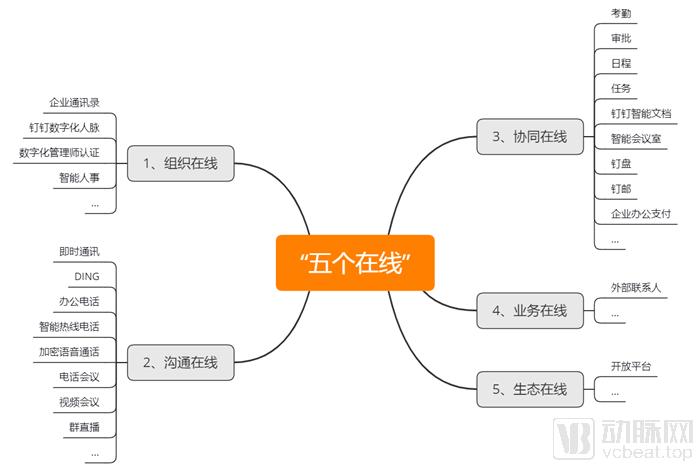
DingTalk's "Five Online" Business Segments
DingTalk provides each enterprise with basic data-driven services featuring a consistent interface, while enterprises’ personalized functional requirements are met either through in-house development or by downloading applications developed by Independent Software Vendors (ISVs) from the DingTalk App Center.
Business Datafication and Data Businessization
Last June, DingTalk first showcased its focus on personalized enterprise office needs at its annual launch event. In August of the same year, during the inaugural Smart China Expo in Chongqing, DingTalk released comprehensive digital solutions tailored for industries such as new retail, healthcare, education, real estate, and food service. This marked DingTalk’s entry into niche industry markets.
Healthcare is undoubtedly the most challenging sector to penetrate. In its healthcare industry solutions, DingTalk proposes “integrating healthcare services into comprehensive solutions that cover all aspects of hospital operations, including hospital management, administration, clinical care, nursing, teaching, and logistics, thereby helping Chinese hospitals comprehensively enhance their capabilities and efficiency. For example, with new ward-round methods, physicians can access patient medical records anytime and anywhere, enabling real-time monitoring of changes in patients’ conditions; and with new scheduling methods, features such as group scheduling, regional replication, rotation, and assignment of remaining shifts are realized, significantly saving nurses’ time.”
Yang Meng summarizes the implementation path of DingTalk Medical into three directions:
First, build a data cockpit to serve hospital management;
Second, enhance hospital operational efficiency through productization;
Third, build future hospitals within the medical consortium to empower primary care institutions through support from higher-level hospitals.
It is evident that DingTalk’s Future Hospital initiative aims to directly empower hospitals. Following a period of rapid expansion in its early stages, DingTalk has already accumulated a substantial base of hospital users. Looking ahead, DingTalk aspires to become the digital foundation for hospitals and medical consortia. In 2018, DingTalk onboarded 3,000 public hospitals at the secondary level or above, with plans to cover 5,000 such institutions in 2019. Within three years, DingTalk aims to achieve a penetration rate of over 80% among the more than 13,000 public hospitals at the secondary level or above across China.
Furthermore, DingTalk invites partners to assist hospitals in business process reengineering and enhancing their digital capabilities. “DingTalk is committed to building a digital foundation, leaving workflow-related tasks to partners with specialized industry expertise. Our ultimate goal is to bring the entire healthcare ecosystem online,” stated Yang Meng, outlining the vision of the DingTalk model.
In fact, an open ecosystem is a currently popular solution to complex problems. It is understood that DingTalk’s new ecosystem has already gathered more than 100 medical service enterprises, covering various business segments of hospital operations.
Last July, VCBeat conducted a review of Alibaba Group’s healthcare landscape. At that time, DingTalk’s strategic pathway in the healthcare sector was not yet clear; beyond its positioning as an enterprise-facing user entry point, its ecosystem-driven development strategy had not been publicly disclosed.
A year later, DingTalk Medical had rapidly initiated or completed the deployment of foundational enterprise-level service platform capabilities—such as “organizational online presence,” “communication online,” and “collaboration online”—across public hospitals nationwide, establishing a stable user base and traffic foundation.
An Ecosystem-Based, B2B-Oriented Attempt at Internet Healthcare 2.0
Next, Dding Medical will forge a path centered on business online and ecosystem online.
Among the five “Online” initiatives proposed by DingTalk, Business Online is the most complex. Historically, the development of underlying hospital systems—such as Laboratory Information Systems (LIS), Hospital Information Systems (HIS), and Electronic Medical Records (EMR)—has been siloed, resulting in the accumulation of numerous standalone systems within hospitals.
Currently, hospital information systems, which have become increasingly saturated, are seeking to evolve toward application-oriented development. The application-level development of underlying data is a strength of internet companies such as DingTalk. However, given the unique characteristics of the healthcare industry, DingTalk’s application initiatives focus on building a digital foundation that enables the interconnection of various process-related data within hospitals.
From DingTalk’s perspective, a digital foundation presents an opportunity for internet healthcare to break through its current impasse and may bring about disruptive changes.
Internet-based healthcare remains a nascent phenomenon in the medical sector. Due to variations in clinical pathways across hospitals, there is no unified understanding of internet hospitals. Consequently, despite numerous attempts by a large number of internet healthcare practitioners over the past decade in areas such as online appointment scheduling, virtual consultations, and prescription outflow, an explosive profit model has yet to emerge, leaving some internet healthcare platforms at a loss for direction.
Today, DingTalk has joined the ranks of those exploring internet healthcare models in its own way.
Currently, the vast majority of physicians’ professional needs remain unmet by informatization. Yang Meng believes that the primary reason internet healthcare 1.0 has struggled to emerge from its stagnation may lie in the fact that all attempts have centered on serving patients, whereas the core components of diagnosis and treatment actually take place within hospitals. Internet healthcare should serve physicians, thereby unlocking greater potential.

Yang Meng, Vice President of Alibaba DingTalk. Image provided by DingTalk.
“By serving patients, practitioners can quickly establish a profitable business loop; however, in reality, such a business loop built around individual hospitals is difficult to replicate,” said Yang Meng. He noted that an internet healthcare model capable of large-scale and rapid replication should be formed by an ecosystem comprising numerous medical enterprises with specialized roles. This is precisely the direction pursued by the “Future Hospital” initiative recently championed by DingTalk.
DingTalk believes that hospitals are the cornerstone of healthcare. Without public hospitals, there would be no thriving medical industry or academic advancement. DingTalk brings to hospitals a transformation in work methods and comprehensive improvements in management efficiency. In an era increasingly emphasizing refined hospital management, the direct value delivered by DingTalk has earned strong endorsement from many directors of public hospitals.
On the other hand, regarding the new healthcare ecosystem, DingTalk has opted for selective cultivation rather than advance planning. Typically, DingTalk chooses to onboard healthcare IT service providers with certain regional influence onto its platform. These relatively mature service providers develop various types of products based on DingTalk’s digital healthcare infrastructure for hospital users to choose from, jointly creating an internet-based model for future hospitals.
Taking Lianfan Technology as an example, the company is a nursing system service provider. However, integrating a comprehensive nursing system directly into hospital workflows proved challenging. To address this, Lianfan Technology decomposed its nursing system into more than 30 modules and, after optimizing the nurse scheduling module—which boasts the broadest coverage, addresses the most critical needs, and sees the highest usage frequency—deployed it on DingTalk. Within one year, this solution achieved coverage in over 2,000 public hospitals at secondary level and above. In essence, DingTalk provided Lianfan Technology with a platform to deliver healthcare informatization through a SaaS model, significantly accelerating implementation speed compared to traditional project-based approaches.
Yang Meng told VCBeat that DingTalk has provided the infrastructure and foundation for hospitals’ digital transformation, enabling rapid adoption within healthcare institutions. In the future, DingTalk aims to build a platform similar to Tmall and Taobao, attracting more merchants and corporate partners. These partners will help DingTalk deliver comprehensive medical services while achieving growth through DingTalk’s user traffic. This strategy outlines a pathway from product development to platform building, and ultimately to a thriving ecosystem.
In fact, entering the market from the B-side is not a high-barrier breakthrough strategy. As Yang Meng pointed out, the real barrier to this endeavor lies not in the business model, but in the need for waiting, investment, and patience.
B-Side Entry Point in Alibaba’s Healthcare Ecosystem
Within Alibaba’s healthcare ecosystem, AliHealth, Ant Financial, Alibaba Cloud, Taobao, and DingTalk each approach the sector from different angles, optimizing their individual performance while collaborating synergistically. “It is the integration of all these modules that forms a comprehensive solution,” said Yang Meng.
Yang Meng pointed out that the true hospital of the future is a platform genuinely based on the internet. “Such a platform has no boundaries and is built upon an organized, society-wide collaborative healthcare system. This is also the original intention behind our initiation of the DingTalk Future Hospital ecosystem development.”
To date, DingTalk has established capabilities for managing online organizational structures and has driven transformative changes in the management and clinical workflows of numerous hospitals. Its influence has expanded from internal hospital administration to external management. However, whether DingTalk can truly instill confidence in internet-based healthcare remains to be validated through extensive medical practice.