

Medscape Files for IPO: Charting the Evolution of a Global Medical Information Pioneer

Medscape
Medical Information Service Provider
“Medscape is a respected veteran and has always served as a role model for our medical community. Our vision is that in the future, the United States will have Medscape, Japan will have M3, and China will have Yixuejie (Medical World).” This statement was made by Chen Qirui, founder of Yixuejie, an interactive medical information community, when it secured RMB 20 million in Series A financing.
“Within the medical community, we have always regarded Medscape as the benchmark for learning.” However, what is it about Medscape that makes it so highly acclaimed? What advantages does it offer to be considered a benchmark? VCBeat (WeChat ID: vcbeat) is also deeply interested in this legendary company.
Medscape’s Entrepreneurial Journey
Medscape was launched on May 22, 1995, originating from the medical journal publisher SCP Communications, Inc. A few days after its establishment, Medscape invited Bill Seitz, a manager at SCP Communications, to post information about Medscape on the Usenet newsgroups (similar to forums). As a newly established website offering free access, Medscape aimed to provide authentic and reliable medical news and information to healthcare professionals and consumers interested in the healthcare industry. The practice-guiding medical information on the site was highly professional and reliable, having been reviewed and edited by experts in fields such as AIDS, infectious diseases, urology, and surgery. Additionally, SCP Communications provided professional content for Medscape. Medscape stated that its professional content and full-color images would complement the medical literature resources and related databases available on the internet.
In the early days of the startup, Peter Frishauf, founder and CEO of Medscape, led the founding team in spending considerable time developing their business on the internet. However, these initial efforts did not receive support from all of the original company’s board members. A board member from SCP Communications once advised Peter, “Stop ‘playing with computers’ and focus on your core business.” At that time, Peter, as the founder, also served as the CEO of SCP Communications, which provided financial backing to Medscape during its first few years.
From its inception, Medscape established a strategy of providing information free of charge, while the question of whether to require user registration became the most contentious issue among the founding team. Some argued that mandatory registration would increase technical complexity and add steps for users accessing the site, leading to significant user attrition, as not all users were willing to spend the 3–5 minutes required to complete the registration process. Ultimately, Peter decided to implement user registration.
He stated, “With user information in hand, websites can directly push content tailored to user preferences in the future.” This has indeed become standard practice for operating websites or apps two decades later. Additionally, he believed that requiring account registration facilitates commercialization. Once registered, users can receive targeted advertisements, enabling merchants to deliver ads more precisely. This approach reduces advertising costs for businesses and improves the measurement of ad effectiveness, thereby attracting many advertisers to place ads on the website and increasing its revenue. From its inception, Medscape focused exclusively on internet-based services. Its founder firmly believed in the rapid widespread adoption of the internet, a visionary perspective that helped Medscape grow rapidly during the internet boom. By 1999, Medscape had amassed 1.1 million members.
In 1995, Medscape partnered with medical publishers to launch a database of original Medscape content and journal articles, enabling users to quickly locate reliable and authentic information tailored to their needs. When Medscape first proposed this initiative, no medical publishers were optimistic about the project; however, within a year, it successfully persuaded 14 journals to join. Currently, multiple publishers and data providers have joined the initiative, offering access to more than 120 publications and databases.
Medscape's Profitable Beginnings
Peter’s long-term vision is truly admirable. He optimized the website design by creating clean pages that contain all the text information and thumbnails users need, with images enlarging upon clicking. At a time when internet technology was still immature, image loading was notoriously slow, and large images made pages appear bloated and complex. The use of thumbnails effectively addressed this issue, an approach that remains in use to this day.
While others remained complacent, Medscape targeted the global market, welcoming all users interested in healthcare to browse its website. At that time, POL, the industry leader, restricted access to U.S. physicians only. Today, Medscape has become an industry benchmark, validating the correctness of its international vision. From the outset, Medscape prioritized globalization, thereby accumulating a substantial international user base. Within the first five years, approximately 15 international partners joined Medscape to translate and manage localized versions of the platform in their respective languages. Currently, Medscape offers content in five languages: English, Portuguese, Spanish, German, and French.
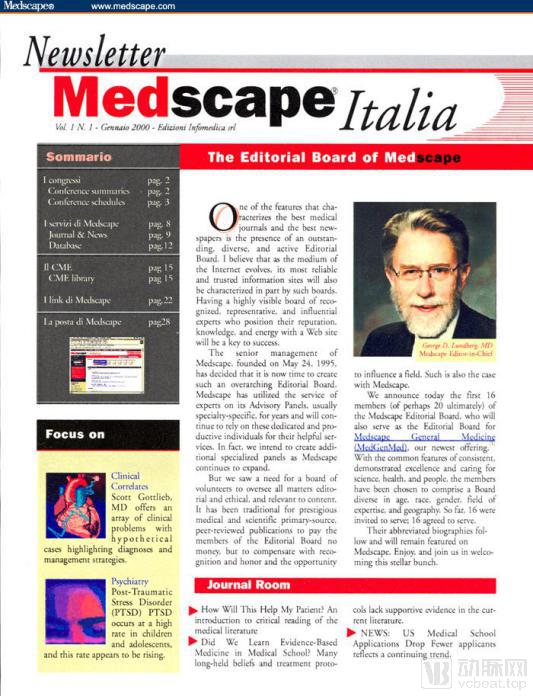
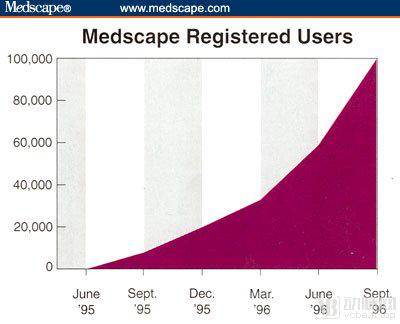
In its first year, Medscape attracted over 40,000 users, with approximately 700 daily visitors who read an average of nine articles per session. By early 1996, Medscape had amassed more than 75,000 registered users, with around 1,800 new accounts created each week, including 700 physicians. With its audience surpassing that of most medical journals, Medscape released its first advertising rate card, marking the inception of its revenue model.
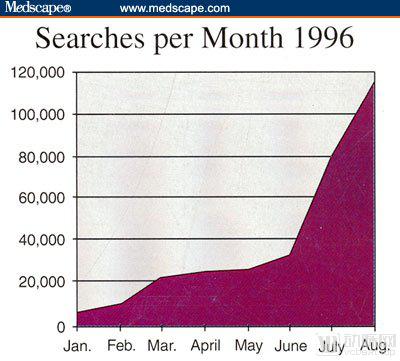
In 1996, Medscape launched the first free, unrestricted internet-based MEDLINE (U.S. National Library of Medicine) search, leading to a surge in page views. The spike in traffic shown on the chart coincides with Medscape’s introduction of MEDLINE access. At that time, apart from universities and libraries, MEDLINE was the only source providing related materials online for free. The large user base and precise marketing strategies made Medscape highly attractive to many advertisers, generating substantial revenue for the company.
Medscape also publishes a large number of articles, commentaries, and research reports in peer-reviewed journals. In July 2002, Spine, one of the most authoritative international professional journals in the field of spinal surgery, began publishing selected original research studies and commentaries from Medscape Neurology and Neurosurgery and Medscape Orthopaedics. This not only enhanced Medscape’s influence but also diversified its revenue streams.
Current Status of Medscape
Medscape currently offers services including medical industry news and expert commentary, medical monographs and drug information, and Continuing Medical Education (CME). Its CME courses are jointly accredited by multiple accrediting bodies, including the Accreditation Council for Continuing Medical Education (ACCME), the American Nurses Credentialing Center (ANCC), and the Accreditation Council for Pharmacy Education (ACPE), underscoring their high credibility. These courses are delivered in a MOOC format on the Medscape website, enabling physicians worldwide to engage in learning and have received widespread acclaim. Free access has always been Medscape’s core strategy, and its CME courses are no exception; Medscape continues to rely on advertising as its primary revenue source.
Medscape provides free access to clinical medical literature and continuing medical education resources. Medscape users can freely access CME course materials, search across multiple databases, look up terms in the medical dictionary, and respond to inquiries from other users. They can also perform categorized searches based on disease names, medical specialties, and content types.
The company also launched the Medscape Doctor Business Academy, which aims to help physicians acquire business knowledge, better manage their assets, and stay ahead in the evolving healthcare landscape by providing essential business courses. The curriculum is specifically designed for physicians by business health experts and experienced doctors. The Academy’s courses will help physicians save time and money by offering valuable business information needed for medical practice free of charge, while providing personalized schedules based on physicians’ availability and interests. Physicians can learn about topics closely relevant to their profession, such as financial management, doctor-patient relationship handling, taxation and insurance, and legal matters.
Currently, Medscape has kept pace with the times by developing three mobile applications—the Medscape App, the Medscape MedPulse News App, and the Medscape CME and Education App—to deliver website content on mobile devices, thereby facilitating user access for browsing and learning. The Medscape App currently boasts over 4 million registered users. Its most popular features include medical news reading, drug information and search tools, drug interaction checkers, and medical calculators. The most widely read news items cover FDA announcements, expert opinions, conference coverage, and highlights from major journal articles.
From its founding until its initial public offering in the fall of 1999, Medscape was funded by private investors, with SCP Communications also injecting capital on multiple occasions. In 2000, Medscape merged with the internet healthcare services company Medicalogic and was later acquired by WebMD, a health and medical information services website. According to WebMD’s 2016 financial report, the company generated over $700 million in revenue that year, with Medscape’s advertising revenue accounting for approximately 60%. In 2017, WebMD, with Medscape as its core asset, was acquired by KKR, a leading U.S. private equity firm, for $2.8 billion and subsequently delisted from the stock market.
Reflections for Domestic Entrepreneurs
The Chinese market currently lacks companies similar to Medscape. Medscape’s success is inseparable from its founder’s long-term vision and the sound strategies he formulated. A founder’s ability to anticipate future trends significantly influences a startup’s trajectory; for instance, Medscape foresaw the rapid growth of the internet and launched online services accordingly, thereby acquiring a large user base. Once founders are confident in their vision, they must execute their strategies with unwavering persistence. Although Medscape faced criticism and ridicule during its development, it ultimately became the industry benchmark, while those who mocked it did not.
What has been crucial to Medscape’s development over the years is its integrity. This may sound somewhat hyperbolic, but on reflection, why do so many users worldwide trust the medical information provided by Medscape? Why are users willing to consult the medical content on its website? It is precisely because Medscape established the brand promise of “trustworthy medical information” from the outset and spared no effort in consistently upholding it that Medscape has achieved its current scale and success.
Medscape is more than just a website providing medical information; it is an internet platform for publishing original educational content that is trusted and recognized by the community, as well as a free repository of medical literature. As one of the most popular websites among consumers and healthcare professionals, it meets the majority of needs for medical news, professional medical knowledge, and medical education, while establishing a channel for patients and physicians to exchange medical information. The rich, relevant tools and specialized content provided by Medscape have driven its growth and development.
Currently, internet healthcare in China is developing rapidly, creating an urgent demand for "Medscape-style" medical information service companies. The industry reports provided by Medscape are of significant importance to the entire sector, helping entrepreneurs and industry professionals gain clear insights into development status and trends. However, similar medical reports in China remain scarce. Producing such reports requires not only the accumulation of extensive raw data but also support from specialized expertise. Although the domestic medical information industry currently faces various challenges, its future prospects are undoubtedly promising.
Perhaps the most important lesson is that Medscape remains able to attract a large volume of users today because it has stayed true to its original mission: ensuring that all users can access free, credible content and CME.