

Union Strong Launches AI-Powered Comprehensive Stroke Care Platform to Empower Neurologists
Union Strong
Developer of Artificial Intelligence-Assisted Diagnosis and Treatment Systems
“As long as you persevere, the goddess of fortune will surely look after you.” After leaving Johnson & Johnson, where she had worked for ten years, Qin Lan has firmly believed in this motto throughout her entrepreneurial journey.
The brain is a remarkable organ, governing all related activities such as language, movement, and emotion. Driven by this fundamental curiosity, Qin Lan chose to specialize in neurology for her master’s degree. However, there is often a gap between academic theory and clinical reality. “When you actually engage with patients in a clinical setting, you realize how distressing it can be—many patients cannot be cured,” Qin Lan stated. “This is particularly true for stroke patients, for whom there are no specific miracle drugs; the only option is to strive to prevent further deterioration of their condition.”

Qin Lan, Founder of Union Strong
We devote considerable effort to precise qualitative diagnosis and disease subtyping, only to find that no corresponding treatment is available. Qin Lan finds such a diagnostic-therapeutic disconnect unacceptable. Unwilling to remain in the hospital as a physician who can diagnose but not cure diseases, she is determined to engage more deeply in the therapeutic aspects of patient care.
In China, there are currently only about 2,000 neurointerventional surgeons, yet there are 40 million potential patients with cerebrovascular disease, with 5 million new stroke cases added annually. Faced with such a large number of potential patients, the limited medical resources are struggling to cope.
Taking intracranial aneurysms as an example, the prevalence of this condition is approximately 2% to 3% in foreign countries, whereas in China, the prevalence among adults reaches as high as 7%, a rate far exceeding that of cancer. For patients, intracranial aneurysms remain asymptomatic and undetected unless they rupture and cause hemorrhage; however, once ruptured, the mortality rate is as high as one-third, and the mortality rate following rebleeding exceeds one-half, making it a veritable “ticking time bomb” within the brain.
Emergency intervention should not be delayed until hemorrhage occurs; the condition must be treated before rupture. Neurointerventional surgery is a safe and effective treatment option. However, this approach faces a shortage of specialized physicians, and its complexity makes it difficult for junior doctors to acquire proficiency rapidly.
The traditional model of physician training follows an “apprenticeship” approach. However, neurointerventional procedures differ from traditional open surgeries in that they do not allow direct visualization of the anatomical structures at the lesion site or the operative techniques being employed. Trainees must rely solely on two-dimensional images displayed on DSA screens and verbal descriptions provided by their mentors, constructing mental models and learning through trial and error. The intricate three-dimensional architecture of cerebral vasculature renders the acquired surgical skills not only non-intuitive but also obscure and difficult to master. Becoming a proficient neurointerventional surgeon is therefore a prolonged and demanding process.
In September 2016, Union Strong was established. Its head of marketing is Liu Wenzhe, a long-time partner of Qin Lan. Liu Wenzhe previously served as the National Sales Manager for the Neurosurgery Division at Johnson & Johnson, bringing 15 years of experience in the sales of neurological pharmaceuticals and consumables. He has repeatedly been awarded the title of Annual Sales Champion and Annual Sales Manager Champion in China.
The company’s Chief Technology Officer, Yang Guangming, holds a Ph.D. in Engineering from Tsinghua University. He has over 10 years of experience in the management of medical imaging equipment and software development, and is also a Senior Engineer in Medical Radiological Imaging.
Qin Lan served at Johnson & Johnson for nearly 10 years, accumulating five years of sales experience and four and a half years of experience in national professional education and national marketing management. She was once the Asia-Pacific Sales Champion and won the China Annual Sales Champion title multiple times. To date, Qin Lan has dedicated 15 years to the field of neurointervention. Union Strong was founded with the aim of addressing critical pain points in clinical treatment, striving to upgrade the diagnostic and therapeutic landscape across the entire industry.
In neurointerventional procedures, proper shaping of microcatheters can reduce surgical difficulty by 50%. This is a widely recognized technical challenge in the field and represents a critical pain point addressed by Union Strong’s inaugural product. During the initial R&D phase, we attempted to use 3D printing for microcatheter shaping. However, merely printing 3D models of cerebral vasculature proved insufficient. First, it failed to resolve the complex challenge of designing the three-dimensional geometries of both the microcatheter and the shaping stylet. Second, the printing process itself was time-consuming, compromising the timeliness required for an intraoperative adjunct and, in particular, rendering it unsuitable for emergency surgeries.
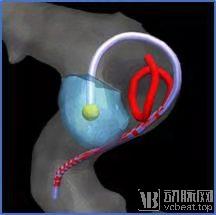
UKnow Intelligent Microcatheter Shaping System & Intelligent Aneurysm Measurement System (Image provided by the company)
Union Strong needs to find the optimal solution—leveraging and integrating surgical simulation algorithms, image processing algorithms, and deep learning algorithms to achieve microcatheter shaping through computer-aided methods. This means that Union Strong urgently needs experts in the field of artificial intelligence to join. “As long as you persevere, Lady Luck will surely smile upon you.” Indeed, Lady Luck did smile upon Qin Lan.
By a fortunate twist of fate, Qin Lan discovered that her high school classmate and close friend, Dr. Yin Yin, is a leading expert in the field of medical artificial intelligence. During his doctoral studies at the University of Iowa in the United States, Dr. Yin focused on AI algorithms for medical imaging and has accumulated over a decade of experience in deep learning algorithms within the healthcare sector. Multiple R&D achievements under his leadership have received certification from the U.S. Food and Drug Administration (FDA), and he led his team to develop the world’s first 3D breast cancer detection product based on deep learning technology. With Dr. Yin’s strong addition, Union Strong has elevated its algorithmic capabilities to a top-tier international level.
“If artificial intelligence can assist physicians in delivering a complete diagnostic and treatment process, the baseline standard of care across the entire healthcare system will be elevated. In other words, patients would receive diagnostic and therapeutic services at the level of a chief physician in a tertiary Grade A hospital, whether they visit primary care facilities or tertiary Grade A hospitals. We aim to enhance the overall diagnostic and treatment capabilities of primary care institutions and young physicians through such intelligent assistance,” said Qin Lan, founder of Union Strong.
Stroke, commonly known as “wind stroke,” is an acute cerebrovascular disease characterized by brain tissue damage resulting from impaired blood flow to the brain. It is categorized into ischemic and hemorrhagic stroke. Ischemic stroke occurs when cerebral blood vessels are obstructed, preventing blood from reaching the brain, while hemorrhagic stroke results from the sudden rupture of cerebral blood vessels, also leading to inadequate cerebral perfusion. According to data from The Lancet, stroke was the leading cause of death in China between 1990 and 2017, with an overall mortality and disability rate exceeding 60%.
Union Strong aims to develop a product line focused on stroke, which inevitably requires the establishment of relevant data standards. Taking the annotation of CT data for early-stage cerebral infarction as an example, Union Strong initially engaged senior physicians from major Grade A tertiary hospitals to perform CT annotations for cerebral infarction. However, they discovered discrepancies in the lesion regions annotated by different physicians for the same CT images. After more than two months of double-blind annotation, it was found that the inter-rater overlap among physicians was low, indicating significant variability in how different physicians interpreted CT scans for early-stage cerebral infarction.
What Exactly Is the True Standard?The Union Strong team has been pondering this issue. “For early-stage cerebral infarction, both senior and junior physicians share a consistent understanding of MRI data, leading to uniform annotations. MRI data serves as the gold standard,” founder Qin Lan told reporters. “We select CT images that have corresponding contemporaneous MRI data, and then accurately annotate the CT images based on the MRI findings.”
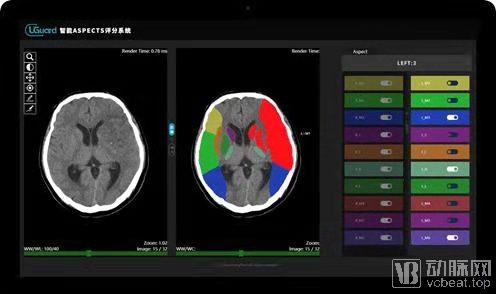
UGuard Intelligent ASPETCS Scoring System (Image provided by the company)
Currently, Union Strong’s AI-powered diagnostic and treatment platform for stroke addresses a major surgical challenge for neurointerventional physicians: microcatheter shaping. Without AI assistance, doctors must mentally reconstruct a 3D visualization of the cerebral vasculature from complex 2D angiographic images, identify the lesion, conceptualize an optimal 3D shape for the therapeutic microcatheter, and then manually shape it. This mental “shaping conception” process is difficult to teach and prone to variability. With AI assistance, computer systems can directly simulate microcatheter pathways and provide the optimal 3D configuration for the microcatheter tip. Union Strong has conducted over 80 clinical validations, achieving successful first-attempt placement in 80% of cases. Procedures that previously required more than two hours when performed solely by physicians can now be completed within half an hour with AI assistance.
For patients with acute cerebral infarction, every three-second delay in treatment results in the permanent death of 190,000 brain cells, prompting physicians to race against time to provide emergency care. However, even neurologists with over a decade of experience require more than a minute to interpret patient scan images. In contrast, Union Strong’s AI-powered stroke diagnosis and treatment platform completes this task in just 2.2 seconds. This substantial increase in speed holds significant clinical value for endovascular thrombectomy in the treatment of acute cerebral infarction.
Furthermore, Union Strong is continuously developing new features and expanding coverage to additional stroke subtypes for its AI-powered diagnosis and treatment solutions. It provides physicians with intelligent assistance across the entire clinical workflow, including disease screening, automated diagnosis, treatment decision-making, surgical planning, selection and simulation of medical consumables, and patient follow-up.
Union Strong’s business model encompasses the deployment and sale of imaging workstations for assisted diagnosis and treatment, as well as an AI-powered diagnostic and therapeutic platform offered via annual service fees or per-case charges. Additionally, the company provides surgical consumables and related services.
To date, the company has completed its angel round investment from Anlong Medical Fund and its Series A financing from Legend Star and Tuojin Capital, and plans to initiate a Series B funding round in the second half of this year. The proceeds will be used for pre-market clinical trials and post-launch marketing promotion.
“Throughout this journey, we have come to realize that our mission is to empower healthcare with AI and safeguard lives through technology. We aim not only to become China’s largest intelligent diagnosis and treatment platform for stroke but also, more ambitiously, to emerge as a globally leading platform in this field.” This is how Qin Lan envisions the future of Union Strong.