

Can Domestic Players Break the High-Price Monopoly in China's Intraoral Scanner Market? — With Market Size Projected at RMB 2.45 Billion in 2023
More than three decades ago, the advent of the first CAD/CAM system for denture restoration marked the initial application of digital technology in dental healthcare. Today, digital advancement is driving the upgrading of the dental healthcare industry, with oral digital impression technology serving as its most fundamental component.
Current Status of Digital Dental Impression Technology
Digital dental impression techniques can be categorized into indirect and direct methods. The “indirect method” refers to the scanning of dental stone casts and physical impressions, where dentists complete data acquisition by scanning the impressions or stone casts. In contrast, the “direct method” pertains to intraoral digital impression technology, wherein dentists use scanning devices inserted directly into the patient’s oral cavity to scan and measure teeth and related soft and hard tissues, thereby obtaining digital impressions in real time.
In recent years, intraoral digital impression technology has developed rapidly, driving the digitization of dental diagnosis and treatment. The method by which dentists acquire dental impressions has shifted from physical molding to digital acquisition, shortening the diagnostic and treatment process, saving materials and time, and improving the accuracy and efficiency of tooth impression-taking. Additionally, it meets the requirements for visual analysis of oral changes. The most critical and fundamental component of intraoral digital impression technology is the intraoral scanner (hereinafter referred to as "intraoral scanning"). Intraoral scanners can directly capture information on hard and soft tissues, such as teeth, gums, and mucosa, within the patient’s oral cavity, offering epoch-making advantages over traditional methods. This technology is set to transform the current model of dental diagnosis and treatment.
Currently, intraoral scanners in China rely primarily on imports, with domestic brands holding a relatively low market share. Major international brands such as Sirona, 3Shape, Align iTero, Carestream, Planmeca, and 3M ESPE dominate the market. Germany’s Sirona mainly sells the CEREC Omnicam series; Denmark’s 3Shape focuses on the TRIOS series; the US-based Align iTero primarily offers the iTero series; Canada’s Carestream mainly markets the CS3500 and CS3600 series; and Finland’s Planmeca primarily sells the Planmeca Planscan series. Notably, Sirona obtained its registration certificate as early as 2006, making it the earliest entrant into the Chinese market and securing a significant share of the intraoral scanner market.
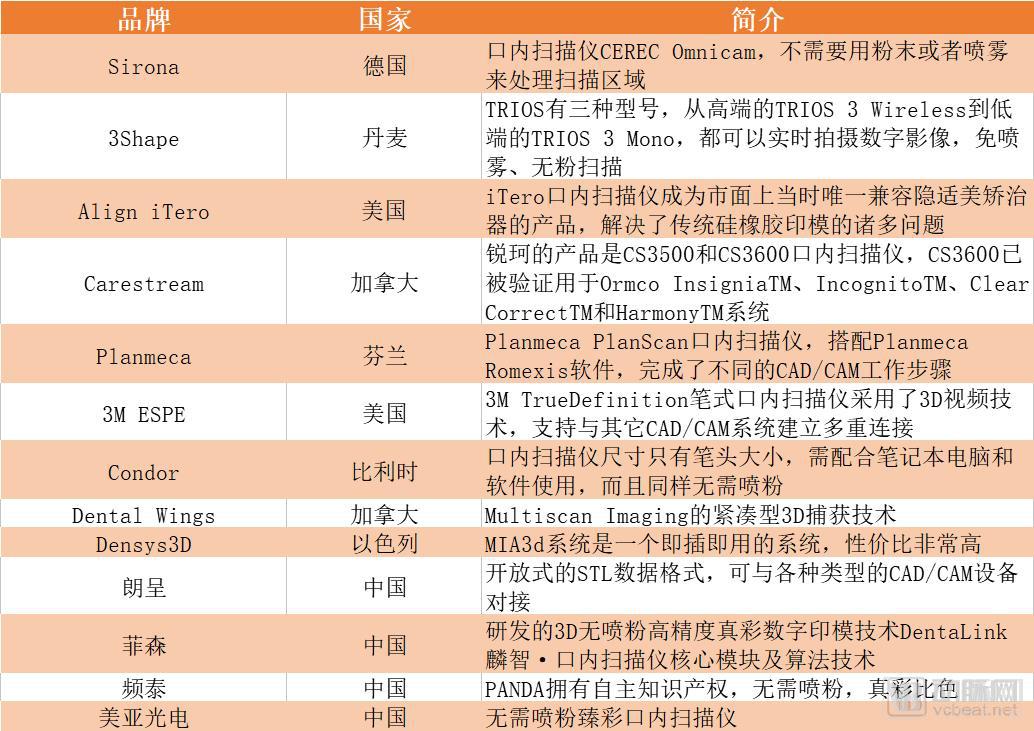
Mainstream Intraoral Scanners on the Market
The intraoral scanner industry faces high barriers to entry, driven by significant technological, capital, and regulatory certification hurdles. Currently, numerous domestic companies have entered the intraoral scanner market, including Langcheng and Fussen, which established early footholds in the sector, as well as Meyer Optoelectronic, which announced in January 2019 that its intraoral scanner was undergoing clinical validation.
In addition, the number of Chinese enterprises and projects applying for patents on intraoral scanners has been increasing in the past two years. Overall, domestically produced intraoral scanners are gradually breaking the monopoly held by foreign brands, which is expected to lead to a reduction in product prices. However, as domestic products entered the market later and have a shorter presence, further market development is still required.
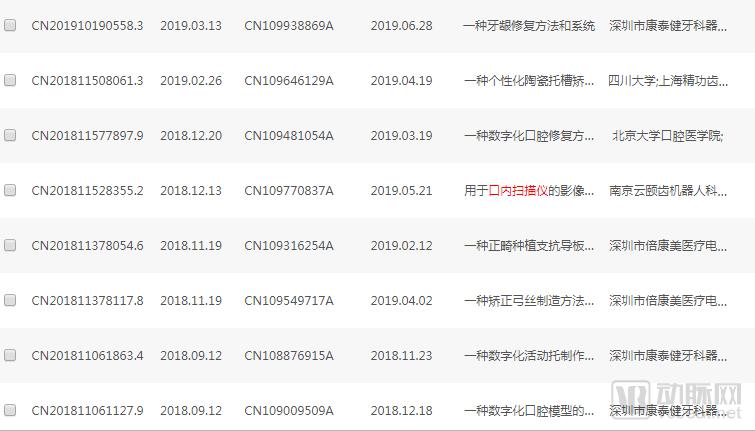
The Number of Chinese Enterprises and Projects Applying for Intraoral Scanner Patents Is Gradually Increasing
Data shows that in 2018, the demand for intraoral scanners in China was primarily concentrated in the central and eastern regions, with widespread demand in first-tier cities such as Beijing, Shanghai, and Guangzhou. East China ranked first, accounting for 40.2% of the total demand, while South China and North China accounted for 23.6% and 18.9%, respectively. The combined share of Central China, Northeast China, and West China was 17.3%, which is lower than that of North China alone. This indicates that economically developed regions have a greater need for equipment offering superior user experience.
As the domestic intraoral scanner market remains seller-driven with high product prices, traditional impression techniques—using impression trays and materials—continue to dominate clinical practice. Digital impressions offer numerous advantages to clinicians and lay the foundation for the future realization of digital diagnosis and treatment in dentistry; early entrants will hold a competitive edge.
What Are the Advantages of Intraoral Scanners?
Intraoral scanners have revolutionized the traditional clinical workflow for taking impressions and fabricating plaster models. By eliminating the need for physical plaster models and dental laboratory assistance, they streamline cumbersome conventional steps such as waiting for impression material to set, disinfecting impressions, and pouring models. This technology reduces material and labor costs while enabling clinicians to directly acquire digital dental models, thereby simplifying clinical procedures.
Many intraoral scanning systems can generate realistic color models, thereby enabling better acquisition of information on tooth structure and gingival texture. This allows for the analysis of changes in tooth and gingival color, a process that cannot be achieved with plaster models. Some systems also offer selective tooth shade matching.
For orthodontic patients opting for clear aligner therapy, acquiring 3D impressions prior to treatment is a critical procedural step. Traditional silicone rubber impressions require patients to keep their mouths open for extended periods and wait a considerable amount of time before the resulting models are available. Intraoral orthodontic scanners, however, circumvent these issues. The scanning devices are compact and refined, avoiding contact with sensitive areas such as the soft palate, thereby preventing gagging, nausea, and infection risks. Furthermore, the 3D orthodontic model data obtained from scanning can be directly integrated with clear aligner platforms, which not only reduces the number of impression-taking steps but also shortens the time required for uploading impression data. Both patients and clinicians can clearly visualize intraoral details, including teeth, on the screen.
Data acquired by intraoral scanners, after computer processing, yields comprehensive intraoral data required for both clinical and laboratory workflows, equivalent to physical impressions in conventional prosthodontics. Once digitized, these "models" can be directly uploaded to the cloud, facilitating convenient storage, traceability, and reduced treatment duration for orthodontic corrections.
After obtaining comprehensive intraoral data, the intraoral dataset can be integrated with other datasets, such as facial scans or 3D X-ray images. By leveraging big data analytics and simulation to magnify intraoral conditions multiple times, more comprehensive and intuitive diagnosis and treatment planning become possible. These data can also be utilized for computer-aided diagnosis, treatment, and restoration, as well as for formulating treatment plans. This approach yields more stable and superior outcomes compared to traditional methods that rely solely on clinicians’ empirical experience.
Data represents the core value of intraoral scanners in clinical applications. By integrating with software such as OraCheck and Cyfex, three-dimensional digital models enable visualized analysis of extensive intraoral changes, including tooth movement, inclination, rotation, gingival recession, and wear, thereby establishing a comprehensive digital orthodontic system.
Intraoral scanners can also have their data accuracy affected by certain individual factors. During intraoral scanning, the scanning device is influenced by head movement and the oral environment (such as saliva and the tongue), thereby affecting the quality of image acquisition. Issues such as operational experience in the confined space of the oral cavity, scanning accuracy on semi-transparent and highly reflective tooth surfaces, stitching accuracy of scan data in cases of extensive dental arch defects or missing teeth, and scanning suitability for severely maloccluded dentitions can, to some extent, affect the fitting and reconstruction between images. Additionally, optical impressions are difficult to handle; operators must undergo prior training to use the equipment, and beginners must adhere to complex scanning paths to obtain correct and precise data.
Intraoral Scanner Industry Trends
As research into the domestic intraoral scanner industry deepens and production technologies achieve breakthroughs, the number of companies in this sector is gradually increasing. With growing public emphasis on oral health and rising demand for advanced dental scanning and restorative equipment, expanding market needs will drive industry development. The overall market size of the intraoral scanner industry is projected to grow steadily from 2019 to 2023, potentially reaching RMB 2.45 billion by 2023.
According to the “Report on Trends in China’s Dental Industry from a Global Perspective,” jointly released in 2019 by VCBeat and the International Exchange and Cooperation Center of the National Health Commission, there are approximately 100,000 dental medical institutions in China. This figure includes 80,000 dental clinics (both chain and independent), around 10,000 dental departments within general hospitals, and approximately 1,000 specialized dental hospitals. When it comes to choosing where to seek dental care, 50% of people still prefer dental departments in general hospitals as their first choice.
General hospitals and specialized dental hospitals typically procure intraoral scanners through bidding processes. Due to their extensive manufacturing experience, mature technology, and significant advantages in product stability and clinical performance, imported products are highly favored.
Currently, intraoral scanning systems remain expensive. Data indicate that Carestream Dental’s intraoral scanners are priced at RMB 250,000 per unit, while Sirona’s intraoral scanners are quoted at RMB 380,000 per unit. Domestically produced intraoral scanners from Guangdong Langcheng Medical Device Technology Co., Ltd. range in price from RMB 168,000 to RMB 350,000. Although the high cost increases expenses for clinics and hospitals, equipping practices with intraoral scanners is an inevitable trend. According to available data, 50% of dentists in the United States are considering purchasing intraoral scanners. Regardless of whether chairside systems are acquired, a growing number of dentists will adopt intraoral scanning and transmit digital impression files.
As the intraoral scanner industry develops, the market value of these devices continues to rise, demand grows steadily, and the industry scale expands. Meanwhile, with advancements in industry development, the technical capabilities of intraoral scanners will further improve, making future new-generation devices more focused on enhancing the timeliness and safety of clinical applications.
In summary, as the intraoral scanner industry develops in the future, market competition will gradually intensify, and product technology will become a key factor for manufacturers to gain market share.
Embracing the Digital Era Is an Inevitable Choice
Currently, intraoral scanners available in the Chinese market are prohibitively expensive, placing them beyond the reach of many private dental clinics. However, it is anticipated that in the near future, as an increasing number of manufacturers enter the market, scanner prices will decline. At that point, domestically produced intraoral scanners will carve out a significant market share, making digital dentistry accessible to the general public.
The development of digital dentistry has revolutionized the interaction between patients and dental healthcare institutions, with patient demands driving these institutions to provide more comfortable equipment and superior services. In China, digital dentistry is receiving policy support, and the market remains substantial. Digital technologies will continue to transform the entire dental market and innovate business models in the future. The digitization of oral healthcare is an inevitable trend for future development; only by keeping pace with the digital era can one stay aligned with market trends.
Currently, multiple companies are dedicated to research on intraoral digital impressions, with some having achieved certain clinical applications. Meanwhile, the domestic clear aligner brand "Meilike" has taken a leading position in digital dental healthcare. The Meilike team was established in 2012, leveraging its clear aligner products to serve the entire oral care industry chain and build an ecosystem for dental medical services.
Meilike has partnered with Boli New Materials, a company dedicated to the R&D of new 3D printing materials, to jointly develop specialized resins and equipment for clear aligner therapy. This collaboration has enabled the in-house production of a comprehensive 3D printing solution for clear aligners, providing dental practitioners with an end-to-end service encompassing scanning, design, printing, and manufacturing. Additionally, Meilike’s clinic-specific 3D model scanner is a representative product of digital technology applications in the dental industry. Unlike traditional impression techniques, this scanner helps eliminate the risk of data loss associated with shipping physical models. Meilike’s independently developed aligner film system delivers gentle and consistent orthodontic forces; its production facility is now operational, with an annual capacity of up to 5 million units.
Meilikeli’s sales channels are primarily online. It currently boasts a business team of over 1,000 members, more than 100 partners, and an online network of 40,000 physicians. To date, Meilikeli’s products have reached over 20,000 outpatient clinics across more than 300 cities in China, serving thousands of patients each month.
Meilikeli has received investments from institutions such as CITIC Capital, Yahui Investment, Century Changhe, and Tianyu Yikang, although the specific funding amounts were not disclosed. In early 2019, Meilikeli planned to offer 1,000 hands-on offline training courses on clear aligner therapy to enhance clinicians’ practical experience. Recently, Meilikeli launched a promotional package that includes one 3S color intraoral scanner, five Meilikeli clear aligner treatment cases, and six sessions of digital dentistry training. (Entry Point for the Immediate Digitalization Package)
The principles and technical characteristics of intraoral digital impression technologies vary. It is essential for professional prosthodontists to understand and master these principles and features, and the packages launched by Meilikely effectively address these pain points. Notably, Meilikely offers a discounted package of 100–300 units of the 3S color intraoral scanner to medical institutions. This initiative aims to promote the development of digital dentistry in China and deliver enhanced services and experiences to both clinicians and patients.
For dentists, digital dentistry not only streamlines the diagnosis and treatment process but also provides patients with a more comfortable healthcare experience. In fact, although digital technologies in the field of oral health have achieved certain successes, medical practice has demonstrated that there is still significant room for improvement in the overall digitalization of dentistry. Achieving comprehensive digital transformation in this sector is not an overnight endeavor. Entrepreneurs and medical institutions that enter the realm of digital dentistry early will gain a first-mover advantage, positioning themselves favorably to secure a foothold in the future market.