

Policy-Driven Surge in Internet Hospital Construction: How 11 Chinese Provinces Tackle Prescriptions, Insurance Reimbursement, and Telemedicine
Recently, the Shandong Provincial People's Government issued the “Action Plan for Promoting the Construction of a Demonstration Province for ‘Internet + Healthcare’ in Shandong Province (2019–2020),” outlining seven major tasks in areas such as settlement and payment, drug supply, public health management, and healthcare big data. This makes Shandong another province to have formulated an action plan for the development of internet-based healthcare.
In April last year, the landmark policy document “Opinions of the General Office of the State Council on Promoting the Development of ‘Internet Plus Healthcare’” was issued. To encourage demonstration and innovation, the National Health Commission approved the establishment of an “Internet Plus Healthcare” demonstration zone in Ningxia, and subsequently signed agreements with ten provinces and municipalities—Tianjin, Jiangsu, Zhejiang, Anhui, Fujian, Shandong, Hubei, Guangdong, Sichuan, and Guizhou—to jointly build “Internet Plus Healthcare” demonstration provinces.
The aforementioned 11 provinces, autonomous regions, and municipalities have successively formulated implementation guidelines or detailed action plans for “Internet + Healthcare” to facilitate the practical application of internet-based medical services. In April and May of this year, Shandong and Ningxia separately announced their respective achievements in the development of “Internet + Healthcare.”
To clarify the current landscape of “Internet + Healthcare” in China, VCBeat (WeChat ID: vcbeat) has reviewed relevant policies across various provinces and municipalities. By integrating corresponding phased data, it examines how internet healthcare is advancing in three key areas: prescription circulation, medical insurance settlement, and telemedicine.
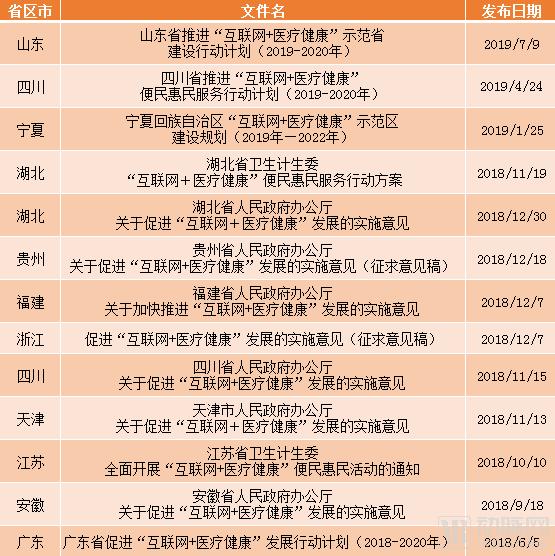
“Internet + Healthcare” Demonstration Provinces, Autonomous Regions, and Municipalities: Major Implementation Policies
Source: Official websites of local health commissions; compiled by VCBeat.
Regarding prescription circulation, most provinces, autonomous regions, and municipalities have proposed corresponding implementation opinions or detailed rules under the following policy framework.
1. After reviewing patients’ medical records, physicians are permitted to issue online prescriptions for certain common and chronic diseases;
2. For prescriptions for common and chronic diseases issued online, after review by pharmacists, medical institutions and pharmaceutical trading enterprises may entrust qualified third-party organizations with delivery;
3. Explore the interconnectivity and real-time sharing of prescription information from healthcare institutions with drug retail consumption data, to promote the standardized development of online drug sales and medical logistics distribution.
Specifically, some provinces and municipalities have formulated corresponding targets or proposed relevant timelines based on their actual local conditions, for example:
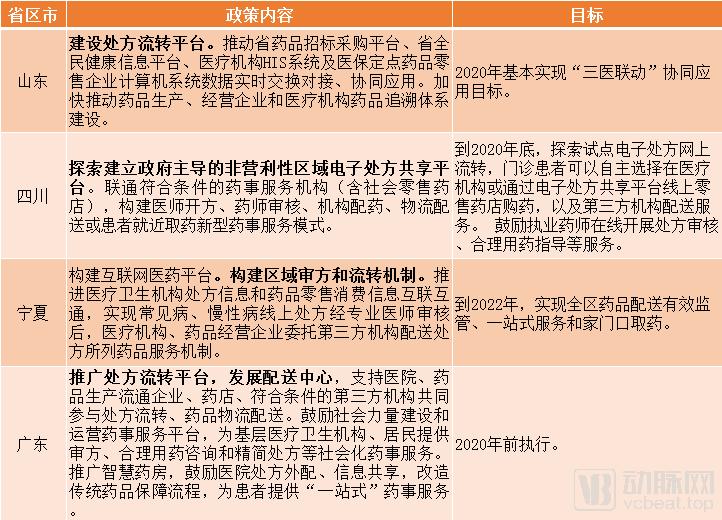
Objectives of Multiple Provinces and Cities in the Construction of Prescription Circulation Platforms
Source: Official websites of local Health and Family Planning Commissions; compiled by VCBeat
As can be seen, multiple provinces and municipalities have set phased targets to establish prescription circulation platforms by 2020. Prescription circulation involves hospital prescription information, inventory and sales data from pharmaceutical retail enterprises, settlement information for medical insurance-covered drugs, and more. In traditional healthcare processes, information barriers were not formed overnight, and breaking down these barriers also requires considerable time. Therefore, achieving the expected goals within the given timeframe is a challenging task with tight deadlines.
Meanwhile, prescription review, as an indispensable component of pharmaceutical care services, is a critical issue that warrants attention. As e-pharmacies and community pharmacies will become the primary recipients of prescription transfers, it is essential to optimize the allocation of pharmacist resources and implement centralized prescription review processes. This approach aims to ensure regulatory compliance while enhancing operational efficiency.
Policies in both Sichuan and Guangdong provinces have highlighted this point. For instance, qualified pharmaceutical care service institutions (including social retail pharmacies) are permitted to participate in the development of prescription-sharing platforms. Additionally, there is encouragement for non-governmental entities to establish and operate pharmaceutical care service platforms, providing社会化 pharmaceutical services such as prescription review, rational medication consultation, and prescription simplification.
Some provinces and municipalities have already explored the construction of prescription circulation platforms. Taking Ningxia as an example, last year the Yinchuan Municipal Health and Family Planning Commission (the predecessor of the Yinchuan Municipal Health Commission) approved the establishment of the Yinchuan Prescription Review and Circulation Center.
In May 2019, the Yinchuan Municipal Health Commission announced the latest developments: one of which is the “Yinchuan Health Square,” a convenient service platform based on WeChat Mini Programs. This platform integrates resources from six municipal hospitals in Yinchuan into a unified system. By leveraging residents’ electronic health codes, it enables precise appointment scheduling for outpatient services, hospital beds, and large-scale equipment examinations across these hospitals. The platform offers a comprehensive suite of convenient services throughout the entire healthcare journey, including intelligent triage, mobile payment, in-hospital navigation, point-of-care settlement, report inquiries, bedside settlement, one-stop settlement, prescription circulation, post-discharge follow-up, emergency medical services (120 ambulance), health education, vaccination, and access to personal health records.
Another is the “Yinchuan Prescription Review and Circulation Platform,” which centrally reviews prescriptions from all hospitals, community health centers, and internet hospitals across the city to ensure medication safety. Meanwhile, patients can autonomously choose pharmacies and purchasing methods based on various options, such as the lowest price, shortest distance, self-pickup, or third-party delivery.
Ningxia has proposed that by 2020, it will achieve effective supervision of pharmaceutical distribution, one-stop services, and convenient access to medications at the doorstep across the entire region. Building on Yinchuan City’s experience in hospital resource sharing, unified prescription review, and resident electronic health codes, these practices could be scaled up for broader coverage throughout the region.
Internet healthcare has entered a stage of standardized development, with a vast market for chronic disease management. For patients with chronic conditions, the long-term need for medication makes medical insurance settlement increasingly important. The policies formulated by various provinces, autonomous regions, and municipalities primarily include the following key points regarding medical insurance settlement:
1. Accelerate the integration and interconnection of medical security information systems to promote one-stop settlement;
2. While ensuring information security, strengthen cooperation with medical insurance providers, commercial insurers, UnionPay, and third-party payment institutions to offer patients a variety of online payment options;
3. Implement intelligent review and real-time monitoring of medical insurance, embed rules such as clinical pathways, rational drug use, and payment policies into hospital information systems, and strictly regulate medical practices and costs.
Among them, some provinces and municipalities have further specified different focal points or implementation progress:
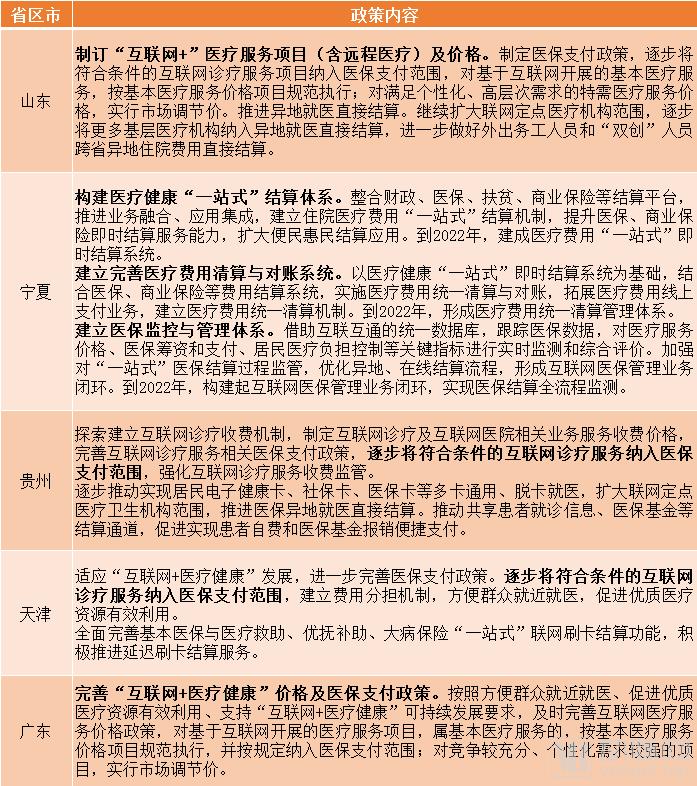
Policy Support for Internet Healthcare and Medical Insurance Settlement in Multiple Provinces and Cities
Source: Official websites of local health commissions; compiled by VCBeat.
In the early stages, internet hospitals were primarily market-driven, with service prices mainly regulated by market forces. Consequently, the same service might be priced differently across various platforms. However, health insurance reimbursement requires unified pricing and standardized coding. Therefore, establishing corresponding price standards is a fundamental step toward including internet healthcare services in health insurance coverage.
As can be seen from the table above, provinces such as Shandong, Guangdong, and Guizhou have all mentioned that they will formulate pricing policies for internet-based medical services, signaling an imminent critical step forward.
Challenges remain in medical insurance reimbursement; let’s first examine the practices in Zhejiang, Guizhou, Sichuan, and other regions:
In May 2018, the Social Insurance Administration of Tongxiang City, Zhejiang Province, issued the "Notice on Adding Designated Medical Institutions for Basic Medical Insurance," incorporating Wuzhen Internet Hospital into the city’s network of designated institutions for basic medical insurance. Insured employees in Tongxiang City can now use their medical insurance for reimbursement when receiving care at Wuzhen Internet Hospital.
In recent years, Guizhou Province has gradually incorporated telemedicine into the reimbursement scope of both the Basic Medical Insurance and the New Rural Cooperative Medical Scheme (NRCMS). Patients in counties with extreme poverty can claim reimbursement for teleconsultation, telediagnosis, and other services as regular medical service items, with reimbursement rates ranging from 70% to 85%.
In October 2016, the Sichuan Provincial Health and Family Planning Commission (the predecessor of the Health Commission), the Development and Reform Commission, and the Department of Human Resources and Social Security took the lead nationwide in issuing the Guiding Opinions on Accelerating the Promotion of Internet Plus Medical and Health Services, while simultaneously introducing supporting policies such as pricing for “Internet Plus Medical and Health” service items and medical insurance reimbursement. Among these, internet-based diagnostic and treatment services, including remote consultations and online outpatient visits, were explicitly assigned pricing and reimbursement standards, and relevant services provided by internet hospitals were made eligible for inclusion in medical insurance reimbursement. In October 2018, Sichuan Province introduced new regulations on the price management of internet medical services, further deregulating the prices of remote outpatient visits, remote consultations, remote diagnostics, remote monitoring, and other internet medical service items offered by public medical institutions, implementing a filing-based management system. In June 2019, the Notice of Sichuan Province on Further Improving Work Related to Internet Hospitals and Internet Diagnosis and Treatment reaffirmed that health administrative departments at all levels and medical institutions should actively coordinate with medical insurance authorities to include internet medical service items within the scope of medical insurance payment.
These milestone achievements represent significant progress. However, it is also evident that they currently apply only to internet-based diagnosis and treatment expenses incurred by locally insured individuals within their own regions. Given that telemedicine inherently transcends geographical boundaries, further efforts are needed to advance the reimbursement of cross-regional telemedicine costs through medical insurance schemes.
In June 2019, the National Healthcare Security Administration issued the Guiding Opinions on Standardization of Medical Security, proposing to achieve unified coding for medical security items nationwide. By 2020, it aimed to gradually implement the adoption of standardized information business codes for 15 categories, including disease diagnosis and surgical procedures. This is a crucial measure for physical healthcare institutions to facilitate cross-regional settlement. However, the document did not address how internet-based healthcare services should align with the national standardization system.
In summary, the inclusion of internet-based healthcare services in medical insurance coverage requires not only pilot initiatives by local governments within existing policy frameworks but also higher-level coordinated planning to drive implementation. In June 2019, the State Council issued the Key Tasks for Deepening the Reform of the Medical and Healthcare System in 2019, explicitly mandating the formulation of policy documents on pricing and medical insurance reimbursement for internet-based diagnosis and treatment services. This task was assigned to the National Healthcare Security Administration, with a deadline for completion by the end of September 2019. Upon its completion, medical insurance settlement for internet-based healthcare services is expected to be implemented more rapidly and comprehensively.
Telemedicine is a critical component of internet-based healthcare for optimizing resource allocation, facilitating the implementation of tiered diagnosis and treatment to the greatest extent. Policies to promote telemedicine have been formulated by provinces and municipalities across China, primarily focusing on the following aspects:
1. Promote the model of “primary-level examination with higher-level diagnosis,” expand functions such as medical imaging, remote electrocardiography, and laboratory testing within primary healthcare information systems, actively apply intelligent computer-aided diagnosis systems, and enhance the capacity and efficiency of primary healthcare services;
2. Support medical and health institutions and qualified third-party organizations in establishing internet-based information platforms to provide telemedicine, health consultation, and health management services;
3. Promote the coverage of telemedicine services across all medical consortiums and county-level hospitals, and gradually extend these services to community health service institutions, township health centers, and village clinics;
4. The lead hospital of the medical consortium shall establish a telemedicine center to provide services such as remote consultations, remote imaging, remote ultrasound, remote electrocardiography, remote ward rounds, remote monitoring, and remote training to medical institutions within the consortium.
Telemedicine relies on information technology to transcend geographical barriers. Consequently, policies formulated by various regions exhibit distinct characteristics due to differences in geographic conditions:
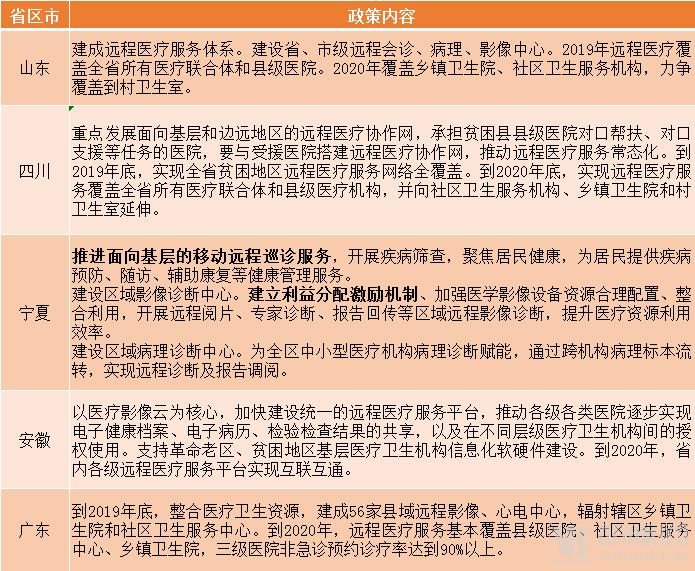
Telemedicine Policies Formulated by Multiple Provinces and Cities Based on Regional Characteristics
Source: Official websites of local health commissions; compiled by VCBeat
Telemedicine: Technological Support Is Key. According to the official WeChat account of the Sichuan Provincial Health Commission, in May this year, experts from West China Hospital of Sichuan University conducted a remote consultation for a complex pulmonary nodule case at Suining Central Hospital via China Telecom’s 5G network technology, providing intraoperative guidance. With technological advancements, video transmission latency has been significantly reduced, enabling specialists to operate as if they were physically present on-site.
Furthermore, technologies such as artificial intelligence and big data are increasingly providing support, enabling telemedicine to reach primary care settings, with even greater possibilities on the horizon.
Meanwhile, it is also worth considering how to increase the utilization rate of telemedicine and participant engagement, promote its normalization, effectively implement tiered diagnosis and treatment, and truly optimize the allocation of medical resources. In this regard, Ningxia has proposed establishing corresponding benefit-distribution mechanisms, while Guizhou has also made some attempts.
Located on the Yunnan-Guizhou Plateau, Guizhou Province has achieved full coverage of four-tier telemedicine services—provincial, municipal, county, and township levels—to address the challenges faced by patients in mountainous areas in accessing medical care. Building on this foundation, Guizhou is currently exploring ways to ensure the normalized and efficient operation of telemedicine services. For instance, the province is optimizing the performance-based allocation of incentives for telemedicine services and making participation in and completion of telemedicine consultations a prerequisite for promotion to higher-level professional health technical titles, thereby motivating healthcare professionals.
The Internet healthcare industry is experiencing rapid growth under the support of various policies, as clearly demonstrated by multiple data points.
The Administrative Measures for Internet Hospitals (Trial) clearly stipulate that, prior to granting accreditation to internet hospitals, provincial-level health administrative departments shall establish a provincial internet medical service supervision platform and integrate it with the information platforms of internet hospitals to enable real-time oversight. Therefore, the establishment of a provincial internet medical service supervision platform is a prerequisite for issuing an internet hospital license.
According to the latest data released by the National Health Commission, provincial-level regulatory platforms for internet medical services have been established in Shandong, Zhejiang, Guangdong, Sichuan, Yunnan, Ningxia, and other regions.6 provinces, autonomous regions, and municipalities. Among them, Shandong has already35 HospitalsNingxia has completed the registration of its internet hospital.29 CompaniesObtain an Internet Hospital License.
As of June 2019, according to statistics based on publicly available data compiled by VCBeat, the number of enterprises participating in the development of internet hospitals had reached200+。
On July 18, Ping An Good Doctor informed VCBeat that it has partnered with the Aviation General Hospital of China Medical University, the Second Traditional Chinese Medicine Hospital of Sichuan Province, and other institutions.Nearly 50 Large HospitalsCo-building a New “Internet Hospital”: Pooling Superior Resources from All Parties to Co-create a New Internet Hospital, and Leveraging Globally Leading AI Medical Technology to Forge a New Ecosystem for Internet Hospitals.
In July, the Health Commission of Shanxi Province issued the "Detailed Rules for Data Integration into the Shanxi Provincial Internet Medical Services Supervision Platform (Trial)," deciding that by the end of 2019, applications for internet medical services from tertiary hospitals would be integrated into the supervision platform. After 2020, based on work progress, applications from secondary hospitals will be gradually integrated, aiming to actively and steadily advance the accreditation of internet hospitals across the province.
In addition, multiple provinces and municipalities, including Shaanxi, Hunan, Henan, and Chongqing, have also issued implementation opinions or action plans to promote the development of “Internet + Healthcare.”
Policy and practice are being progressively advanced.
Furthermore, according to the analysis in VCBeat’s “2018 Internet Hospital Report,” as local authorities finalize detailed regulatory rules for internet hospitals and improve provincial-level regulatory platforms in the first half of 2019, a third wave of internet hospital development is expected to emerge in the second half of the year.
How Will the Internet Healthcare Industry Perform in the Second Half of the Year?
What Progress Will Be Made in Prescription Circulation?
How Detailed Will the Health Insurance Settlement Guidelines Be?
VCBeat will continue to monitor the situation.