

Chipscreen Biotech Secures STAR Market IPO Approval, Denying Rumors of Rejection
On July 17, VCBeat learned from the China Securities Regulatory Commission (CSRC) that Shenzhen Chipscreen Biosciences Co., Ltd. has received approval for its listing on the STAR Market.
On the morning of the 17th, media reports stated that the China Securities Regulatory Commission (CSRC) had essentially reached a negative conclusion on Chipscreen Biosciences’ initial public offering (IPO). To avoid an official rejection record, the company was encouraged to voluntarily withdraw its registration application, and intermediaries were already in discussions with the company regarding the withdrawal of registration materials. In the afternoon, Essence Securities, the sponsoring institution for Chipscreen Biosciences, issued a statement to refute these rumors.
On June 11, after three rounds of in-depth inquiries, Chipscreen Biosciences emerged as one of the first three companies to gain approval. However, its delayed registration fueled widespread market rumors. Just moments ago, the China Securities Regulatory Commission (CSRC) released an official announcement approving the initial public offering (IPO) registration of Chipscreen Biosciences.
MicroCore Biopharm, founded in 2001, specializes in the original research and development of small-molecule drugs. Prior to submitting its listing application to the STAR Market, the company completed seven rounds of financing, with investors including Lilly Asia Ventures, CCB Capital, Shenzhen Capital Group, and CMB International, among other renowned investment institutions.
MicroCore Bio primarily engages in the research and development of innovative small-molecule drugs, with its core technology being an integrated drug innovation and early-stage evaluation system based on chemogenomics.
Chemical genomics technology leverages large-scale known gene expression data and their functional significance to analyze the correlations between the effects of various known and novel compounds on global gene expression. This approach enables the evaluation and prediction of potential molecular pharmacological and toxicological profiles of compounds, facilitates the continuous optimization of candidate compound structures, and ensures that lead compounds with the most favorable comprehensive evaluation metrics advance to the next stage of development, thereby reducing the risks associated with new drug development.
MicroCore Biologics has accumulated 121 domestic and international invention patents over the years and has obtained three software copyright registration certificates.
It is understood that Chipscreen Biosciences, leveraging its core technologies, has successfully discovered and developed three first-in-class innovative drugs as well as a series of new molecular entity (NME) drug candidates.
Among them, Chidamide (brand name: Epidaza), a Class I innovative drug developed in China, has been launched and is marketed for the treatment of peripheral T-cell lymphoma. It is the world’s first subtype-selective histone deacetylase (HDAC) inhibitor.
Chiglitazar sodium, another Class I new drug in China, has completed its Phase III clinical trials, becoming the first PPAR pan-agonist worldwide to complete Phase III clinical trials.
The third drug, Xioroni, is also a National Class I new drug. It is a novel multi-target, multi-pathway (Aurora/VEGFRs/CSF1R) selective kinase inhibitor, with multiple Phase II clinical trials currently underway.
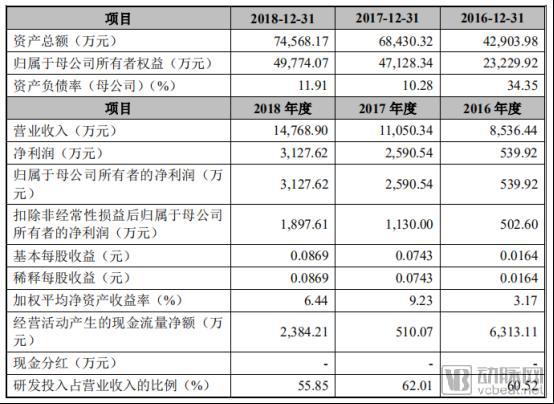
The prospectus shows that Chipscreen Biosciences’ compound annual growth rate (CAGR) of operating revenue over the past three years was 34.53%. Its operating revenues in 2017 and 2018 were RMB 111 million and RMB 148 million, representing year-on-year increases of 28.45% and 33.65%, respectively. In 2017 and 2018, its net profits amounted to RMB 25.9054 million and RMB 31.2762 million, reflecting year-on-year growth of 379.80% and 20.73%, respectively.