

Tencent Medpedia Balances Medical Rigor and Public Accessibility with Over 8,000 Disease Entries and 1,500 Videos

Tencent
Internet Comprehensive Service Provider
Do you remember the annual list of top health myths? “Baking soda can starve cancer cells to death,” “HPV vaccination causes pregnancy,” and “Urine drop test for cancer detection”... These rumors proliferate online, are frequently shared by our parents’ generation, and often forwarded to their children with warnings to take heed, leaving us both amused and exasperated.
To enhance health science popularization and provide the public with authoritative, multi-format medication knowledge, the News Center of the National Medical Products Administration and Tencent Yidian signed a strategic cooperation agreement in Beijing on July 17.
Both parties will actively respond to the policy call outlined in the “Opinions of the State Council on Implementing the Healthy China Action,” fully leverage their respective advantages in expert resources, content production, and channel distribution, and invite experts to appear in a series of popular science short videos. By building an authoritative platform for medication safety education and promoting it jointly through the government media matrix of the drug regulatory system and Tencent’s content ecosystem platform, they aim to popularize professional medication safety knowledge across society, thereby effectively safeguarding public medication safety and physical health.
As a pioneer in professional medical science popularization on the Chinese internet, Tencent Yidian is dedicated to translating complex and abstruse medical expertise into content accessible to the general public, thereby providing more reasonable and effective care guidance for individuals and their families. It aims to facilitate better communication between patients and physicians, fostering enhanced doctor-patient collaboration.。
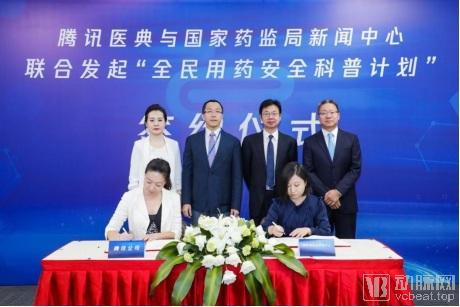
Representatives from the News Center of the National Medical Products Administration and Tencent Yidian Sign Strategic Cooperation Agreement


Recently, in the "Opinions of the State Council on Implementing the Healthy China Action," the State Council explicitly stated that improving health literacy should be regarded as a prerequisite for enhancing the health of the entire population. It emphasized strengthening health education and promotion in a targeted manner according to the characteristics of different groups, so that health knowledge, behaviors, and skills become universal qualities and capabilities possessed by all citizens. Among these, "popularizing knowledge and skills related to rational drug use among families and individuals" has been listed as one of the key tasks.
"In accordance with the requirements of the CPC Central Committee and the State Council, the National Medical Products Administration (NMPA) is advancing reforms in the review and approval processes for drugs and medical devices, while actively promoting public education on safe and rational medication use. 'We will actively respond to policy directives by partnering with Tencent Yidian to build a scientific and professional platform for popularizing medical knowledge. By engaging authoritative experts as key communicators to share accurate knowledge and concepts regarding safe medication, and leveraging the combined reach of our respective multi-platform matrices, we aim to foster an environment conducive to the dissemination of drug safety education,' stated the head of the NMPA News Center."
Tencent Yidian’s popular science articles are consistently authored or reviewed by authoritative experts. To date, it has established collaborations with over 100 renowned hospitals and more than 1,000 experts across China, including over 80 academicians of the Chinese Academy of Sciences and the Chinese Academy of Engineering, as well as disciplinary leaders.
Tencent Medical Encyclopedia has also constructed in-depth, structured medical knowledge graphs for various diseases, with content covering symptom identification, preliminary diagnosis, treatment options, and rehabilitation management. Among these, the rich medication guidance information tailored to different populations and diseases provides strong support for the subsequent implementation of nationwide health education initiatives.
Behind health rumors lies a scarcity of accessible, authoritative medical science communication. In the field of public medical education, professional articles often have a high barrier to entry, resulting in suboptimal dissemination of authoritative information. Meanwhile, various marketing advertorials and “viral online posts” circulate widely. Most of these pieces are mass-produced solely to chase traffic and attract attention, cobbled together from multiple sources with little fact-checking, making their credibility questionable. Although an increasing number of clinical experts are engaging in public science communication, their efforts remain limited in the face of pervasive misinformation and “pseudoscience.”
Zhang Meng, Vice President of Tencent Healthcare and Head of the Medical Information Product Center, stated in an interview that, according to a survey by Penguin Intelligence, China had over 40,000 self-media accounts focused on healthcare in recent years, with weekly readership exceeding one million and daily search volume for health-related questions reaching 60 million.。
The internet has become the primary source of information for users seeking medical care and medications; however, due to constraints such as recommendation algorithms, content provenance, and commercial interests, the extent to which public needs are met remains low.
To this end, Tencent has established its smart medical information platform, Tencent Medical Classic, on three foundational pillars: a comprehensive medical knowledge base, human-centric technological capabilities, and deep integration within the Tencent ecosystem. With a patient-centered approach, the platform aims to collaborate with leading domestic and international science communication peers, eliminate commercial interference, and ensure that content achieves a unified standard of scientific rigor, practical applicability, and authoritative credibility, thereby positioning Tencent Medical Classic as a definitive medical reference for safeguarding the health of the Chinese population.
In addition, Zhang Meng stated that as a platform-based company, Tencent designs its products to address various user needs. With the growing public demand for authoritative health information, Tencent Medical Dictionary was launched in response.
Upon opening Tencent Medical Dictionary, most popular science articles are credited to experts. Zhang Meng stated that the majority of articles on Tencent Medical Dictionary are authored by renowned medical experts and department heads, ensuring the authority and accuracy of the content. Two-thirds of the Tencent Medical Dictionary team consist of experienced medical editors, most of whom have professional backgrounds in natural sciences, medicine, and related fields. They are responsible for translating medical knowledge into accessible language, thereby ensuring the readability of the content.
Zhang Meng told VCBeat that medical experts in China have very tight schedules, leaving them little time to create popular science content. Experts have their own reasons for being willing to participate in the production of content for Tencent Medical Dictionary.
In 2017, at the inception of the Tencent Medical Dictionary project, experts informed the team that they saw at least 50 patients during a single morning clinic session, spending an average of 3–5 minutes per patient. Approximately 80%–90% of the patients’ questions were repetitive and straightforward.
Within this limited timeframe, physicians and patients should engage in more substantive discussions regarding the patient’s condition and treatment plans; however, much of the time is instead spent addressing basic questions. Therefore, experts hope for an effective product that can help patients gain a preliminary understanding of these fundamental issues before their clinical consultations.。
On the other hand,Experts also have a stronger desire to disseminate information, hoping to leverage Tencent’s vast channel and traffic advantages to spread accurate, authoritative, and cutting-edge concepts through platforms such as WeChat, QQ Browser, and Penguin Media, in ways that are easily understood by the general public.. This enables these experts to voice their support for accurate medical concepts.
Initially, some doctors approached their collaboration with Tencent with a tentative, try-it-out attitude. As the partnership deepened, they witnessed the growth of Tencent Medical Encyclopedia, Tencent’s professional approach, and the tangible results achieved. Consequently, experts became more willing to devote additional time to writing and reviewing articles. Many patients, after reading these physicians’ articles, would contact Tencent Medical Encyclopedia directly or seek consultations with the experts themselves. This has also served as an effective channel for enhancing the doctors’ professional reputations.
With the launch of Tencent Medical Dictionary, many patients have benefited from it and left messages in the background. These messages have allowed experts to see that their actions are influencing more and more users. The growth of users' medical knowledge has also increased their efficiency in seeking medical care. At the same time, experts have gained an understanding of the general public's level of medical knowledge through user feedback, gradually improving their wording when writing popular science articles and engaging in daily communication. Many terms that experts take for granted may not be clear to patients, leading to communication issues.
When experts write medical popular science content, it is not merely a transfer of knowledge, but also a process of mutual understanding and learning between doctors and patients.
As collaboration models deepen and the reputation of medical experts spreads, many specialists are now proactively reaching out to launch exclusive columns on Tencent Yidian. Recently, the State Council issued a document emphasizing the need to strengthen health science popularization and build a robust expert database. Due to its early market entry and stringent requirements for products and content, Tencent Yidian has gained a first-mover advantage.
Since 2017, Tencent Medical Dictionary has become increasingly mature, with growing public acceptance. Some department directors have even stated that they now advise patients to consult the Medical Dictionary to resolve their health concerns during consultations. Additionally, some physicians use it as a reference tool during ward rounds. These developments were beyond the expectations of the Tencent Medical Dictionary team.
In the future, Tencent Medical Encyclopedia will step into the background, empowering physician authors to take center stage. They will create popular science content based on their professional insights and user needs, thereby meeting the public’s demand for authoritative health education.
Medical knowledge carries a high cognitive barrier; therefore, the accessibility and comprehensibility of content play a crucial role in the effectiveness of science communication. To address this, the News Center of the National Medical Products Administration (NMPA) and Tencent Yidian will jointly launch a flagship short-video series tailored to current user reading preferences. Featuring expert on-camera explanations complemented by animations, the series will translate complex drug safety information into content that is “easy to understand and accessible” for the general public, thereby enhancing the efficiency and impact of science dissemination.
Under the strategic cooperation agreement, the News Center of the National Medical Products Administration (NMPA) and Tencent Yidian will produce a series of short educational videos on rational drug use. These videos will provide in-depth explanations and visual presentations on widely concerned topics such as drug identification, precautions for medication use, and vaccination knowledge. The videos will be promoted through the NMPA system’s government new media channels, Tencent Yidian, and Tencent’s content ecosystem platforms. By leveraging big data and artificial intelligence technologies, the initiative aims to achieve scenario-based outreach, helping the public access desirable, useful, and practical drug safety education content at the right time and place.
It is reported that the News Center of the National Medical Products Administration (NMPA) and Tencent have established a solid foundation for cooperation. Previously, the series of short videos jointly produced by both parties garnered extensive attention and acclaim from both within and outside the industry, thanks to their authoritative, professional, vivid, and accessible content. The total views across all online platforms approached 30 million, with an average of over 700,000 views per video. These videos achieved precise user outreach through the official Weibo and WeChat accounts of more than 100 provincial and municipal government departments. This current collaboration will further deepen and upgrade upon this existing basis.
To date, Tencent Medical Classic provides authoritative medical and pharmaceutical information on over 8,000 diseases, including more than 1,500 videos and other multimedia content.Guided by the Healthy China Initiative, Tencent Medical Encyclopedia will continue to uphold the philosophy of “Tech for Good,” deepen collaboration with governments, medical institutions, professionals, and other stakeholders, and provide the public with systematic, user-friendly, and scenario-based approaches that integrate science popularization into daily life, thereby making health knowledge, behaviors, and skills universal competencies among the entire population.
A representative from the News Center of the National Medical Products Administration (NMPA) stated, “Drug safety is closely linked to the public’s physical health and life safety. The News Center has always prioritized popular science communication as a key focus. Through our collaboration with Tencent Medpedia, we aim to leverage complementary strengths, enhance the quality and efficiency of science dissemination, advance public education on rational drug use to a new level in the internet era, and jointly foster a model of collaborative societal governance for drug safety.”
Zhang Meng, Vice President of Tencent Healthcare and General Manager of the Medical Information Product Center, stated, “Tencent Yidian is committed to enhancing public health literacy through in-depth, systematic, and professional medical science popularization, thereby putting into practice the philosophy of ‘Tech for Good.’ We will work closely with the News Center of the National Medical Products Administration (NMPA) to leverage our accumulated expertise in building expert teams and producing high-quality content. Together, we aim to build a comprehensive knowledge base for drug safety education, making scientific and engaging medication information more accessible, and comprehensively improving the public’s awareness and ability to use medications safely.”