

Holistic Intelligence: Empowering Hospital Management through Advanced Healthcare Data Analytics and Risk-Adjusted Decision Support
In early 2014, Professor Li Tao returned to China to launch a startup after nearly two decades of hospital management experience in the United States. As a cross-disciplinary expert spanning clinical medicine, health informatics, and hospital administration—holding a medical background as a clinician, a Master’s degree in Information Systems from Carnegie Mellon University, and a Master’s degree in Hospital Administration from the University of Houston—he was most profoundly impressed by the exceptional lean management practices that U.S. hospitals had developed through their deep understanding and application of healthcare data.
Professor Li aims to introduce advanced U.S. hospital data analytics methodologies and hospital management expertise to China. Together with a group of hospital management and big data modeling experts who share this vision, he founded “Chengdu Houli Information Technology Co., Ltd.” in Chengdu. The company’s name conveys the philosophy that “accumulated depth leads to excellence, and reputation is well-deserved.” As industry veterans with profound insight into the understanding and application of medical data in the United States, Houli Information is committed to building a closed-loop system for lean hospital management, starting with in-depth analysis of healthcare data.
“Without in-depth front-end analysis, medical data can hardly deliver real value in clinical practice and hospital management.” Professor Li told VCBeat that with the development of China’s healthcare information industry and the accumulation of data, it has become feasible to promote lean hospital management through medical data analysis. Drawing on advanced international hospital management models and experience, the company is committed to conducting in-depth analysis of medical data to identify the core issues and strategic directions for hospital development. It then provides multi-dimensional, comprehensive management solutions focusing on medical quality control, operational efficiency analysis, cost-benefit management, and performance management, thereby helping hospitals enhance their lean management capabilities.
Houli Information has opted to implement front-end processing of medical data through disease risk adjustment. Professor Li pointed out that there are significant variations in diseases and risks among different patients, a phenomenon best described as “unique profiles for each individual.” However, the evaluation of healthcare management outcomes in China still relies on crude average-based metrics or diagnosis-related groupings to represent the characteristics of each case. This approach leads to the performance of treating high-risk cases being “averaged out,” thereby dampening the enthusiasm of highly skilled physicians and hospitals. Meanwhile, low-risk cases artificially inflate resource utilization benchmarks under these “average” metrics, resulting in substantial waste of resources. Consequently, medical technology is not positively advanced but rather stagnates, while management systems generate significant internal inefficiencies.
Incorporating international methodologies for disease risk adjustment, the process begins by establishing baseline models (conceptually understood as disease groupings), with nearly 4,000 such models developed based on foundational information. Within each model, patients exhibit varying differences, known as risk variables, including demographic data, diagnoses of diseases and related health conditions or surgical procedures, and clinical laboratory and diagnostic test results. These variables are clustered and analyzed within different grouping models. Statistical algorithms are employed to pre-process variables that demonstrate statistical significance regarding patient mortality, length of hospital stay, and costs, thereby constructing relevant predictive models. The outputs of these models are then used to predict outcomes for individual cases, such as mortality rates, resource utilization, and medication usage.
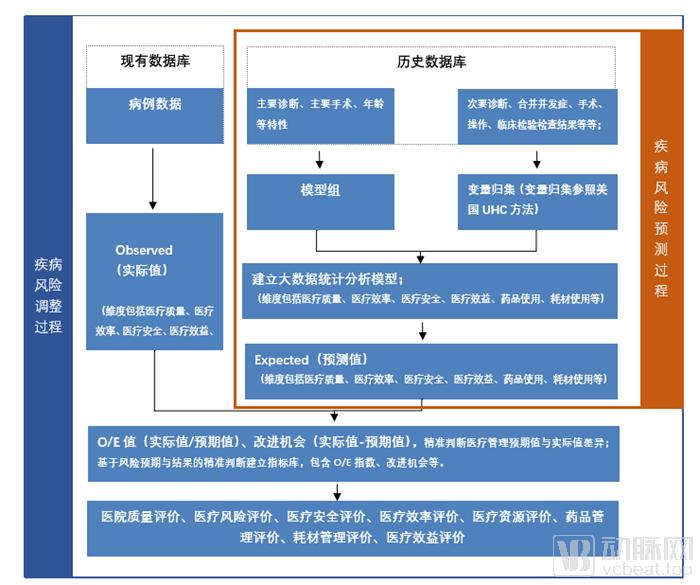
Schematic Diagram of Disease Risk Adjustment
"Disease Risk Adjustment" refers to the process of first using a disease risk prediction model to forecast outcomes across various management dimensions for each case. The actual observed values (Observed) are then compared with the predicted expected values (Expected)—a step known as the adjustment process. Medical outcomes are evaluated based on the resulting ratio coefficient rather than absolute values. Because this approach scientifically reflects the relationship between patient risk levels and treatment outcomes, it is considered fair and reasonable. Consequently, it has gained international recognition and widespread adoption in countries including the United States and Germany, becoming a globally accepted method for healthcare quality assessment and an application for lean hospital management.
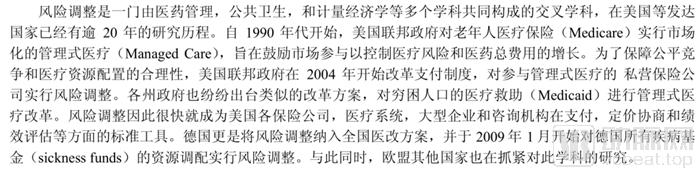
Excerpted from “Application of Risk Adjustment and Predictive Models in International Pharmaceutical Management and Reform,” by Yi Rong, a female who currently serves as Vice President at Verisk Health.
Based on disease risk adjustment methodologies, Houli Information has developed the Hospital Management Intelligent Analysis and Evaluation System (DMIAES). During data collection, DMIAES extracts data from various hospital operational systems, including Hospital Information Systems (HIS), Laboratory Information Systems (LIS), Patient Care Administration Systems (PCAS), and Hospital Resource Planning (HRP) systems, to create inpatient-centered datasets. Through data modeling, more than 60,000 disease risk adjustment models have been established. These models enable multi-dimensional analysis and evaluation of medical quality, efficiency, safety, cost control, medication use, and consumable usage across different dimensions such as hospitals, departments, physicians, and disease types. The evaluation results are applied to hospital management processes—including quality control, operational efficiency improvement, cost-benefit analysis, and performance management—aligning with modern hospital management principles.
Ms. Chen Xia, Executive Vice President and Chief Operating Officer of Houli Information, told VCBeat that DMIAES data extraction requires integration with hospital information systems, while the application of its tools necessitates collaboration across multiple functional departments, including quality control, operations, performance management, IT, and medical records. “Initially, we were concerned about resistance from clinical departments.” Surprisingly, breaking down data integration barriers and enabling interoperability among administrative departments has facilitated more scientific and streamlined business coordination and management, making it easier to implement and carry out related work. Throughout its development, the DMIAES application has garnered high recognition from healthcare management professionals. In their words, “We are truly impressed; we have finally found a specialized team that understands both medical data and hospital management.”
Houli Information positions itself as the “evangelist” of the healthcare industry, winning over clients with professional expertise and driving business expansion through technological capabilities. By promoting its solutions through relentless, suitcase-in-hand business travel, DMIAES has advanced in the healthcare sector with remarkable momentum, akin to operating with an unfair advantage.
On one hand, to meet the hospital management needs of the National Health Commission (NHC), DMIAES was deployed on the NHC’s Regional Quality Supervision Platform. It was applied by the Chengdu Municipal Health Commission in 2016 (for modeling and analysis of data from over 100 secondary-level and above hospitals); in 2017, it was adopted by the Shenzhen Hospital Administration Center (for modeling and analysis of data from more than 10 tertiary hospitals) and the Wenzhou Municipal Health Commission (for modeling and analysis of data from more than 10 tertiary hospitals); in 2018, it was implemented by the Sichuan Provincial Health Commission (for modeling and analysis of data from over 800 secondary-level and above hospitals) and the Hebei Provincial Health Commission (for modeling and analysis of data from more than 40 tertiary hospitals). Houli Information also undertook the construction of the NHC’s Quality Evaluation Platform for Socially-Run Medical Institutions, serving the quality evaluation of socially-run medical institutions nationwide.
On the other hand, hospitals have an inherent need for self-driven lean management improvement. Since 2017, DMIAES has been implemented in numerous well-known tertiary hospitals across China, achieving remarkable results and widespread recognition. As demonstration sites, these hospitals have frequently hosted peer visits, attracting officials from both provincial and National Health Commissions to observe the application of disease risk adjustment and DMIAES. Furthermore, at the 2019 China Hospital Information Network Conference (CHIMA), two outstanding case studies based on disease risk adjustment applications by clients were recognized among only nine national awardees for big data applications in hospitals.
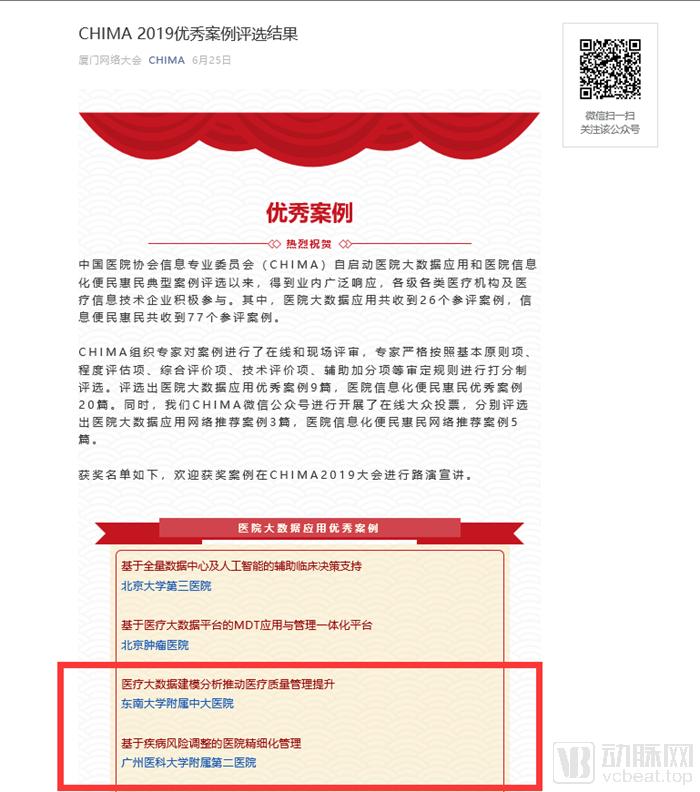
DMIAES Clients Receive CHIMA Excellent Case Study Certificates (Zhongda Hospital Affiliated to Southeast University and The Second Affiliated Hospital of Guangzhou Medical University)
Disease risk adjustment serves as the foundation and cornerstone of medical data analysis and application. However, the utilization of medical data extends far beyond the evaluation of hospital management outcomes. Post-analysis, medical data can serve health commissions, healthcare security administrations, and hospitals, while also assisting both physicians and patients. Risk prediction models help physicians anticipate risks and resource consumption during diagnosis and treatment, providing timely alerts. Furthermore, by matching three key profiles—disease risk, resource consumption, and physician clinical capability—patients can precisely select appropriate hospitals and doctors. This approach not only facilitates effective triage and conserves medical resources but also enables genuine information exchange between physicians and patients. Houli Information has collaborated with multiple institutions to integrate the comprehensive application of medical data across the “pre-event, intra-event, and post-event” stages, thereby establishing a closed loop for professional medical data analysis and application.
In 2015, at its inception, Houli Information secured angel-round financing from a publicly listed company in the healthcare sector, fostering industrial complementarity and jointly promoting the application of DMIAES. In line with Houli Information’s subsequent development and strategic planning, the company is currently initiating its next round of financing.
Ms. Chen pointed out that, compared with pure financial investors, Houli Information places greater emphasis on forming industrial and resource complementarity with its investors. The company has also been seeking like-minded partners to jointly advance in-depth analysis of medical data and maximize its application value within the healthcare industry.