

MindsGo Life Sciences Advances Brain Imaging AI Platform to Simplify Neurological Disease Diagnosis Like Blood Tests

MINDSGO
Medical Imaging Analysis and Health Assessment Service Provider
Mr. Mao Huiwu from Shenzhen Capital Holdings told VCBeat that he felt deeply fortunate as an investor to have participated in MINDSGO’s early-stage financing. Established in April 2016, MINDSGO specializes in providing precise medical imaging analysis services for the healthcare and related industries. In December 2017, MINDSGO launched its angel round of financing, led by Zeekoo Capital, with follow-on investment from Donghai Investment, a subsidiary of Shenzhen Capital Holdings.
“When we first came across this project, MINDSGO’s angel round was nearing its close, with only a small portion of the capital raised,” recalled Mr. Mao Huiwu, with a tinge of regret over nearly missing out on the angel investment in MINDSGO. “Fortunately, we managed to participate in its second financing round.” In December 2018, MINDSGO launched its Pre-A financing round, led by Nankex Angel Investment. Nankex Angel is a fund jointly established by Shenzhen Investment Holdings (SIHC) and Southern University of Science and Technology (SUSTech), and it was among the first batch of sub-funds to sign agreements with the Shenzhen Angel Fund-of-Funds, as well as the first to complete registration and establishment.
Precision medical imaging analysis is no stranger to healthcare professionals. In recent years, the integration of artificial intelligence with medical imaging has become increasingly common, with AI-powered products for early cancer screening in lung and breast cancers, pulmonary nodule detection, and ophthalmic disease screening gradually gaining public attention.
MINDSGO chose the track of “brain imaging + artificial intelligence,” developing the Brain Label precision analysis platform for brain medical imaging. In 2018, as a joint applicant, it participated in the key special project of the 13th Five-Year Plan titled “Research on Prevention and Control of Major Chronic Non-communicable Diseases,” taking charge of building the national big data platform for neurodegenerative disease imaging and developing image interpretation tools. The project was jointly applied for by four national clinical research centers for diseases—Xuanwu Hospital, Tiantan Hospital, Xiangya Hospital, and West China Hospital—with more than 100 hospitals participating. How did this AI medical imaging company, founded in 2016, gain the favor of Shenzhen Capital Holdings and participate in the key special projects of the national 13th Five-Year Plan? VCBeat interviewed Lv Haiyan, co-founder of MINDSGO, to hear him explain the entrepreneurial logic behind MINDSGO.
MINDSGO’s core team graduated from Harbin Institute of Technology and has maintained long-term collaboration with Johns Hopkins University in the field of brain imaging research. Prior to founding the company, Lü Haiyan and his team conducted in-depth research into neurological disorders and AI technology. “Johns Hopkins Hospital is the birthplace of global neurosurgery, and its neurology department has consistently ranked among the top three in the United States. Nevertheless, the hospital’s misdiagnosis rate for brain diseases remains as high as 30%,” Lü Haiyan told VCBeat, noting that this figure may be even higher in China.
In fact, brain disorders such as Alzheimer’s disease, Parkinson’s disease, and depression have gradually become major threats to human health. According to data from the World Health Organization, the global socioeconomic burden attributable to brain disorders accounts for 19% of that of all diseases, surpassing the 11% for cardiovascular diseases and the 7% for cancer.
On the other hand, brain diseases face the dilemma of difficult diagnosis and treatment. As the most complex organ in the human body, the brain still has many unclear pathogenic mechanisms and disease models, and there is overlap in symptoms among different brain diseases, making the diagnosis of brain diseases closely related to scientific research.A new research finding can often change the diagnostic and therapeutic strategies for brain disorders, making neurological diseases perhaps the medical field most in need of AI-assisted support..” said Lu Haiyan.
What makes the situation even more challenging is that neurological disorders typically manifest as chronic conditions, requiring patients to undergo regular follow-up visits. In China, however, hospitals qualified to diagnose and treat such conditions are predominantly concentrated in major metropolitan areas, resulting in high healthcare costs for patients and an inability to meet the demand for medical services. “Neurological disorders may represent the most difficult, complex, and worthwhile area for in-depth research. If the diagnostic and treatment expertise of senior physicians can be transformed into clinical tools through AI technologies and deployed at the primary care level, it could benefit hundreds of times more patients,” said Lv Haiyan.
The integration of brain imaging and AI serves as MINDSGO’s entry point. To structure complex brain imaging data, the primary step is brain parcellation, an area in which MINDSGO holds a first-mover advantage.
Professor Susumu Mori of Johns Hopkins University, Chief Scientist at MINDSGO and inventor of magnetic resonance DTI fiber tracking technology, heDeveloped the world’s first white matter atlas and the only whole-brain atlas globally.This atlas comprises 283 brain regions, achieving a level of granularity that is indiscernible to the naked eye for the vast majority of clinicians.
Furthermore, by integrating MINDSGO’s proprietary NeuroFingerprint technology, we perform image fusion and deep information mining on brain images across different modalities and sequences to construct comprehensive neurofingerprints and establish a standardized neurofingerprint database specific to the Chinese population. Leveraging big data and AI technologies, we enable classification and subtyping of brain diseases, prediction of brain disorders, and assessment of brain health.
“Simply put, neural fingerprinting technology leverages brain parcellation to structure and output multimodal data from specific regions using AI, ultimately storing it as a unique neural fingerprint,” explained Lv Haiyan. “Our goal is to make the diagnosis and assessment of brain disorders as simple as a blood test.”
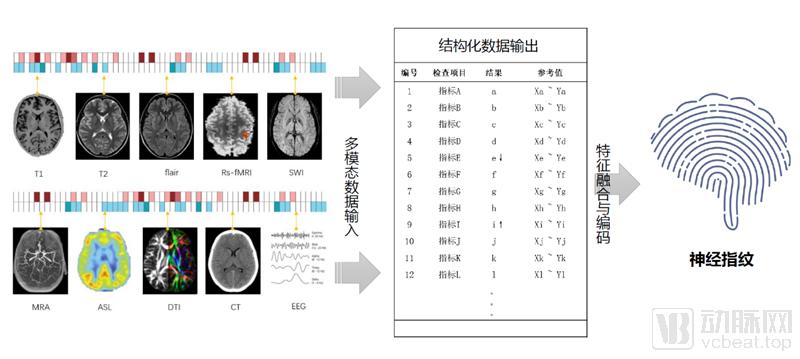
Neural Fingerprint Technology
Brain Label is an AI-powered brain imaging application platform developed by MINDSGO around its NeuroPrint technology. It leverages AI to achieve automated, structured analysis of brain imaging data, offering various functional modules including brain region segmentation, 3D reconstruction, atrophy analysis, and white matter lesion analysis. Building on this foundation, MINDSGO has developed a multimodal portfolio of medical decision-support products, including MRI-based auxiliary diagnostic tools, PET-based auxiliary diagnostic tools, and decision-support systems for neurosurgical procedures.
MINDSGO’s products are developed in accordance with the complete clinical decision-making logic of physicians.Lv Haiyan explained, “The most prevalent form of medical artificial intelligence currently is still narrow AI—machine learning. Many medical AI products on the market are built upon existing open-source systems, using large datasets of specific diseases for disease-specific adaptation. This approach does not actually involve the development of underlying algorithms; it can only be regarded as an application of AI algorithms. Once a new dataset is introduced, this ‘black-box’ AI may no longer guarantee the accuracy of disease recognition. This is why we believe that relying solely on machine learning is not the solution for medical AI at the current stage, and solutions based on a single algorithm are unlikely to become a trend.”
“MINDSGO’s product development is not confined to the continuation or application of a single method or technological outcome. Instead, it targets common challenges along the diagnostic and treatment pathway for brain diseases as its AI R&D objectives, integrating breakthroughs and development in multiple algorithms—including expert knowledge mining, standardized knowledge graph construction, image processing and recognition, and deep learning. The algorithmic results are presented in accordance with the logic of evidence-based medicine, supporting clinicians’ decision-making through a user-friendly interface,” added Lv Haiyan. “Therefore, unlike other companies that require tens of thousands of cases to build a single AI model,”Our medical AI can continuously self-iterate based on a small amount of physician diagnostic data.“This is precisely where our technological advantage lies: BrainLabel does not require large-scale data collection at the outset, as it features a proprietary data learning mode.”
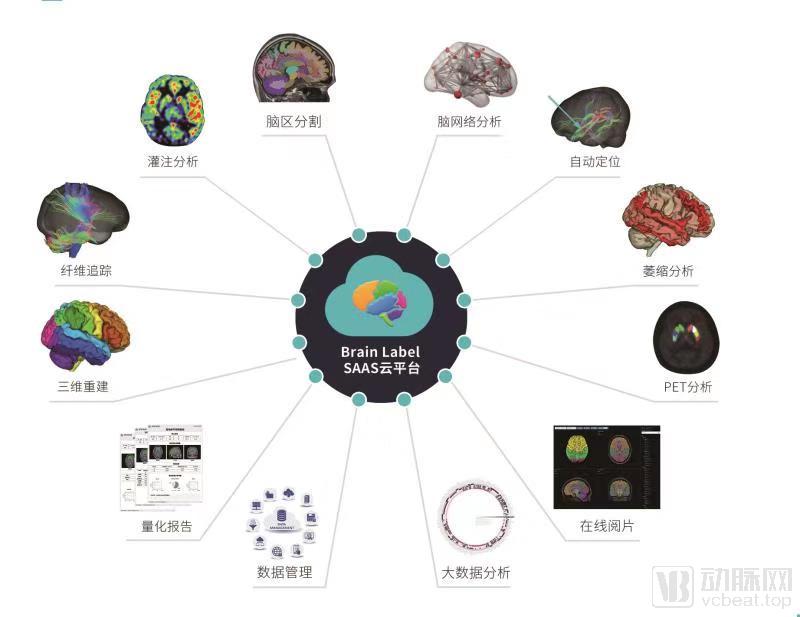
MINDSGO Brain Label Platform
“MINDSGO’s Neuro-Fingerprint technology is a structured and standardized data technology. At the foundational level, it comprehensively mines characteristic information from the human brain and diseases, thereby serving as a tool for generating new knowledge and enabling the development of tailored upper-layer applications for various diseases and needs. Thus, BrainLabel can function as a foundational technology output platform in the field of brain disorders, offering open APIs to companies developing upper-layer applications. In the future, MINDSGO will evolve from merely a software provider into a comprehensive service provider,” said Lv Haiyan.
Due to strict government regulations, medical AI products have generally faced significant challenges in practical implementation. However, there is now positive news regarding the approval of AI-based medical products. In June this year, the National Medical Products Administration (NMPA) officially released the “Key Points for the Approval of Medical Device Software Using Deep Learning for Decision Support,” formally establishing specific criteria for approval through this regulatory document.
The pathway for MINDSGO’s product commercialization has always been a subject of contemplation for Lü Haiyan. “Most medical AI products currently on the market adopt a bottom-up, internet-driven market entry model, leveraging AI technology to drive the healthcare industry by penetrating grassroots hospitals to capture patient traffic or acquire more medical data.” Although Lü Haiyan acknowledges that the ultimate application scenario for AI technology lies in grassroots hospitals, he does not believe that the internet model is suitable for the healthcare industry. “To achieve the commercial implementation of medical AI in the healthcare sector, it is still necessary to collaborate with institutions at the upper end that have the capacity to establish national standards and clinical guidelines, jointly develop products, and introduce new products and technologies into the industry from the top down.”
Leveraging its foundational AI technologies for brain imaging, MINDSGO has developed a comprehensive cloud-based artificial intelligence solution for neuroimaging. The company offers diverse deployment options—including public or private SaaS solutions and data analysis API services—to research institutions, medical facilities, health checkup centers, insurance companies, pharmaceutical firms, and CROs. MINDSGO has established collaborations with leading domestic neurology hospitals such as Xuanwu Hospital, Beijing Tiantan Hospital, Huashan Hospital, and Peking Union Medical College Hospital. Furthermore, as the designated imaging big data cooperation platform for the National Clinical Research Center for Geriatric Diseases (Xuanwu Hospital), MINDSGO provides imaging analysis services to over 400 alliance member units under the National Center.
MINDSGO aims to engage in the formulation of national approval standards for AI medical products or clinical practice guidelines by forging deep collaborations with leading hospitals accredited as National Clinical Medical Research Centers and participating in the construction of key national special projects under the 13th Five-Year Plan. This strategy will enable a seamless transition from research to clinical application as relevant regulations and guidelines are implemented.
MINDSGO has long had a plan for the product's business model.MINDSGO believes that the future commercialization of medical AI will be driven more by services than by the sales of standalone software or medical devices.In response, MINDSGO has adopted an integrated healthcare solution for specialized neurological conditions, combining “neuroimaging analysis products + specialized medical service teams + implementation at healthcare institutions.” It first provides imaging-assisted diagnostic products to stratify patients’ condition severity, then delivers medical services through its specialized care teams, and finally refers patients to partner healthcare institutions for on-the-ground treatment.
Currently, MINDSGO is undergoing a new round of financing, with the funds to be used for team expansion, initiating the registration of Class III medical devices, and other purposes.
Mao Huiwu of Shenzhen Capital Group stated, “Neurological disorders affect a vast patient population, indicating a high market ceiling. We are optimistic about MINDSGO’s innovative capabilities in foundational brain imaging AI technologies, its top-down implementation strategy, and its service-driven business model. We also look forward to the collaboration between the MINDSGO team and Johns Hopkins University bringing new opportunities for the deployment of AI-powered neurological products at the primary care level and for better serving patients.”