

SnapECG Files IPO Prospectus to Address Cardiovascular Health Needs of 290 Million People in China
“The Report on Cardiovascular Diseases in China 2018” shows that, as of 2017, the number of patients with cardiovascular diseases in China reached 290 million. The mortality rate of cardiovascular and cerebrovascular diseases was higher than that of tumors and other diseases, accounting for more than 40% of the total disease-related deaths among residents. One important reason is the low awareness rate of cardiovascular diseases, making it difficult for patients to effectively prevent and control them.
So, how can this challenge be addressed? In fact, patients can monitor their heart rate in real time to detect cardiac abnormalities early, thereby providing physicians with sufficient time for intervention and effectively preventing and controlling cardiovascular diseases. Studies have shown that 72% of patients experience noticeable discomfort before cardiac arrest occurs, and among them, 70% have warning symptoms lasting more than 15 minutes. Real-time monitoring can effectively reduce the severe consequences caused by cardiovascular and cerebrovascular diseases, lowering rates of disability and mortality.
The benefits of real-time monitoring are evident. However, obtaining an electrocardiogram (ECG) at a hospital is cumbersome, requiring dedicated time for the visit and significant waiting in queues. Furthermore, given the unpredictable nature of cardiovascular and cerebrovascular disease onset, hospital-based ECG testing fails to meet the need for continuous real-time monitoring. As preventive care concepts become more widespread, increasing numbers of people seek hospital ECG examinations, which not only squanders medical resources but also causes most individuals to lose considerable time due to queuing and other logistical delays.
To address the aforementioned issues, Nanjing Xijian Information Service Co., Ltd. has introduced mobile ECG devices into users’ homes, enabling more convenient electrocardiogram monitoring. Nanjing Xijian is a company specializing in the field of portable ECG monitoring, offering portable ECG monitoring products and providing cardiac health management services for physicians, patients, and individuals in a sub-health state.
Traditional Medical Device Makers Pivot to Mobile Health, Targeting the Untapped Market for Portable ECG Monitoring
The founder of Nanjing Xijian transitioned from the traditional medical device sector to mobile healthcare. When the first generation of smartphones entered the market, he conceived the idea of bringing chronic disease monitoring and management into the home. After conducting research and analysis, he ultimately chose to focus on the field of ECG monitoring.
As the first-generation mobile smart medical hardware product, “Pocket ECG” had no successful case studies to reference at the time. It was developed entirely by leveraging traditional medical product experience and integrating it with smartphones. The first-generation “Pocket ECG” had to be designed according to smartphone performance capabilities; both the product and app design and usage not only needed to align with the characteristics of smartphones but also comply with medical standards and regulatory requirements. Finally, Nanjing Xijian Information Service Co., Ltd. developed a prototype product in 2012.
In the same year, Nanjing Xijian was selected as a key enterprise under the “Nanjing 321 Leading Entrepreneurial Talent Program” and received RMB 2 million in financial support, thereby opening the door to rapid development:
In December 2013, Nanjing Xijian officially launched its first product.
In September 2014, it secured a multi-million-dollar angel investment from Sinovation Ventures.
In March 2016, it received RMB 45 million in investment from Precision Medicine Baijiahui.
During this period, Nanjing Xijian continuously enriched its service offerings to users, evolving from an initial single-lead ECG monitoring device and mobile app to a later portfolio comprising multiple wearable ECG monitoring devices, an optimized mobile app, and an intelligent big data cloud platform for analytics. According to the "In-Depth Market Research and Investment Prospect Forecast Analysis Report on the ECG Monitor Industry (2018–2023)" published by the New Thinking Industry Research Center, Nanjing Xijian is the largest manufacturer of ECG monitors in China, holding a 25.5% share of the domestic market.
Nanjing Xijian currently uses portable ECG monitoring products as a link to connect patients and doctors. Through mobile apps, it helps doctors build their own patient groups and personal brands, establish stable diagnosis and treatment service relationships, and create Chinese-style family doctors. Nanjing Xijian is committed to shifting the focus of disease management from late-stage treatment to early prevention and follow-up, improving primary healthcare services, addressing the imbalance in medical resources, and better serving the public.
Multiple ECG Monitoring Devices Meet User Needs Across Various Scenarios: Joint B2B and B2C Promotion
Nanjing Xijian’s core product is a handheld ECG monitor, which has obtained EU CE certification and China CFDA certification.
The handheld ECG monitor employs single-lead electrocardiogram monitoring and consists of an ECG data collector and a user-facing mobile application. The collectors are available in patch-style, card-style, wearable, and handheld forms to meet the needs of various scenarios. For instance, the card-style device requires users to simply place their fingertips on the unit to initiate testing; the wearable version is designed for use during physical activity and must be properly positioned on the chest; while the patch-style device is plug-and-play with simple operation, making it suitable for elderly users. After data acquisition, users can connect the collector to a smartphone or tablet installed with the handheld ECG app to generate an electrocardiogram.
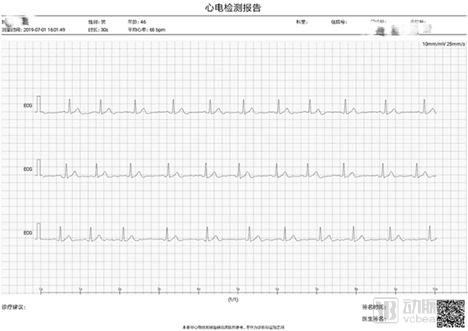
(ECG recorded by the Palm ECG H-19; image provided by Nanjing Xijian)
The H-19 handheld ECG device is currently more popular in the market. The H-19 is a highly convenient ECG monitoring device for out-of-hospital use by patients, suitable for daily arrhythmia screening in high-risk populations. This ECG device features high sensitivity, enhancing the detection of arrhythmia risks. Additionally, to address specific user needs, Nanjing Xijian has introduced the H-09 handheld ECG model as a supplement, which supports on-demand charging to ensure daily usability. All these products can generate electrocardiograms with a single click.
Interpreting an electrocardiogram (ECG) is a specialized skill; how can users make sense of a jumble of waveforms to determine whether their heart is healthy? To address this, Nanjing Xijian Information Service Co., Ltd. offers ECG analysis services. By uploading their recorded ECGs to the Zhangshang Xindian (Handheld ECG) app, users can receive automated ECG monitoring and diagnostic analyses. Additionally, the Zhangshang Xindian app has onboarded licensed physicians, enabling users to send their ECGs to doctors for professional diagnoses and recommendations.
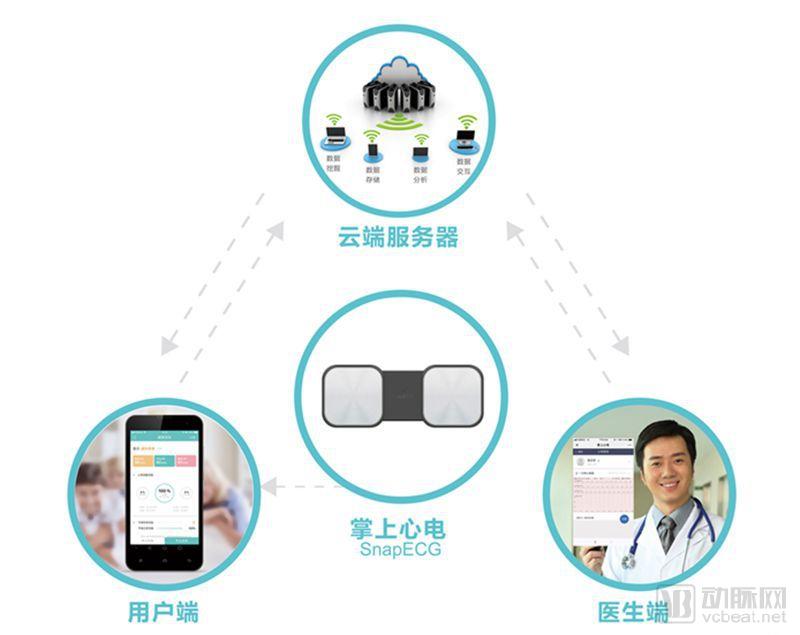
(Palm-sized ECG data transmission process, photo provided by Nanjing Xijian)
With the product in place, how can it reach users? Nanjing Xijian adopts three sales models: online channels, hospital partnerships, and distributors. Its online platforms include JD.com, WeChat Mall, and the company’s official website. Additionally, Nanjing Xijian has partnered with more than 30 hospitals to provide follow-up care services for cardiovascular disease patients. By leveraging both B2B and B2C models, Nanjing Xijian has successfully penetrated the market and gradually grown into China’s largest manufacturer of ECG monitors.
Strive for Product Excellence and Target the Chronic Disease Management Market in the Future
In recent years, numerous companies have entered the out-of-hospital ECG monitoring market. However, transitioning from in-hospital to out-of-hospital settings requires market education and a shift in consumer perceptions, which is a long-term and gradual process. Although cardiovascular disease awareness campaigns have been launched across China, Rome was not built in a day, nor can market transformation be achieved overnight. In light of this, Nanjing Xijian Information Service Co., Ltd. has stated that it aims to refine its products to the highest standard and plans to enter the chronic disease management market in the future.
Mobile chronic disease management in China is still in its infancy, and the market remains immature. Due to patients’ lack of awareness regarding chronic disease management and insufficient medical data, mobile chronic disease management in China still has a long way to go. However, the country’s vast population of chronic disease patients lays a solid foundation for the development of this sector. According to the Joint Research Report on China’s Healthcare Reform, jointly released by the World Health Organization, the National Health and Family Planning Commission, and other institutions, the number of chronic disease patients in China has exceeded 260 million, with their treatment costs accounting for more than 70% of the nation’s total healthcare expenditures. This clearly indicates that the chronic disease management market represents a significant opportunity.
According to the "Medium- and Long-Term Plan for the Prevention and Control of Chronic Diseases in China (2017–2025)," efforts will be made to reduce the premature mortality rate from cardiovascular and cerebrovascular diseases, cancer, chronic respiratory diseases, and diabetes among people aged 30–70 by 10% by 2020 compared with 2015, and by 20% by 2025. Nanjing Xijian stated: “Nanjing Xijian aims to become a leader in the out-of-hospital ECG monitoring market, making mobile ECG devices simpler and introducing them into ordinary households to serve public health.”