

JD Health Appointed Vice Chair of Internet Hospital Committee of Chinese Research Hospital Association, Driving Collaboration with Medical Institutions
In 2019, China entered the 10th year of its “New Healthcare Reform.” As the reform moved into its “deep-water zone,” internet technology has become a powerful support for addressing reform challenges. In recent years, the State Council has successively issued the Outline of the “Healthy China 2030” Plan and the Guiding Opinions of the State Council on Actively Promoting the “Internet Plus” Action, laying out strategic plans for the development of the “Internet Plus” healthcare industry.
Driven by policy incentives and technological advancements, the internet healthcare industry has achieved rapid growth. Statistics show that enterprises with “Internet Hospital” in their names are increasing at a rate of two per week. However, as this industry is still in its early stages of development, many issues require urgent resolution, such as the lack of unified standards for operations and management, the need for further improvement in regulatory frameworks, and the necessity for guidance and promotion from relevant industry organizations.
In this context, on July 20, the China Research Hospital Association held its High-Level Forum in Hainan and announced the establishment of the Internet Hospital Branch of the China Research Hospital Association.
The Chinese Research Hospital Association is a national first-tier academic society officially approved and registered with the Ministry of Civil Affairs of China. Since its establishment, it has been committed to organizing its members to strengthen theoretical and practical research on research-oriented hospitals and promoting academic exchanges both domestically and internationally. Meanwhile, adhering to translational medicine as its core, the association actively explores new models for hospital development. The establishment of the Internet Hospital Branch aims to study and guide the industry from aspects such as policy research, diagnostic and treatment standards, technical specifications, industry self-regulation, and industrial development, thereby advancing the progress of the “Internet + Healthcare” industry.
Meanwhile, in recognition of his contributions to implementing the national “Internet + Healthcare” strategy and the value created in promoting the decentralization of medical resources and achieving online-offline integration of healthcare services, the Society appointed Mr. Xin Lijun, CEO of JD Health, as its Vice President.
“The Society needs the participation of leading enterprises in this industry,” stated President Wen Jian, Head of the Internet Hospital Branch of the Chinese Research Hospital Association, at the summit. “JD.com possesses comprehensive and robust technological capabilities, with a clear strategic vision and direction for its development in the healthcare sector. We believe that JD Health has the potential to become an industry leader and play a more significant role in driving the comprehensive and rapid development of China’s ‘Internet + Healthcare’ initiative.”
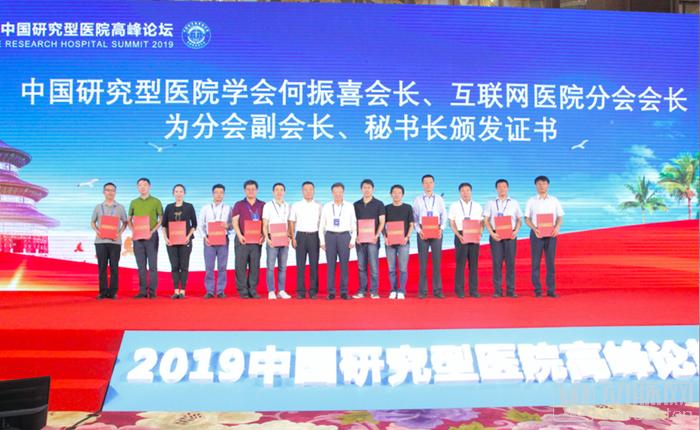
The establishment of the Internet Hospital Branch of the Chinese Research Hospital Association was announced at the meeting. (Source: Photo provided by the enterprise)
In early 2019, the “Internet + Healthcare White Paper” released by Kantar Consulting indicated that various stakeholders in the traditional healthcare sector—including hospitals, patients, and physicians—had long been plagued by numerous pain points. The rise of the internet has provided a wealth of solutions. Encouraged by supportive policies, internet hospitals have experienced rapid development since 2018, with consultation volumes accelerating accordingly.
In recent years, JD Health has been actively expanding its presence in the internet healthcare industry and, centered on patient needs, has launched online medical services on the JD platform, including online consultations and appointment scheduling.
Launched in December 2017, “JD Internet Hospital,” as the core product of JD Health’s internet medical services segment, is among the first batch of internet hospitals in China to obtain an internet hospital license. Users can not only quickly find suitable doctors for online consultations on JD Internet Hospital but also conduct follow-up visits and chronic disease management online after initial offline hospital consultations. This means that people can access professional medical consultations through the internet hospital, with follow-up visits available from the comfort of their homes, eliminating the hassle of travel.
Meanwhile, leveraging its unique advantages in the pharmaceutical supply chain, JD Health pioneered the industry’s first online “medical consultation + medication” closed-loop system. After a consultation, patients can purchase medications directly on the JD platform and enjoy home delivery services, truly realizing a user-centric, comprehensive, smart, and convenient experience for medical care and drug procurement.
Currently, physicians on the JD Internet Hospital platform hail from 327 cities across 32 provincial-level administrative regions in China. Among them, 60% are affiliated with Grade A tertiary hospitals, and 78% hold attending physician positions or higher. During this year’s JD 618 Shopping Festival, the volume of online consultations on JD Internet Hospital surged by a factor of 36.2 year-on-year, while the transaction value of psychological counseling services increased by a factor of 9.3 year-on-year, establishing it as one of the fastest-growing internet healthcare platforms in the industry.
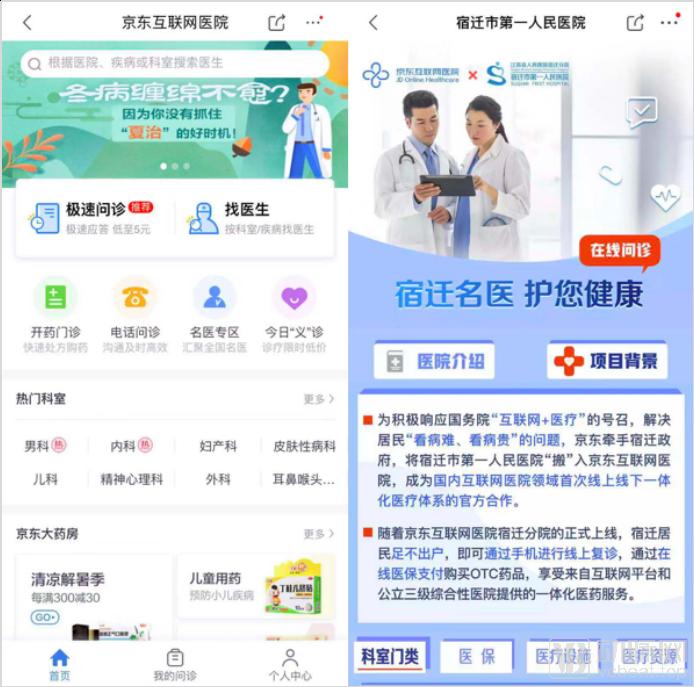
JD Internet Hospital (Source: Corporate Photo)
With the further upgrading of the internet healthcare industry, supply chain-integrated internet hospitals that unify online and offline services have become a key trend in sector development. Taking Suqian First People’s Hospital (Suqian Branch of Jiangsu Province Hospital) as an example, in January 2019, the hospital fully migrated its operations to the JD Internet Hospital platform. This move truly achieved the integrated connectivity of online and offline medical resources and services, thereby providing stronger guarantees for both resource allocation and operational efficiency.
Meanwhile, with the systematic integration of Suqian’s medical insurance system with JD.com, Suqian saw the emergence of the “first individual to use online medical insurance payment” on a pharmaceutical e-commerce platform, marking a epoch-making step. Thus, JD.com has achieved an internet-based closed loop of “medical care, pharmaceuticals, and medical insurance” in Suqian, creating a patient-centric “Smile Healthcare Curve” that connects “care–drugs–insurance,” delivering to consumers a truly integrated online-to-offline experience for medical consultations and medication purchases.
The comprehensive integration of JD Internet Hospital with Suqian First People's Hospital marks the first online-offline integrated collaboration between a public hospital and a platform-based internet hospital in China. Currently, JD Health is collaborating with multiple top-tier hospitals across China, leveraging JD’s technological leadership to implement patient-centric solutions that span the entire healthcare journey. By creating smart hospital solutions that integrate online and offline services, JD Health facilitates seamless interconnectivity among medical institutions in a flexible and efficient manner. This digital empowerment enhances the quality of diagnosis and treatment provided by healthcare professionals, delivers a superior patient experience, and continuously drives innovation in medical services.
At the conference, Xin Lijun, CEO of JD Health, accepted the letter of appointment and stated, “JD Health will continuously leverage its superior resources and capabilities to empower healthcare industry reform through technology. With a patient-centric approach, we will actively promote collaboration with medical institutions to facilitate the optimized allocation of healthcare resources.”
It is reported that JD Health officially began independent operations in May this year as a subsidiary group under JD.com, focusing on big health-related businesses. Currently, based on its four core business segments—pharmaceutical and healthcare e-commerce, internet healthcare, health services, and smart solutions—JD Health has initially achieved coverage across the entire pharmaceutical industry chain, the full medical service process, all health scenarios, and the entire user lifecycle. It has built the most extensive and comprehensive “Internet + Healthcare” ecosystem in the industry.