

Wuhan Langdi Remote Medical Files IPO Prospectus to Build China's Largest ECG Information Database
In 2014, the State Council, the National Health and Family Planning Commission, and the China Food and Drug Administration successively issued documents emphasizing the importance of developing telemedicine and providing specific guidance, accelerating the construction of telemedicine platforms. Riding on the momentum of these supportive policies, Wuhan Langdi Telemedicine Technology Co., Ltd. (hereinafter referred to as “Wuhan Langdi”) was established in September 2014.
Wuhan Langdi is a professional high-tech enterprise specializing in telemedicine, integrating research and development, production, and sales. Its flagship product, the Zhongke Xindian Remote Real-Time Dynamic ECG Monitor, is currentlyThe Only ECG Monitoring Product in China Capable of Simultaneously Meeting the Four Criteria of Remote, Real-Time, Dynamic, and Diagnostic Functionality, among which the 7-lead remote real-time dynamic ECG monitor and the AI-powered ECG analysis system are unique to the industry and maintain a leading position.
Wuhan Langdi was not the first company founded by its chairperson, Liu Qing. Prior to establishing Wuhan Langdi, she had successively founded a pharmaceutical company and a diagnostic reagent R&D company. A review of Liu Qing’s 20-year entrepreneurial journey reveals that she has consistently aligned her companies’ business scopes with national policy directions.
In 2000, Liu Qing first entered the healthcare sector by establishing a pharmaceutical company. “Starting in 2001, public hospitals began implementing centralized volume-based procurement for drugs through tendering, which fostered lawful competition in the pharmaceutical market,” said Liu Qing. “Later, as national policies were introduced to reduce the proportion of drug expenditures in total medical costs, the pharmaceutical industry faced certain constraints, prompting me to consider a career change.”
Subsequently, Liu Qing entered the in vitro diagnostics (IVD) industry. At its peak, the IVD reagents independently developed by Liu Qing’s company accounted for 80% of the national market share in China.
In 2014, the Chinese government issued the “Notice on Promoting Telemedicine Services in Medical Institutions,” which spurred the rise of telemedicine. At that time, Liu Qing’s team began to consider entering the telemedicine sector.
In fact, as early as the initial stage of internet popularization more than a decade ago, Liu Qing noticed a phenomenon: the uneven distribution of medical resources, with tertiary hospitals overcrowded and community health centers largely ignored. This led her to focus on telemedicine. “At that time, due to limitations in internet and communication technologies, we could only conduct light consultations via platforms such as QQ and the video chat features of instant messaging software, providing medical support to grassroots areas through remote guidance.”
In 2014, with the widespread adoption of 4G and a significant boost in internet transmission capacity, the mobile internet began to rise. Liu Qing decided to establish Wuhan Langdi, starting with ECG monitors to promote the development of telemedicine.
When asked why he chose to enter the telemedicine field by starting with ECG monitoring devices, Liu Qing cited two reasons.
First, arrhythmia requires long-term, continuous 24-hour monitoring. Conventional electrocardiogram (ECG) equipment provides very limited information due to the short duration of testing. Furthermore, since most cardiac events and resulting sudden deaths occur outside hospital settings, reliance solely on in-hospital examinations is far from sufficient.
In cardiovascular diseases, sudden cardiac death is a leading cause of mortality, often resulting in fatality within an extremely short period. Abnormal electrocardiographic (ECG) information is characterized by its transient nature and difficulty in preservation; symptoms such as palpitations and heart flutters are often fleeting and thus fail to attract adequate attention. Liu Qing’s viewpoint has received unanimous endorsement from top domestic cardiovascular experts: “Sudden cardiac death has precursors, but they are often overlooked.” ECG monitoring can record abnormal ECG data and provide timely warnings.
Second, blood pressure and blood glucose monitoring data are presented in numerical form, allowing users to clearly understand the metrics and engage in self-management. In contrast, electrocardiogram (ECG) data are displayed as waveforms, which require interpretation and guidance by physicians. Users cannot interpret these results on their own and need professional medical intervention.
It is reported that the annual number of sudden cardiac deaths in China reaches as high as 570,000. In 2019, the National Center for Cardiovascular Diseases released the "Report on Cardiovascular Diseases in China 2018." The report indicated that the prevalence of cardiovascular diseases in China has been on a continuous rise, with the mortality rate ranking first among all disease categories and accounting for more than 40% of all causes of death among residents. One of the contributing factors to cardiovascular diseases is arrhythmia.
Liu Qing stated, “There are approximately 300 million patients with cardiovascular disease in China, yet only 300,000 physicians possess the foundational knowledge of cardiac electrophysiology required to interpret electrocardiograms (ECGs).” In hospital settings, it typically takes a physician 30 minutes to analyze a single ECG report. By adopting remote monitoring, physicians can simultaneously monitor multiple patients and directly review ECG waveforms generated by the system, thereby significantly enhancing their work efficiency.
To meet the demand for daily ECG monitoring, Wuhan Langdi, shortly after its establishment, launched its flagship product—the Zhongke Xindian Remote Real-Time Dynamic ECG Monitor.
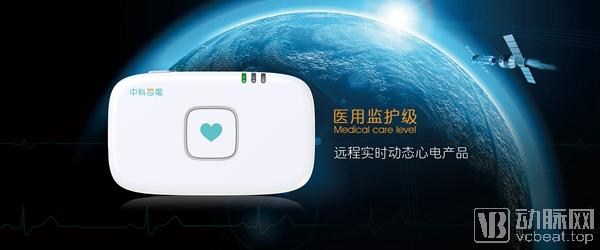
Zhongke Xindian Remote Real-Time Dynamic ECG Monitor (Image from the company's official website)
The Zhongke Xindian Remote Real-Time Dynamic ECG Monitor employs world-leading vital sign sensing and communication technologies. Weighing only 39 grams, it achieves the goals of enhancing adjunctive diagnosis and treatment of heart disease, preventing sudden cardiac events, and reducing cardiac mortality through real-time, continuous recording and monitoring of electrocardiographic data.
This remote real-time dynamic ECG monitor consists of a data collector, lead wires, specialized electrodes, an ECG analysis and management system, smart terminals, and servers. It enables real-time upload of dynamic ECG data every second, performs data analysis every 6 seconds, and conducts warning analysis every 60 seconds. Its sampling accuracy and sampling rate far exceed domestic standards. The company’s independently developed AI-based ECG analysis achieves an accuracy rate of over 92%, providing a basis for physicians to assess patients’ conditions and deliver timely treatment.
As the sole remote ECG monitoring product designated by the Chronic Disease Monitoring and Prevention Engineering Technology Center of the China Internet of Things Research and Development Center, this product currently provides six common diagnostic categories based on arrhythmias: tachycardia, supraventricular premature beats, irregular RR intervals, ventricular premature beats, bradycardia, asystole, and normal ECG.
Based on the different application scenarios of the Zhongke Xindian remote real-time dynamic ECG monitor in medical institutions at all levels, Wuhan Langdi has established three business lines.
Telemetry ECG Monitoring Services: Provide in-hospital monitoring, continuous ECG nursing monitoring, and early warning alarm services for patients in tertiary hospitals;
Remote ECG Diagnosis Services for Tiered Diagnosis and Treatment: Provide 24- to 72-hour ambulatory ECG monitoring for outpatients and inpatients at primary care hospitals, establish networks and platforms, and have upper-level or central hospitals provide interpretation and diagnostic services for ambulatory ECG;
ECG Cloud Business: Extend the in-hospital ECG platform capabilities of individual medical institutions to models such as urban medical consortia, county-level medical communities, ECG specialty alliances, and telemedicine collaborations. Provide ECG data acquisition and workflow management, integrate with health insurance and Hospital Information Systems (HIS), and offer services including patient appointment scheduling and remote registration. Achieve data interoperability, mutual recognition of results, and single-disease analysis; establish an ECG database as a vital component of national personal health records; and simultaneously meet the four core needs of medical institutions and regulatory authorities: clinical care, education, research, and management.
According to a joint report released by GSMA and PwC, China’s medical monitoring services market is projected to reach $1.2 billion by 2017. Within this sector, the consumer-grade medical monitoring device market holds significant potential, and Wuhan Langdi is actively promoting its ECG monitors to households and individual consumers.
“In the consumer market, blood glucose and blood pressure monitors are highly popular. However, electrocardiogram (ECG) is a more vital sign that deserves greater attention and real-time monitoring.” Given China’s base of 300 million cardiovascular patients alone, the market for consumer-grade wearable ECG monitoring devices exceeds RMB 100 billion. Leveraging its robust technological capabilities, a top-tier domestic ECG expert team honed over several years, and its existing ECG big data platform along with a talent pool skilled in AI algorithms, Wuhan Langdi has emerged as an industry leader. Liu Qing projects that by 2020, Wuhan Langdi’s ECG monitors will achieve RMB 30 million in sales within the consumer market, with growth rates reaching several-fold to tenfold annually over the subsequent three to five years.
“China has a huge population, yet it lacks its own ECG database,” said Liu Qing. “Since the company’s inception, my goal has not been to develop individual ECG monitoring devices, but to establish an ECG data repository.”
Electrocardiographic (ECG) data serve as a critical diagnostic basis for the screening, early warning, and diagnosis of major cardiovascular diseases. The big data analysis, accumulation, refinement, and summarization of ECG information can significantly enhance the quality of diagnosis and treatment for cardiovascular diseases. Furthermore, leveraging big data from ECG records enables scientific screening and intervention for high-risk populations in China, thereby promoting the establishment of a national system for cardiovascular disease prevention and tiered diagnosis and treatment.
Liu Qing noted that the electrocardiogram (ECG) information database constitutes the company’s core competitive advantage. “While there is a plethora of ECG monitoring hardware products on the market, individual products are highly susceptible to substitution by competitors. We have strategically focused on building our database. By collaborating with government agencies, as well as top-tier cardiovascular hospitals and physicians in China, we have established regional ECG information databases and monitoring platforms. This approach has enabled us to secure critical medical resources, thereby creating an irreplaceable competitive edge.”
Wuhan Langdi has successively partnered with numerous hospitals and government agencies to establish ECG big data centers, including Fuwai Hospital of the Chinese Academy of Medical Sciences, Renmin Hospital of Wuhan University, and Nanjing Health Information Center. Upon completion of these ECG big data centers, affiliated healthcare institutions can utilize the Zhongke Xindian remote real-time dynamic ECG monitors to perform real-time online monitoring and remote diagnosis of patients’ electrocardiogram (ECG) data. Furthermore, the collected ECG data can be leveraged for big data analytics to advance research in cardiovascular diseases.