

SlaapLekker: An 'Unnoticeable' AI-Powered Health Monitoring Solution for Seniors by Bobo Tech, Co-Founded by Alibaba Alumni and Eindhoven University of Technology
Art stems from life, and technology is no exception. The original intention behind Zhang Biyong’s entrepreneurship in founding Hangzhou Bobo Technology Co., Ltd. (abbreviated as: Bobo Technology) was inseparable from his filial devotion to his parents.
Like all students studying abroad, Zhang Biyong was unable to keep a constant watch on his parents’ health while pursuing his studies in the Netherlands.
Zhang Biyong holds a Master’s degree in Computer Science and a Ph.D. in Human-Computer Interaction Engineering from Eindhoven University of Technology in the Netherlands. During his academic tenure, he participated in research on Allura Xper medical big data analytics and three-dimensional imaging systems for magnetic resonance imaging (MRI) scanners at Philips Healthcare Electronics.
Eindhoven, the Netherlands, is the birthplace of Philips. As one of the “Big Three” in the global healthcare industry, Philips has long prioritized innovation in health technology. The company has undertaken numerous research collaborations with Eindhoven University of Technology, dedicated to translating the latest scientific advancements into clinical practice. Zhang Biyong studied in this academic environment for ten years.
An event in 2012 altered the course of Zhang Biyong’s life. At the end of that year, Zhang returned to China after studying abroad in the Netherlands. He had expected his parents to pick him up at the airport, but instead learned that his father had been hospitalized due to illness a week earlier. On the very day Zhang returned, his father was undergoing brain surgery with only a 50% success rate. Yet Zhang had been completely unaware of this situation beforehand.
When Zhang Biyong recounted this episode to a reporter from VCBeat (WeChat ID: vcbeat), he lamented that his generation—the only children born in the 1980s—had paid insufficient attention to their parents. Some went abroad, while others moved to coastal cities for career development; as a result, many were unable to live with their parents, leading to inadequate attention being given to their parents’ health issues. It was at that moment that Zhang Biyong conceived an idea: to leverage his expertise to enable children living far from home to monitor their parents’ health conditions in real time.
Before founding the company, Zhang Biyong served as a user research expert and product expert at Alibaba Group. At Alibaba, more than 90% of employees are from other regions, making it common for them to live far from their hometowns. This situation resonated with Wang Bin, also an Alibaba employee, who similarly neglected attention to his parents' health.
Wang Bin, a native of Xinjiang, serves as a technical expert at Alibaba Group. Holding a Master’s degree in Computer Engineering from Tsinghua University, he has lived apart from his elderly parents for many years since leaving home to pursue his education. When Zhang Biyong shared his entrepreneurial idea with Wang Bin, the two immediately hit it off.
A promising project naturally requires financial support. An angel investor specializing in supporting Alibaba employees’ entrepreneurial ventures extended an olive branch to them. Zhang Biyong returned to Europe and presented his startup plan to his former mentor, Professor Hu Jun. The idea received high acclaim; Professor Hu Jun believed it was a project with significant social value and broad market prospects.
In May 2016, the initial founding team of SLAAP LEKKEP was assembled. Subsequently, the International Smart Health Laboratory, jointly established by SLAAP LEKKEP and Eindhoven University of Technology in the Netherlands, was officially launched, further enhancing SLAAP LEKKEP’s R&D capabilities. With the team in place, the next step was to select an appropriate product format to bring the idea to fruition. SLAAP LEKKEP’s initial positioning was to develop a remote health monitoring product for the elderly, which relies on various sensor technologies to capture users’ physiological signals.
SLAAP LEKKEP conducted multiple discussions to select the appropriate information collection technology and ultimately chose BCG (ballistocardiography). BCG refers to a series of corresponding periodic movements of the human body induced by cardiac pulsations, which are recorded using sensitive instruments and depicted as waveform graphs.
The reason for choosing BCG is its significant advantage: non-intrusive data collection. Zhang Biyong put himself in the shoes of the elderly, stating, “Many older adults struggle even with charging their mobile phones, let alone operating complex health devices. BCG technology perfectly addresses this issue. Once the relevant equipment is installed, it can silently monitor their health without disturbing their sleep, requiring no action from the elderly users.”
With the technical roadmap finalized, the company began developing and implementing relevant algorithms. By 2017, the “breakthrough” seemed imminent, but an unexpected setback occurred.
Zhang Biyong told reporters that the entire R&D process was conducted in Europe at the time, which quietly planted a hidden risk for SLAAP LEKKEP. In 2018, as all R&D efforts were nearing completion, SLAAP LEKKEP began preparing for mass production of its products. However, the supplier of product components refused to provide large-scale supplies to the Chinese company at that juncture. According to relevant EU international agreements, components may be supplied to corporate entities for R&D purposes, but not to Chinese enterprises for mass production.
The supply source for components has been cut off, forcing SLAAP LEKKEP to urgently return to China in search of alternative components. The new components require fresh testing and adjustments. Whether the company’s funding can sustain SLAAP LEKKEP through this phase remains uncertain, posing a significant test for the enterprise.
This search lasted eight months. Zhang Biyong told reporters that when they were looking for new component suppliers, many vendors overlooked startups like theirs, focusing instead on large enterprises with substantial supply demands. Moreover, SLAAP LEKKEP required customized components, making such needs even more difficult to meet.
After comparing multiple suppliers, a suitable manufacturer was identified. Recognizing SLAAP LEKKEP’s leading technology in artificial intelligence algorithms, the manufacturer determined that this technology could maximize the performance of its components and consequently entered into a partnership with SLAAP LEKKEP. Living up to expectations, SLAAP LEKKEP impressed the new supplier with its “R&D achievements” during an evaluation conducted in March and April of this year, prompting the supplier to decide on providing customized components to the company.
This product, which demonstrates value to suppliers, has been named “SLAAPLEKKER” by Bobo Technology. SLAAPLEKKER can be understood as a big data analytics platform based on BCG biosignals. Installed beneath the user’s mattress, it captures more than ten types of physiological signals—such as heart rate, respiratory rate, sleep posture, and AHI index—without the user’s awareness.
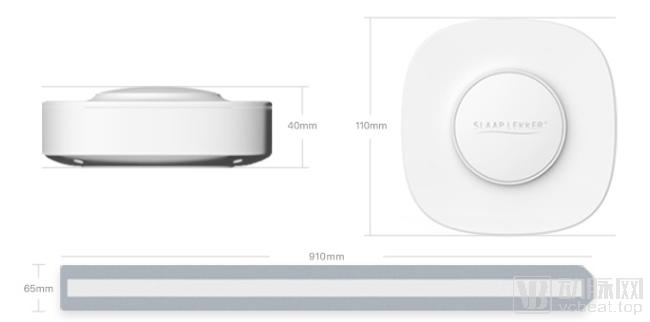
SLAAPLEKKER Product Image
Unlike traditional wearable devices that detect human physiological signals, the most significant distinction of SLAAP LEKKEP is that it no longer merely presents cold, impersonal data such as heart rate or respiratory rate. Instead, it provides users with auxiliary diagnostic screening and risk warning functions for various diseases, including screening for arrhythmias, atrial fibrillation, sleep apnea-hypopnea syndrome, and cardiac arrest, as well as screening for sleep disorders and early warning of stroke risk.
SLAAP LEKKEP began selling products to consumer customers in May of this year, allowing users to monitor their parents' health status remotely after purchase.
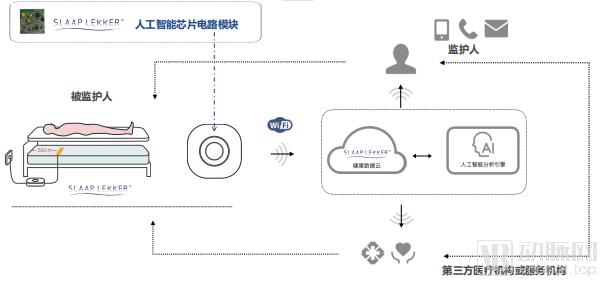
Remote Monitoring Schematic Diagram
In addition, SLAAP LEKKEP has partnered with more than ten nursing homes and hotels to provide value-added services for their customers, enabling them to receive a health report after sleep. Of course, the value of SLAAP LEKKEP’s technology extends beyond this; the company is engaging in multiple collaborations and research initiatives to apply its technology to monitor the physical health status of special populations in specific scenarios, such as pilots, long-haul drivers, and athletes.
Enabling a “health check-up” during sleep, this technology from SLAAP LEKKEP has vast application scenarios. The company is seeking new partnerships to maximize the value of its technology.