


BeautyU.S. FDA Approves Celgene’s Otezla for the Treatment of Oral Ulcers Associated with Behçet’s Disease
Celgene Announces U.S. FDA Approval of Otezla (apremilast) 30 mg Twice Daily (BID) for the Treatment of Oral Ulcers Associated with Behçet’s Disease, Marking the First and Only FDA-Approved Therapy for This Condition
Otezla is an oral, selective phosphodiesterase 4 (PDE4) inhibitor
In the randomized, placebo-controlled, double-blind Phase 3 clinical trial RELIEFTM, 207 adult patients with Behçet’s disease and active oral ulcers were enrolled; these patients had previously received treatment with at least one non-biologic agent and were candidates for systemic therapy.
At Week 12, Otezla 30 mg twice daily (BID) resulted in a 42.7-point greater reduction from baseline in oral ulcer pain, as measured by the Visual Analog Scale (VAS), compared with placebo. At Week 12, the proportion of patients achieving complete resolution of oral ulcers (i.e., absence of oral ulcers) was 52.9% in the Otezla group versus 22.3% in the placebo group.
SurgiMab Announces That Its Investigational Fluorescent Tumor-Specific Antibody SGM-101 Has Entered Pivotal Phase 3 Clinical Trials
SurgiMab Announces That Its Investigational Fluorescent Tumor-Specific Antibody SGM-101 Has Entered Pivotal Phase 3 Clinical Trials. The Antibody Has Been Used to Improve Surgical Outcomes in Patients with Colorectal Cancer (CRC) and Has Yielded Positive Results
SGM-101 is a tumor-specific antibody conjugated to a fluorescent dye.
Phase II trial: SGM-101 for detecting residual tumor tissue, with conventional surgery as the control
As an intraoperative imaging agent, SGM-101 can detect residual tumor tissues that are undetectable by other methods. In 35% of patients with recurrent or peritoneal metastatic colorectal cancer (CRC), the use of SGM-101 improved surgical procedures, enabling the resection of more tumor tissue or less healthy tissue.
Dicerna Announces FDA Grants Breakthrough Therapy Designation to Its Investigational RNAi Therapy for the Treatment of Primary Hyperoxaluria Type 1 (PH1)
Dicerna Pharmaceuticals Announces That the U.S. FDA Has Granted Breakthrough Therapy Designation to Its Investigational RNAi Therapy DCR-PHXC for the Treatment of Primary Hyperoxaluria Type 1 (PH1)
DCR-PHXC is currently the only RNAi therapeutic approved for the treatment of all types of primary hyperoxaluria (PH).
Phase I Clinical Trial in Patients with PH1 and PH2: A Comparison with Standard Therapy
Urinary oxalate levels were substantially reduced 24 hours after dosing in patients with PH1 and PH2. A single dose of DCR-PHXC enabled most patients to achieve normal or near-normal urinary oxalate levels.
Astellas Submits Biologics License Application (BLA) for Antibody-Drug Conjugate (ADC) Co-Developed with Seattle Genetics to the U.S. FDA
Astellas Pharma and Seattle Genetics jointly announced the submission of a Biologics License Application (BLA) to the U.S. FDA for enfortumab vedotin, an antibody-drug conjugate (ADC) co-developed by the two companies.
Enfortumab vedotin is an antibody-drug conjugate (ADC) that links an anti-Nectin-4 monoclonal antibody to the microtubule-disrupting agent MMAE.
Inclusion Criteria and Study Design: In the pivotal Phase 2 clinical trial, 125 patients received enfortumab vedotin. These patients included those who were refractory to PD-1/L1 inhibitors and those who had received more than three prior lines of therapy.
Enfortumab vedotin achieved an objective response rate of 44% in these patients. The duration of response was 7.6 months. The median overall survival was 11.7 months, and the median progression-free survival was 5.8 months.
Mechanism of Action of Enfortumab Vedotin
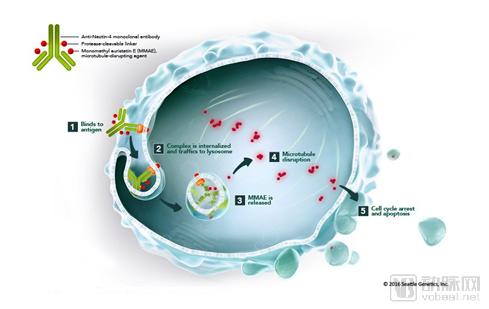
Data source: Seattle Genetics
Neon announced that its personalized neoantigen cancer vaccine significantly prolonged progression-free survival (PFS) in patients with melanoma, non-small cell lung cancer (NSCLC), and bladder cancer.
Neon Therapeutics Announces That Its Personalized Neoantigen Cancer Vaccine Prolonged Progression-Free Survival in Patients with Melanoma, Non-Small Cell Lung Cancer (NSCLC), and Bladder Cancer in Early-Stage Clinical Trials
Mechanism of Action: NEO-PV-01 is a “tailor-made” personalized neoantigen vaccine
Inclusion Criteria and Study Design: In a multicenter Phase 1b clinical trial, patients with advanced or metastatic melanoma, smoking-related non-small cell lung cancer (NSCLC), and bladder cancer received combination therapy consisting of NEO-PV-01 and Opdivo (nivolumab).
Compared with historical data for Opdivo monotherapy, the combination therapy prolonged progression-free survival (PFS) in patients with all three types of cancer. At a median follow-up of 13.4 months, the median PFS had not been reached in patients with melanoma, whereas the median PFS was 5.6 months in patients with non-small cell lung cancer (NSCLC) and bladder cancer.
GlaxoSmithKline (GSK) Announces Positive Results from Phase 3 Clinical Trial of PARP Inhibitor Zejula
GlaxoSmithKline (GSK) announced that its PARP inhibitor Zejula (niraparib) achieved positive results in the Phase 3 PRIMA clinical trial.
Zejula is a key PARP inhibitor acquired by GSK following its $5.1 billion purchase of TESARO last year.
In the Phase II clinical trial, treatment was administered to patients with BRCA gene mutations and homologous recombination deficiency.
Efficacy was observed in ovarian cancer patients with BRCA mutations (overall response rate, 29%) and in those without BRCA mutations but with homologous recombination deficiency (overall response rate, 15%).
RemeGen Announces Key Clinical Study Results of Its Self-Developed Biologic Drug RC18 for the Treatment of Systemic Lupus Erythematosus (SLE)
RemeGen Co., Ltd. (Yantai) Releases Key Clinical Study Results of Its Self-Developed Biologic New Drug RC18 (Generic Name: Telitacicept; Brand Name: Taiai) for the Treatment of Systemic Lupus Erythematosus (SLE)
Telitacicept can simultaneously inhibit the two cytokines BLyS and APRIL.
In a multicenter, randomized, double-blind, placebo-controlled study, 249 patients with systemic lupus erythematosus (SLE) were enrolled to evaluate the efficacy and safety of telitacicept in treating SLE subjects.
The difference in clinical response rates between the telitacicept treatment group and the placebo control group was statistically significant, thereby meeting the primary endpoint of the clinical trial. Specifically, the 48-week response rate in the high-dose telitacicept group was 79.2%, compared with 32.0% in the placebo control group.
CDE Accepted the Clinical Trial Application for Hanmi Pharmaceutical’s Poziotinib, a Drug Targeting Exon 20 Insertion Mutations in Lung Cancer
According to the New Drug R&D Monitoring Database, the Center for Drug Evaluation (CDE) has recently accepted the clinical trial application from Hanmi Pharmaceutical Co., Ltd. for poziotinib, a drug targeting exon 20 insertion mutations in lung cancer.
Poziotinib, developed by Hanmi Pharmaceutical, is a novel oral quinazoline-based pan-HER inhibitor currently in Phase II clinical trials, the most advanced stage of development globally.
Inclusion Criteria and Study Design: In the Phase 2 trial, poziotinib was administered to patients with lung cancer harboring exon 20 insertion mutations.
Poziotinib achieved a disease control rate of up to 90% in the treatment of lung cancer with exon 20 insertion mutations, with a best overall response rate (ORR) of 55%, a confirmed ORR of 43%, and a median progression-free survival (PFS) of 5.5 months.
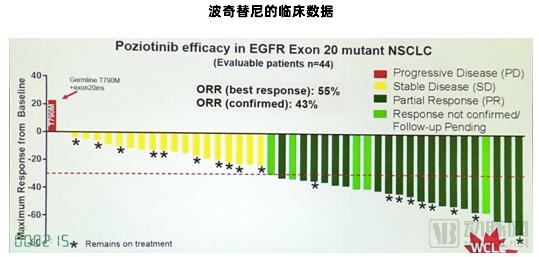
Data Source: WCLC