

Select Medical: Building a Rehabilitation Giant Through Strategic Acquisitions and Partnerships
Select Medical
Patient Care Service Provider
Rehabilitation medicine has been introduced to China for over three decades, and rehabilitation institutions are flourishing in the Chinese market. In recent years, the rapid development of the rehabilitation industry has attracted a large number of investment firms and private capital. However, during its development, many rehabilitation institutions have encountered issues such as insufficient patient volume, imperfect referral mechanisms, and homogenization of rehabilitation services.
So, today we take Select Medical, a giant in the rehabilitation sector, as a case study to examine how it evolved from a startup rehabilitation outpatient clinic into a powerhouse in the healthcare services industry.
Select Medical’s Legendary Founder: A Streak of Unbroken Victories
In November 1996, Select Medical was co-founded by father and son Rocco A. Ortenzio and Robert A. Ortenzio. Headquartered in Pennsylvania, the company provides outpatient rehabilitation services to residents.
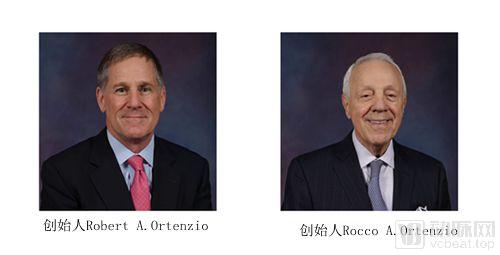
(Image source: Select Medical official website)
Speaking of Rocco, his entrepreneurial journey could well be written as a legendary tale. He began his career in rehabilitation medical services in 1958, working as a physical therapist. Over the next 25 years, he founded two rehabilitation companies, each valued at millions of dollars. In 1985, he sold the second of these ventures, Rehabilitation Medical Services Company, to National Medical Enterprises. However, just one year later, he established another rehabilitation medical services company, Continental Medical Systems, Inc. (CMS).
Within just nine months of its establishment, CMS acquired seven nursing homes, including Riverdale Gardens, California Physical Therapy, and Braintree Rehabilitation Hospital, as well as two rehabilitation service providers and one rehabilitation hospital. Until 1988, CMS never ceased its acquisition of nursing homes, with its nursing home operations spanning the U.S. East Coast, Florida, Virginia, and other regions. After 1988, CMS shifted its strategic acquisition focus to the rehabilitation sector. Through this realignment of business priorities, CMS’s revenue exceeded $100 million in 1988, reaching $113 million. This represented a 120% increase from the previous year, while net income surged by 192% to $4.7 million. By 1993, CMS’s revenue had surpassed $900 million.
Multiple acquisitions enabled CMS to grow into a nationwide enterprise within a relatively short period. Its robust revenue growth was driven primarily by its rapid acquisition pace, but also owed much to Rocco’s keen market sense and strategic long-term vision. When persuading other company members to shift CMS’s acquisition focus, Rocco stated, “Rehabilitation services is a young industry, being driven by the aging U.S. population and rising patient experience expectations. Demand for rehabilitation services will only increase in the aftermath of critical illnesses or other catastrophic medical events. The market for rehabilitation services is continuously expanding, and we cannot afford to miss this opportunity.”
In Just Three Years, Select Medical Grew from a Startup Outpatient Rehabilitation Clinic into a Diversified Healthcare Services Provider
Rocco’s entrepreneurial legend remains unchanged, as he replicated the rapid expansion path of CMS at Select Medical.
Six months after its founding, Select Medical saw relatively low patient volumes. Rocco once remarked publicly, “I envied the bustling traffic at other rehabilitation clinics. Why was my clinic’s patient volume so low? Through market research and careful reflection, I concluded that the services offered by our clinic were insufficient.” Consequently, in February 1997, Select Medical introduced outpatient surgical services and expanded its contract therapy offerings. As expected, patient volumes soon reached Rocco’s expectations, but he remained unsatisfied. He aspired to achieve more and capture a larger share of the market.
In June 1997, Select Medical made a bold move by completing its first acquisition, thereby ushering in an era of large-scale mergers and acquisitions. This acquisition of therapy services brought a substantial patient volume to Select Medical, naturally generating sufficient profitability. This success significantly boosted the confidence of the Rocco father-and-son team, laying the foundation for their future acquisition endeavors.
In 1998, Select Medical acquired the critical care rehabilitation hospital Pedestal LTAC Hospital and launched long-term acute care services. In 1999, the company further acquired NovaCare Rehabilitation, a physical therapy and rehabilitation service provider, marking one of its largest acquisitions to date. Since then, Select Medical has begun offering diversified medical rehabilitation services.
Nearly Two Decades Since Its IPO: How Select Medical Continues to Lead the Pack
Select Medical went public on the NASDAQ in 2001, delisted four years later to complete its privatization, and did not return to the public markets until 2009, when its subsequently formed parent company, Select Medical Holdings Corporation (hereinafter referred to as “SEM”), listed on the New York Stock Exchange. Although SEM became the parent company of Select Medical, it reverted the corporate brand back to Select Medical in 2009. Its journey—going public, then private, and public again—has been notably tortuous; nevertheless, it is undeniable that Select Medical has consistently maintained a leading pace in growth. Its acquisition spree has never ceased: after 2000, it successively acquired SemperCare, a post-acute rehabilitation hospital network; 600 outpatient rehabilitation clinics from Southern Health; the healthcare company Concentra; and Physiotherapy Associates, an outpatient rehabilitation care provider, among others.
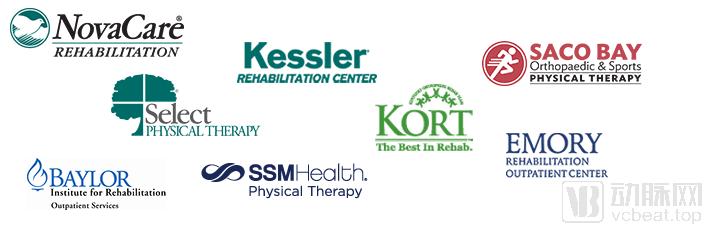
(Brands Acquired by Select Medical, Content from the Select Medical Official Website)
Beyond acquisitions, Select Medical explored a new development model after 2012 by partnering with industry leaders to jointly establish research institutes and hospitals, while also forming joint ventures with leading companies to leverage smaller capital investments for greater market impact. For instance, in the field of post-acute rehabilitation care, it collaborated with Emory Healthcare; partnered with OhioHealth to establish OhioHealth Rehabilitation Hospital; worked with TriHealth to establish TriHealth Rehabilitation Hospital; and joined forces with Cedars-Sinai and UCLA Health System to establish the California Rehabilitation Institute. Additionally, it formed joint ventures with Cleveland Clinic to establish Cleveland Clinic Rehabilitation Hospital, and with Pinnacle Health to establish Helen M. Simpson Rehabilitation Hospital.
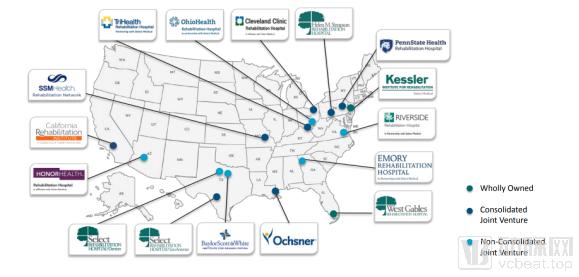
(Companies Established Under the Select Medical Partnership Model)
Through an “acquisition + partnership” model, Select Medical has grown into one of the largest providers of inpatient rehabilitation hospitals, specialty hospitals, and outpatient rehabilitation services in the United States. The company’s operations span 47 U.S. states and the District of Columbia. As of the end of 2018, Select Medical employed nearly 50,000 people across the United States. Currently, Select Medical primarily operates four business segments: critical illness recovery hospitals, inpatient rehabilitation hospitals, outpatient rehabilitation clinics, and medical centers. Specifically, Select Medical operates 97 critical illness recovery hospitals in 28 states, 27 inpatient rehabilitation hospitals in 11 states, and 1,684 outpatient rehabilitation clinics in 37 states and the District of Columbia. In addition, Select Medical’s joint venture subsidiary, Concentra, operates 525 healthcare centers in 41 states. Robert, co-founder of Select Medical, stated, “We provide post-acute rehabilitation care to 78,000 patients nationwide every day.”
Changes in Select Medical’s Business from a Revenue Perspective
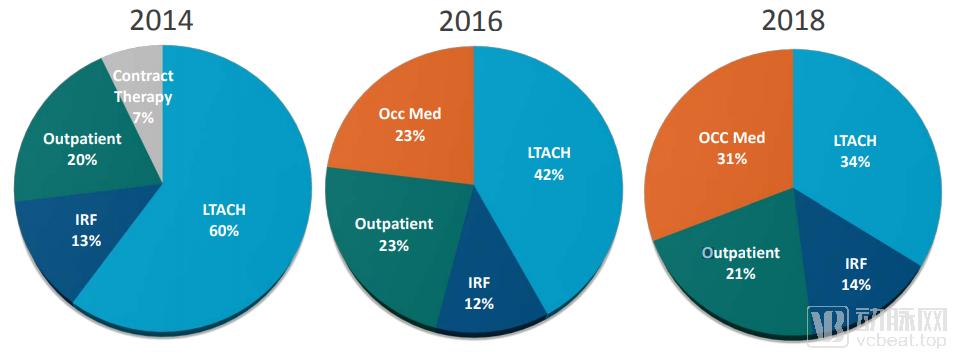
According to Select Medical’s 2019 financial report, its net revenue in 2018 was $5.081 billion. By source of revenue, critical illness recovery hospitals accounted for 34%, medical centers 31%, outpatient rehabilitation services 21%, and inpatient rehabilitation hospitals 14%.
Revenue Sources | Amount | Proportion |
LTACH | $1.754 billion | 34.51% |
OCC Med | $1.558 billion | 30.66% |
Outpatient | $1.062 billion | 20.91% |
IRF | $707.5 million | 13.92% |
Total | $5.081 billion | 100% |
(Data sourced from the official Select Medical website; compiled by VCBeat)
A review of Select Medical’s annual financial reports reveals continuous business adjustments in its recent development. According to the financial statements, prior to 2015, Select Medical’s revenue streams included critical illness rehabilitation hospitals, skilled nursing facilities, outpatient rehabilitation centers, and contract therapy services. After 2015, the company discontinued its contract therapy business, while the revenue contribution from critical illness rehabilitation hospitals steadily declined, and that from medical centers continuously increased.
(Image from the official website of Select Medical)
This situation stems from Select Medical’s strategic shift. After 2014, the company accelerated its large-scale acquisition activities and expedited collaborations with industry leaders to establish hospitals and research institutes. Its acquisition of the healthcare company Concentra in 2015 was one of the largest in the company’s history. Moreover, Select Medical’s model of forming joint ventures with other enterprises was primarily implemented after 2014.
Regarding the shift in revenue sources, Robert stated, “The rehabilitation sector has turned out differently from my initial expectations. With the continuous development of the rehabilitation market, we will increase our investment in this area. The change in revenue proportion is merely a slight fluctuation following the acquisition; it will ultimately stabilize. Our original commitment to the rehabilitation field has never wavered.”
Select Medical’s acquisitions and business collaborations in 2018 validated Robert’s judgment. In 2018, the company acquired U.S. Healthworks and integrated it into its subsidiary, Concentra, thereby expanding its rehabilitative care services. Select Medical also partnered with Ochsner Health and the University of California to establish joint ventures and open rehabilitation hospitals, while broadening its collaboration with OhioHealth to include outpatient rehabilitation services.
Select Medical’s growth to its current scale has not relied solely on acquisitions. Robert stated, “First, we have extensive clinical experience along with a strong track record in operations and finance. Second, we maintain close relationships with patients, their families, and healthcare professionals, fostering collaboration and mutual development. Third, we are committed to innovation, excelling in technology and services to deliver a better patient experience. Finally, our management team upholds its own traditions and culture; we know how to operate the company more effectively and accelerate its growth, which businesses to acquire for greater strategic benefit, and how to manage acquired companies.”
In short, Select Medical’s success is multifaceted: “buying and buying” is merely a means, while how to “buy and buy” reflects strategic wisdom.