

Changsang Technology Disrupts Traditional Cuff-Based Blood Pressure Monitoring with Medically Certified Cuffless Continuous Blood Pressure Monitor
Just as farmers cannot know whether the seeds they sow will ultimately yield a harvest, Wei Chuanmin, founder of VITA-COURSE TECHNOLOGIES CO.,LTD (hereinafter referred to as “Vita-Course”), did not know whether their five years of relentless efforts would bear fruit before the company’s “black-tech” innovation—the cuffless continuous blood pressure monitor—was approved for market launch by the China Food and Drug Administration (CFDA) in May 2018.
The sustained investment and effort over the past five years stem from Wei Chuanmin’s foresight, a decade ago, regarding the impending wave of technological innovation. In 2007, Apple launched its first smartphone, ushering in the era of mobile internet. By 2013, smart hardware had taken center stage, with increasingly compact devices and growing computational power making it ever more feasible to measure and monitor human physiological data using such gadgets. At that time, Wei Chuanmin predicted that smart hardware would play an indispensable role in the future of information technology, and he set out to develop a smart device capable of collecting human vital sign data.
At that time, among the body’s major vital signs, parameters such as heart rate and respiration could already be measured digitally, while blood pressure monitoring still relied on the traditional mechanical method—measuring blood pressure by inflating a cuff and detecting changes through the inflation and deflation of an air bladder. The lack of full digitalization in blood pressure monitoring presented an opportunity for Wei Chuanmin to identify an emerging trend and a breakthrough point for entrepreneurship.

Wei Chuanmin, Founder of VITA-COURSE TECHNOLOGIES
Navigating the Path Forward: From Testing the Waters with Smartwatches to Successful Fundraising
In November 2013, VITA-COURSE TECHNOLOGIES CO.,LTD (hereinafter referred to as “Vita-Course”) was established. At its inception, there was a severe shortage of professionals specializing in precise blood pressure measurement for smart devices. By reviewing relevant academic literature, the company recruited a professor who was at the global forefront of research and development in blood pressure measurement using smart devices. Guided by cutting-edge industry publications, Vita-Course aspired to develop a wearable smart hardware device capable of non-invasive, continuous, real-time, and accurate blood pressure monitoring, aiming to be among the first pioneers (“early adopters”) in this emerging technological trend.
In 2015, after arduous and intensive research and development, VITA-COURSE TECHNOLOGIES CO.,LTD achieved its initial breakthroughs. Leveraging the professor’s algorithms, the company developed a smartwatch that was lightweight and compact, capable of continuous real-time blood pressure monitoring—a feature that immediately captivated onlookers. Soon, sales companies with keen market intuition proactively reached out to negotiate exclusive distribution rights for the product. The founding team rejoiced at the promising prospects ahead, as if the dawn of a new technological trend was just around the corner.
However, when the startup team went to the hospital for clinical testing, they encountered the biggest setback since the company’s inception. The product’s test results were unsatisfactory, with significant errors in blood pressure measurements, failing to match the accuracy levels of traditional sphygmomanometers already on the market. Precision is the lifeline of blood pressure monitoring devices. Even with the allure of being “smart,” “wearable,” and “convenient,” rational consumers will not accept an inaccurate blood pressure device. Faced with this challenge, the sales company began to hesitate, initial marketing efforts stalled, and the startup team’s earlier efforts seemed poised to come to naught.
The company found itself in dire straits, groping its way forward without finding a clear exit. Fortunately, those years coincided with a peak in investment enthusiasm for smart hardware. Perhaps recognizing VITA-COURSE TECHNOLOGIES CO.,LTD’s dedication to technology, passion for R&D, and decisive execution in entering the smart hardware sector, Shanghai Licheng Fuyi led a 15 million yuan angel financing round, providing the momentum needed for the company’s continued progress.
With the infusion of capital, VITA-COURSE TECHNOLOGIES CO.,LTD began to inject new vitality. Lu Ying, who holds a Ph.D. in Statistics from the University of North Carolina; Deng Jian, who earned his Ph.D. in Fluid Dynamics from Brown University; and Peng Heng, who obtained his Ph.D. in Mathematics from The Chinese University of Hong Kong, also joined the team. The integration of statistics, fluid dynamics, and mathematics appeared to make it possible to establish a digital model for blood pressure. Indeed, this proved to be the case. Following this round of financing, VITA-COURSE TECHNOLOGIES CO.,LTD embarked on a promising path forward.
“I feel less like I’m starting a business and more like I’m fully dedicated to scientific research.”
Since 2015, with the addition of three core members, VITA-COURSE TECHNOLOGIES has begun to revitalize, and its new data model has been largely finalized. Lu Ying stated frankly that if blood pressure-related data were available, blood pressure could be calculated using mathematical methods.
Behind every great innovation lies the arduous and meticulous completion of countless trivial details. In the pursuit of precise blood pressure measurement using photoplethysmography (PPG) technology, the most critical missing element was foundational data on blood pressure and PPG waveforms. Thus, VITA-COURSE TECHNOLOGIES CO.,LTD embarked on a “Long March” to collect such data. Reflecting on this challenging journey, Wei Chuanmin later joked self-deprecatingly, “I felt less like an entrepreneur and more like a researcher fully devoted to scientific inquiry.”
“Transforming signals into data, and then data into information. Each step involves a massive workload and significant challenges.” This is how Wei Chuanmin evaluates the process of data collection. The technical team at VITA-COURSE TECHNOLOGIES CO.,LTD needs to acquire various types of signals, such as photoplethysmography (PPG) waveforms, and then convert these signals into vascular data. This is no easy feat; during its research on “converting signals into data,” VITA-COURSE applied for sixteen international (PCT) patents.
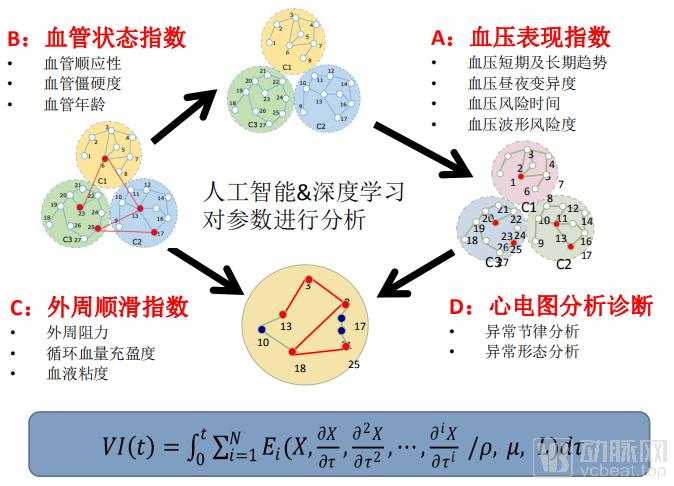
Vascular Index Model
The most fundamental signals still need to be collected step by step through on-site hospital visits. The technical team at VITA-COURSE TECHNOLOGIES CO.,LTD recruited and established a professional team of doctors and nurses, who began visiting primary care hospitals one by one to measure blood pressure via auscultation—using the basic Korotkoff sound method to determine precise blood pressure values while recording corresponding photoplethysmographic (PPG) waveform signals. Prolonged auscultation inevitably leads to some degree of hearing impairment among the staff. However, this was not the most challenging aspect for the VITA-COURSE technical team. Wei Chuanmin told reporters that they spent nearly two years exploring data collection methods. “The most tormenting part was that everyone was working hard on this project yet could see no hope, as there was no progress in algorithm development at that time.”
“Is this the right direction?” Everyone was asking. Wei Chuanmin himself did not know; he could only grit his teeth and press on.
Hope often arrives unannounced. In mid-2016, after more than a year of data collection, on what seemed like an ordinary day no different from any other, Professor Lu Ying suddenly called Wei Chuanmin late at night. With excitement and enthusiasm, Professor Lu informed Wei that the blood pressure measurement technology developed by VITA-COURSE was likely to meet international standards. Hearing this long-awaited yet unexpected news, Wei was overwhelmed with mixed emotions and his heart surged with excitement. Apple, Samsung, Huawei, Xiaomi, and the 37 Band—countless competitors in the same arena have entered and exited, while new players continue to emerge. Yet opportunity always favors those who persevere to the end.
By the end of 2016, VITA-COURSE TECHNOLOGIES’ achievements finally reached the stage of clinical validation. Wei Chuanmin brought this technological breakthrough back into hospitals, and the results of this round of testing can be summarized as “surprising.” The digital blood pressure measurements obtained using the new algorithm significantly outperformed the laboratory benchmarks required by relevant national standards and met the precision ranges stipulated by international standards. VITA-COURSE TECHNOLOGIES subsequently conducted further trials at multiple hospitals, where the test results proved highly stable and reliable, meeting the accuracy requirements for blood pressure measurement devices across various testing environments.
Riding the wave of this technological momentum, VITA-COURSE TECHNOLOGIES CO.,LTD accelerated preparations for the market launch of its device. In the second quarter of 2017, the company submitted a clinical trial application to the China Food and Drug Administration (CFDA); its clinical trials were completed in January 2018; and in May of the same year, it obtained the registration certificate and received approval for market launch.
First Medical-Grade Cuffless Blood Pressure Monitor Approved: VITA-COURSE Technology Opens a New Blue Ocean for Application
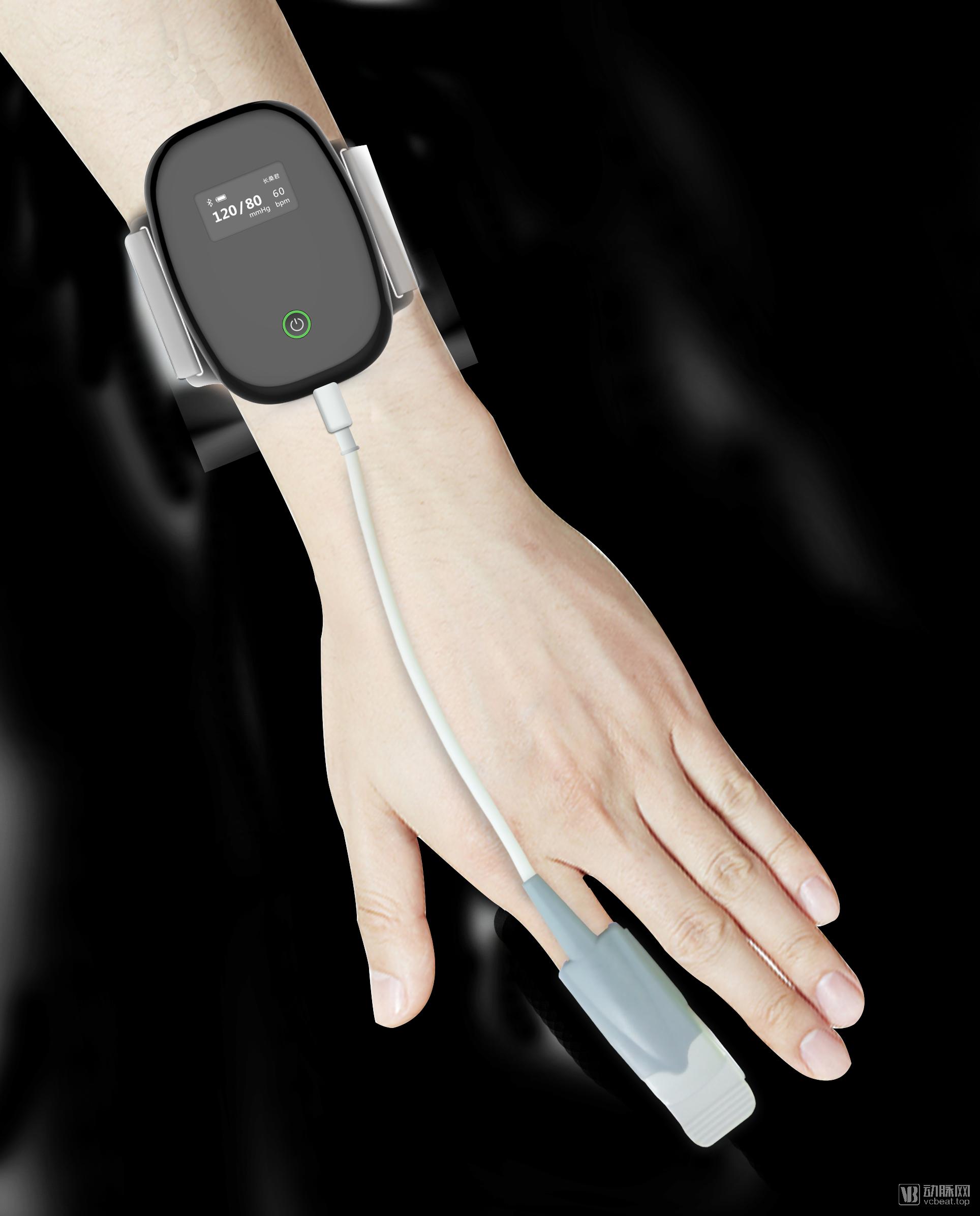
Schematic Diagram for Wearing a Cuffless Blood Pressure Monitor
Currently, VITA-COURSE TECHNOLOGIES CO.,LTD has become the first company in China to gain approval for a medical-grade cuffless blood pressure monitoring device, marking a breakthrough after extensive exploration. Wei Chuanmin, founder of VITA-COURSE, stated, “While many companies in China are working on digital blood pressure solutions, we were the first to develop and obtain market approval for our product. We welcome the participation of industry peers to jointly promote the development of the digital blood pressure sector.”
It is worth noting that the cuffless blood pressure monitor developed by VITA-COURSE TECHNOLOGIES CO.,LTD is medical-grade, meaning its products can be directly applied in clinical settings. This represents one of the core target audiences for cuffless blood pressure monitors. Currently, VITA-COURSE has initiated preliminary clinical collaborations with institutions such as The First Affiliated Hospital of Sun Yat-sen University and Fuwai Hospital, Chinese Academy of Medical Sciences, aiming to replace invasive blood pressure monitoring devices and traditional electronic sphygmomanometers in typical blood pressure monitoring scenarios.
If a technology is developed but can only be applied to a single product, it seems that its full potential has not yet been realized. How can the transformative impact of digitizing blood pressure permeate every aspect of daily life? This is the question VITA-COURSE TECHNOLOGIES CO.,LTD is currently exploring.
According to statistics published in The Lancet in 2017, the detection rate of hypertension in China was 37.2%, yet only about 6% of patients had their condition under control. Although the World Health Organization has recommended regular blood pressure monitoring for individuals aged 35 and older, hypertension is increasingly affecting younger populations in China.
“However, not everyone is willing to proactively visit a hospital for blood pressure monitoring. ‘If understanding one’s health status requires proactive effort, then 80% of people might simply not do it,’ said Wei Chuanmin. ‘How can we enable blood pressure measurement to be completed seamlessly, without the user even noticing? This represents a new application scenario for our core technology.’”
“We are seeking to export our technology by miniaturizing and modularizing it, thereby integrating our blood pressure measurement algorithm into wearable devices such as smartwatches, making blood pressure monitoring real-time, convenient, and readily accessible,” Wei Chuanmin told reporters. “In the future, measurement of basic human vital signs will become a standard feature in smartphones, smartwatches, and fitness trackers. While heart rate and body temperature sensors are already embedded in smart hardware, this breakthrough in digital blood pressure monitoring will enable portable devices to incorporate blood pressure measurement capabilities.”
“The medical-grade, cuffless blood pressure geometric statistical algorithm developed by VITA-COURSE Technologies could potentially reshape the current landscape of the wearable device market if applied to smart wearables,” Wei Chuanmin envisioned.