

Menocan Biotech Advances Universal Therapeutic mRNA Cancer Vaccine Targeting Tumor-Associated Antigens
In the early 1960s, mRNA was discovered for the first time; in the 1970s, scientists delivered mRNA into cells using liposomes; by the 1990s, RNA delivery technology had become sufficiently mature to support preclinical research on mRNA-based vaccines and cancer immunotherapy. Since then, mRNA therapies have begun to demonstrate their potential in preventing and treating a wide range of diseases, including hemophilia, myocardial infarction, AIDS, and various types of cancer. Led by companies such as Moderna, BioNTech, and CureVac, multiple firms have utilized mRNA to stimulate immune responses and develop mRNA vaccines, offering a unique and innovative pathway for vaccine development. mRNA technology is increasingly favored by investors and international pharmaceutical giants.
Thera Mab Bioscience Inc. (Taicang) (hereinafter referred to as “Meno Hengkang”) was established in 2013, initially focusing on outsourcing services. As cancer vaccines have emerged as a new favorite in the biotechnology sector, Meno Hengkang has pivoted to the field of oncology vaccines, embarking on the research and development of mRNA-based cancer vaccines. Within just over a year, Meno Hengkang’s mRNA cancer vaccine achieved Proof of Concept. In preclinical animal pharmacodynamic studies, the company’s mRNA cancer vaccine demonstrated significant tumor growth inhibition in models of pancreatic cancer, colorectal cancer, and liver cancer.
In 1986, Wu Chenyan, founder and general manager of Thera Mab Bioscience Inc., graduated with a degree in Biochemistry from Xiamen University. In 1992, he earned a master’s degree from the Shanghai Institute of Biochemistry and Cell Biology, Chinese Academy of Sciences. In 1993, Mr. Wu went to the United States for further studies and obtained his Ph.D. from the University at Buffalo, State University of New York, in 1998. After completing a one-year postdoctoral fellowship at Harvard University, he joined Pfizer in 1999, working for 11 years at its R&D centers in California and Michigan, USA, as well as in the UK. As a Senior Principal Scientist at Pfizer, Dr. Wu was responsible for new drug development. He is highly familiar with the new drug development process and has extensive experience in molecular cloning, cell biology, drug screening, and animal pharmacodynamics studies.
At the end of 2010, Dr. Wu Chenyan returned to China. Two years later, he founded Thera Mab Bioscience Inc., (Taicang) to provide outsourcing services for the expression of recombinant proteins and recombinant antibodies. When asked why he chose to engage in contract research services, Dr. Wu stated, “When starting the company, our primary consideration was to establish self-sustaining revenue streams to enhance the company’s viability. Additionally, while providing outsourcing services, we could build molecular biology and cell biology laboratories, develop a high-efficiency mammalian cell expression platform for recombinant antibodies and proteins, and train staff, thereby laying the groundwork for future independent drug development.”
Thera Mab Bioscience’s laboratory spans over 400 square meters, enabling a wide range of activities including DNA cloning, DNA extraction, cell culture, and the expression and purification of recombinant proteins and antibodies. During its period of providing outsourced services, Thera Mab Bioscience engaged in extensive and in-depth collaborations with numerous major clients, achieving self-sustainability and breaking even. Nevertheless, Dr. Wu Chenyan has been continuously exploring pathways for transformation: “Outsourced services do not fully reflect the company’s value. We aim to maximize corporate value through independent research and development of novel drugs.”
mRNA-based cancer vaccines are both simple and effective, having demonstrated promising results in clinical studies. In July 2017, Nature reported successful cases of rapid clinical remission in melanoma patients treated with mRNA vaccines. In 2018, Nature recognized the development of cancer vaccines as “one of the biomedical technology breakthroughs of 2018.” Dr. Wu Chenyan stated, “As research focus shifts from PD-1 antibodies to mRNA cancer vaccines, it is an inevitable trend for companies to pivot their R&D efforts toward mRNA cancer vaccines.”
In early 2018, Thera Mab Bioscience discontinued its outsourcing services to focus intensively on the research and development of mRNA cancer vaccines. Benefiting from five years of accumulated expertise, the company had established a highly sophisticated experimental platform, and its staff had gained extensive R&D experience, enabling rapid progress in its mRNA cancer vaccine program. Within just over a year, the company successfully completed proof of concept.
mRNA Vaccines Are Safer Than Traditional Vaccines. Since mRNA functions within the cytoplasm and does not need to traverse the formidable nuclear membrane, mRNA vaccines do not integrate into the genome of target cells, thereby eliminating the risk of inducing cancer. Additionally, mRNA undergoes a natural degradation process in the body, further ensuring its safety. mRNA vaccines can be manufactured rapidly. While producing a traditional influenza vaccine typically requires at least five to six months, mRNA vaccines enable standardized production, allowing the required vaccine to be produced within ten days. In terms of immunogenicity, mRNA vaccines can induce both B-cell and T-cell immune responses, generate immune memory, deliver a greater amount of effective antigen, and express multiple antigens simultaneously—advantages that are unmatched by traditional vaccines.
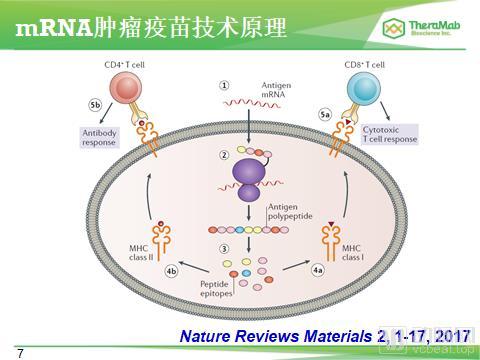
Unlike the personalized vaccines developed by Moderna and BioNTech, Thera Mab Bioscience identifies targets from Tumor-Associated Antigens (TAA) to develop universal therapeutic vaccines. Dr. Wu Chenyan pointed out that the manufacturing cycle for personalized vaccines is lengthy, typically requiring three to six months; the epitopes designed for these vaccines lack experimental validation, resulting in a 30% to 50% probability of inefficacy. While the frequency of genetic mutations is relatively high in melanoma, making it more likely to identify melanoma-specific neoantigens, most other cancers exhibit lower mutation frequencies, thereby reducing the likelihood of finding cancer-specific neoantigens. Furthermore, the high cost of personalized vaccines represents their most significant drawback. Dr. Wu stated, “In light of the aforementioned limitations of personalized vaccines, Thera Mab Bioscience has decided to develop universal therapeutic vaccines, providing cancer patients with cost-effective mRNA tumor vaccines.”
The first step in developing an mRNA cancer vaccine is to identify targets. “When selecting tumor targets, we strive to include those with high prevalence across the majority of cancer types, thereby broadening the therapeutic coverage of the cancer vaccine,” pointed out Dr. Wu Chenyan. Thera Mab Bioscience Inc. (Taicang) selected three cancer gene targets that cover 28 out of 33 cancer types. Once successfully developed, this vaccine will be applicable to multiple cancer types, offering significant market potential. After target identification, the next step involves designing epitope antigens using computer software. Ultimately, Thera Mab designed nine epitope antigens for each target. Following screening, the company finalized the selection of 16 epitope antigens, which were cloned into two vectors for further evaluation.
In animal models of rectal cancer, the mRNA tumor vaccine developed by Thera Mab Bioscience Inc. demonstrated exceptional tumor suppression efficacy, achieving complete tumor regression. Following vaccination, 13 out of 19 mice exhibited complete tumor regression, representing a rate of 68%. Mice that achieved complete tumor regression were re-challenged with CT26 and Gene3-CT26 cancer cells in their forelimbs around day 49. Without any additional treatment, these mice did not develop new tumors, indicating robust anti-tumor efficacy and the presence of memory T cells. On day 77, the mice were re-challenged with H22 liver cancer cells. By day 94, the tumor growth inhibition (TGI) rate reached 92.2%, demonstrating that the vaccine provides long-term anti-tumor immune protection and exhibits significant efficacy against liver cancer.
Furthermore, mRNA tumor vaccines have also demonstrated efficacy in inhibiting tumor growth in pancreatic cancer animal models. In the initial experiment, Dr. Wu Chenyan found that the mRNA tumor vaccine developed by Thera Mab Bioscience Inc. achieved a tumor growth inhibition rate of 41% with no significant side effects. In contrast, while the positive control chemotherapy drug cisplatin achieved a tumor growth inhibition rate of 55%, it was associated with pronounced side effects.
Pancreatic cancer is known as the “king of cancers,” and currently, no macromolecular or small-molecule drugs have been proven to effectively inhibit it. Thera Mab Bioscience Inc. (Taicang) is revising its experimental protocol in an effort to enhance the inhibitory efficacy of its mRNA tumor vaccine against pancreatic cancer. If successful, the value of this mRNA tumor vaccine would be substantial.
Currently, Thera Mab Bioscience Inc. (Taicang) is applying for Chinese patents for its mRNA cancer vaccine to accelerate the product's market commercialization.
Wu Chenyan pointed out, “Over the past seven years, investment institutions have achieved solid returns from their investments in research hotspots such as PD-1 and PD-L1 antibodies. There is no doubt that mRNA cancer vaccines are the new investment hotspot in the pharmaceutical industry.” Thera Mab Bioscience Inc. (Taicang) is seeking RMB 30 million in financing to advance its next phase of R&D work.
Thera Mab Bioscience Inc. (Taicang) plans to allocate the funds raised from financing to construct a new GMP-compliant laboratory for mRNA vaccine production, while outsourcing the manufacturing of lipid nanoparticles (LNPs). The company is currently discussing patent licensing with patent holders and negotiating outsourcing agreements with European and American companies that possess both large-scale LNP production capabilities and GMP certification. Additionally, the company intends to use these funds to conduct animal pharmacodynamic studies, as well as safety assessments in rats and non-human primates.
“If the financing proceeds smoothly, Thera Mab Bioscience will complete pre-clinical regulatory submission activities—including LNP patent licensing, manufacturing, toxicology studies, and pharmacodynamics studies—within one to two years after closing the financing round,” said Dr. Wu Chenyan. “Upon completion of these pre-clinical activities, Thera Mab Bioscience plans to simultaneously submit Investigational New Drug (IND) applications in China and the United States.”
Dr. Wu Chenyan pointed out that many available targets remain undeveloped; once successfully developed, mRNA cancer vaccines will demonstrate significantly enhanced therapeutic efficacy, enabling better treatment outcomes for more cancer patients. “In the next two to three years, Thera Mab Bioscience Inc. (Taicang) will select new tumor-associated antigens as targets to expand its product development pipeline.”