

Tiny Microbes, Big Impact: How MooN Biotech Drives Industrialization Across Healthcare and Agriculture
A century ago, the average human life expectancy did not exceed 35 years. Through increased supply of agricultural and sideline products and the use of antibiotics, the average human life expectancy has been successfully raised to over 70 years. Both the advancement of agriculture and the advent of antibiotics are closely linked to microorganisms, which have left an indelible mark on the history of modern medicine.
Microorganisms are a collective term for all minute life forms that are invisible or indistinct to the naked eye, and these microscopic organisms are closely intertwined with human health. The discovery of microorganisms emerged alongside humanity’s struggle against disease; from the development of the rabies vaccine and the production of penicillin to the advent of insulin and interferon, each milestone is inextricably linked to microorganisms.
Beyond the traditionally recognized gastrointestinal diseases and inflammatory conditions, mounting evidence underscores the links between microbes and tumor immunity, metabolic disorders, and autoimmune diseases. Pathogen resistance driven by antibiotic overuse, obesity and diabetes resulting from dietary habits, environmental factors, and endogenous metabolic disturbances, as well as mental health disorders arising from various causes, continue to pose significant threats to human health. Microbes, despite their minute size, are poised once again to take center stage in disease treatment.
The gut is the primary site for the metabolism of food and pharmaceuticals. The consumption of unhealthy foods or antibiotic medications can disrupt the entire gut ecosystem, thereby affecting the immune system. These effects are transmitted systemically via circulatory mediators, such as blood and lymphatic fluid.
To some extent, the gut serves as the engine of the immune system, influencing overall human health.
Abroad: Microbial Therapy Becomes a Hotbed for Investment
Major research breakthroughs have also driven commercial exploration in the microbiome sector. According to partial statistics from Global Engage, nearly $1.8 billion in venture capital funding (from seed to Series C) has flowed into the microbiome industry since 2010, with $1 billion invested between 2016 and 2017 alone. Among the four application areas, microbiome therapeutics has become a hotspot for investment, accounting for 61% of the total; this is followed by clinical diagnostics (18%), agricultural applications (12%), and consumer products (9%).
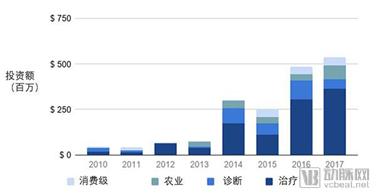
Global Distribution of Microbiome Investments (2010–2017), Data Source: Blue Rainbow
In the United States, microbiome therapeutics has become the most prominent area within microbiome application research. It not only boasts the largest number of companies but also represents the commercial sector attracting the greatest amount of financing. According to statistical data compiled by VCBeat in March 2019, 57 companies engaged in microbiome application research raised a total of $3.065 billion, with $1.588 billion of that amount going to microbiome therapeutics companies.
Not only that, but the European venture capital firm Seventure Partners has also established two dedicated microbiome funds and has to date invested in approximately 20 startups focused on microbiome research.
However, in China, current large-scale applications remain limited to the sequencing level of microbiomics, and there are very few companies conducting therapeutic research based on microbiomics.
Guangzhou Colony Biotechnology Co., Ltd., established in 2015, is one of the few companies in China engaged in microbiome-based therapeutics. The company focuses on the innovation and commercialization of microbial resources. Its team comprises young scientists and industry elites from renowned universities, multinational biotechnology companies, and leading domestic research institutions worldwide, including the Chinese Academy of Sciences, Tsinghua University, Sun Yat-sen University, National Taiwan University, the University of Newcastle (Australia), and the University of Caen Normandy (France), bringing extensive experience in product development and industrialization.
One of the World's Largest Commercial Microbial Resource Discovery Centers
In innovative research across the entire microbiology industry, microbial strain resources serve as the cornerstone. Microbial strain resources refer to culturable bacteria, fungi, viruses, cell lines, and their associated information that possess scientific significance or practical value. As one of the nation’s strategic biological resources, they constitute a critical material foundation for the sustained development of microbiological research in agriculture, forestry, industry, medicine, pharmaceuticals, and veterinary science, as well as for biotechnology research and the microbiology industry. In essence, strain resources are a vital scientific and technological infrastructure supporting advancements and innovation in microbiological science and technology.
For companies engaged in microbiome therapeutics research, possessing proprietary strain libraries along with screening and pharmaceutical development platforms constitutes a significant technological advantage. For instance, Vedanta Biosciences and Second Genome have garnered considerable attention due to their independently developed strain libraries, microbiome discovery platforms, and pharmaceutical manufacturing capabilities. Second Genome raised $11.5 million in its Series A financing round and $51.4 million in its Series B round.
Colony Biotechnology’s microbiome discovery platform, Culture-To-Product, also provides advantages for its therapeutic research on microbes. Culture-To-Product comprises three components: a strain discovery platform, a high-throughput screening platform, and a fermentation production and formulation development platform. Its strain discovery capability is 5 to 15 times greater than that of traditional isolation and culture techniques.
It is reported that the number of microbial strains held by Colony Biotechnology has exceeded 80,000 (as of July 2019), and is projected to reach 100,000 by December 2019. The company is currently one of the largest commercial microbial resource discovery centers globally, boasting the highest level of biodiversity.
A scarce resource: one of the few microbiome therapy companies in China
Abroad, most microbiome therapeutics companies have chosen to enter the field through infectious diseases, with clinical trials for recurrent Clostridioides difficile infection (CDI) having advanced most rapidly into Phase III. However, Jiang Xianzhi is more optimistic about research into treatments for metabolic and immune-mediated diseases.
“The gut is the body’s largest immune organ, and there is a strong correlation between microbiota and immunity. This was our initial understanding,” he explained. At that time, cancer immunotherapy had achieved preliminary success, prompting hundreds of companies to flock into the field. However, cancer immunotherapy remained far from perfect, characterized by low drug response rates, significant toxic side effects, and frequent onset of intestinal inflammation in patients during treatment. Jiang Xianzhi believed that these factors might all be related to gut microbiota. Coincidentally, during this period, Science and Nature published numerous high-impact studies, elucidating the relationship between gut microbiota and tumor immunity. Jiang Xianzhi was convinced that cancer immunotherapy represented a promising market entry point.
Although it entailed certain risks at the time, this very decision enabled Guangzhou Colony Biotechnology Co., Ltd. to gain a first-mover advantage in the tumor immunotherapy market based on gut microbiota research.
Currently, Guangzhou Colony Biotechnology Co., Ltd. has five products in its pharmaceutical pipeline. In addition to two tumor immunotherapy products for liver cancer and colorectal cancer, the pipeline includes one therapeutic product for non-alcoholic fatty liver disease (NAFLD) and two products for obesity treatment. Spanning from tumor immunotherapy to metabolic diseases, the portfolio covers the most prominent areas of current microbiome-based therapeutic research.
It has been revealed that the Phase I data for the current obesity treatment product have met expectations. The company has established a partnership with Denmark’s Novo Nordisk, aiming to advance the product into clinical trials as soon as possible.
“Almost every product line of foreign microbial drug companies has major collaborations. Such partnerships help startups mitigate some risks associated with early-stage research, and we are also open to this approach, as our collaboration models are quite flexible,” stated Jiang Xianzhi. It is understood that their tumor immunotherapy products have already undergone multiple animal studies and are about to enter the preclinical research phase. The company hopes to identify partners to continue exploring combination therapies with PD-1 inhibitors.
Dual Development of Agriculture and Medicine
In addition to microbial therapeutics, agriculture is also a significant component of Guangzhou Colony Biotechnology Co., Ltd.’s commercial portfolio. The company has entered the agricultural sector by leveraging microbes for seed treatment and crop performance enhancement.
Microorganisms are a vital component of the ecological environment. In agriculture, microbial-based methods and products—such as soil treatment, microbial fertilizers, and microbial pesticides—are frequently employed to boost crop yields and reduce pests and diseases. Among all these applications, Jiang Xianzhi is particularly optimistic about the use of microorganisms in seed treatment.
“Establishing a symbiotic relationship between these microbes and the seeds during the germination stage is akin to customizing an optimal microbial consortium for an individual at birth,” Jiang Xianzhi analogized. In his view, microbial seed treatment represents the optimal approach, as “interference from other microorganisms is minimal at the seed stage, and the cost is also the lowest.” Treating just a few kilograms of seeds required per hectare is far simpler and more efficient than managing an entire hectare of crops and land.
Enhancing crop yields by leveraging the innate interactions between microbes and crops represents the mainstream direction of international research in microbial agriculture. To date, Guangzhou Colony Biotechnology Co., Ltd. has registered 11 agricultural microbial products, four of which are fertilizer products that have obtained product certification. The company has also reached product cooperation and sales agreements with multiple large-scale agricultural enterprises.
A Market Space of Nearly RMB 10 Billion: Great Potential for the Microbial Application Industry
According to the data from “China Source: Globocan 2018” published by the WHO IARC, there were approximately 4.285 million new cancer cases in China in 2018. Assuming the cost of microbial therapy in combination with PD-1 inhibitors is RMB 50,000 per patient, the following scenarios apply: The response rate to PD-1 inhibitors is currently 10%–15%, with potential to increase to 30% in the future. If 20% of the remaining 70% of patients who respond poorly to PD-1 inhibitors adopt combination therapy with microbial drugs (corresponding to a penetration rate of 14%), the market size for oncology microbial therapy in China would reach RMB 3.447 billion. If 40% of these poor responders adopt the combination therapy (penetration rate of 28%), the market size would amount to RMB 6.894 billion.
In the agricultural sector, according to 2017 data from the National Bureau of Statistics, China’s sown areas for major crops in 2016 were as follows: corn, 36,763 thousand hectares; rice, 30,180 thousand hectares; wheat, 24,181 thousand hectares; soybeans, 7,199 thousand hectares; cotton, 3,350 thousand hectares; and rapeseed, 7,332 thousand hectares.
According to data from several multinational agribusiness companies, the average cost of seed coating per 1,000 hectares is RMB 45,000 for corn, RMB 75,000 for rice, RMB 75,000 for wheat, RMB 225,000 for soybeans, RMB 75,000 for cotton, and RMB 75,000 for rapeseed. Consequently, China’s microbial seed treatment market has the potential to reach billions of yuan; however, this sector currently remains untapped domestically, with no high-quality products yet available on the market.
In these two markets, the concept of microbial therapeutics is only just emerging. Traditional microbial agriculture lacks technological innovation, and the translation of academic research into industrial applications still requires time to mature. Significant market gaps remain in both fields. As one of the few companies driving technological innovation in the industry, Guangzhou Colony Biotechnology Co., Ltd. has seized the first-mover advantage and positioned itself at the forefront of the market.
Although the current capital trend has not yet taken shape, we can foresee future enthusiasm based on investment and financing trends in the field of microbiology research abroad. Next, Guangzhou Colony Biotechnology Co., Ltd. will continue to advance its various pipelines in the fields of biopharmaceuticals and agriculture. The approval system for biopharmaceutical businesses is relatively strict, and commercial risks are greater. Guangzhou Colony Biotechnology Co., Ltd. hopes to keep up with the progress of foreign products and avoid commercial risks by seeking strong partners.
On another front, research into the agricultural applications of microbes has become well-defined, with related products already launched in overseas markets. In the absence of domestic competitors, Guangzhou Colony Biotechnology Co., Ltd. rapidly brought its products to market, reinvesting the cash flow generated from the agricultural sector into the development of its pipeline candidates. “Our agricultural products have now entered the commercialization phase and secured a certain volume of orders. Currently, we are focusing on how to increase production capacity.”
Although most overseas microbiome drugs are still in clinical stages and early microbiome pharmaceutical companies have experienced some setbacks, Jiang Xianzhi has always believed in the bright prospects of the microbiome industry. The core team members of the company mainly come from the Chinese Academy of Sciences, Tsinghua University, the University of Science and Technology of China, Sun Yat-sen University, National Taiwan University, the Chinese Academy of Agricultural Sciences, and renowned overseas universities. They have long held positions at internationally renowned biotechnology companies and leading domestic research institutes. The team’s extensive experience in product development and industrialization gives him full confidence in the company’s future.
Jiang Xianzhi told VCBeat that new microbial drugs will undoubtedly emerge in China in the future. Microbial resources are a national strategic resource, and China possesses unique advantages in this area. Although commercialization is still in its early stages, he firmly believes that China’s microbial market holds great promise, and globally renowned industry giants will certainly emerge in the future.
References
Blue Rainbow: Industry Research | Gut Microbiota (Part I): The Gut Microbiota Industry Is Promising, with Significant Differences in Domestic and International Layouts
Probe Capital: Microbial Industry Research
VCBeat: The Commercialization Path of Microbiomics | Therapeutic Companies Attract the Most Funding, Pharmaceutical Giants Rush to Invest, and Only Three Companies in China Have Entered the Field