

Minsheng Otorhinolaryngology Files IPO Prospectus: Building a Specialty Pyramid and Expanding in the Blue Ocean of ENT Healthcare
In recent years, heightened public awareness of health management has led to a growing demand for diagnosis and treatment of ENT (ear, nose, and throat) conditions, which were previously overlooked. Minsheng ENT Medical Group (“Minsheng ENT”) is a specialized medical chain that has gradually emerged in response to this market demand. What is the current landscape of the ENT specialty market? How should large-scale ENT chain groups strategize? To address these questions, VCBeat (WeChat ID: vcbeat) conducted an exclusive interview with Dong Mifang, CEO of Minsheng ENT Medical Group.
About Dong Mifang
Dong Mifang: Holds a Bachelor of Medicine from Peking University and a Master’s degree in Economics; serves as an MBA lecturer at Tsinghua University School of Economics and Management and as a mentor for the “Key Talent Training Program” of the Ministry of Industry and Information Technology. Currently, she is the CEO of Minsheng ENT Medical Group and a Partner at Tianyi Group’s Health Industry Fund.
“Minsheng ENT’s hospital management philosophy, centered on disciplines, management, and operations, is not merely a conceptual framework; we have translated it into robust and effective actions, engaging and involving the entire group. The right core philosophy, coupled with organization-wide recognition and promotion, is the prerequisite for the rapid development of chain medical institutions.” This young CEO of the medical group and partner at a health industry fund exudes both gentleness and resolve.

Dong Mifang, CEO of Minsheng ENT Medical Group
With a medical background, Dong Mifang did not enter healthcare institutions after graduating from Peking University Health Science Center; instead, she was recommended for admission to the main campus of Peking University to pursue a master’s degree in economics. In the years following her graduation, she transitioned from an investment partner specializing in the healthcare services sector to the head of a chain hospital group, aiming to integrate the critical aspects of healthcare investment and management. Each step she has taken in the healthcare industry has been focused and solid.
Since entering the field of otorhinolaryngology and ophthalmology, Dong Mifang has been contemplating: How should a large-scale specialized chain group in this sector be operated? This, in itself, is a continuous process of exploration, practice, and summarization.
Significant Market Expansion: ENT Emerges as a Blue Ocean
Over the past decade, we have witnessed a surge in capital market activity across several specialized healthcare sectors, including ophthalmology, dentistry, obstetrics and gynecology, and medical aesthetics. However, otolaryngology has not attracted the same frenzied investor interest as these other segments.
“Every medical specialty is distinct, yet they all enjoy equal opportunities—differing only in timing. You can never predict exactly when a particular field will surge; what we do is make thorough preparations before the boom arrives and then patiently await its onset.” In an interview, this post-1980s CEO shared a set of data: The prevalence of ear, nose, and throat (ENT) diseases among individuals aged 20 and above exceeds 70%, while the treatment rate remains below 10%; ENT outpatient visits in public hospitals account for over 96% of the total, with private hospitals comprising less than 4%; high-quality specialized ENT hospitals are scarce in second- and third-tier cities, with some such cities lacking these specialized facilities altogether. A cross-sectional comparison across the entire healthcare sector clearly reveals the supply–demand imbalance in ENT care.
In Dong Mifang’s view, with rising economic standards and heightened health awareness, people will pay greater attention to ear, nose, and throat (ENT) health issues. The ENT field spans five sub-specialties—otology, rhinology, laryngology, thyroid surgery, and head and neck surgery—covering more than 20 diseases, ranging from common conditions such as deafness, tinnitus, and rhinitis to complex cases requiring interventions like cochlear implants, thyroid procedures, and treatment of head and neck tumors. The emergence of new technologies and novel consumables in ENT therapy will significantly enhance the effectiveness of disease management, shifting the focus from general specialty care to disease-specific treatment, thereby substantially expanding the overall market demand for ENT diagnosis and treatment services.
The ophthalmology market has been validated, with the traditional segment primarily driven by the large population of myopic individuals and patients with ocular diseases. Meanwhile, as greater emphasis is placed on vision prevention and control among adolescents, the optometry and vision care market continues to expand. Furthermore, the utilization of high-end consumables, such as premium cataract intraocular lenses, is rising rapidly.
Differentiation as the Core, Accumulating Momentum for Breakthrough Growth
Minsheng ENT & Ophthalmology was established in 2005, initially focusing on otolaryngology services. In 2017, it expanded into the ophthalmology sector. Currently, its chain of institutions covers 10 provinces and municipalities across China, with 13 physical medical facilities, making it the largest otolaryngology and ophthalmology healthcare chain in the country. Minsheng boasts the highest patient volume among private otolaryngology specialty providers and ranks among the top three nationwide in corneal transplant surgeries.
“Minsheng’s Values: Infusing Specialization, Professionalism, and Focus into Every Aspect of Disciplines, Management, and Operations.” Dong Mifang distills hospital management into three core elements: disciplines, management, and operations.
“Bringing together the top experts in the field to create a disciplinary platform, engaging every healthcare professional in discipline development, and achieving the integration of medical care, education, and research—from specialty development to specialized disease centers—is the core of Minsheng’s discipline construction.” In recent years, Minsheng ENT & Ophthalmology has completed several major initiatives, including establishing postgraduate training bases and university-affiliated ENT hospitals with Zhengzhou University and Hubei University of Science and Technology, building an international eye bank, setting up standardized residency training bases, founding the Institute of Fundus Diseases, and forming a national group of leading expert physicians. Furthermore, it has focused on developing specialized centers based on specific diseases, such as the Hearing Center, Respiratory Sleep Center, Cornea Center, and Optometry Center. Dong Mifang believes that only by transforming resources into disciplines, and disciplines into concrete medical services and products, can patient care be maximized.
“Effective hospital management must prioritize standardization and safety while delivering high-quality, compassionate medical services. This is the fundamental expectation people hold for valuable healthcare institutions,” said Dong Mifang. She believes that healthcare institutions need to return to the essence of medical practice, as this aligns with the basic principles for their long-term operation and enables them to go further. Standardization, safety, and quality have long been the most emphasized factors in Minsheng’s management system, which has helped build a strong reputation among patients. “Moving forward, we will strive to integrate compassionate care into every aspect of hospital management, ensuring that everyone who interacts with Minsheng—whether patients or employees—feels trust and warmth.”
Faced with fierce competition from public hospitals, what path should private hospitals take? This is a challenge confronting all private medical institutions. “The key lies in differentiated development, with a focus on health management by shifting the treatment frontier forward to preventive care and safeguarding the ENT (ear, nose, and throat) health of the Chinese population. Providing more comprehensive solutions for common and frequently occurring diseases, along with more humanized and convenient medical services, constitutes the foundation for the survival and growth of private hospitals. The relationship with public hospitals should be characterized as ‘co-opetition’; establishing medical consortiums to achieve complementary resource allocation and realize win-win outcomes is the true solution.” Dong Mifang believes that private hospitals differ significantly from the public system in their operational models. She highlighted four core pillars of Minsheng ENT’s operations: strengthening internal management, building external brand reputation, enhancing distribution channels, and upholding public welfare. The core of operations is value creation. Minsheng aims to drive change from within outward, continuously iterating through the value-creation process to establish a sustainable positive cycle that progresses from creating value to giving back to society and patients, and ultimately reinvesting in the hospital itself.
Building an Efficient Healthcare System Rooted in the Specialty Pyramid
“Regarding our future strategy, we will build a nationwide ‘Pyramid of Major ENT Specialties’ business system,” pointed out Dong Mifang. Minsheng ENT will center on its existing framework to establish regional medical centers that address complex and critical cases, serving as a platform for multi-site surgical practice by specialists. At the grassroots level, it will set up frontline clinics or collaborate with community healthcare institutions to form medical consortia, thereby extending specialized ophthalmology, otolaryngology, and head-and-neck surgery expertise to primary care settings. This approach aims to retain patients at the grassroots level while referring complex and critical surgical cases to specialized hospitals or regional medical centers, thus achieving efficient healthcare delivery.
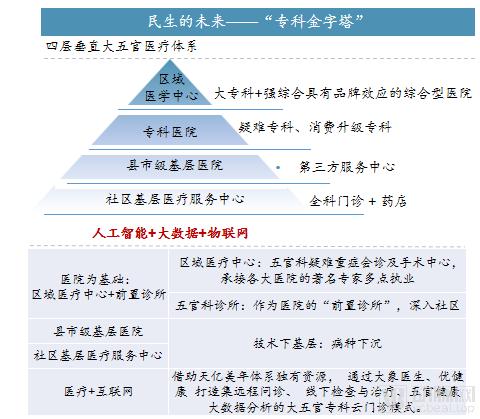
Pyramid Business System for ENT Specialties, Source: Minsheng ENT
Meanwhile, Minsheng ENT & Ophthalmology plans to develop an internet-based smart healthcare system, which will not only establish connections among medical resources at various levels but also expand its future service radius and enhance service capabilities. By fully leveraging the advantageous resources of its parent company, Tianyi Group, and the Meinian Onehealth ecosystem, Minsheng ENT & Ophthalmology aims to achieve a diversified and multi-dimensional development strategy.
In addition, Minsheng ENT will fulfill its social responsibilities and remain committed to charitable causes. As a medical group, Minsheng ENT will collaborate with upstream and downstream partners, public hospitals, the Red Cross Society, Lions Clubs International, and other organizations to launch more public welfare and charitable projects. In the coming years, Minsheng ENT aims to establish a comprehensive system that encourages an increasing number of institutions and compassionate individuals to join in these charitable efforts.
“The era of blind expansion and abundant opportunities fueled by a large market is gone. The development model based on demographic and policy dividends is gradually declining. In the midst of the investment and entrepreneurship boom in the healthcare industry, we must return to the essence of medicine, engage in ‘rational reflection’ and ‘solid accumulation,’ focus on connotative improvement, strengthen discipline construction, standardize medical management, enhance brand awareness, and pursue meticulous operations to achieve long-term success.” Dong Mifang firmly believes that deep cultivation of the ENT (ear, nose, and throat) specialty market holds significant promise.