

Zhuojian Launches Smart Internet Hospital Platform 3.0 to Enable End-to-End Patient Health Management and Multi-Stakeholder Win-Win Outcomes
In the first half of this year, with the formulation and implementation of detailed rules for “Internet + Healthcare” across various provinces and municipalities, the internet healthcare sector is advancing toward diversified exploration and standardized development. According to the “2018 Internet Hospital Report” by VCBeat’s Eggshell Research Institute, as regulatory details are filled in and provincial-level regulatory platforms are gradually improved, the second half of the year will witness a third wave of internet hospital construction.
During the development of internet hospitals, informatization transformation serves as a foundational component. It determines whether a seamless closed-loop workflow can be established for patient consultations, physician diagnoses, and follow-up management. Furthermore, it impacts the quality of experience for both patients and providers, as well as the hospital’s ability to enhance operational efficiency and thereby achieve better financial performance.
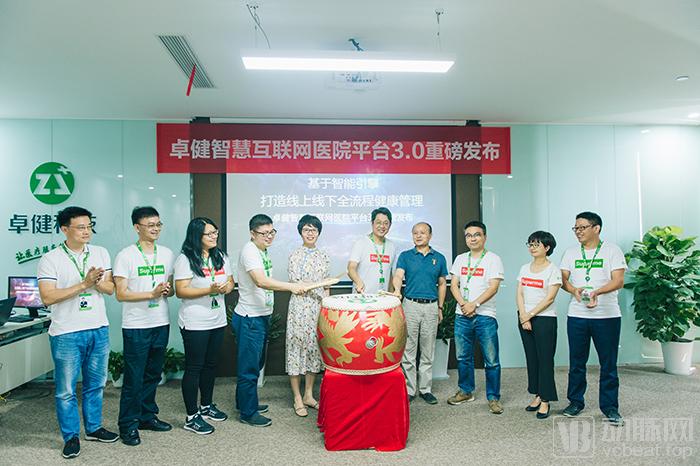
Zhuojian Smart Internet Hospital Platform 3.0 Released
As an IT service provider that has delivered internet hospital solutions to over 400 Grade A tertiary hospitals, Zhuojian Technology has observed that while the internet hospital sector has undergone several years of exploration and its technologies and business models have become increasingly mature, a key challenge remains: a patient-centered health management workflow has not yet been truly established. To address this issue and achieve a win-win outcome for patients, physicians, and hospitals alike, the Zhuojian Smart Internet Hospital Platform 3.0 was developed and officially launched on July 22 this year.
Enhancing the Patient Experience: The Birth of Smart Internet Hospital Platform 3.0
From physician to entrepreneur, and then to Chief Product Designer of an internet hospital, Wei Jianfeng, Founder and CEO of Zhuojian Technology, has always leveraged a cross-disciplinary perspective to continuously identify and promptly address industry challenges.
For instance, Wei Jianfeng found that internet services at most hospitals currently remain at the 1.0 stage, which primarily addresses online consultation issues. Typical services include appointment registration, payment, inquiry, and online text-and-image consultations, as well as prescription circulation and medication delivery built upon these foundations. Patients mainly use these services on their own initiative, without proactive intervention from hospitals. The 2.0 stage achieves online-to-offline integration, such as online consultations and appointments combined with offline examinations; however, a continuous healthcare experience has not yet been fully established. Outside the hospital setting, patients’ health awareness is incomplete, and they lack health maintenance guidance under hospital supervision.
To address these issues, Wei Jianfeng and his team conceived the idea of developing a 3.0 product. In March this year, the team proposed a comprehensive plan and swiftly moved into the execution phase, completing development and launching the product in July—a process that took five months.

Zhuojian Technology's Medical Team
Many senior executives at Zhuojian Technology have medical backgrounds, and its medical team is led by multiple holders of Doctor of Medicine (M.D.) degrees. The medical team, represented by Wei Jianfeng, has participated in numerous key research projects. With deep insights into the characteristics of the healthcare industry and a profound understanding of clinical needs and medical data, the team has integrated this expertise into the Smart Internet Hospital Platform 3.0, significantly enhancing its practical utility.
Enhancing Healthcare Efficiency with a Rule Engine and Knowledge Base at the Core
Smart Internet Hospital Platform 3.0 builds upon previous versions by introducing an intelligent engine, which leverages a dual-drive mechanism of a rules engine and a medical knowledge base to enable automated and semi-automated tracking services for various specialized diseases.
The Rules Engine Center categorizes various types of input information to generate health management plans and can accept comprehensive service plans initiated across diverse scenarios. As each patient represents a unique case with distinct circumstances, all generated plans are personalized.
The health management knowledge base encompasses various types of content, including health education materials, health guidance, health questionnaires, and patient management questionnaires. This content can be automatically delivered across diverse clinical workflows, such as appointment scheduling for examinations, prescription renewals, and intelligent patient education.
The platform is clear and convenient to use.
Healthcare Provider Portal: Medical staff only need to access the backend system to perform daily management of the rule base and related care plans, as well as data statistics. The system can then automatically or semi-automatically issue various instructions to patients. It also supports the feedback of examination and test results, automatically adjusting subsequent patient management plans based on these findings. This helps healthcare providers reduce workload and improve work efficiency.
Patient Side: Primarily based on platforms such as hospital WeChat service accounts, mobile apps, and Alipay, with data interoperability across all platforms. Patients can log in to view and manage their medical records, diagnosis and treatment histories, test reports, and vital signs data. Pre-consultation, patients can access services through multiple internet healthcare entry points; during consultation, they can enjoy text-based and video consultations; post-consultation, they can receive long-term, continuous, and follow-up care services.
The Smart Internet Hospital Platform 3.0 initially developed full-process management protocols for two conditions: thyroid cancer and laparoscopic resection, both of which have clearly defined management pathways and trigger points.
Taking thyroid disease as an example, a patient undergoing thyroid surgery experiences a full five-year care cycle encompassing initial consultation, hospital admission, surgery, home monitoring, follow-up testing, outpatient visits, and post-discharge services. In-hospital stay lasts only one week, home recovery takes three months, and annual follow-up examinations are conducted five times. On the Zhuojian Smart Internet Hospital Platform 3.0, the thyroid surgery rule engine is invoked to automatically schedule the entire process of treatment, health education, and diagnostic tests. It alerts medical staff to perform necessary actions and sends information and reminders to help both doctors and patients better understand the condition, enabling effective interventions. This ensures that patients receive timely postoperative follow-up visits and examinations, with services continuing until complete recovery is achieved.
Comprehensive Coverage of the Entire Health Management Process, Achieving a Win-Win-Win for All Three Parties
As evidenced by the aforementioned operational models and case studies, the Smart Internet Hospital Platform 3.0 is primarily designed from the patient’s perspective, addressing issues on the patient side more effectively. Specifically, under disease-specific management, the three dimensions of follow-up examinations, follow-up consultations, and prescription renewals at each stage of the patient’s journey are intelligently segmented. Regarding the medical care process, patients need only to execute the instructions they receive.
The platform serves not only in-hospital patients but also provides comprehensive, closed-loop management across online and offline channels, covering pre-hospital, in-hospital, and post-hospital stages. It encompasses various modules, including internet hospital services, mobile hospital services, collaborative diagnosis and treatment, integrated appointment scheduling, and patient-provider health education. Patients can access a range of services on the platform, such as inpatient care, appointment registration for consultations and examinations, prescription refills for chronic diseases, medication reminders, health education, satisfaction surveys, and post-discharge health management, thereby truly realizing a “patient-centered” approach.
On the surface, the Smart Internet Hospital Platform 3.0 directly addresses the issue of being “patient-centric.” In essence, it also achieves a win-win outcome for patients, doctors, and hospitals.
Specifically, patients benefit from comprehensive medical services spanning from appointment scheduling to the completion of treatment. Full-process tracking across pre-consultation, intra-consultation, and post-consultation phases enhances the care experience and ensures more reliable treatment outcomes. Physicians gain precise access to complete patient clinical data, enabling timely interventions based on individual conditions while simultaneously managing a larger patient load, thereby improving efficiency. At the institutional level, hospitals enhance their capacity for patient reception and management, increase the volume of served patients, and achieve improved operational performance.
Diversified Solutions to Drive the Upgrading of the Internet Healthcare Industry
It is understood that the Smart Internet Hospital Platform 3.0 can provide healthcare institutions with various types of solutions.
On July 23 this year, the Bureau of Medical Administration and Hospital Management under the National Health Commission issued the “Letter on Carrying Out the 2019 Graded Assessment of Smart Hospital Services,” specifying that the assessment would target secondary hospitals and above that utilize information systems to provide smart services. As early as March this year, the National Health Commission had formulated the “Graded Assessment Standard System for Hospital Smart Services (Trial),” which evaluates hospitals based on two aspects: the functionalities of informatics applications in delivering smart services to patients and the perceived effectiveness from the patients’ perspective. The system classifies smart services into Levels 0 to 5, with corresponding indicators established for each level.
The Zhuojian Smart Internet Hospital Platform 3.0 is applicable to all medical institutions at Level II and above. After undergoing corresponding informatization upgrades, these institutions can offer service items corresponding to Levels 4–5 in the aforementioned evaluation system.
Furthermore, Platform 3.0 is also applicable to Medical Consortia, enabling the rational matching of healthcare providers within a region. It supports multi-institutional integrated collaboration in medical treatment, nursing, and elderly care across the region. Specifically, it provides comprehensive post-discharge services for community-dwelling elderly patients by facilitating coordination among tertiary hospitals, county-level hospitals, and community health centers, thereby achieving bidirectional referrals and multidisciplinary consultations.
Looking back, by the end of 2018, Zhuojian Technology had provided internet hospital solutions to more than 400 Grade A tertiary hospitals and over 60 medical consortium collaboration platforms, covering more than 3,000 hospitals. It boasted 35 million registered users and 92,000 medical professionals, with its user base spanning 22 provinces.
Taking The First Affiliated Hospital, Zhejiang University School of Medicine and Henan Provincial People’s Hospital as examples, these two institutions, with the support and facilitation of Zhuojian Technology, provide online consultation services through their internet hospitals, promote the development of tiered diagnosis and treatment, and build a smart healthcare ecosystem. Currently, the Internet Hospital of The First Affiliated Hospital, Zhejiang University School of Medicine has entered a new stage in its exploration of digital healthcare.
Zhuojian Technology also provides services to the Henan Provincial People’s Hospital Internet-based Smart Tiered Diagnosis and Treatment Platform, as well as the Internet-based Smart Health Hospital. In March of this year, Henan Provincial People’s Hospital completed the construction of its information integration platform, achieving standardized data consolidation. The smart tiered diagnosis and treatment platform has connected 17 hospitals and 111 county-level hospitals across the province, enabling system integration and information sharing among HIS, LIS, and PACS.
Looking at the present, internet hospitals have entered the 3.0 stage, and Zhuojian Technology’s Smart Internet Hospital Platform 3.0 has already been implemented in multiple strategic partner hospitals. With the advent of the internet hospital construction boom, Zhuojian Technology continues to enhance its smart new healthcare solutions. By building smart internet hospitals, it assists hospitals and grassroots communities in establishing medical consortia, medical communities, family doctor contracting services, and telemedicine systems, thereby promoting industry upgrading.