

Chunxitang's Integrated Online-Offline Model Drives Synergy Across Home, Community, and Institutional Elder Care Services
In 2013, Feng Shaojun, then 40 years old, already had a diverse range of experiences. After returning to China with an MBA from France, he worked successively in state-owned enterprises, government departments, and private companies, feeling increasingly eager to embark on an entrepreneurial venture. During a gathering with friends, casual conversation around the dinner table turned to family matters: “Friend A’s mother was diagnosed with Alzheimer’s disease, and Friend B’s father had lost the ability to walk....” The atmosphere at the table gradually grew somber.
At that moment, Wang Tao, who had just returned from studying in Germany, shared insights into the German elderly care sector that he had gained while working in strategic consulting for the industry there. Feng Shaojun recognized the development gap between the domestic and international elderly care industries and identified a business opportunity. After the dinner gathering, he arranged to meet with Wang Tao.
After further discussions, Feng and Wang decided to collaborate and, in 2014, co-founded Shanghai Chunqi Ji Investment Management Co., Ltd. (hereinafter referred to as “Chunxitang”). Leveraging their respective backgrounds and the prevailing conditions in China, they entered the elderly care industry by introducing information-based systems.
However, the two IT system projects launched online by Chunxitang did not achieve the expected results. After summarizing the reasons for the failure, Feng Shaojun realized that online initiatives must be integrated with offline operations. By September 2015, Chunxitang had begun launching its first operational community-based smart elderly care service project in Wuzhen.
Chunxitang leverages smart technologies, including its self-developed smart elderly care information platform and intelligent IoT devices, to provide emergency assistance and health monitoring services for the elderly. Adhering to professional service standards and protocols, it delivers long-term care services to seniors in communities, at home, and in institutional settings. To date, its services have covered 25 sub-districts/towns across 9 prefecture-level cities, serving over 500,000 individuals through more than 100 service outlets.
“The concept of ‘smart elderly care’ was first proposed in 2015. Prior to 2015, the focus was largely on smart devices, linking wearable devices through the Internet of Things, but without incorporating intelligent operations,” Feng Shaojun told VCBeat (WeChat ID: vcbeat). “Smart elderly care is essentially a service model that prioritizes philosophy, relies on offline services as its foundation, and employs technology as a means. If information technology is regarded as the core of the service, it is not truly ‘smart.’”
The elderly care industry serves older adults. To engage them throughout the entire information lifecycle, “intelligence” must be integrated into every stage—specifically, human intelligence. By involving personnel, information technologies can be effectively leveraged, such as big data analytics and smart devices. When issues arise, proactive human response is essential to achieve true intelligent operations.
In terms of online services, Chunxitang emphasizes “precision,” which is specifically reflected in offline service delivery coupled with real-time online recording and updates. Taking elderly care service information as an example, Feng Shaojun listed three points:
First, dynamically record the health information of the elderly. Chunxitang establishes health records for the elderly, continuously recording and updating these records through wearable smart devices. The resulting data enables multi-dimensional and comprehensive analysis of the elderly's health status;
Second, comprehensively record service information for the elderly. Information regarding seniors’ participation in community activities and receipt of home-based services is also fully documented in the Chunxitang Service Management System, enabling effective supervision of service delivery;
Third, provide 24/7 year-round security data monitoring services, respond to and process alarm information, and establish a rescue network for vulnerable groups such as the elderly and individuals with disabilities who are of concern to the government.
In addition to recording elderly individuals' information and service details, the system periodically generates service reports through data exchange to facilitate government oversight.
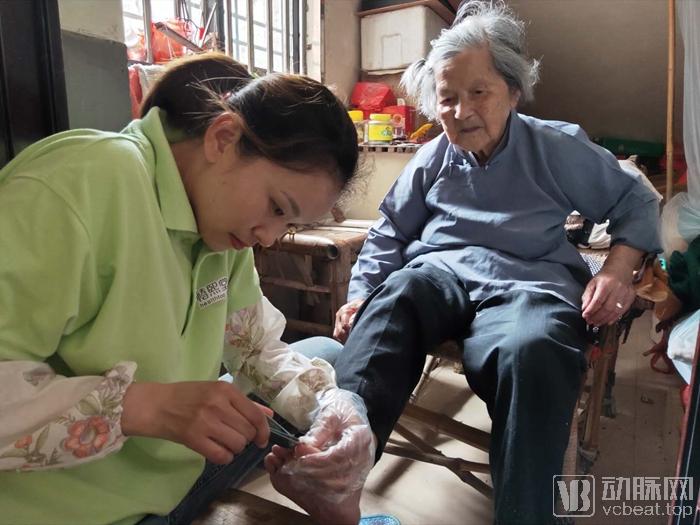
Chunxitang Staff Trim Toes for the Elderly (Image source: Provided by the enterprise)
Compared with its online services, Chunxitang places greater emphasis on “standardization” in its offline offerings. It is understood that Chunxitang is the first enterprise in Zhejiang Province to participate in national and provincial pilot projects for elderly care standardization. The company has developed 17 local elderly care standards (for Tongxiang City) and 87 corporate elderly care service standards, covering community-based, home-based, institutional, and smart elderly care sectors. Currently, through standardized processes, Chunxitang effectively reduces service risks, improves service efficiency, and ensures service quality.
Notably, to ensure service quality, Chunxitang maintains high professional standards for its staff. In addition to onboarding and position-specific training, Chunxitang has established its Wuzhen project as an internship base and launched school-enterprise collaborations with three local vocational and technical schools.
Chunxitang is grounded in the philosophy of “long-term care services,” establishing an integrated service system encompassing home-based, community-based, and institutional care. It provides “whole-process” care services to elderly individuals within its service area, although the specific content of services varies across home, community, and institutional settings.
Feng Shaojun told VCBeat that community-based elderly care services, operated under the public-private partnership model where facilities are publicly built and privately operated, form the foundation of industry participation. Therefore, Chunxitang builds upon its foundational community projects to extend services into the homes of the elderly. The primary recipients of these home-based services are special groups of seniors eligible for government safety-net support, such as those who are widowed without children, living alone, or in empty-nest households; most of these service programs are procured through government purchases. In contrast, institutional projects primarily serve the general elderly population, targeting the mid-tier market segment, which consists mainly of seniors receiving retirement pensions.
Chunxitang’s community-based elderly care services utilize “home-based care service stations” as their operational platform to establish a standardized service system encompassing health management, community cultural activities, professional nursing, daily living assistance, and dietary services. Leveraging an intelligent community elderly care management platform, the organization achieves smart management of its services.
Chunxitang’s home-based elderly care services primarily provide daily living assistance—such as bathing, cleaning, and meal support—to older adults who are childless and widowed, living alone, or disabled. Additionally, leveraging its 24/7 platform, the company equips home-dwelling seniors with smart caregiving devices to deliver safety and health early-warning services.
In institutional elderly care services, Chunxitang leverages its core advantages of intelligence and standardization to primarily accommodate elderly individuals with disabilities and dementia. It implements tiered care and provides professional nursing, chronic disease management, rehabilitation therapy, and nutritional dietary services.
The Wuzhen Community Smart Elderly Care Service Model is a typical representative of the Chunxitang model, providing customized services for the elderly by establishing a data center and an integrated management platform.
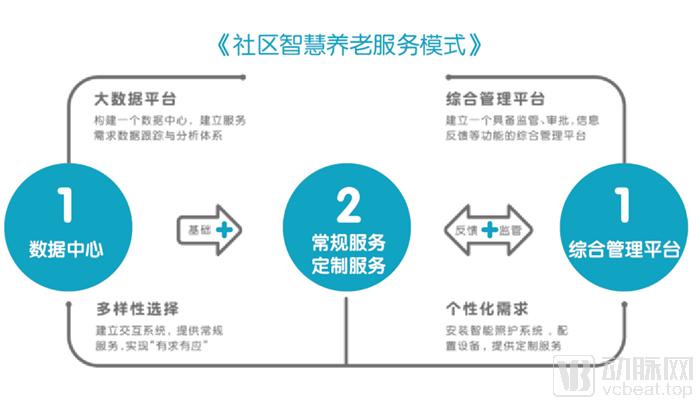
Chunxitang Community Smart Elderly Care Service Model (Source: Provided by the Enterprise)
Regarding future plans, Chunxitang will leverage the company’s community-based elderly care business to replicate and expand its long-term care service system. Currently focused on the Yangtze River Delta region, it aims to gradually expand its presence across the Chinese market.
VCBeat has learned that Chunxitang is currently undergoing Series A financing, with the funds primarily allocated to adding 1,500 beds, thereby enabling effective coordination of its service resources across the Yangtze River Delta region.