
July 22–28, 2019: A total of 9 new drug data entries were recorded this week, including 3 in oncology, 2 in antiviral therapy, 2 in metabolism, and 2 in the nervous system.
❖BMS announced the preliminary results of CheckMate 227. The good news is that the combination of Opdivo (O) and Yervoy (Y) demonstrated significant benefits compared to chemotherapy in PD-L1-positive patients with non-small cell lung cancer (NSCLC). The bad news is that the combination of Opdivo and chemotherapy did not show a significant overall survival (OS) benefit compared to chemotherapy alone in the first-line treatment of NSCLC, regardless of PD-L1 and TMB expression levels. Given that Keytruda (K), either as monotherapy or in combination with chemotherapy, has covered the first-line treatment for core NSCLC patient populations since 2018, irrespective of PD-L1 expression levels, Opdivo now faces a situation where it is being comprehensively outperformed by Keytruda in the NSCLC field. Among China’s “three golden flowers” of PD-1 inhibitors—Hengrui, Innovent, and Junshi—which one resembles Opdivo, which one resembles Keytruda, or which one will surpass its predecessors? Let us wait and see.
❖Amgen and Allergan Announce Launch in the U.S. MarketMvasiandKanjinti; these two drugs are biosimilars of Avastin and Herceptin, respectively. Meanwhile, Teva and Celltrion are expected to launch the Rituxan biosimilar Truxima later this year. Over the past two decades, the “three musketeers”—Avastin, Herceptin, and Rituxan—ushered in a monumental era of antibody therapeutics, leaving an indelible mark on the history of oncology. Now, their curtain call may finally be approaching. Nevertheless, Roche continues to innovate, with Ocrevus (for multiple sclerosis), Perjeta (for breast cancer), and Tecentriq (a PD-L1)Hemlibra (hemophilia), if developed properly, should become one of the "Four Little Dragons" of the next decade.
Pharmaceutical R&D Updates
BMS Announces Opdivo and CTLA-4 Inhibitor Yervoy
Combination Therapy in PD-L1-Positive NSCLCachieved some of the co-primary endpoints in China
BMS Announces That Opdivo in Combination with the CTLA-4 Inhibitor Yervoy Met the Co-Primary Endpoints of Part 1a in a Phase 3 Clinical Trial for Patients with Non-Small Cell Lung Cancer (NSCLC) Exhibiting Tumor PD-L1 Expression ≥1%
Opdivo and Yervoy are immune checkpoint inhibitors developed by BMS.
Inclusion Criteria and Study DesignCheckMate 227 was divided into three groups. Part 1a evaluated nivolumab plus ipilimumab or nivolumab monotherapy versus chemotherapy in patients with PD-L1-positive NSCLC; Part 1b evaluated nivolumab plus ipilimumab versus chemotherapy, and nivolumab plus chemotherapy versus chemotherapy, as first-line treatment for patients with PD-L1-negative NSCLC. Part 2 compared nivolumab plus chemotherapy versus chemotherapy, regardless of PD-L1 expression and tumor mutational burden (TMB), with the primary endpoint being overall survival (OS).
Exploratory analyses of 1a and 1b found that Opdivo met the co-primary endpoints, prolonging OS. However, no significant benefit was observed in group 2.
CExperimental Design of CheckMate 227
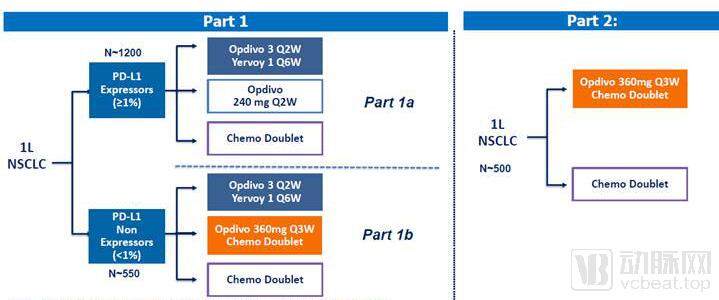
Data Source:BMS
Janssen announced that ponesimod, an investigational therapy for the treatment of multiple sclerosis,
Achieved the primary endpoint and most secondary endpoints in Phase III clinical trials
Janssen Announces That Investigational Therapy Ponesimod for Relapsing Multiple Sclerosis (MS) Met Primary and Most Secondary Endpoints in Phase 3 Clinical Trial
Ponesimod is a selective sphingosine-1-phosphate receptor 1 (S1P1) modulator.
Inclusion Criteria and Study DesignIn a randomized, double-blind, active-controlled Phase 3 superiority clinical trial involving 1,133 patients with a treatment duration of up to 108 weeks, the efficacy, safety, and tolerability of ponesimod were primarily compared with those of the approved therapy teriflunomide in patients with relapsing multiple sclerosis (MS).
Ponesimod met the primary endpoint of the trial compared with teriflunomide, demonstrating at least comparable efficacy.
FDA Accepts Submission of Epizyme’s Investigational Drug TazemetostatNew Drug Application (NDA),
while granting it priority review status
Epizyme Announces FDA Acceptance of New Drug Application for Investigational Drug Tazemetostat (for Epithelioid Sarcoma) and Grant of Priority Review
Tazemetostat is a first-in-class inhibitor of the histone-lysine N-methyltransferase EZH2.
Inclusion Criteria and Study DesignPhase II Clinical Trial for the Treatment of Patients with Epithelioid Sarcoma
The ORR for tazemetostat was 15%, and the DCR reached 26%. Median OS has not yet been reached. Furthermore, tazemetostat demonstrated a favorable safety and tolerability profile.
Roxadustat in patients on long-term dialysis and those not undergoing dialysis
Two Phase 3 Trials in Patients with Kidney Disease Meet Clinical Endpoints
Two Articles Published Online in NEJM Announce Results of Two Phase 3 Clinical Trials of Roxadustat in China
Roxadustat is a “first-in-class” hypoxia-inducible factor prolyl hydroxylase inhibitor (HIF-PHI)
Inclusion Criteria and Study DesignIn the trial on dialysis-associated anemia, 305 patients with end-stage renal disease were enrolled and randomized in a 2:1 ratio to the experimental group and the control group; in the trial on renal anemia, 154 patients with chronic kidney disease were randomized in a 2:1 ratio.
In the dialysis anemia group, the median hemoglobin level in subjects was 10.4 g/dL from week 23 to week 27, meeting the prespecified non-inferiority criterion; in the renal anemia group, hemoglobin levels in patients receiving the investigational drug increased significantly after 8 weeks of treatment, achieving the primary clinical endpoint.
Myovant Sciences Announces Its Investigational Relugolix Combination Therapy,
Phase 3 Clinical Trial for the Treatment of Uterine Fibroids Met Primary Efficacy Endpoint
Myovant Sciences Announces That Its Investigational Relugolix Combination Therapy Met the Primary Efficacy Endpoint and Six Key Secondary Endpoints in the Phase 3 LIBERTY 2 Clinical Trial for the Treatment of Uterine Fibroids
Relugolix combination therapy: Each tablet contains relugolix (40 mg), estradiol (1.0 mg), and norethindrone acetate (0.5 mg).
Inclusion Criteria and Study DesignPhase III Clinical Trial: Primary Endpoint is Menstrual Blood Loss
The primary clinical endpoint of achieving the predefined response criteria was met by 71.2% of patients receiving relugolix combination therapy, compared with 14.7% in the placebo group (p<0.0001).
Merck & Co. Announces Innovative Drug Islatravir for the Treatment of HIV Infection,
Positive Results Achieved in Phase I Clinical Trial
Merck & Co. (MSD) announced that islatravir (formerly known as MK-8591), an innovative nucleoside reverse transcriptase translocation inhibitor (NRTTI) for the treatment of HIV infection, achieved positive results in Phase I clinical trials
Islatravir is an innovative nucleoside reverse transcriptase translocation inhibitor (NRTTI) developed by Merck & Co. It inhibits the function of HIV reverse transcriptase through multiple mechanisms, with a mode of action distinct from currently approved anti-HIV therapies and traditional nucleoside reverse transcriptase inhibitors (NRTIs).
Inclusion Criteria and Study DesignIn the Phase I clinical trial, islatravir was incorporated into a matchstick-sized polymer drug-eluting implant. It was subcutaneously implanted into the upper arm of healthy volunteers, and the implant was removed after 12 weeks.
The implant maintains intracellular islatravir concentrations above the pharmacokinetic threshold for 12 weeks.
ViiV Healthcare announced fostemsavir in
Positive Results Achieved in Phase 3 Clinical Trials of HIV-1 in Adult Patients
ViiV Healthcare Announces Positive Results from Phase 3 Clinical Trial of Its First-in-Class Antiviral Therapy, Fostemsavir, in Heavily Pretreated Adults with HIV-1
Fostemsavir is a prodrug of temsavir. Temsavir binds to the gp120 subunit of the HIV-1 envelope glycoprotein gp160 complex, thereby blocking the interaction between the virus and the cellular CD4 receptor.
Inclusion Criteria and Study DesignPhase 3 Clinical Trial: Fostemsavir in Combination with Optimized Background Therapy (OBT) for the Treatment of Heavily Treatment-Experienced Patients Harboring Multidrug-Resistant HIV-1
At Week 96 of combination therapy with fostemsavir and OBT, 60% of patients in the randomized cohort (n=163/272) achieved virologic suppression (HIV-1 RNA <40 copies/mL), representing a 6% increase compared with results at Week 48.
Vertex Pharmaceuticals Submits NDA to the U.S. FDA,
Application for Market Approval of a Drug for the Treatment of Cystic Fibrosis (CF)
Vertex Pharmaceuticals Announces Submission of New Drug Application (NDA) to the U.S. FDA for a Triple-Combination Therapy Comprising VX-445 (elexacaftor), tezacaftor, and ivacaftor for the Treatment of Cystic Fibrosis (CF)
VX-445 is a next-generation CFTR protein corrector that restores the function of CFTR proteins carrying the F508del mutation, thereby improving respiratory function in patients with cystic fibrosis (CF).
Inclusion Criteria and Study DesignIn a randomized, double-blind, placebo-controlled Phase 3 clinical trial, the triple combination therapy of VX-445, tezacaftor, and ivacaftor was used to treat patients carrying one F508del gene mutation and one minimal function gene mutation.
Compared with the placebo-treated control group, patients in the treatment group showed significantly improved lung function.
Manifestations of Cystic Fibrosis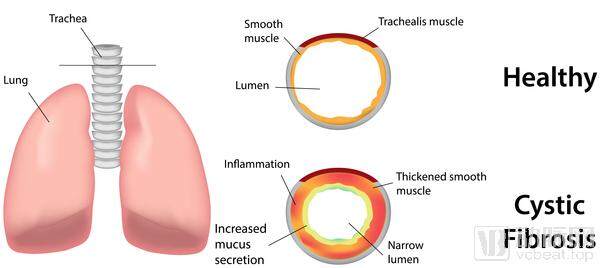
Data Source:NIH
Acadia announces that its 5-HT2A inverse agonist Nuplazid in
A Phase III Clinical Trial Failure of ENHANCE
Acadia Announces Phase III Clinical Trial Failure of Its 5-HT2A Inverse Agonist Nuplazid in the ENHANCE Study
Nuplazid is a highly selective serotonin 5-HT2A receptor inverse agonist with no dopaminergic activity, thereby avoiding the involuntary movement side effects associated with other antipsychotic medications.
Inclusion Criteria and Study DesignThis trial enrolled 396 patients with moderate-to-severe schizophrenia, who received either Nuplazid or placebo for 6 weeks in addition to standard therapy.
There was no difference between the two groups in the total Positive and Negative Syndrome Scale (PANSS) scores, resulting in a failure to meet the primary endpoint. Nuplazid demonstrated significant superiority over the placebo group on the prespecified secondary endpoint of negative symptom scores; however, due to the failure to meet the primary endpoint, this finding can only be considered as exploratory efficacy.
❖The U.S. FDA has approved Baqsimi, a powder formulation developed by Eli Lilly and Company, for marketing as an emergency treatment for severe hypoglycemia. Baqsimi is an intranasal glucagon powder therapy and represents the first non-injectable emergency treatment for severe hypoglycemia to receive FDA approval.
❖Merck (MSD) and Eisai jointly announced that the U.S. FDA has granted Breakthrough Therapy Designation to the combination therapy of Keytruda (pembrolizumab) and Lenvima (lenvatinib) for the first-line treatment of patients with advanced unresectable hepatocellular carcinoma (HCC) who are not candidates for locoregional therapy.
❖Freenome Announces Completion of $160 Million Series B Financing, Bringing Total Funding to $238 Million. Freenome Aims to Develop Simple and Accurate Multi-omics Blood Tests for Early Cancer Detection and Screening
❖Researchers at UT Southwestern Medical Center have discovered that PARP inhibitors, currently used to treat fewer than 10% of breast cancer patients, can be applied to a broader range of cancer types, including ovarian and prostate cancers. The new study also identified a potential biomarker that could guide the use of PARP inhibitors in combating cancer in these patients.
❖GSK Announces Appointment of Former Novartis and AstraZeneca CFO Jonathan Symonds as Next Chairman. GSK is undergoing a significant business transformation, currently seeking to “create value through innovative R&D approaches,” and plans to “create and demerge two new world-leading companies,” one focused on pharmaceuticals and vaccines, and the other on consumer healthcare.
❖Amgen and Allergan Announce the U.S. Launch of Mvasi and Kanjinti, Biosimilars to Avastin and HerceptinAvastin and Herceptin are the two best-selling oncology drugs globally, with worldwide sales in 2018 reaching CHF 6.849 billion and CHF 6.982 billion, respectively. In the United States, their combined sales totaled $5.9 billion in 2018.

