

Jinhua Tuo Secures Tens of Millions Series A Funding to Expand Traditional Chinese Medicine Practitioner Training Platform
Recently, VCBeat (WeChat ID: vcbeat) learned that Jin Huatuo, a leading one-stop platform for the professional development of Traditional Chinese Medicine (TCM) practitioners in China, has completed an A-round financing of tens of millions of yuan. The investors in this round include Supply and Marketing Capital Management (Beijing) Co., Ltd. and the chairman of a well-known listed company in the health industry. The funds will be primarily used to strengthen its teaching and research capabilities, accelerate clinic franchise partnerships, and jointly build a new TCM clinic model integrating clinics with educational institutions.
Jin Huatuo was founded in May 2015, with its headquarters in Guangzhou, Guangdong. It is currently the only enterprise in the Chinese market dedicated exclusively to the training and heritage of Traditional Chinese Medicine (TCM). Initially, Jin Huatuo adopted a business model combining “online lightweight consultations” with “offline TCM clinics.” In June 2015, Jin Huatuo secured RMB 6 million in angel financing from Qifu Capital. The following February, the company announced the completion of its Pre-A round of financing, amounting to tens of millions of RMB, with investors including Legend Stars, Angels Bay Venture Capital, Qifu Capital, and Health 160.
In mid-2016, Jin Huatuo shifted its business focus from TCM O2O to apprenticeship training for Traditional Chinese Medicine (TCM) practitioners and specialized competency certification. It has promoted its courses in 17 cities across Guangdong Province, signed contracts with over 400 chief-level mentors, covering 35% of the province’s chief-level and above mentor resources. The company has also partnered with multiple Grade A tertiary TCM hospitals to provide high-quality offline intensive training and online courses, resulting in rapid growth in both student enrollment and paying users.
In December 2017, the Interim Measures for the Administration of Examination and Registration of Physician Qualifications for Practitioners with Proven Expertise in Traditional Chinese Medicine (TCM) (i.e., Order No. 15 of the former National Health and Family Planning Commission) were issued, stipulating that TCM practitioners with proven expertise could obtain the qualification of TCM Specialist Physician through an examination process. According to Order No. 15, those who pass the examination will be awarded the “Traditional Chinese Medicine (Specialist) Physician Qualification Certificate” by the provincial-level administrative department of traditional Chinese medicine. After registering with the local administrative department of traditional Chinese medicine at or above the county level and obtaining the “Traditional Chinese Medicine (Specialist) Physician Practice Certificate,” they may engage in TCM medical activities either by opening a private practice or within medical institutions.
Previously, both the TCM Expertise Certification Exam and the Apprenticeship Completion Exam served as preliminary prerequisites for subsequently obtaining the Assistant TCM Physician and Licensed TCM Physician qualifications; passing these exams did not, in itself, grant the right to practice clinically.
The promulgation of Order No. 15 has undoubtedly broadened the career pathways for TCM practitioners, which is why 2018 came to be regarded as the inaugural year of TCM training. Dai Yunfeng, founder of Jin Huatuo, believes that social learners, licensed physicians, and high-quality clinics are the core elements driving the operation of TCM training platforms oriented toward cultivating TCM specialists with expertise.
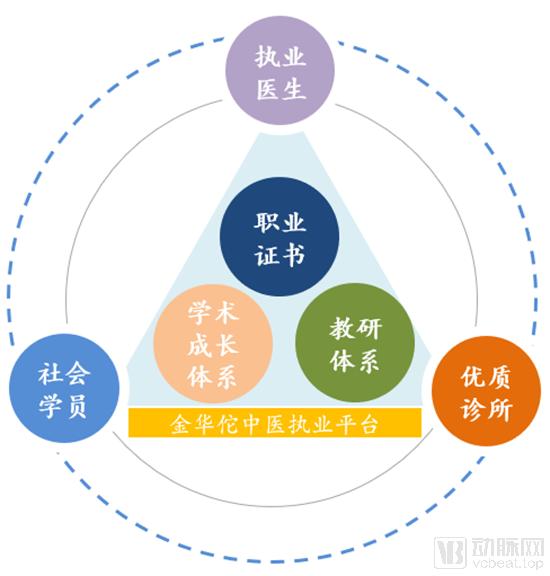
Core Elements of the Jin Huatuo TCM Practice Platform
Jin Huatuo has built a comprehensive TCM heritage education system centered on its unique teaching and research framework, continuous curriculum development, and multiple schools of traditional Chinese medicine (TCM) thought. It has established a “0-to-1” and “1-to-N” training architecture for TCM practitioners, providing high-quality opportunities for certification preparation and mentorship selection to both general learners and TCM professionals. Dai Yunfeng told VCBeat that Jin Huatuo has innovatively digitized and standardized more than 4,000 TCM knowledge points, and invited renowned senior TCM experts—including national academic leaders in acupuncture, TCM oncology, Shanghan (cold damage), and classical TCM—to develop online courses for students, thereby creating a top-tier teaching and research system.
Meanwhile, Jin Huatuo integrates online coursework with offline scenario-based learning, connecting students to the expert resources essential for obtaining professional licensure. Centered on building an extracurricular training system, Jin Huatuo collaborates with academic institutions, professional societies, and high-quality traditional Chinese medicine (TCM) healthcare providers to offer TCM practitioners and students pathways for enhancing their academic capabilities and achieving continuous professional growth, thereby establishing mechanisms for both academic and economic synergy across the upstream and downstream segments of the TCM industry. On one hand, it has deployed a network of over 2,000 clinics nationwide to create offline practice settings for TCM, while continuously supplying mentorship-apprentice students to Jin Huatuo. On the other hand, by continually developing new courses, it provides TCM practitioners with a comprehensive system for learning, assessment, and certification, effectively linking their educational outcomes with personal income and brand development.
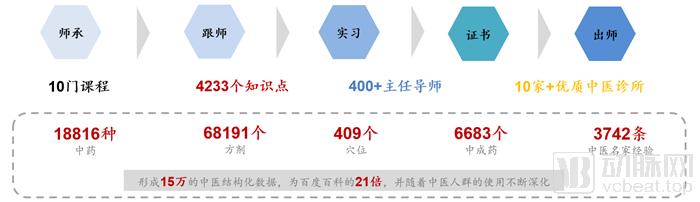
Jin Huatuo TCM Practitioner Training Process
Thus, Jin Huatuo has established a dynamic closed loop between fringe practitioners and TCM institutions. While supplying the TCM market with TCM physician resources, it leverages its partnerships with TCM physicians to integrate the upstream and downstream segments of the TCM healthcare industry, thereby forming a complete TCM service industrial chain.
Currently, Jin Huatuo has established partnerships with China Press of Traditional Chinese Medicine, Guangdong Provincial Hospital of Chinese Medicine, Kangmei Pharmaceutical, Xiangxue Pharmaceutical, Yifang Pharmaceutical, the Guangdong Medical Students Alliance, and Guangzhou University of Chinese Medicine, as well as with numerous renowned TCM practitioners in Guangdong. Dai Yunfeng stated that Jin Huatuo aims to become China’s leading third-party provider of off-campus training and certification by collaborating with top-tier TCM associations, universities, and medical institutions.
Dai Yunfeng told VCBeat that the prototype of Jinhuatuo actually originated from an original traditional Chinese medicine (TCM) knowledge base created by the Jinhuatuo TCM Informatics Team at Guangzhou University of Chinese Medicine. Dai, who specialized in integrated traditional Chinese and Western medicine, studied for three years and worked for three years at Guangdong Provincial Hospital of Traditional Chinese Medicine. During this period, he observed that although TCM has a long history, as an industry it remains in an early, non-standardized stage of development with overall low efficiency.
The solution Dai Yunfeng could envision at the time was to empower the traditional Chinese medicine (TCM) industry with standardized tools. Starting in 2013, Dai began building a structured TCM database. After securing angel investment in 2015, he left his hospital position to launch his own venture. To date, although Jin Huatuo’s business strategy has undergone several adjustments, the foundational database that Dai established six years ago has remained a critical underpinning for the evolution of its empowerment model.
Originating in 2015, when the O2O model was gaining widespread traction, Jin Huatuo can be regarded as a veteran player in the internet-based traditional Chinese medicine (TCM) sector. In the process of attempting to break down the barriers between online lightweight consultations and offline clinics, and exploring profitability, Dai Yunfeng gradually realized that this business model, lacking a clearly defined population with rigid demand, was excessively cash-burning and difficult to scale rapidly. Consequently, it failed to establish core competitive advantages capable of driving revenue growth in the short term. Ultimately, the internal friction caused by the intricate web of vested interests within the O2O model led Dai Yunfeng to consider transitioning toward TCM education, which offers a more streamlined business process.
“During our initial O2O phase, we cultivated an internet healthcare DNA that conventional TCM training institutions lack. While accumulating extensive physician resources, we have developed stronger capabilities in recruiting both students and faculty, enabling us to conduct more clearly structured training programs that integrate online and offline components.”
Domestic TCM practitioner training is at a nascent stage similar to that of English language training two decades ago. While entry qualifications remain ill-defined, market demand is clear. Currently, there are 49,000 TCM medical institutions in China, with an annual demand for 38,000 TCM physicians. However, the current annual output of clinical TCM physicians stands at only 12,600, resulting in an annual shortfall of 25,400 practitioners. Given that TCM education is a highly challenging field within vocational training and demands substantial industry resources, no major enterprises in China have yet established large-scale programs for TCM apprenticeship or specialized expertise certification.
Over the past two years, Jin Huatuo has invested more than RMB 3 million in market education initiatives in Guangdong Province, estimating that the interest rate in traditional Chinese medicine (TCM) learning among the general population is approximately 3‰. This means that out of every 1,000 individuals who have reviewed Jin Huatuo’s promotional materials, three will ultimately purchase its training courses, which range in price from RMB 10,000 to tens of thousands of yuan.
By extrapolating from this, Jin Huatuo has an estimated 140,000 potential users nationwide, corresponding to a market size of approximately RMB 15 billion. Among these, Jin Huatuo currently has around 800 students enrolled in its offline training programs. Compared with other similar platforms that offer only small-class instruction with an annual enrollment of 50–100 students, Jin Huatuo’s advantage is evident. In addition, the platform has over 10,000 paying online learners, with online courses priced from RMB 9.9 to RMB 399.
Dai Yunfeng believes that Traditional Chinese Medicine (TCM) will evolve toward a greater role in preventive healthcare and wellness, focusing on the concept of “treating potential disease before it arises.” Meanwhile, the talent pool for TCM will become more diversified, including professionals from social backgrounds and Western medicine practitioners who specialize in TCM. Diversified TCM clinics will proliferate, forming a decentralized, networked landscape. Knowledge consortia will emerge among physicians, and brick-and-mortar institutions will adopt an integrated model combining clinical services with educational functions.
Currently, there are over 50,000 TCM clinics in China. Jin Huatuo will empower these clinics and supply talent through its Cloud University of Traditional Chinese Medicine. “At this stage, Jin Huatuo TCM primarily offers offline courses focused on practical training and qualification exam preparation. In the future, it will develop AI algorithms based on a question bank to enable intelligent, targeted delivery of individual knowledge points, thereby extending TCM knowledge services to a broader population.”
Zeng Zheng, Partner at Qifu Capital, stated that Jinhua Tuo was an angel investment project funded by Qifu Capital in 2015. The rationale behind this angel investment was optimism regarding the Chinese government’s medium- to long-term support and encouragement for the traditional Chinese medicine (TCM) industry through industrial policies, confidence in the strong market demand from Chinese consumers for TCM services and the multi-hundred-billion-yuan market size, as well as appreciation for founder Dai Yunfeng’s comprehensive background—being formally trained at Guangzhou University of Chinese Medicine, having professional TCM experience in Guangdong Province, demonstrating innovative spirit in building an original TCM knowledge base, and harboring ambitions for the digitalization of the TCM industry. Over four years of entrepreneurship, Jinhua Tuo has transformed from its initial heavy O2O model of “online lightweight consultations + offline TCM clinics” into a blended online-offline training platform focused on TCM apprenticeship and certification for specialized expertise. This pivot has effectively addressed the pain points of insufficient supply of TCM practitioners and the market need for standardized training, while capitalizing on opportunities in the consumer market for online paid TCM knowledge content. With its unique teaching and research system, continuous course development, and core focus on various TCM academic schools, Jinhua Tuo has established a comprehensive TCM heritage education system. It has grown into a leading one-stop platform for TCM professional development in China, with promising prospects for future growth.