

HLT Partners with Tsinghua University and Peking University Cancer Hospital to Launch Intelligent Clinical Trial Innovation Base, Ushering in a New Era of AI-Driven Drug Development
VCBeat (WeChat ID: vcbeat) has learned that on July 29, Happy Life Technology (hereinafter referred to as “HLT”), in collaboration with the Tsinghua University–Yidu Cloud (Beijing) Joint Research Center for Intelligent Autonomous Healthcare Systems (Department of Automation, Tsinghua University; hereinafter referred to as the “Tsinghua University Center for Intelligent Autonomous Healthcare”), unveiled its latest innovative achievements in intelligent clinical trials at Tsinghua University. Meanwhile, HLT and the National Drug Clinical Trial Institution of Peking University Cancer Hospital jointly established the “Intelligent Clinical Trial Innovation Base,” marking the entry of drug clinical development into a new era of artificial intelligence.
The “Tsinghua University–HLT Technology-Enabled Research Achievements Launch Conference and the Kickoff Ceremony of the Collaboration between Peking University Cancer Hospital’s National Drug Clinical Trial Institution and Tsinghua University’s Center for Intelligent Autonomous Healthcare,” themed “Integration, Innovation, and Leapfrog Development,” attracted numerous experts and scholars from top domestic universities, as well as representatives from government bodies, industry sectors, and pharmaceutical enterprises.
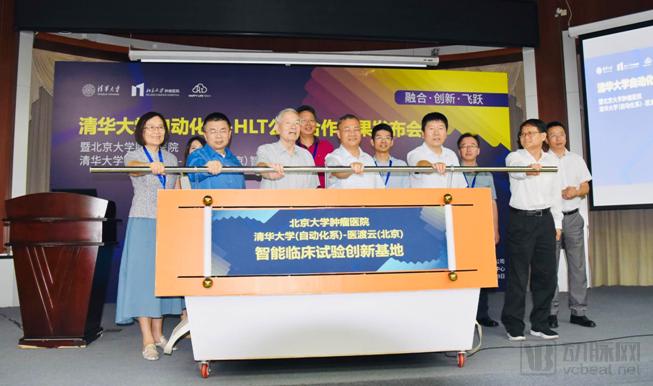
“Smart Clinical Trial Innovation Base” Officially Launched
Regarding this collaboration, Ji Jiafu, President of Peking University Cancer Hospital and Dean of the School of Clinical Oncology at Peking University, stated, “The interdisciplinary and cross-sector partnership between a ‘world-class university’ and a ‘world-class hospital’ not only aligns with the national strategy of building a science and technology powerhouse but also supports the development of a Healthy China. Applying advanced domestic artificial intelligence technologies to the medical field will further promote independent innovation in China’s healthcare sector, advance the development of China’s medical and health services, and make healthcare more affordable, safer, and more accessible.”
As a pioneer in the early informatization of China’s manufacturing industry, Wu Cheng, an academician of the Chinese Academy of Engineering and a professor at Tsinghua University, stated that artificial intelligence must not only aim for the highest technological heights but also be grounded in practical applications. The healthcare sector is closely tied to the public’s health and well-being throughout life, including birth, aging, sickness, and death, and is therefore intimately connected with the vital interests of the people. He expressed hope that both parties will leverage their respective strengths to engage in deep collaboration, thereby further advancing the development of medical artificial intelligence.
Dai Tao, Deputy Director of the Medical and Health Science and Technology Development Research Center under the National Health Commission, stated that technological innovation will comprehensively empower the reform and development of the healthcare sector, providing all-around support for clinical diagnosis and treatment, public health, drug research and development, and even policy formulation. In the face of new trends and changes, we must ensure the effective implementation of national policies, create a healthy and sustainable development environment, and fully promote the innovative development of smart healthcare.
Xu Jiaqi, former Director of the Center for Drug Evaluation (CDE) under the China Food and Drug Administration (CFDA), has expressed strong endorsement for the prospects of artificial intelligence (AI)-enabled clinical trials. He stated that the emergence of AI offers a certain possibility for China to achieve leapfrog development in the international competition for new drug research and development. The interdisciplinary collaboration between AI and the pharmaceutical sector serves as a powerful catalyst for China’s pharmaceutical industry; therefore, we must maintain a sense of urgency and seize the opportunities presented by this era.
At the conference, Tsinghua University’s Center for Intelligent Autonomous Healthcare and Peking University Cancer Hospital’s National Drug Clinical Trial Institution officially launched their collaboration on the “Innovation Base for Intelligent Clinical Trials.” Zhang Tao, Chair of the Department of Automation at Tsinghua University; Shen Lin, Vice President of Peking University Cancer Hospital; and Jiang Min, Director of the Office of the Drug Clinical Trial Institution at Peking University Cancer Hospital, respectively presented the respective strengths of the collaborating parties.
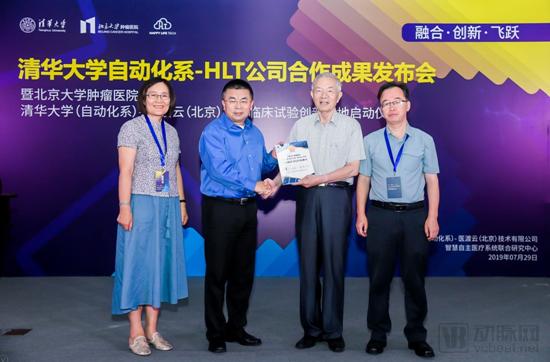
Academician Wu Cheng and Professor Fan Wenhui presented the plaque for the “Innovation Base for Intelligent Clinical Trials” to President Ji Jiafu and Vice President Shen Lin.
Zhang Tao stated that intelligent unmanned systems are a key technological focus of national strategic planning and a current hotspot in international academic and industrial research. On September 5, 2017, the Research Center for Intelligent Unmanned Systems at Tsinghua University was unveiled. Later that year, on November 19, the Industry-Academia-Research Alliance for Intelligent Unmanned Systems was established, which will promote progress in related industries and lead the development of intelligent unmanned systems.
As a professional and authoritative figure in clinical research, Shen Lin analyzed the key challenges encountered in the clinical development of anticancer drugs and shared her perspectives on novel clinical trial designs. She noted that domestic clinical research in China primarily suffers from partial conflicts with clinical practice, lack of flexibility, substantial consumption of human and material resources, cumbersome workloads, administrative burdens, and high error rates. There is an urgent need for precise, data-driven management in the clinical development of new drugs. Looking ahead, she expressed the expectation that the prolonged duration and high costs of clinical research can be quantified through data analytics, while clinical research processes, Clinical Research Coordinators (CRCs), monitoring, and management can be digitized. This transformation would liberate clinicians from overwhelming administrative tasks, thereby enhancing the quality and efficiency of clinical research.
Taking the National Drug Clinical Trial Institution of Peking University Cancer Hospital as an example, Jiang Min provided a detailed introduction to the specific implementation strategies and technologies for empowering clinical trials with data intelligence. The institution established a de-identified database of clinical trial participants, which serves as the data foundation and ensures regulatory compliance for artificial intelligence (AI) applications. Building on this infrastructure, they have primarily applied AI in four areas: intelligent patient recruitment, intelligent alerting for adverse events (AE) and adverse reactions (AS), intelligent alerting for protocol deviations, and automated eSource data entry. These applications have already achieved practical collaborations and phased results.
Academician of the Chinese Academy of Engineering and Professor at Tsinghua University, Dai Qionghai, has high expectations for this collaboration. He stated, “Tsinghua University’s Department of Automation has a long history and substantial technical accumulation in addressing key national technological challenges in artificial intelligence, bioinformatics, and complex manufacturing. Peking University Cancer Hospital is a leading institution in China for clinical research and development of new drugs in oncology, having pioneered numerous firsts. This collaboration, leveraging next-generation artificial intelligence technologies and real-world data to accelerate new drug development, is just beginning. In the future, we will engage in closer cooperation to systematically systematize, digitize, and intelligentize the entire clinical trial process. Together, let us create greater value and benefit society.”
After years of exploration, development, and practice, data intelligence has achieved significant success in addressing the shortcomings of drug development, with real-world evidence supported by big data playing a crucial role in this process.
Yao Chen, Director of the Medical Statistics Office at Peking University First Hospital, stated that by establishing a clinical research data platform anchored in hospital-based clinical scientific research and centered on source data from clinical studies, hospitals can implement standardized management processes for such source data. This approach addresses issues such as defects in electronic medical record data within hospital information systems that fail to meet the needs of clinical research, the absence of a comprehensive hospital-based clinical research management model, and concerns regarding research integrity. Consequently, high-quality source data for clinical research can be obtained, enabling real-world data to effectively serve clinical research endeavors.
Chen Xiaoxiang, Chief Product Development Officer at Harbour BioMed, presented a case study on how innovative data science drives advancements in clinical research. He stated that HBM9036, part of Harbour BioMed’s clinical pipeline, is the first-in-class TNF-α eye drop undergoing clinical trials for the treatment of dry eye disease. In collaboration with strategic partner HLT, both parties leveraged a network of ophthalmology experts to conduct epidemiological surveys of the target study population and develop preliminary patient profiles. Based on these insights, they precisely selected trial centers and collaborating research hospitals. These steps significantly accelerated patient enrollment and other processes, facilitating the successful completion of Phase II clinical trials for this product candidate.
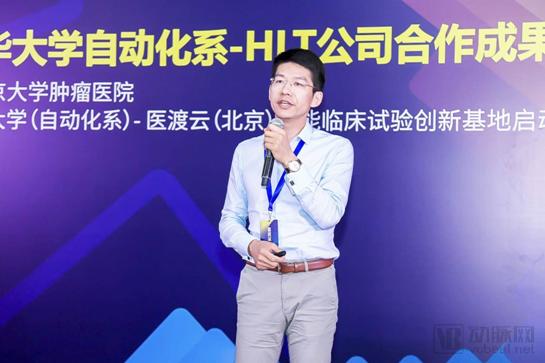
Xu Jiming, Co-Founder of HLT
As a partner of Harbour BioMed, HLT is well aware of the transformative impact of data empowerment on clinical trials. Xu Jiming, Co-Founder of HLT, shared the technical foundations of data-driven intelligent clinical development, along with HLT’s integrated services for data-driven intelligent clinical development (hereinafter referred to as “HLT-iCD”) and their advantages. He introduced that HLT-iCD is primarily an intelligent, full-lifecycle service platform designed for innovative pharmaceutical companies both in China and abroad. Its offerings include identifying high-potential innovative drugs, evaluating the commercial viability and scientific merit of drug candidates, accelerating drug R&D, and providing post-launch strategic planning.
The advantages of HLT-iCD are mainly reflected in the following aspects: Technical analyses based on preclinical data and real-world data enable faster and more precise clinical trial registration and protocol design; optimized SOP systems and processes, precise site/subject identification and selection, robust project risk management mechanisms, rapid start-up, and faster enrollment with fewer sites contribute to more efficient and optimized clinical operations; relying on a comprehensive intelligent clinical development service system, a powerful smart information platform, and innovative intelligent technological products, along with systematic professional training and quality management systems, ensures that SMO full-process services are more professional and stable.
“The Chinese government attaches great importance to the development of artificial intelligence in the healthcare sector. All of you present today are key participants in medical AI; you are not only the backbone of this field but also a crucial component in building the future healthcare ecosystem.” Fan Wenhui, Deputy Head of the Department of Automation and Director of the Research Center at Tsinghua University, concluded by stating that the prospects for medical AI are exceedingly broad. Through the concerted efforts of all stakeholders, artificial intelligence is bound to become a new highlight in healthcare development and will undoubtedly propel the medical field to new heights.