

AI-Powered Healthcare Innovator ZuoShou Doctor Poised for Breakthrough Amid China's Smart Hospital Evaluation Drive
In late July, the National Health Commission issued the “Notice on Printing and Distributing the Graded Evaluation Standard System for Hospital Smart Services (Trial)” (hereinafter referred to as the “Notice”), deciding to carry out the 2019 graded evaluation of hospital smart services in secondary-level and above hospitals that apply information systems to provide smart services, and setting forth clear requirements for the grading criteria and evaluation methods for smart hospitals.
At that time, whether a hospital is “smart” will become part of its performance evaluation. How to configure a standardized smart hospital system at a reasonable cost is not only a question for the IT department but also one that many health IT enterprises need to consider.
# Six Tiers Determine the Level of Hospital IntelligenceIn this tiered classification, the National Health Commission will evaluate hospitals based on two aspects: the functionality of information technology applications in providing smart services to patients, and the perceived effectiveness from the patients’ perspective, resulting in a total of six tiers.
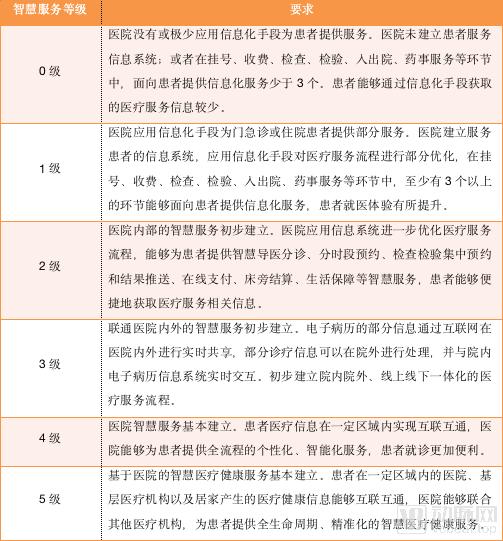
Official Rating Criteria
As can be seen, the entire evaluation process considers both local and overall applications. Based on the basic service content that should be covered in each stage—pre-diagnosis, during diagnosis, and post-diagnosis—it defines five categories: pre-diagnosis services, services during diagnosis, post-diagnosis services, whole-process services, and infrastructure and safety, comprising a total of 17 assessment items. Centered on these assessment items, scores are assigned respectively for the functionality and effective application scope of hospital smart service information systems. The items are divided into mandatory and optional ones; hospitals are eligible to participate in the corresponding level of rating only after completing a specified number of mandatory items.
Taking the three basic Level 3 items for pre-consultation services as an example, the Notice requires hospitals undergoing rating assessment to “support patients in making appointment registrations outside the hospital through channels such as websites, mobile apps, and regional appointment platforms”; and to “timely notify patients of any changes in hospital resources or information, such as changes in inpatient bed availability, temporary caps on registration numbers, physician schedule cancellations, or malfunction of diagnostic equipment.” From these requirements, it is evident that convenient and transparent medical services will be the future trend, with medical technology playing a significant role.
In recent years, with the advancement of hospital informatization, many Grade 3A hospitals have matured their information technology systems and achieved Level 2–3 smart healthcare capabilities. However, to progress further, they require the support of technologies such as big data and artificial intelligence.
Smart healthcare has long been regarded as an inevitable trend, prompting many health IT enterprises to make early strategic investments. Taking Beijing Zuoyi Technology Co., Ltd.’s “Zuoshou Yisheng” (Left Hand Doctor) as an example, among the 17 initiatives outlined in the Notice, its solutions are applicable to ten of the Level 5 evaluation categories, covering more than 50% of the rated items. The AI-powered products corresponding to these categories span the entire patient care journey and can also assist hospitals in delivering physician education and patient education.
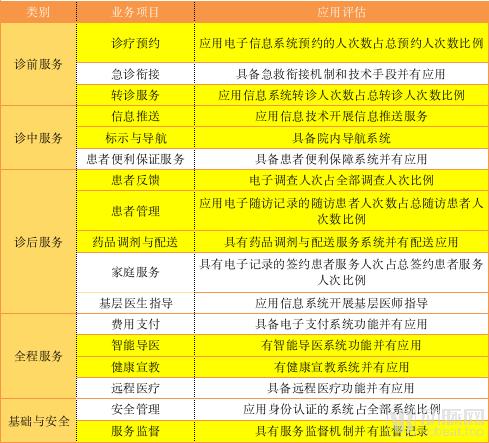
The yellow-highlighted sections indicate the rating items that can be covered by Zuoshou Doctor.
For different scenarios, Left Hand Doctor has developed various entry points for pre-consultation, during-consultation, and post-consultation phases, which can be easily embedded into hospitals’ WeChat Official Accounts. If patients require services such as pre-consultation triage, department recommendations, or intelligent medication inquiries, they can simply interact via Q&A within the Official Account to obtain information on their condition, relevant departments, and medications. Additionally, in hospital settings, Left Hand Doctor’s intelligent triage system can alleviate pressure on information desks. Once integrated with the hospital’s registration system, it can also assist patients in scheduling appointments.
Many patients, particularly those with chronic conditions, only complete the consultation phase at hospitals, while subsequent rehabilitation and recuperation must take place at home. However, once discharged, patients often fail to adhere to medication regimens or provide timely feedback as prescribed. Meanwhile, China’s relatively scarce medical resources leave physicians with insufficient time for proactive follow-up. In this context, Zuoshou Doctor’s Medication Manager, Intelligent Follow-Up, and Chronic Disease Management services can handle patients’ daily healthcare needs after clinical visits.
Once a hospital integrates the skills from the Zuoshou Yisheng (Left Hand Doctor) Open Platform, patients need only upload photos of their prescriptions. The platform then leverages OCR technology to recognize and analyze medical records, enabling intelligent services such as automated follow-ups, rehabilitation guidance, and medication reminders. Meanwhile, doctors and nurses at partner hospitals can track patients’ post-consultation conditions in real time by collecting patient feedback, thereby achieving intelligent follow-up care.
“Zuoshou Yisheng’s existing products fully meet the requirements of items in the rating system,” Peng Yu, Vice President of Product at Zuoshou Yisheng, told VCBeat. “Currently, most of our partner hospitals are at Level 2 or 3, and we can provide these hospitals with smart systems that meet Level 5 requirements. In the future, we may also integrate our existing products to attempt building a one-stop service system, facilitating hospitals in achieving better smart healthcare ratings.”
So, how large is this market? According to the "Notice," 32 zones across 31 provinces and municipalities in China will conduct assessments in four batches within just one month. This means that in the near future, more than 11,000 secondary-level and above hospitals will participate in the assessment of hospital smart service grading, giving rise to a market worth tens of billions of yuan.
Although the market is large, there are quite a few participating companies. In comparison, Zuoshou Doctor’s first-mover advantage is relatively obvious.
As early as 2015, Left Hand Doctor recognized the connection between artificial intelligence and smart hospitals. Peng Yu told VCBeat, “In 2017, our intelligent triage and intelligent pre-consultation systems were successfully developed and implemented. By 2018, our smart hospital products had taken shape. However, at that time, many hospitals were still focusing primarily on internal information technology infrastructure. With the advancement of digitalization, services are gradually extending from within hospitals to external settings, giving rise to various patient-friendly and beneficial services. Coupled with the introduction of supportive policies, this market is becoming increasingly clear, and our deep cultivation in the field of natural language processing (NLP) is poised to yield returns.”
Today, the core team of Zuoshou Doctor—comprising experts from Baidu’s Natural Language Processing Department, Tencent, and the National Health Commission—integrates cutting-edge technologies such as deep learning, big data processing, semantic understanding, and interactive medical dialogue with clinical medicine. The medical knowledge graph they have developed covers 20 types of entities, 200 types of relationships, and tens of millions of edges. Related applications have processed diagnostic data for tens of millions of patients, handling nearly 100,000 user interactions daily.
In terms of implementation, Zuoshou Yisheng’s first-generation products, such as triage and pre-consultation services, have undergone a major round of optimization and have cumulatively served more than 70 Grade A tertiary hospitals. Meanwhile, its next-generation products, including patient management and medication management tools, are already serving nearly 20 Grade A tertiary hospitals. With supportive policies now in place, the development of smart hospitals will become a key focus in the coming period. Zuoshou Yisheng is well-positioned to leverage this trend to establish a differentiated competitive advantage through artificial intelligence in hospital informatization, thereby providing more comprehensive support to healthcare institutions.