

EY Report: NHS Health Data of 55 Million People Valued at £9.6 Billion Annually, with Genomic Data Highlighted as a High-Value Asset
Harnessing the power of healthcare data to drive innovation in medical research and enhance patient care is at the core of today’s healthcare revolution.
Recently, EY, one of the Big Four accounting firms, released the report “Realizing the Value of Healthcare Data: A Framework for the Future.” Using the UK’s National Health Service (NHS) as its case study, the report suggests that the 55 million patient records held by the NHS could have tens of billions of pounds in explicit commercial value, and that a well-managed NHS dataset could generate £9.6 billion in value annually.
Analyses and insights derived from NHS datasets can help the UK Government optimize healthcare delivery in disease prevention and patient care, positioning the NHS and the UK at the forefront of global health innovation and making the NHS a model admired and emulated worldwide.
VCBeat has compiled this report, which primarily covers the following aspects:
I.Patient Data as an Intangible Asset
II.Market Value of Medical Data
III.The Future of Medical Data
The UK’s National Health Service (NHS) possesses the world’s largest integrated healthcare dataset, with an estimated 55 million medical records covering the entire population from birth to death. Historically, the healthcare industry and professionals have generated vast amounts of data in accordance with clinical and regulatory requirements. However, the collection and storage of such data were predominantly paper-based. Only in recent years has this information been digitized, leading to exponential growth in digital health data.
After digitizing the data, it is organized and consolidated into a comprehensive dataset that documents the entire continuum of an individual’s health journey, encompassing wellness, illness, diagnosis, treatment, therapeutic processes, and outcomes. The knowledge derived from these medical records holds significant value for all stakeholders within the healthcare ecosystem, benefiting patients, healthcare providers, pharmaceutical companies, and medical device manufacturers alike.
With the advancement of medical health technologies and the digitalization of data, we can achieve the following direct objectives by analyzing real-world information contained in specific patients’ medical records: deeper understanding of diseases, enhanced treatment safety, improved quality of care, faster early diagnosis, increased patient access to treatments, effective identification of targets for new therapies and drugs, shortened time-to-market for new therapies, and personalized medicine.
In this regard, healthcare providers need to recognize the value of the patient data they accumulate. It is not only a valuable intangible asset expected by multiple stakeholders but also an information treasure trove that details the deep-seated causes of health and disease.
To make a compelling case, we have quantified the value of the NHS dataset in monetary terms to provide a clearer perspective on the worth of healthcare data.
We estimate that the 55 million patient records currently held by the NHS may have an explicit market value of billions of pounds to commercial organizations. This estimate is based on the following indicators: the transaction values of health and life sciences companies with substantial patient data assets, and recent merger and acquisition transactions involving big data companies.
As the proportion of genomic records within NHS datasets increases, along with the growing volume of records available for management and linkage, the value of the data is expected to rise further. We estimate that over the next five years, the total number of whole-genome sequencing records associated with patients will increase from the current 100,000 to more than 5 million. In addition to this expansion in genomic mapping, the UK Department of Health and Social Care has announced that patients will be required to consent to having their genomic data used for scientific research by accredited researchers.
To further unlock the value of patient records, the NHS needs to create longitudinal patient-level datasets by integrating data from all care settings (such as primary, secondary, and social care) with available genomic profile data for each patient. However, it should be noted that the costs associated with this data transformation are substantial. We estimate that, if undertaken, the managed NHS dataset could generate up to £5 billion in annual value, while also delivering approximately £4.6 billion in annual benefits to patients.
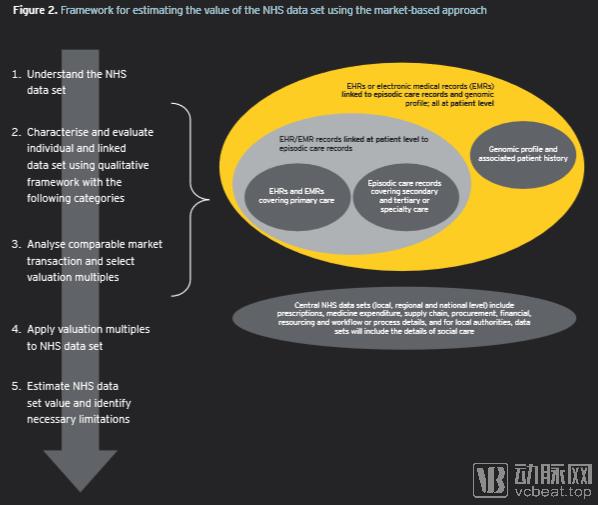
An Analytical Framework for Estimating the Value of NHS Datasets Using a Market-Based Approach
(Screenshot from the original report)
We quantify the value of data using two approaches. One is a “top-down” market-based approach, which estimates the value of a dataset based on its profile (size, content, nature, availability, maturity, uniqueness, and data quality) and observed pricing of data assets in the market. Market pricing is analyzed by calculating the implied “per-record” valuation multiples for data assets. In the absence of “pure-play” data assets, we calculate the valuation multiples of companies with significant patient data assets, then apply the benchmark per-record valuation multiple to NHS datasets to estimate the value of the data based on recent market transactions.
Another approach is the “bottom-up” revenue-based method, which quantifies value by assessing the economic benefits generated from managed datasets. Value can be calculated in terms of business utility and economic growth. Business utility encompasses faster and more accurate patient diagnoses, improved new products, enhanced care pathways, and operational efficiency, while economic growth includes socioeconomic benefits to UK society or increases in total gross value added. For example, if a life sciences company’s business planning leverages data utilization, the value of such data can be quantified when it shortens drug development timelines and facilitates the launch of new therapies.
In fact, the understanding of associations and trends in medical data has been applied to research on human health. Major companies are leveraging data to build analytical models that identify and predict high-risk patients, and developing early intervention plans to proactively improve health outcomes.
Each fragmented and isolated dataset holds some value, albeit limited. True value emerges when these datasets are aggregated, managed, processed, and linked to create longitudinal datasets. The transformed datasets will contain genomic information obtained from a patient over time. With advances in molecular biology technologies, omics data generated from patient tissue and liquid samples will become increasingly useful in the coming years. Greater value can be realized and converted when datasets are analyzed using basic or advanced analytical methods to identify knowledge with commercial value.
Electronic Health Records (EHR) represent a domain that exemplifies the value of data. In recent years, the capital markets have witnessed a series of transactions involving EHRs. For instance, the 2016 merger of IMS Health and Quintiles Incorporated involved 15 petabytes of prescription, promotional, claims, and EHR data from approximately 530 million patients. The merged entity, IQVIA, boasts a market capitalization of around $20 billion and employs 50,000 people. Similarly, Roche’s acquisition of Flatiron Health integrated patient data, EHRs, and an oncology platform, granting Roche access to real-world data derived from the Flatiron network, which spans approximately 280 oncology communities and covers around 2 million cancer treatment regimens for patients. Based solely on acquisition costs and the number of records, we can estimate the value of each patient record at $950.
In certain cases, investment information is not in the public domain. For example, when Great Point Partners acquired Corrona, a company that maintained an observational registry with data on approximately 65,000 patients, we can estimate the value based on other transactions. In these deals, Great Point Partners obtained EHR datasets used to test and refine artificial intelligence solutions.
IBM spent approximately $4 billion to acquire Phytel, Explorys, Merge, and Truven to enhance its Watson Health (AI) offerings. These individual acquisitions enable us to estimate the data costs paid by IBM; for instance, an anonymized pool of medical images valued at roughly $30 billion, including those generated by X-rays, computed axial tomography (CAT), and magnetic resonance imaging (MRI) scans. Based on this, we can estimate that each patient record is worth approximately $30.
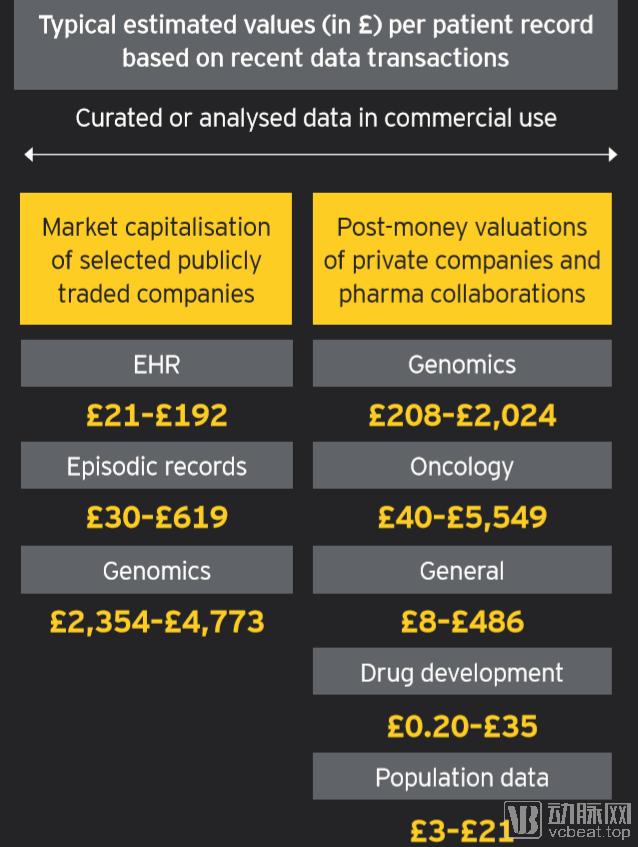
Summary of the Estimated Market Value Range of NHS Datasets
(Screenshot from the original report)
Genomic Profiles and Medical History: Genomic data are regarded by experts as a key component of future drug discovery and personalized medicine. However, in the absence of longitudinal health and medical data, such data remain highly isolated and of limited value. Due to the high cost of sequencing, large-scale datasets are currently lacking, a scarcity that is driving the valuation of each DNA sample to over $1,500.
Silverlake and GIC’s investment in Ancestry indicates that its 1.5 million consumer DNA samples, linked to over 20 billion digitized historical records and more than 80 million genealogy profiles, carry an estimated value of approximately $1,700 per genotype record. The research collaboration between 23andMe and Genentech suggests a value of around $5,000 per patient record, highlighting that consumer genotypic traits become more “pharmaceuticalized” when correlated with relevant medical histories. As an unnamed director at a pharmaceutical company stated, “With genetic information and longitudinal data, we can paint the clearest picture of patients’ epidemiology, disease progression, and overall experience.”
The value of data is also fully realized in the pharmaceutical sector. The NHS possesses electronic health record (EHR) data from all care providers and has the capability to link these records with the 100,000 Genomes Project in England. Transactions or partnerships involving these linked datasets require a high valuation per patient record (approximately $1,000–$5,000 per record), as they provide a holistic view of patient cohorts. These longitudinal, patient-level phenotypic and genotypic datasets hold intrinsic value for drug discovery and broader population health analysis, given their unparalleled scale and depth.
We can provide estimated valuations for any transaction or investment, such as Amgen’s success in the public tender held by the Icelandic Parliament. Amgen’s data, sourced from Iceland, comprises 600 genetic samples drawn from a population of 320,000, and has been used to create a genealogical database linking genotypic data with phenotypic data. We estimate the value of each record at approximately $1,300.
NHS datasets hold immense value for all stakeholders across the entire healthcare ecosystem. As a managed intangible asset, these datasets generate £9.6 billion in annual benefits, comprising £5 billion for the NHS and £4.6 billion for patients.
If the NHS fully leverages its stored patient data to unlock value in big data, artificial intelligence, and personalized medicine, it can achieve broader economic benefits.
If the NHS were to organize these datasets and generate longitudinal patient-level records, it would be able to unlock significantly greater data value, despite the high costs associated with data transformation and insight generation. Our economic analysis reveals the short-term (1–3 years), medium-term (3–9 years), and long-term (10+ years) impacts, which can yield substantial economic benefits.
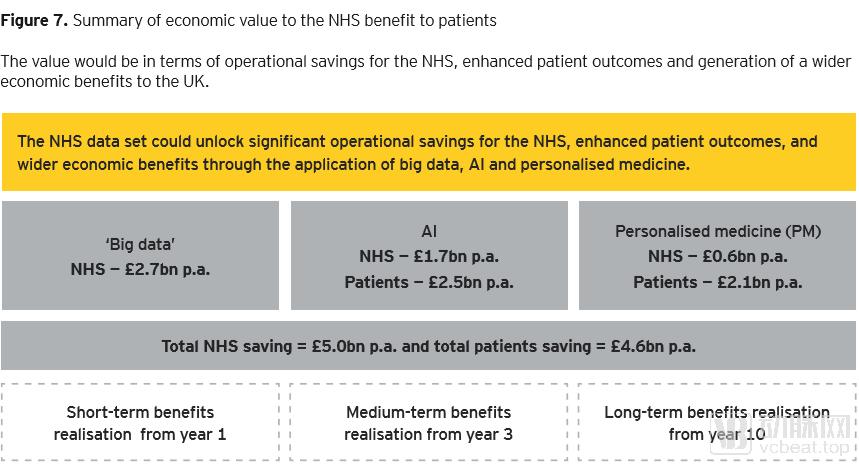
Summary of the Economic Benefits to Patients from NHS Data
(Screenshot from the original report)
Big data refers to large, static datasets that can be analyzed to provide genuine insights into trends and patterns. Consolidating all NHS datasets into a single, analyzable patient-level dataset will create opportunities to enhance NHS productivity and healthcare delivery. Our analysis estimates that the productivity savings from big data are equivalent to 2% of the National Health Service’s annual budget, amounting to £2.7 billion in yearly expenditure savings. This value can begin to be realized within one year of implementing NHS dataset management. Furthermore, the NHS can leverage a comprehensive NHS dataset to identify best-practice care pathways, thereby boosting productivity and enabling more effective utilization of its limited resources.
Currently, artificial intelligence (AI) has been widely applied in early detection, diagnosis, decision-making, treatment, and research within healthcare. AI can support the National Health Service (NHS) in expanding its operational capacity. Our economic model indicates that applying AI to longitudinal patient-level NHS datasets can yield economic benefits for the NHS in the medium term, saving the NHS £1.7 billion annually and patients £2.5 billion annually. As datasets grow, AI can further assist the NHS in addressing clinical and financial challenges.
Personalized medicine tailors treatment plans to the specific characteristics of individual patients. If the NHS establishes a patient-level longitudinal dataset encompassing phenotype- and genotype-related data, it will enable personalized healthcare. Genomic data can be leveraged for drug discovery, facilitating more precise diagnoses, more effective medication use, and improvements in both quality of life and longevity. By promising more targeted and effective treatments, personalized medicine could have a significant impact on the National Health Service, patients, the life sciences industry, and the economy.
Our analysis estimates that personalized medicine could save the National Health Service (NHS) budget £600 million annually, while generating £2.1 billion in benefits for patients each year. The application of data in personalized medicine will only be realized over a period of 10 years or more. Personalized medicine can reduce resource allocation to ineffective treatments by employing more effective drugs or technologies for patient care. Early evidence suggests that personalized medicine can not only curb NHS spending on ineffective treatments but also lower patient morbidity and mortality rates.
Finally, we believe that big data can realize the value of data in the short term, followed by artificial intelligence, and lastly personalized medicine. In the long run, personalized medicine is the field that best reflects the value of data.
With technological advancements, there is no doubt that data will play an increasingly valuable role.
Compiled by: Fan Xin
Report source: https://assets.ey.com/content/dam/ey-sites/ey-com/en_gl/topics/life-sciences/life-sciences-pdfs/ey-value-of-health-care-data-v20-final.pdf