State Council Issues Reform Plan to Eliminate Markup on High-Value Medical Consumables by Year-End
VCBeat (WeChat ID: vcbeat) has learned that the State Council has just issued a notice on the reform plan for high-value medical consumables. The notice explicitly states that all public medical institutions must achieve “zero markup” sales of medical consumables by the end of 2019.
High-value medical consumables refer to medical supplies that act directly on the human body, are subject to stringent safety requirements, are used in large clinical volumes, carry relatively high prices, and impose a significant financial burden on the public. In recent years, China’s high-value medical consumables industry has experienced rapid development, with continuous improvements in quality and notable technological advancements. It has played a positive role in meeting the public’s health needs and promoting the growth of the health industry. However, prominent issues such as artificially inflated prices and excessive use have also emerged, drawing strong public concern and widespread social attention. To comprehensively and thoroughly address these issues, standardize medical service practices, curb unreasonable growth in medical expenses, and safeguard the public’s health rights and interests, and in accordance with the decisions and deployments of the Central Committee of the Communist Party of China and the State Council, the following reform plan for the governance of high-value medical consumables is hereby formulated.
The main contents of the notice are as follows:
(I) Clarification of Management Subjects and Content. The Measures define and classify medical consumables, and specify full-process management covering selection, procurement, acceptance, storage, distribution, clinical use, monitoring, and evaluation of medical consumables.
(II) Establishing a Supply Catalog of Medical Consumables for Medical Institutions. Medical institutions are required to formulate their own supply catalogs for medical consumables in accordance with the principles of legality, safety, efficacy, appropriateness, and cost-effectiveness, and to adjust them regularly. Meanwhile, medical institutions are required to limit the number of varieties and specifications of medical consumables, and to restrict the number of suppliers for medical consumables with identical or similar functions.
(3) Stipulate requirements for the procurement of medical consumables. It is stipulated that the procurement of medical consumables shall be subject to unified management. Other departments or units shall not engage in the procurement of medical consumables, nor shall they use medical consumables procured and supplied by entities other than the designated medical consumables management department.
(4) Establish a tiered management system for the clinical use of medical consumables. The clinical use of medical consumables shall be managed under three tiers. In accordance with the Medical Device Classification Catalogue issued by the National Medical Products Administration (which classifies medical devices into Class I, II, and III), medical consumables are categorized into Tier I, Tier II, and Tier III. Tier I medical consumables may be used by healthcare professionals; Tier II medical consumables may be used by qualified healthcare professionals after receiving relevant training; Tier III medical consumables shall be used by healthcare professionals who possess the requisite technical operation qualifications, in compliance with relevant regulations on the administration of medical technologies. For implantable medical consumables, preoperative discussions shall also be conducted prior to use.
(5) Clarify regulatory measures. Medical institutions are required to establish information systems for the management of medical consumables, covering all stages including selection, procurement, acceptance, warehousing, storage, inventory counting, requisition, outbound delivery, clinical use, reporting of quality and safety incidents, adverse reaction monitoring, key surveillance, abnormal usage alerts, and evaluation, thereby achieving full lifecycle traceability for each medical consumable. Meanwhile, the management of purchasing and sales of medical consumables shall be incorporated into the framework of professional ethics construction, and efforts shall be intensified to investigate and penalize violations of the “Nine Prohibitions” and other irregularities in the management of medical consumables.
The reform plan also specifies the implementation steps and coordinates with medical insurance to roll out the reform initiative for high-value consumables.
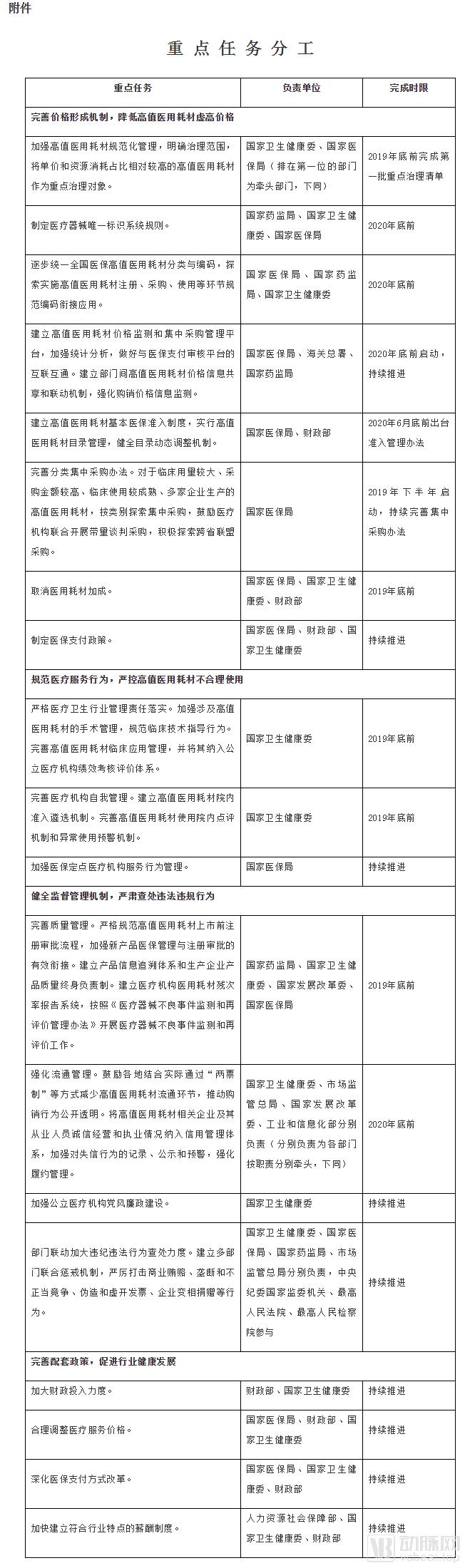
II. Improve the Price Formation Mechanism to Reduce Inflated Prices of High-Value Medical Consumables
(1) Unified coding system and information platform. Strengthen the standardized management of high-value medical consumables, clarify the scope of governance, and prioritize those with relatively higher unit prices and resource consumption shares. Formulate rules for the Unique Device Identification (UDI) system. Gradually unify the classification and coding of high-value medical consumables covered by national medical insurance, and explore the integrated application of standardized codes across registration, procurement, and usage stages. Establish a price monitoring and centralized procurement management platform for high-value medical consumables, enhance statistical analysis, and ensure interoperability with the medical insurance payment review platform. Establish mechanisms for inter-departmental information sharing and coordination on high-value medical consumable pricing, and strengthen monitoring of purchase and sales price information.
(II) Implement dynamic adjustments to medical insurance coverage and the reimbursement catalog. Establish a basic medical insurance access system for high-value medical consumables, implement catalog-based management for such consumables, improve mechanisms for dynamic catalog adjustments, timely include necessary new technological products, and remove products no longer suitable for clinical use. Gradually implement price negotiations for medical insurance coverage of high-value medical consumables to achieve “volume-based price reductions.” Establish a reporting system for manufacturers of high-value medical consumables; enterprises must submit reports on pricing, market sales volume, health economic evaluations, and adverse event monitoring for products intended for inclusion in medical insurance coverage, as required, serving as essential bases for medical insurance access reviews. Establish an evaluation and management system and standard framework for medical insurance coverage of high-value medical consumables.
(III) Improve the classified centralized procurement mechanisms. Explore classified centralized procurement of high-value medical consumables in accordance with principles such as volume-based procurement, linkage between volume and price, and promotion of market competition. All public medical institutions must conduct transparent, open transactions for the procurement of high-value medical consumables on designated procurement platforms. For high-value medical consumables characterized by substantial clinical usage, high procurement expenditures, mature clinical application, and production by multiple manufacturers, explore category-based centralized procurement; encourage medical institutions to jointly carry out volume-based negotiated procurement, and actively explore cross-provincial alliance procurement. For high-value medical consumables that have already gained reimbursement approval, with clearly defined reimbursement standards and relatively stable prices, implement direct online listing procurement. Strengthen oversight of the actual procurement volumes of high-value medical consumables by medical institutions.
(4) Eliminate markups on medical consumables. Public medical institutions shall eliminate markups on medical consumables, achieving “zero markup” sales for all such items across all public medical institutions by the end of 2019, with the selling prices of high-value medical consumables aligned strictly with their procurement costs. Any reasonable revenue shortfall incurred by public medical institutions due to the elimination of these markups shall be appropriately addressed primarily through adjustments to medical service prices, appropriate fiscal subsidies, and effective coordination with medical insurance payment mechanisms. Public medical institutions shall reduce costs and ensure sound, stable operations by implementing categorized centralized procurement, strengthening cost accounting, and promoting standardized and rational use of medical consumables.
(5) Formulate medical insurance payment policies. Taking into account factors such as the payment capacity of the medical insurance fund, patients’ affordability, categorized centralized procurement outcomes, and actual market transaction prices of high-value medical consumables, and giving full consideration to the normal operation of public medical institutions, study and formulate medical insurance payment policies; scientifically establish payment standards for high-value medical consumables under medical insurance, and implement a dynamic adjustment mechanism. For items that have passed medical insurance access negotiations, the negotiated prices shall be adopted as the medical insurance payment standards. For high-value medical consumables of the same category with similar functions, explore the establishment of unified medical insurance payment standards. The medical insurance fund and patients shall respectively cover the costs of high-value medical consumables based on the medical insurance payment standards, thereby incentivizing medical institutions to proactively reduce procurement prices.
III. Standardize medical service practices and strictly control the unreasonable use of high-value medical consumables
(6) Strictly implement management responsibilities in the medical and health industry. Improve clinical diagnosis and treatment standards and guidelines for key departments and major diseases, strictly manage clinical pathways, and enhance the standardization of clinical diagnosis and treatment. Strengthen surgical management involving high-value medical consumables and regulate the conduct of clinical technical guidance. User institutions shall incorporate the standardized use of high-value medical consumables into the standardized training and continuing education programs for medical personnel, ensuring strict adherence to product instructions, technical operation specifications, and other requirements. Explore and promote the development of professional career systems and specialized workforce construction for relevant practitioners in medical institutions. Improve the clinical application management of high-value medical consumables and include it in the performance appraisal and evaluation system of public medical institutions. Intensify spot checks on medical quality, launch special governance campaigns in key areas, strictly investigate and punish violations in the clinical use of high-value medical consumables by all types of medical institutions, and establish and improve a related credit evaluation system.
(7) Improve self-management of medical institutions. Establish an in-hospital access and selection mechanism for high-value medical consumables, and strictly prohibit departments from procuring them independently. Designate specific departments responsible for the management of high-value medical consumables, and assign clear post responsibilities to individuals. Improve the in-hospital review mechanism and abnormal use early warning mechanism for high-value medical consumables. Carry out monitoring and analysis of medical personnel’s use of single-brand high-value medical consumables and the consumption of high-value medical consumables per surgical procedure. Promptly conduct admonitory interviews with relevant medical personnel in cases of abnormal use, and link the results of monitoring and analysis to their performance evaluations.
(8) Strengthen the management of service conduct by designated medical institutions under the medical insurance scheme. Incorporate the utilization of high-value medical consumables into the medical insurance service agreements with designated medical institutions, and enhance the oversight of physicians participating in the medical insurance program. Violations of medical insurance service agreements shall be addressed through measures such as regulatory interviews, warnings, circulars of criticism, orders for rectification within a specified timeframe, and suspension or termination of agreements. Improve the construction of intelligent medical insurance audit information systems, strengthen big data analysis of high-value medical consumables, and implement focused monitoring, targeted audits, regular public notifications, and social disclosure for medical institutions and healthcare personnel with high frequency and high costs of high-value medical consumable usage. Establish a “blacklist” system for designated medical institutions and healthcare personnel, and improve the credit evaluation system for designated medical institutions under the medical insurance scheme.
IV. Improve the supervision and management mechanism, and strictly investigate and deal with illegal and irregular activities
(9) Improve quality management. Strictly standardize the pre-market registration and approval processes for high-value medical consumables, and strengthen the effective coordination between new product medical insurance management and registration approval. Raise technical requirements for medical device registration to promote the gradual alignment of high-value medical consumable standards with international norms. Timely disclose relevant approval information to enhance public oversight. Establish a product information traceability system and implement a lifelong responsibility system for product quality among manufacturing enterprises. Strengthen quality management throughout the entire lifecycle of high-value medical consumables, and improve policies regarding research and development, approval, and standardized application. Encourage innovative development of high-value medical consumables, support their R&D and production, accelerate the registration and approval of high-tech high-value medical consumables, and promote fair market competition. Increase the intensity of sampling inspections, unannounced inspections, and production process inspections of manufacturing enterprises. Establish a reporting system for the defect rate of medical consumables in medical institutions, and carry out monitoring and re-evaluation of adverse events related to medical devices in accordance with the Measures for the Administration of Monitoring and Re-evaluation of Adverse Events of Medical Devices.
(10) Strengthen distribution management. Enhance the scale, specialization, and informatization of the high-value medical consumables distribution sector. Public medical institutions shall establish mechanisms for selecting distributors of high-value medical consumables to promote fair market competition. Standardize the management of purchase and sales contracts; medical institutions must strictly make payments in accordance with contractual terms. Encourage localities to reduce distribution links for high-value medical consumables through measures such as the “Two-Invoice System,” tailored to local conditions, thereby promoting transparency in purchasing and sales activities. Incorporate the integrity records and professional conduct of enterprises involved in high-value medical consumables and their practitioners into the credit management system, strengthen the recording, public disclosure, and early warning of dishonest behaviors, and reinforce contract performance management.
(11) Strengthen the construction of Party conduct and integrity in public medical institutions. Fully leverage the leadership role of Party organizations in public medical institutions, strictly implement the “one position, dual responsibilities” requirement, and effectively enhance efforts to promote Party conduct, uphold integrity, and combat corruption. Party organizations in public medical institutions shall regard the prevention and punishment of corruption in the management and use of high-value medical consumables as a key component of comprehensive and strict Party governance, assume primary responsibility, and establish and improve working systems for stringent supervision and management of high-risk departments, positions, and personnel. Discipline inspection and supervision agencies within public medical institutions shall fulfill their duties of supervision, discipline enforcement, and accountability, strengthen oversight of Party members, cadres, and medical staff to ensure strict compliance with Party discipline and state laws, and seriously investigate and deal with misconduct and corruption in the field of high-value medical consumables.
(12) Strengthen inter-departmental coordination to intensify the investigation and punishment of disciplinary and legal violations. Establish a multi-departmental joint punitive mechanism to severely crack down on commercial bribery, monopolistic and unfair competition practices, forgery and fraudulent issuance of invoices, and disguised corporate donations. Discipline inspection and supervision authorities at all levels shall strengthen their review and investigative efforts, and seriously investigate and handle disciplinary and legal violations such as embezzlement, bribery, dereliction of duty, and malfeasance in the field of high-value medical consumables. Adhere to the principle of investigating both bribe-taking and bribe-giving; cases requiring criminal liability or falling under the jurisdiction of judicial organs shall be transferred to judicial authorities in accordance with the law. Increase the public notification of typical cases involving high-value medical consumables to create a strong deterrent effect.
V. Improve Supporting Policies to Promote the Healthy Development of the Industry
(13) Increase fiscal investment. Clarify the government’s primary responsibility for operating medical institutions, implement funding guarantees for public medical institutions that comply with regional health planning in areas such as capital construction, equipment procurement, discipline development, personnel training, and response to public health emergencies, and enforce investment policies covering expenses for retired personnel in accordance with national regulations and subsidies for policy-related losses, thereby ensuring the sound operation of public medical institutions.
(14) Rationally adjust medical service prices. In accordance with the principles of overall cost control, structural adjustment, selective increases and decreases, and gradual implementation, and following the pathway of creating fiscal space, optimizing structure, and ensuring policy coherence, rationally adjust medical service prices. Priority should be given to increasing prices for medical services that reflect the value of technical labor, while ensuring effective coordination between medical insurance and pricing policies. Establish a dynamic adjustment mechanism for medical service prices, gradually rationalize price ratios, promote an increase in the proportion of medical service revenue within total medical revenue, and create favorable conditions for rationalizing the prices of high-value medical consumables.
(15) Deepen the reform of healthcare insurance payment methods. Accelerate the implementation of payment reforms such as case-based payment and Diagnosis-Related Groups (DRGs), and establish an incentive and risk-sharing mechanism characterized by “retention of surpluses and shared responsibility for reasonable overruns.” This will encourage medical institutions to internalize the use of high-value medical consumables into their operational costs and proactively control their utilization. Adhere to the dual objectives of controlling medical expenses and standardizing the quality of medical services. In conjunction with clinical pathway management, formulate reasonable case-based payment schemes and expand the coverage of case-based payment.
(16) Accelerate the establishment of a compensation system tailored to the characteristics of the healthcare industry. Implement the policy that “allows medical and health institutions to exceed the current wage control levels for public institutions, and permits revenue from medical services—after deducting costs and allocating various funds in accordance with regulations—to be primarily used for personnel incentives.” Improve compensation distribution policies to motivate medical staff to actively participate in the reform of high-value medical consumables governance.
VI. Adhere to the Tripartite Coordination of Medical Care, Health Insurance, and Pharmaceutical Services, and Strengthen Implementation
(XVII) Raise Awareness and Strengthen Leadership. The governance of high-value medical consumables is a key task in deepening the reform of the medical and healthcare system. Given its broad scope and widespread concern from all sectors of society, local governments and relevant departments must fully recognize the significant importance of this work, effectively strengthen leadership, implement responsibilities, adhere to a problem-oriented approach, adopt categorized measures, combine regulatory restrictions with constructive guidance, and ensure the steady and orderly advancement of the reform.
(18) Clarify responsibilities and coordinate division of labor. All localities and relevant departments must firmly commit to reform, clearly define roles and responsibilities, and work closely together to ensure the effective implementation of various reform measures aimed at governing high-value medical consumables. Localities are encouraged to explore effective practices and models tailored to their specific circumstances, with a focus on categorized centralized procurement, strengthened distribution management, and standardized services in public medical institutions, and to promptly summarize and promote these experiences.
(19) Strengthen publicity and provide rational guidance. Localities and relevant departments shall interpret policies in a timely and accurate manner, enhance publicity and guidance, promptly respond to public concerns, rationally guide social expectations, and strive to create a favorable atmosphere for reform.