

Ping An Good Doctor and Quzhou Municipal Health Commission Sign Strategic Cooperation Agreement to Co-Build Quzhou Ping An Internet Hospital

PINGAN GOOD DOCTOR
Internet Medical Health Platform
On the afternoon of July 30, the signing ceremony for the strategic cooperation on the construction of Quzhou Ping An Internet Hospital was held in Quzhou. Tang Feifan, Deputy Secretary of the Municipal Party Committee and Mayor, and Wang Tao, Chairman and CEO of Ping An Health Internet Co., Ltd. (hereinafter referred to as "PINGAN GOOD DOCTOR"), attended the event. The meeting was presided over by Wang Liangchun, Vice Mayor of the Municipal Government. Leaders from the Municipal Health Commission, the Municipal Healthcare Security Administration, and the Municipal Big Data Bureau, along with relevant personnel from PINGAN GOOD DOCTOR, also attended.
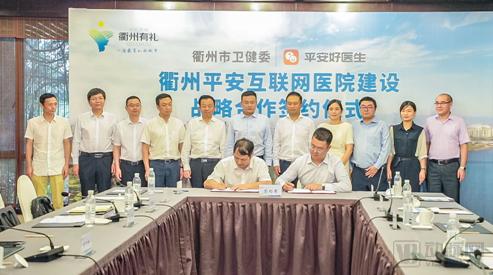
The establishment of Quzhou Ping An Internet Hospital aligns with the strategic deployment of Quzhou City’s “Digital Economy and Smart Industry” initiative, focusing on addressing public healthcare access challenges by actively exploring new technologies, industries, business formats, and models in the development of “Internet + Healthcare.”
Following the signing of the strategic cooperation agreement for the establishment of the Quzhou Ping An Internet Hospital, both parties will fully leverage their respective strengths to integrate Quzhou’s physical medical resources with PINGAN GOOD DOCTOR’s “Internet + Healthcare” model. This collaboration aims to expand the ecosystem connecting hospitals, physicians, and patients, advance the “At Most One Visit” reform in Quzhou’s healthcare services, and promote the development of medical consortia and medical communities, thereby jointly building the Quzhou Ping An Internet Hospital.
By leveraging internet information technology, we will integrate pre-consultation, consultation, and post-consultation stages across online and offline channels, optimize medical service processes, promote tiered diagnosis and treatment, enhance the service capacity of primary healthcare institutions, and foster the development of “Internet + Healthcare.” Guided by the public’s health needs, we aim to further improve medical services, elevate the quality of care, and increase the public’s sense of gain.
Meanwhile, Quzhou Ping An Internet Hospital truly delivers “one-stop” medical services with precision, creating an integrated online–offline healthcare loop that encompasses disease prevention, online appointment scheduling, virtual follow-up consultations, online payment, home delivery of medications, post-discharge follow-up, and chronic disease management. It promotes healthy lifestyles, enhances residents’ health management capabilities and health literacy, establishes a “patient-centered” service model, and improves the accessibility of medical resources.
Tang Feifan, on behalf of the Municipal Party Committee and Municipal Government, extended congratulations on the successful signing of the agreement between the two parties. He pointed out that healthcare is a most tangible aspect of public welfare and a key area for extending the “At Most One Visit” reform into the realm of public services. Quzhou will highly cherish this opportunity for cooperation, leveraging PINGAN GOOD DOCTOR’s robust medical resources and internet technology to break down barriers between in-hospital and out-of-hospital settings, integrate online and offline resources, further address the city’s shortcomings in medical resource availability, and provide higher-quality medical services to the general public. He emphasized the need to adopt an open, inclusive mindset that tolerates errors and encourages experimentation, strengthen support for the digital economy and internet industries, and strive to forge a path characterized by “exchanging demonstration projects for application scenarios and market access for industrial development.”
Wang Tao stated that PINGAN GOOD DOCTOR will fully leverage its strengths, integrate medical resources from both parties, build a one-stop healthcare ecosystem, establish an “ecosystem” connecting hospitals, doctors, and patients, pioneer a new model of “Internet + Healthcare” services, and contribute to the development of “Healthy Quzhou.”
At the meeting, Ji Genshou provided a detailed overview of the key components in the development of the Quzhou Ping An Internet Hospital. He stated that, in response to the construction needs of the Quzhou Ping An Internet Hospital, the Municipal Health Commission would adopt a “regulation + service” approach to actively support PINGAN GOOD DOCTOR in collaborating with local medical and health institutions to establish an internet hospital. This initiative aims to contribute meaningfully to deepening healthcare reform and advancing the digital transformation of health services.
The main components of the Quzhou Ping An Internet Hospital construction agreed upon by both parties are:
1. Provide a complete set of information systems for internet-based medical diagnosis and treatment services.
Comprising four major modules—a one-stop medical service platform, an appointment registration and referral platform, a prescription information sharing platform, and a refined patient disease management platform—it will promote the sharing of high-quality resources and the equalization of medical services, effectively enhance primary healthcare capabilities, improve the treatment level for complex and critical cases, and boost the overall efficiency of healthcare resource integration and health service implementation.
2. Actively foster new business models in online healthcare services.
Leverage information technology to facilitate the vertical flow of high-quality medical resources, promote the comprehensive implementation of online medical technologies and healthcare service operations in physical hospitals, and realize a “patient-centered” model. This entails shifting from the current status quo where patients revolve around hospitals and physicians, toward a new paradigm where hospitals and physicians prioritize serving patients, thereby establishing a new ecosystem for online healthcare services.
3. Support new models of medical insurance payment and create new pilots for online payment.
Actively respond to the new national policies on healthcare security reform, support the new model of online medical insurance, and explore pilot programs through internet hospitals to advance online follow-up services for common and chronic diseases, enabling them to be covered by offline medical insurance payment policies, thereby enhancing the convenience and satisfaction of patients’ online medical consultations.