DXY Talent Releases '2018 China Hospital Compensation Survey Report'—First Industry Report Based on Direct Data from Hospitals
Recently, DXY Talent, the professional healthcare human resources service platform under DXY, officially released the “2018 Hospital Compensation Survey Report” (hereinafter referred to as the Report). The Report provides a clear presentation and analysis of compensation levels across 17 provinces and municipalities, more than 40 hospitals, 20 key departments, four job-level tiers, and 80 specific positions, offering an in-depth interpretation of the current state of hospital compensation structures in China.
From the perspective of hospital human resources, this report incorporates expert-guided research commissioned by the National Health Commission. By conducting a comprehensive benchmarking analysis of current hospital compensation levels and structures, it provides hospitals with a reference basis for assessing the competitiveness of their own compensation packages and formulating related policies. As is well known, “how to reasonably determine compensation levels” has long been a focal point and a challenging issue for hospitals, medical professionals, and society at large. The market is replete with various compensation survey reports attempting to delineate the compensation systems of Chinese hospitals.
However, existing industry compensation data rely primarily on self-reported information from physicians, lacking scientific and extensive surveys, which results in certain deficiencies in rationality and comprehensiveness. The "2018 China Hospital Compensation Report" released by DXY Talent directly obtains compensation data from hospital human resources departments, presenting physician compensation levels with more authentic and comprehensive data, thereby setting a precedent in the industry.
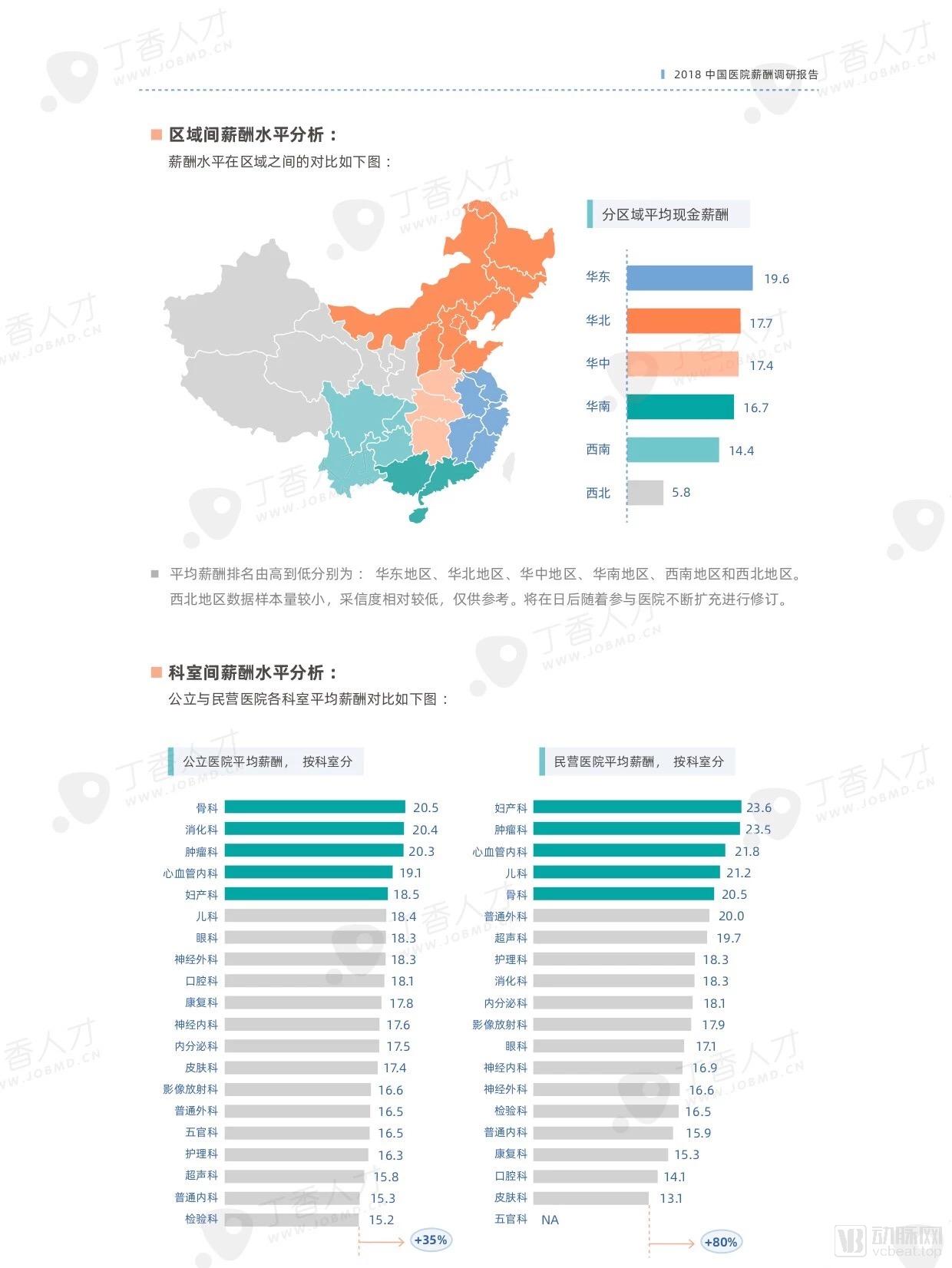
The report shows that the average compensation level in public hospitals is 10% lower than that in private medical institutions; there are significant regional disparities in compensation, with first-tier provinces having significantly higher compensation levels than second-tier provinces, with a gap of up to 30%.
Furthermore, the vast majority of hospitals have implemented autonomous compensation distribution, reasonably widening internal pay disparities. The salary differential between adjacent professional titles ranges from 40% to 50%; the pay gap between different departments in public hospitals is 35%, while that in private hospitals reaches 80%.
The survey data were processed and analyzed by McKinsey, a top-tier global think tank. To ensure objectivity and authority, the report also incorporated expert guidance. Zhang Guangpeng, a researcher at the Health Development Research Center of the National Health Commission, provided interpretations of the survey findings regarding compensation structures, compensation levels, and task allocation. Zhang Guangpeng stated that improving the compensation system for medical personnel requires respecting inherent principles, reflecting professional characteristics, and demonstrating value. “While the vast majority of hospitals have established job valuation and performance appraisal systems centered on service volume, quality, and outcomes, it is still necessary to refine factors such as technical complexity, occupational risk, and labor value, strengthen performance assessment, and enhance management efficiency.”
The 2019 China Hospital Compensation Survey is currently open to the medical community in China. Scan the QR code below to participate. Upon approval, you will receive a complimentary copy of the latest report.