
From May 20 to May 26, 2019, there were a total of 12 new drug data entries this week, including 5 for oncology, 2 each for respiratory system, metabolic diseases, and rare diseases, and 1 for neurological disorders.
❖Following this year’s setbacks in gastric and liver cancer, Keytruda has once again suffered a Phase III clinical trial failure in triple-negative breast cancer. Additionally, Opdivo failed to meet its primary endpoint in a clinical trial for first-line treatment of glioblastoma this month. The journey of PD-1/PD-L1 inhibitors to replace chemotherapy and targeted therapies is entering increasingly complex territory. Domestic PD-1 developers, whose clinical trial designs have often referenced those of overseas agents such as Opdivo and Keytruda, must now proceed with greater caution.
❖Novartis’ gene therapy for spinal muscular atrophy, Zolgensma, has been approved for market launch. This landmark SMA product holds the promise of a one-time curative treatment and is currently priced at $2.125 million, making it the most expensive new drug on the global market. Recently, several high-cost gene therapies have gained approval, with companies like Bluebird Bio and Novartis opting for outcome-based pricing models. More industry insiders are calling for reforms to the traditional fee-for-service payment system in the United States to better accommodate these novel therapies. Such innovations in payment mechanisms may also offer valuable insights for China’s rare disease drug industry.
❖Array Biopharma’s targeted triplet therapy for patients with BRAF V600E-mutant metastatic colorectal cancer has recently reported positive data. BRAF mutations account for approximately 15% of the colorectal cancer patient population and are associated with a very poor prognosis, with the BRAF V600E mutation being the most common. This triplet regimen may become the first chemotherapy-free targeted treatment option for colorectal cancer, and it has been recommended in the recent NCCN Clinical Practice Guidelines in Oncology for Colorectal Cancer.
Pharmaceutical R&D Updates
Agios’ New Cholangiocarcinoma Drug TIBSOVO
Achieved Primary Endpoints in Global Phase 3 Clinical Trials
Recently, Agios announced that its investigational new drug TIBSOVO (ivosidenib) for cholangiocarcinoma met its primary endpoint in a global Phase 3 clinical trial. The drug is indicated for the treatment of patients with cholangiocarcinoma harboring isocitrate dehydrogenase 1 (IDH1) mutations.
TIBSOVO is an oral inhibitor targeting IDH1 gene mutations.
Inclusion Criteria and Study DesignThe Phase 3 ClarIDHy clinical trial had progression-free survival (PFS) assessed by independent radiological review as its primary endpoint. Secondary endpoints included investigator-assessed PFS, overall response rate, overall survival, duration of response, pharmacokinetics/pharmacodynamics (PK/PD), quality of life assessments, and other safety and tolerability metrics.
Trial data showed that patients treated with TIBSOVO achieved a statistically significant improvement in PFS.
K Drug in Triple-Negative Breast Cancer
Failed to Meet Clinical Endpoints in Phase 3 Clinical Trials
Merck & Co. recently announced that its PD-1 monoclonal antibody drug, Keytruda, failed to meet the primary endpoint in a Phase 3 clinical trial evaluating monotherapy as second- or third-line treatment for triple-negative breast cancer.
Keytruda is a PD-1 monoclonal antibody drug.
Inclusion Criteria and Study DesignKeynote-119 is a multicenter, phase 3 study that enrolled 622 patients with previously treated triple-negative breast cancer.
Trial data showed that the K drug group failed to demonstrate an OS advantage over chemotherapy.
Array Biopharma: Colorectal Cancer
Targeted Triple Therapy Achieves Positive Clinical Outcomes
Array Biopharma announced positive interim data from its Phase 3 trial of a targeted triplet therapy for patients with metastatic colorectal cancer harboring BRAF V600E mutations, demonstrating improved overall survival (OS). The company plans to submit a marketing application for the combination therapy in the second half of the year.
This targeted triple therapy consists of Array’s BRAF inhibitor Braftovi (encorafenib), MEK inhibitor Mektovi (binimetinib), and the anti-EGFR monoclonal antibody Erbitux (cetuximab).
Inclusion Criteria and Study DesignThe BEACON CRC trial, a randomized, open-label, Phase 3 clinical study. The interim objective response rate (ORR) analysis included 331 patients, out of a total enrollment of 665 patients.
Targeted triple therapy met the primary endpoint of the clinical trial, significantly improving patient ORR compared with the control group (26.1% vs. 1.9%). Patient OS reached 9 months, with a 48% reduction in the risk of death.
Figure: BRAF Protein Signaling Pathway
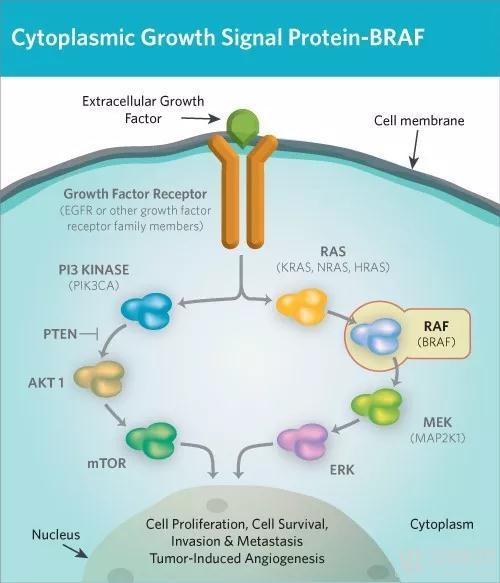
Source: Massachusetts General Hospital Official Website
Novocure Tumor Treating Fields Therapy
Approved for First-Line Treatment of Malignant Pleural Mesothelioma
The First New Therapy in 15 Years
Novocure’s tumor treating fields therapy, NovoTTF-100L, has recently received FDA approval for marketing in combination with pemetrexed and platinum-based chemotherapy for the treatment of metastatic or unresectable locally advanced malignant pleural mesothelioma. This marks the first new therapy approved by the FDA for malignant pleural mesothelioma in nearly 15 years. The system had previously been approved for the treatment of glioblastoma.
The NovoTTF-100L System selectively affects mitosis in tumor cells by applying alternating electric fields of a specific intensity to the tumor region.
Inclusion Criteria and Study DesignApproval was granted based on the STELLAR clinical trial, in which 80 patients received NovoTTF-100L in combination with chemotherapy.
The median survival for patients receiving combination therapy was 18.2 months, whereas previously such patients could only receive palliative care to alleviate symptoms.
Iovance’s Tumor-Infiltrating Lymphocyte Therapy
LN-145 Granted Breakthrough Therapy Designation by the FDA
Iovance Biotherapeutics’ tumor-infiltrating lymphocyte (TIL) therapy, LN-145, which attracted significant attention due to its abstract at the ASCO conference last week, has been granted Breakthrough Therapy Designation by the FDA for the treatment of patients with recurrent, refractory, or metastatic cervical cancer.
TIL therapy involves isolating tumor-infiltrating lymphocytes from the patient and stimulating their expansion ex vivo using the cytokine IL-2. The activated and expanded TILs, with enhanced anti-tumor efficacy, are then infused back into the patient to target and destroy tumor cells.
Inclusion Criteria and Study DesignThe Breakthrough Therapy designation was granted based on positive data from early-stage clinical trials of LN-145. Prior to treatment, patients had received a mean of 2.6 prior lines of therapy.
Among the 27 evaluable patients, 1 achieved complete response, 9 achieved partial response, and 2 had unconfirmed partial responses. In summary, this TIL therapy achieved an ORR of 44%, which is nearly three times that of Keytruda in a similar patient population (14%).
Novartis Asthma Combination Therapy QVM149
Positive Results Achieved in Phase 2 Clinical Trial
Novartis’ QVM149, a combination therapy for asthma, met its clinical endpoints in Phase 2 trials, significantly improving patients’ lung function. The therapy is currently undergoing Phase 3 clinical trials, with top-line results expected soon.
QVM149 is a combination product comprising fixed doses of a long-acting muscarinic antagonist (glycopyrronium bromide), a long-acting β2-adrenergic agonist (indacaterol), and an inhaled corticosteroid (mometasone furoate).
Inclusion Criteria and Study DesignPhase 2 clinical trial was a randomized, double-blind, active-controlled study. Enrolled patients received either QVM149 or the standard therapy of salmeterol/fluticasone propionate combination.
Experimental data show that QVM149 met the primary endpoint of the trial, improving patients' forced expiratory volume in one second (FEV1).
BI Company’s Novel Drug for Systemic Sclerosis-Associated Interstitial Lung Disease
Nintedanib Met Primary Endpoint in Phase 3 Clinical Trial
Nintedanib, a novel drug developed by Boehringer Ingelheim for systemic sclerosis-associated interstitial lung disease (SSc-ILD), met the primary endpoint in its Phase III clinical trial, significantly slowing the rate of decline in lung function.
Nintedanib is a small-molecule tyrosine kinase inhibitor.
Inclusion Criteria and Study DesignA total of 576 patients participated in the Phase 3, randomized, double-blind, placebo-controlled clinical trial named SENSCIS.
Trial results showed that the rate of decline in lung function was reduced by 44% in patients treated with nintedanib.
Innovative RNAi Therapy Lowers LDL Cholesterol Levels
Reduction of over 50%
The Medicines Company announced that Inclisiran, an siRNA therapy co-developed with Alnylam, achieved a sustained reduction of low-density lipoprotein cholesterol (LDL-C) levels by more than 50% in Phase 3 clinical trials. Elevated LDL-C increases the risk of cardiovascular disease, and existing statin therapies often fail to adequately control these cholesterol levels.
Inclisiran reduces mRNA levels by binding to the mRNA encoding PCSK9, ultimately lowering the levels of this type of “bad cholesterol.”
Inclusion Criteria and Study DesignApproval of the open-label extension study named ORION-3.
Trial results indicate that inclisiran reduces low-density lipoprotein levels by 51% and maintains this effect for more than 210 days.
Figure: Mechanism of Inclisiran Binding to PCSK9
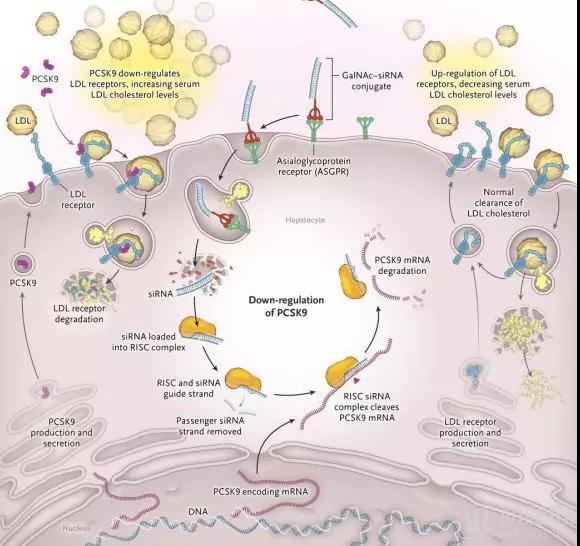
Source: diseases
Canagliflozin Approved for the Treatment of Patients with Type 2 Diabetes
Priority Review Designation for Chronic Kidney Disease
Janssen recently announced that it has submitted a supplemental New Drug Application (sNDA) to the FDA for canagliflozin (Invokana) for the treatment of chronic kidney disease in patients with type 2 diabetes, and has been granted Priority Review designation.
Canagliflozin is an SGLT2 inhibitor used as an adjunct to improve glycemic control in type 2 diabetes.
Inclusion Criteria and Study DesignThe CREDENCE trial, a randomized, double-blind, two-arm, placebo-controlled Phase 3 clinical trial, enrolled a total of 4,401 patients with type 2 diabetes and stage 2–3 chronic kidney disease.
By the median follow-up of 2.62 years, patients treated with canagliflozin had a 30% lower incidence of end-stage renal disease and a 20% reduced risk of MACE.
UCB’s New Intranasal Epilepsy Drug Approved by FDA
The FDA recently approved UCB’s new nasal spray, Nayzilam (midazolam), for the treatment of cluster seizures in epilepsy patients aged 12 years and older. This is the first FDA-approved intranasal medication for the treatment of cluster seizures.
The main component of Nayzilam is a benzodiazepine.
Inclusion Criteria and Study DesignApproval of a randomized, double-blind, placebo-controlled Phase 2 trial enrolling 201 patients.
Trial results showed that a higher proportion of patients treated with Nayzilam achieved seizure cessation within 10 minutes of treatment (80.6% vs. 70.1%) and remained free of recurrence within 6 hours (58.2% vs. 37.3%).
Novartis Gene Therapy for Spinal Muscular Atrophy
Zolgensma Approved for Market Launch
The FDA has approved the marketing of Zolgensma (onasemnogene abeparvovec-xioi), a gene therapy developed by AveXis, a Novartis subsidiary, for the treatment of spinal muscular atrophy (SMA) in patients under two years of age with SMN1 mutations. The official list price has been announced at $2.125 million, payable in installments over five years.
Zolgensma is a gene therapy utilizing non-replicating adeno-associated virus 9.
Inclusion Criteria and Experimental DesignApproval based on the results of Zolgensma in the Phase 1 START clinical trial and the ongoing Phase 3 STR1VE clinical trial.
Phase 1 results indicated that all 15 treated pediatric patients remained alive and free from permanent respiratory support after a 24-month follow-up period, whereas under natural conditions, more than 90% of such patients would die or require permanent respiratory support by the 24-month mark. Interim results from the currently announced Phase 3 trial show that 21 out of the 22 treated pediatric patients remain alive to date.
Eli Lilly's New Crohn's Disease Drug Mirikizumab
Achieved Positive Results in Phase II Clinical Trials
Eli Lilly Announces Positive Phase 2 Clinical Data for Investigational New Drug Mirikizumab in Patients with Moderate-to-Severe Crohn's Disease
Mirikizumab is a fully humanized monoclonal antibody drug targeting the p19 subunit of IL-23.
Inclusion Criteria and Study DesignThe SERENITY trial, a randomized, double-blind, placebo-controlled study, had endoscopic remission rate at 12 weeks as its primary endpoint, with secondary endpoints including patient-reported outcomes to assess clinical remission and other safety parameters.
Mirikizumab met the primary and key secondary endpoints, with endoscopic remission rates of 43.8% in the highest-dose group versus only 10.9% in the placebo group.

❖Merck entered into an acquisition agreement with Peloton Therapeutics, with the transaction scheduled to close in the third quarter of 2019. Peloton is a clinical-stage biopharmaceutical company focused on developing novel small-molecule candidates targeting HIF-2α for the treatment of oncology and other non-oncology indications. Merck paid an upfront consideration of $1.05 billion, with potential future milestone payments totaling $1.15 billion.
❖Danish pharmaceutical company Lundbeck acquired U.S. biotech firm Abide Therapeutics for an upfront payment of $250 million and potential milestone payments of up to $150 million, aiming to leverage the latter’s chemoproteomics platform to discover drugs for a broad range of brain disorders.
❖Amgen acquired the Danish biotechnology company Nuevolution for $167 million. Nuevolution’s drug discovery platform, Chemetics, enables the synthesis of DNA-encoded small molecules and the screening of their activity against targets, thereby facilitating the rapid development of drugs targeted to specific therapeutic targets.
❖On May 20, Catalent announced the acquisition of Paragon Bioservices, an internationally leading developer and manufacturer of viral vectors for gene therapy, for $1.2 billion. Paragon currently has more than 70 rAAV programs in its development pipeline.
❖Synlogic, a synthetic biology company, recently announced a clinical development collaboration with Roche to jointly investigate the efficacy of combining Synlogic’s SYNB1891 with Roche’s atezolizumab for the treatment of advanced solid tumors. The company currently plans to submit an Investigational New Drug (IND) application in the second half of 2019. Synlogic, founded by MIT entrepreneurial star Timothy Lu and his mentor James Collins, leverages engineered probiotics for gene therapy to treat rare diseases.
❖Amgen’s receptor activator of nuclear factor-κB ligand (RANKL) inhibitor, denosumab, has recently received conditional approval from the National Medical Products Administration (NMPA) for the treatment of giant cell tumor of bone in adults and skeletally mature adolescents for whom surgical resection is not feasible or would result in severe functional impairment. To date, the NMPA has approved 15 drugs included in the first batch of the List of Overseas Drugs in Urgent Clinical Need.
❖GSK’s shingles vaccine, Shingrix, has also been approved for marketing in China for the prevention of herpes zoster in adults aged 50 and older. Analysts speculate that WuXi Biologics may have become the CDMO supplier for this GSK vaccine. WuXi will construct a new vaccine-dedicated facility to serve the global market, marking the first-ever case of outsourced commercial production of a vaccine.
❖Takeda and Frazier Healthcare Partners have jointly established a new company, Phathom Pharmaceuticals, which will be dedicated to the development and commercialization of innovative therapies for gastrointestinal diseases. The company also secured $90 million in Series A financing from Frazier.
❖Less than a year after Pfizer’s innovative lung cancer drug, dacomitinib (brand name: Duorunze), was approved in September last year for first-line treatment of patients with advanced non-small cell lung cancer (NSCLC) harboring EGFR mutations, the drug has now received approval in China as monotherapy for first-line treatment of patients with locally advanced or metastatic NSCLC who have EGFR exon 19 deletions or exon 21 L858R substitution mutations.
❖Novartis’ novel CGRP-targeted therapy, Aimovig (erenumab), recently submitted an Investigational New Drug (IND) application in China. Developed jointly by Novartis and Amgen, this drug prevents migraines by blocking the CGRP receptor and was approved for marketing in the United States in 2018.