
April 29, 2019–May 5, 2019This week, there were 15 new drug data entries, including 6 for oncology, 2 each for hematologic diseases and metabolic disorders, and 1 each for liver diseases, HIV/AIDS, ophthalmology, neurological disorders, and tropical diseases.
●Bluebird Bio has announced Phase 1 data for its BCMA CAR-T therapy in the treatment of relapsed/refractory multiple myeloma. BCMA is another hot CAR-T target besides CD19, and due to its predominant expression on the surface of mature B cells, it is considered highly specific for multiple myeloma. In the current race to develop BCMA-targeted therapies, Celgene and Bluebird’s bb2121 are leading the pack, closely followed by Legend Biotech’s LCAR-B38M.
●Sanofi’s dengue vaccine, Dengvaxia, has finally received FDA approval after two decades of turbulence, becoming the first dengue vaccine approved by the FDA. However, administering this vaccine to individuals who have not previously been infected carries a high risk of severe disease and death. Consequently, the drug has faced repeated crises during its market launch, and controversy persists despite its approval. The FDA had previously granted Dengvaxia Priority Review designation and awarded Sanofi a Tropical Disease Priority Review Voucher.
●Antibody-Drug Conjugates Are in the Spotlight. This week, DS-8201, a novel antibody-drug conjugate jointly developed by AstraZeneca and Daiichi Sankyo, achieved a 93.7% disease control rate in breast cancer. Genentech’s new antibody-drug conjugate, Kadcyla, reduced the risk of death by 50% compared with Herceptin and was approved for the treatment of early-stage breast cancer. Meanwhile, China saw its largest-ever license-in deal this week, also focused on an antibody-drug conjugate: Everest Medicines acquired sacituzumab govitecan for total potential consideration exceeding $835 million (including a $65 million upfront payment and subsequent royalties of 14–20%). The drug will be used for the treatment of solid tumors.
Decitabine Combined with Hengrui PD-1 Monoclonal Antibody
TreatmentRemarkable Efficacy in Relapsed/Refractory Hodgkin Lymphoma
Professor Han Weidong of the Chinese PLA General Hospital published the results of a Phase II clinical trial on camrelizumab combined with decitabine for the treatment of relapsed/refractory Hodgkin lymphoma in the Journal of Clinical Oncology (impact factor: 26.303), with data showing remarkable efficacy of this combination therapy.
Camrelizumab is a PD-1 monoclonal antibody independently developed by Hengrui Medicine. For this clinical trial, camrelizumab was provided free of charge by Hengrui Medicine, while decitabine was supplied by Chia Tai Tianqing.
Inclusion Criteria and Study DesignThis clinical trial is a single-center, open-label, two-arm Phase 2 study. Cohort 1 consists of PD-1 inhibitor–naïve patients treated with camrelizumab monotherapy or camrelizumab plus gemcitabine; Cohort 2 comprises patients who experienced disease progression after prior PD-1 inhibitor therapy and are subsequently treated with camrelizumab plus gemcitabine.
In Cohort 1, the CR rates for the monotherapy and combination therapy groups were 32% and 71%, respectively; in Cohort 2, the ORR and CR for the combination therapy were 52% and 28%, respectively.
Bluebird Bio Announces Its BCMA-CAR-T Therapy
TreatmentClinical Data on Relapsed/Refractory Multiple Myeloma
Recently, Phase 1 clinical data on the BB21 therapy, co-developed by Bluebird Bio and Celgene, for the treatment of relapsed and refractory multiple myeloma were published in The New England Journal of Medicine (NEJM).
BB2121 is a CAR-T therapy targeting B-cell maturation antigen (BCMA).
Inclusion Criteria and Study DesignThis trial reported data from 33 patients, each of whom received at least three treatments, in a dose-escalation study using CAR-positive T-cell doses of 50×10⁶, 150×10⁶, 450×10⁶, and 800×10⁶.
In this trial, 25 patients (76%) experienced cytokine release syndrome (CRS), with 23 of them having Grade 1/2 CRS. Neurological toxicities occurred in 14 patients (42%). The objective response rate was 85%, and the complete response rate was 45%. The median progression-free survival was 11.8 months. Although this figure is slightly below investors’ prior expectation of 15 months, it is still considered impressive given that these patients had received an average of seven prior therapies and each had undergone at least one stem cell transplantation.
Input Response Efficacy of BB2121
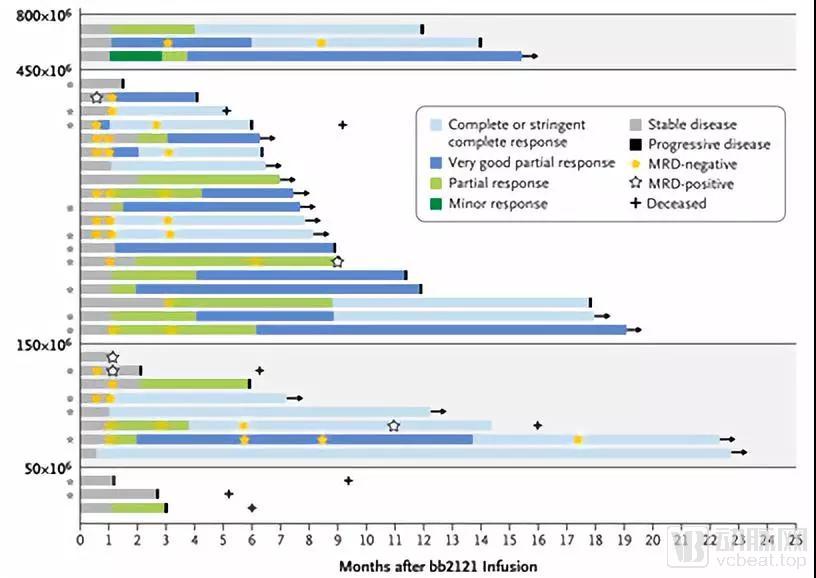
Data source: New England Journal of Medicine
Daiichi Sankyo & AstraZeneca Novel Antibody-Drug Conjugate
Achieved a 93.7% disease control rate in breast cancer
Daiichi Sankyo and AstraZeneca Announce Positive Efficacy Results from Phase 1 Clinical Trial of Their Co-Developed Antibody-Drug Conjugate DS-8201 in Treating HER2+ Metastatic Breast Cancer and Gastric Cancer
DS-8201 is an anti-HER2 antibody-drug conjugate developed by Daiichi Sankyo, comprising the humanized monoclonal antibody trastuzumab, which targets the HER2 receptor, linked via a tetrapeptide linker to a novel topoisomerase I inhibitor.
Inclusion Criteria and Study DesignA total of 115 patients with HER2-positive metastatic breast cancer received treatment with DS-8201.
The experimental results showed an objective response rate of 59.5%, a disease control rate of 93.7%, and a median progression-free survival of 22.1 months.
Genentech’s Novel Antibody-Drug Conjugate Kadcyla
Approved for the Treatment of Early-Stage Breast Cancer
Genentech Announces FDA Approval of Expanded Indication for Its Novel Antibody-Drug Conjugate Kadcyla (ado-trastuzumab emtansine) as Adjuvant Therapy for Patients with HER2-Positive Early Breast Cancer Who Have Residual Disease After Preoperative Treatment
Kadcyla is a novel antibody-drug conjugate, with one end targeting the HER2 antibody trastuzumab and the other end linked to the chemotherapy agent DM1.
Inclusion Criteria and Study DesignA Phase 3 clinical trial named KATHERINE.
Trial results showed that, compared with patients receiving Herceptin, those treated with Kadcyla had a 50% significant reduction in the risk of breast cancer recurrence or death.
Merck’s PDL1-TGF-β Fusion Protein
Significantly Improving the Prognosis of HPV-Related Cancers
A clinical study by the U.S. National Cancer Institute has shown that bintrafusp alfa, a bispecific therapy co-developed by Merck and GSK, can effectively reduce the size of human papillomavirus (HPV)-positive tumors and significantly extend overall patient survival.
Bintrafusp alfa is a fusion protein capable of binding to both PD-L1 and TGF-β.
Inclusion Criteria and Study DesignThis Phase I clinical trial enrolled a total of 43 patients with advanced cancer, including 36 who were HPV-positive.
Experimental results showed that 35% of patients experienced tumor shrinkage, with this proportion reaching 39% among patients with HPV-positive tumors. The median overall survival (OS) for the 43 patients was 16.2 months, compared to only 9 to 11 months reported in previous trials using conventional PD-1 or PD-L1 immune checkpoint inhibitors for the treatment of HPV-associated cancers.
Structure of Bintrafusp Alfa
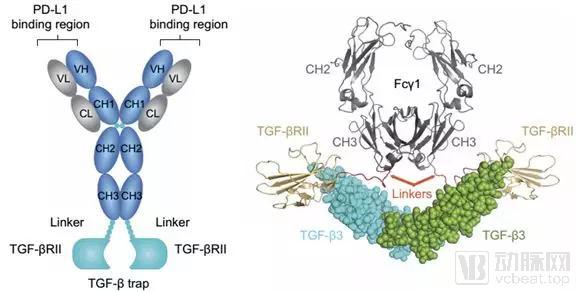
Source: Science Translational Medicine
Reduces the Risk of Tumor Metastasis and Death by Nearly 60%
Bayer’s New Prostate Cancer Drug Granted FDA Priority Review
The FDA recently accepted Bayer’s new drug application for the androgen receptor antagonist darolutamide and granted it priority review status for the treatment of non-metastatic castration-resistant prostate cancer.
Darolutamide is a nonsteroidal androgen receptor antagonist.
Inclusion Criteria and Study DesignThe priority review designation was granted based on the Phase 3 ARAMIS trial, a randomized, double-blind, placebo-controlled clinical study in which a total of 1,509 patients received either darolutamide or placebo.
The median metastasis-free survival was 40.4 months in patients receiving darolutamide, compared with 18.4 months in the placebo group. Meanwhile, the drug had very few side effects and demonstrated a safety profile comparable to that of placebo.
Agios Announces Its IDH1 Inhibitor Tibsovo
Approved for First-Line Treatment of Acute Myeloid Leukemia
Agios Pharmaceuticals’ IDH1 inhibitor, Tibsovo, has received FDA approval for an expanded indication: first-line treatment of patients with acute myeloid leukemia (AML) harboring susceptible isocitrate dehydrogenase-1 (IDH1) mutations. For AML patients in this category who are unable to tolerate intensive chemotherapy due to advanced age or other comorbidities, Tibsovo is the first and only approved therapy.
Tibsovo is a first-in-class oral IDH1 inhibitor.
Inclusion Criteria and Study DesignThis approval was based on the results of an open-label, single-arm, multicenter clinical trial of Tibsovo in 28 patients.
Trial results showed that 28.6% of treated patients achieved complete remission, and 14.3% achieved complete remission plus partial hematologic improvement; among those who achieved complete remission, 58.3% remained in remission one year after treatment.
Orchard Therapeutics’ Autologous Hematopoietic Stem Cell Gene Therapy
Successful Reduction in Transfusion Requirements for Patients with Transfusion-Dependent β-Thalassemia
Orchard Therapeutics Presented Clinical Proof-of-Concept Data for Gene Therapy OTL-300 in the Treatment of Transfusion-Dependent Beta-Thalassemia (TDT) at the 22nd Annual Meeting of the American Society of Gene & Cell Therapy (ASGCT), Demonstrating Its Efficacy in Reducing Patients’ Transfusion Requirements.
OTL-300 gene therapy is an ex vivo autologous stem cell gene therapy utilizing lentiviral vectors.
Inclusion Criteria and Study DesignThis conference presented efficacy and safety data for OTL-300 from six pediatric patients and three adult patients.
All 9 patients reached the safety endpoint of survival during the follow-up period ranging from 16 to 43 months, while 8 cases achieved the primary efficacy endpoint of reduced transfusion at 12 months.
Sanofi's First Dengue Vaccine Approved for Market Launch
Sanofi’s first dengue vaccine, Dengvaxia, has received FDA approval for marketing. It is indicated for the prevention of dengue disease caused by all four serotypes (1, 2, 3, and 4) in individuals aged 9 to 16 years; however, the vaccine is restricted to administration only in patients with a laboratory-confirmed history of prior dengue infection.
Dengvaxia is a live attenuated dengue vaccine developed by Sanofi. The vaccination regimen consists of three injections, with an interval of 6 months between each dose.
Inclusion Criteria and Study DesignThis approval is based on three randomized, placebo-controlled clinical trials conducted in dengue-endemic regions, with a total of nearly 35,000 participants vaccinated.
Trial data show that the vaccine has 76% efficacy in individuals aged 9–16 years.
FDA Approves AbbVie’s First Therapy
Therapies for Children with Hepatitis C Virus of All Genotypes
AbbVie’s Mavyret (glecaprevir and pibrentasvir) has received FDA approval to expand its indication for the treatment of hepatitis C virus (HCV) infection across all six genotypes in pediatric patients aged 12 to 17 years.
Mavyret consists of glecaprevir, which inhibits HCV NS3/4A protease activity, and pibrentasvir, which inhibits HCV NS5A activity.
Inclusion Criteria and Study DesignThis approval is based on a clinical trial involving 47 pediatric patients.
100% of patients who received treatment tested negative for the virus in blood tests conducted 12 weeks after the completion of therapy, indicating that the patients were cured.
ViiH Submits First New Drug Application for Long-Acting Injectable Dual-Drug HIV Therapy
ViiV Healthcare announced the submission to the FDA of a New Drug Application for a two-drug HIV combination therapy consisting of Janssen’s rilpivirine and ViiV Healthcare’s cabotegravir. Administered via once-monthly injection, this regimen would become the first long-acting injectable two-drug HIV therapy if approved.
This medication consists of Janssen’s rilpivirine and ViiV Healthcare’s cabotegravir.
Inclusion Criteria and Study DesignThis new drug application is based on the results of the pivotal Phase 3 clinical trials, ATLAS and FLAIR, which collectively enrolled more than 1,100 patients.
The novel once-monthly therapy is as effective as the existing standard of care in suppressing the virus.
EU Approves First SGLT1/2 Dual Inhibitor for the Treatment of Type 1 Diabetes
The European Union has announced the approval of Zynquista (sotagliflozin), jointly developed by Sanofi and Lexicon Pharmaceuticals, for marketing as an adjunct to insulin therapy for improving glycemic control in adults with type 1 diabetes. This marks the first global approval of Zynquista for the treatment of patients with type 1 diabetes.
Zynquista is an oral SGLT1/SGLT2 inhibitor.
Inclusion Criteria and Study DesignThis approval is based on the inTandem clinical trial program, which includes three Phase 3 clinical trials involving a total of 3,000 patients with type 1 diabetes who received treatment.
Clinical studies have shown that Zynquista significantly reduces patients’ glycated hemoglobin, body weight, and systolic blood pressure levels at 24 weeks. Compared with insulin monotherapy, Zynquista adjunctive therapy yields better glycemic range profiles and patient-reported outcome data.
AstraZeneca's Triple Therapy for Type 2 Diabetes
Qternmet Approved by FDA for Market Launch
AstraZeneca Announces FDA Approval of Qternmet XR Extended-Release Tablets to Improve Glycemic Control in Patients with Type 2 Diabetes
Qternmet XR is a once-daily oral triple-combination therapy comprising dapagliflozin, saxagliptin, and metformin.
Inclusion Criteria and Study DesignThis approval is based on two Phase 3 clinical trials.
In patients receiving metformin background therapy, the addition of combination therapy with dapagliflozin and saxagliptin significantly reduced glycated hemoglobin (HbA1c) levels and increased the proportion of patients achieving the target HbA1c level.
ReNeuron’s Development of Progenitor Cell Therapies in
In Phase 1/2a Clinical Trial for Retinitis Pigmentosa
Achieved Positive Preliminary Results
ReNeuron Announces Positive Preliminary Results from Phase 1/2a Clinical Trial of Its Human Retinal Progenitor Cell Therapy for Retinitis Pigmentosa
This therapy involves subretinal injection of human retinal progenitor cells to facilitate the differentiation of new photoreceptor cells, thereby restoring patients' vision.
Inclusion Criteria and Study DesignThree patients received the therapy in an open-label clinical trial.
The patient's vision showed significant and sustained improvement compared to baseline.
Biogen's Antisense RNA Drug for ALS: BIIB067
Positive Results in Early-Stage Experiments
Tofersen (BIIB067), licensed by Biogen from Ionis Pharmaceuticals, demonstrated positive results in Phase 1 trials, indicating that the drug can slow disease progression in patients with amyotrophic lateral sclerosis (ALS) carrying mutant SOD1 genes.
Tofersen is an antisense oligonucleotide designed to reduce the production of toxic proteins.
Inclusion Criteria and Study DesignIn the Phase 1 clinical trial, 50 ALS patients with SOD1 mutations received 20 mg, 40 mg, 60 mg, or 100 mg of tofersen or placebo via lumbar puncture over a period of three months.
Compared with the 12 participants who received placebo, the 10 participants in the highest-dose tofersen group exhibited a 37% reduction in SOD1 protein levels in cerebrospinal fluid.

●The largest license-in deal in China to date has been announced: Everest, invested by Qiao Capital and the U.S. biotech company Immunomedics, has secured the rights to develop and commercialize the star antibody-drug conjugate (ADC) Sacituzumab Govitecan (IMMU-132) for all cancer indications in Asian markets outside Japan, with a total potential value exceeding $835 million. Sacituzumab Govitecan is a first-in-class ADC composed of SN-38 and an anti-Trop-2 monoclonal antibody component. It targets the Trop-2 receptor, which is overexpressed in many solid tumors, and delivers the SN-38 payload directly into tumor cells for therapeutic effect.
●Applied DNA Sciences’ subsidiary, LineaRx, announced that it has leveraged the Solupore platform to enhance the expression levels and viability of linear DNA constructs delivered into human T cells under virus- and plasmid-free conditions. Through its collaboration with Avectas, LineaRx achieved a more than four-fold increase in cell viability and a greater than 50% improvement in linear gene expression of its model amplicons.
●Bellicum Pharmaceuticals has successfully engineered a dual-switch CAR-T cell system featuring its rimiducid-inducible MyD88 and CD40 (iMC) signaling component and a rapamycin-inducible caspase-9 safety switch (iRC9). This design promotes drug-dependent expansion of CAR-T cells while enhancing the durability of such expansion, and provides a safety mechanism to mitigate toxicity.
●Transgene recently announced an exclusive licensing agreement with AstraZeneca to jointly develop five oncolytic virus candidates, leveraging Transgene’s proprietary novel viral technology platform, Invir.IO. Transgene’s technology platform enables the introduction of exogenous transgenes into oncolytic viruses, allowing them to express therapeutic proteins while lysing tumor cells, thereby further enhancing the efficacy of the oncolytic viruses.
●CStone Pharmaceuticals and Switzerland’s Numab Therapeutics AG announced that they have entered into a regional exclusive licensing agreement for the development and commercialization of the candidate drug ND021. ND021 is a monovalent trispecific antibody fragment molecule targeting PD-L1, 4-1BB, and human serum albumin. Under the agreement, CStone Pharmaceuticals will obtain exclusive rights to develop and commercialize ND021 in Greater China, South Korea, and Singapore, and will provide research and development funding until ND021 completes its initial Phase Ib clinical trial.
●AstraZeneca and BenevolentAI Announce Long-Term R&D Collaboration AgreementThe two companies will collaborate to leverage artificial intelligence and machine learning technologies to develop innovative therapies for chronic kidney disease and idiopathic pulmonary fibrosis. This marks another instance of a major pharmaceutical company partnering with an AI-driven drug discovery biotech firm, following Gilead Sciences’ recent R&D agreement with Insitro to utilize machine learning for identifying novel targets in non-alcoholic steatohepatitis (NASH).