
From April 15, 2019 to April 20, 2019, there were a total of 12 new drug data entries this week, including 2 cell therapies and 2 gene therapies, 2 for liver diseases, and 1 each for oncology, ophthalmology, HIV/AIDS, metabolism, smoking cessation, and rare immune disorders.
●The highly anticipated CRISPR technology is set to be validated in 2019 through additional clinical trial data. A team from the University of Pennsylvania recently announced the launch of a clinical trial for a novel TCR therapy engineered using CRISPR technology, with two cancer patients already having received treatment. Last year, CRISPR Therapeutics initiated a CRISPR-based therapy for beta-thalassemia in Europe, and Editas Medicine’s EDIT-101, a treatment for Leber congenital amaurosis, is also poised to commence clinical trials.
●Mustang Bio’s novel gene therapy, licensed from St. Jude Children’s Research Hospital, has restored immune system function in seven children with severe combined immunodeficiency (SCID), with some patients regaining B-cell function sufficient for vaccination. These striking experimental results have generated significant external anticipation for the gene therapy, driving the company’s stock price up by as much as 300% on the day.
●Janssen Announces FDA Accelerated Approval of Erdafitinib for Locally Advanced or Metastatic Bladder Cancer, Marking the First FGFR Kinase Inhibitor and the First Targeted Therapy Approved for Metastatic Bladder Cancer. While the FGFR target has spurred numerous pipelines and indications under investigation, the emergence of this first approved drug still leaves its therapeutic efficacy and future commercial potential to be observed.

University of Pennsylvania Team Launches Use of CRISPR Technology
NovelTCR TherapyFirst Clinical Trial
Tmunity, co-founded by CAR-T pioneer and University of Pennsylvania professor Dr. Carl June; the Parker Institute for Cancer Immunotherapy, established by Facebook co-founder Sean Parker; and the University of Pennsylvania research team have jointly launched the first clinical trial of NYCE T-cell therapy, a novel TCR therapy utilizing CRISPR editing, for cancer treatment.
NYCE T-cell therapy employs CRISPR technology ex vivo to knock out endogenous TCRα, TCRβ, and PD-1 receptors on the surface of patient-derived T cells, followed by the use of lentiviral vectors to express a T-cell receptor (TCR) targeting the NY-ESO-1 antigen in the T cells. Researchers aim to enhance the efficacy of TCR therapy against tumor cells by knocking out the PD-1 receptor.
Inclusion Criteria and Study DesignTo date, one patient with multiple myeloma and one patient with sarcoma have received treatment. It is expected that 18 additional patients will be treated in the future.
Clinical trials are ongoing.
Legend Biotech CAR-T for Multiple MyelomaPhase I Clinical Trial
Achieving Breakthrough Progress
National Center for Translational Medicine, Legend Biotech, Shanghai Changzheng Hospital, and Jiangsu Province People’s Hospital Published Phase I Clinical Trial Results in PNAS
LCAR-B38M, developed by Legend Biotech, is a dual-epitope CAR-T product targeting the BCMA antigen.
Inclusion Criteria and Study DesignThe article reports that 17 patients with relapsed/refractory multiple myeloma received treatment. A Phase II clinical trial initiated in 2019 will enroll 60 patients.
At the data cutoff for this study, the median follow-up time for the 17 patients was 417 days. The overall response rate (ORR) was 88.2%, the overall survival rate was 63.5%, and the progression-free survival rate was 53%. Two patients exhibited restored normal hematopoiesis in the bone marrow.
St. Jude Children’s Research Hospital Achieves Major Clinical Breakthrough in Gene Therapy
Restoration of Immune System Function in Seven Children with Severe Combined Immunodeficiency
SSt. Jude Children’s Research Hospital-authorized novel gene therapy from Mustang Bio restored immune system function in seven children with X-linked severe combined immunodeficiency (SCID-X1). Previously, only partial immune reconstitution was achievable through bone marrow transplantation, requiring patients to receive monthly immunoglobulin (Ig) antibody injections thereafter; in contrast, gene therapy offers a one-time curative solution.
St. Jude Children’s Research Hospital employed a modified lentiviral vector to transduce the IL2RG gene into bone marrow stem cells ex vivo, followed by transplantation.
Inclusion Criteria and Study DesignA total of 10 pediatric patients received treatment, and data for 8 of them have been released to date.The median follow-up time was 16.4 months.
To date, 7 of the 8 infants who received treatment have restored normal IgM levels.In addition to T cells, the pediatric patients also developed B cells and NK cells. Among them, four patients discontinued intravenous immunoglobulin therapy for immune enhancement, and three of these patients were able to generate antibodies in response to childhood vaccines.The clinical outcomes were remarkably impressive.However, the subsequent effects remain to be seen.
Mustang Bio has established a presence in both gene therapy and CAR-T. Regarding its SCID treatment programs, the patient enrollment age for the collaborative project with St. Jude is under 2 years, while that for the collaborative project with the NIH is over 2 years; preliminary data from the latter is expected to be released around late 2020.
Mustang Bio's Pipeline
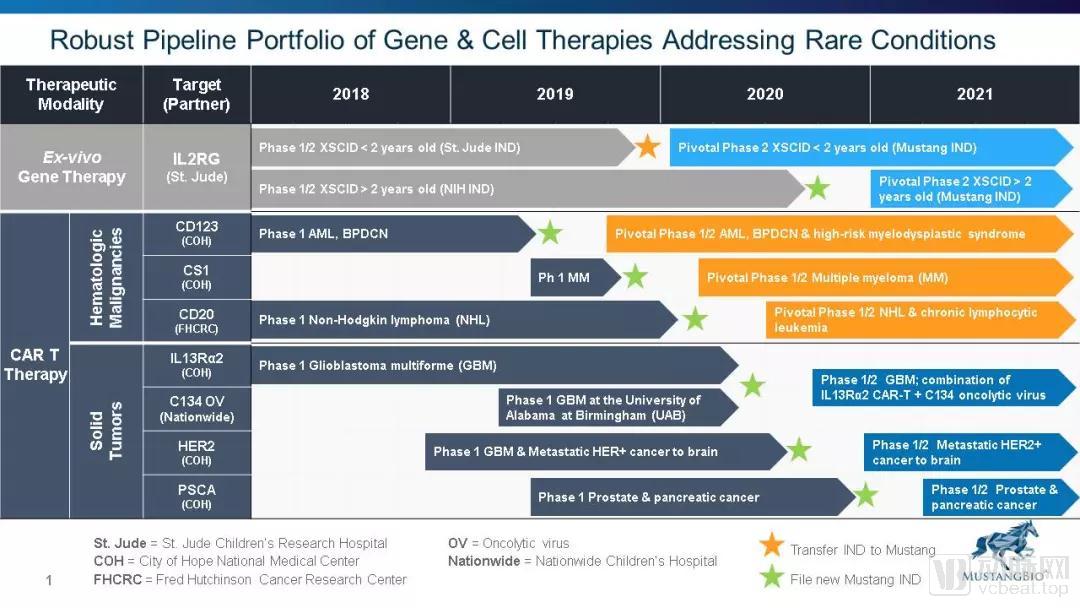
Data Source:Mustang Bio Official Website
Novartis’ SMA Gene Therapy Achieves Positive Interim Results in Phase III Clinical Trial
Novartis’ AveXis reports positive interim results from Phase 3 trial of gene therapy Zolgensma for Type 1 spinal muscular atrophy (SMA), with approval expected in May.
Zolgensma utilizes the AAV9 viral vector to deliver the gene for normally expressed SMN protein into patients.
Inclusion Criteria and Study DesignOpen-label, single-arm, single-dose, multicenter clinical trial. A total of 22 patients received treatment.
Of the 22 patients who received treatment, 21 survived with no adverse events.The patient's motor function improved compared to baseline.
CD19 Monoclonal Antibody Inebilizumab
Granted Breakthrough Therapy Designation by the FDA
Viela Bio Announces FDA Breakthrough Therapy Designation for Its Investigational CD19 Monoclonal Antibody, Inebilizumab. The drug is indicated for the treatment of neuromyelitis optica spectrum disorder (NMOSD), a rare autoimmune disease. Viela Bio was established in 2018 by spinning off six inflammation and immunology programs from AstraZeneca, and secured $250 million in Series A financing from Boyu Capital, Tonghe Yucheng, and Hillhouse Capital.
Inebilizumab is a high-affinity human monoclonal antibody targeting CD19, which effectively binds to the CD19 antigen on the surface of B cells and eliminates cells producing autoantibodies.
Inclusion Criteria and Study DesignA total of 231 patients with neuromyelitis optica spectrum disorder (NMOSD) participated in the N-Momentum clinical trial, in which one group received inebilizumab and the control group received placebo; all patients subsequently received inebilizumab after 6.5 months. The primary clinical endpoint of the study was the time from treatment initiation to disease relapse.
The FDA granted Breakthrough Therapy Designation to Inebilizumab based on certain undisclosed key data.
Taiwan United Biologics’ New Antibody Prolongs HIV Suppression Duration
Data from the Phase 2 clinical trial of UB-421, an antibody developed by United Biomedical Inc. (Taiwan), demonstrate that regular weekly or biweekly injections of UB-421 can achieve long-term suppression of HIV.
UBI is a human-derived, aglycosylated IgG1 monomer targeting domain 1 of the CD4 receptor, the site where HIV recognizes and binds to infect host cells.
Inclusion Criteria and Study DesignThis Phase 2, non-randomized, open-label study enrolled a total of 29 participants, who were assigned to two cohorts receiving UB-421 therapy either once weekly or once every two weeks. All patients received eight injections. The primary endpoint was the time to virologic rebound.
Except for one patient who discontinued treatment due to a mild rash, all other patients reduced their HIV RNA levels to below 20 copies/mL.
Smoking Cessation Drug AXS-05 Shows Positive Results in Phase II Clinical Trial
Axsome Therapeutics Announces That Its Investigational Drug AXS-05 Met the Primary Endpoint in Phase 2 Trial, Significantly Reducing Smoking Quantity.
AXS-05 is an innovative oral NMDA receptor antagonist that utilizes Axsome’s metabolic inhibition technology and consists of dextromethorphan and bupropion.
Inclusion Criteria and Study DesignForty-eight smokers, each consuming more than ten cigarettes per day on average, were randomly assigned to receive either AXS-05 or bupropion for three weeks.
Trial results demonstrated a 25% greater reduction in cigarette consumption in the AXS-05 group compared with the bupropion group. Adherence was similar between the two groups. AXS-05 exhibited a favorable safety and tolerability profile, with no serious adverse events reported.
First Targeted Therapy for Metastatic Bladder Cancer Hits the Market
Janssen Pharmaceuticals Announces FDA Accelerated Approval of Balversa (Erdafitinib) for the Treatment of Locally Advanced or Metastatic Urothelial Carcinoma (mUC) with Specific Fibroblast Growth Factor Receptor (FGFR) Genetic Alterations. This marks the first FGFR kinase inhibitor approved by the FDA; while some previous drugs exhibited inhibitory effects on FGFR, FGFR was not their primary target.
Balversa is a novel FGFR kinase inhibitor.
Inclusion Criteria and Study DesignThis approval is based on the Phase 2 clinical trial. The clinical trial, named BLC2001, was an open-label, single-arm, multicenter study that enrolled a total of 87 participants.
The objective response rate (ORR) was 32.2%, and the median duration of response (DoR) was 5.4 months. However, this drug showed no response in patients with FGFR2 fusions (n=6).
Efficacy and Safety of Erdafitinib in Patients with FGFR Mutations
All recognized
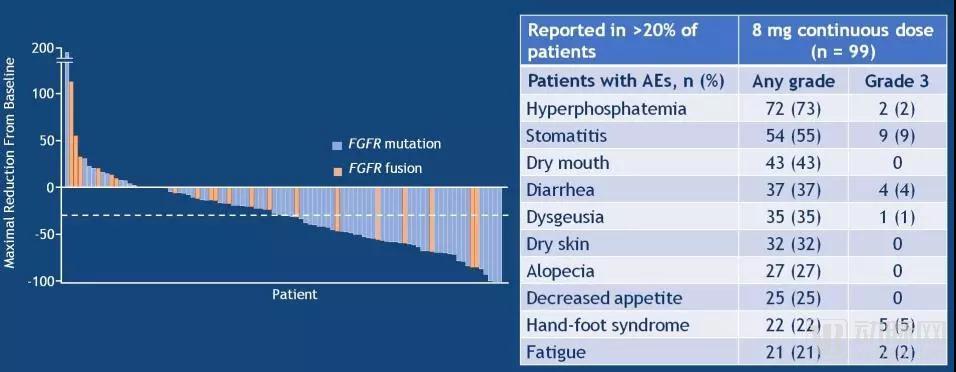
Data source: Janssen; ASCO
Novartis Used a Priority Review Voucher for Its Wet Macular Degeneration Drug
Novartis recently announced that it has submitted a Biologics License Application for brolucizumab, a treatment for wet age-related macular degeneration (AMD), and utilized a Priority Review Voucher to expedite the process, aiming to launch the drug by the end of 2019.
Brolucizumab is a humanized single-chain variable fragment (scFv) antibody against VEGF-A.
Inclusion Criteria and Study DesignApproved based on two Phase III clinical trials named HAWK and HARRIER.
The trial results demonstrated that brolucizumab was non-inferior to aflibercept in improving visual acuity, with less retinal fluid observed compared to the control group.
First-in-Class Drug Bulevirtide Shows Promise for Curing Hepatitis B
MyrPharma Announces Positive Phase 2b Clinical Results for Bulevirtide
Bulevietide is a protein that targets the hepatic bile acid transporter (NTCP), which interacts with key receptors of the HBV envelope protein.
Inclusion Criteria and Study DesignThe patient underwent testing after 48 weeks of combination therapy with bulevirtide and pegylated interferon-α.
More than 50% of patients with hepatitis B/hepatitis D had undetectable HDV RNA after treatment, and hepatitis B surface antigen (HBsAg) was undetectable in some participants. The therapeutic effect was sustained after discontinuation of treatment.
FDA Grants Breakthrough Therapy Designation to New Liver Disease Drug Elafibranor
Genfit’s Elafibranor, a drug for the treatment of primary biliary cholangitis (PBC), was recently granted Breakthrough Therapy Designation by the FDA.
Elafibranor is a first-in-class dual PPARα/δ agonist that does not activate the PPARγ receptor, thereby avoiding the toxic side effects associated with PPARγ receptor activation.
Inclusion Criteria and Study DesignA 12-week, randomized, double-blind, placebo-controlled Phase 2 trial enrolled 45 participants. The primary endpoint was the change in alkaline phosphatase (ALP) levels.
Elafibranor significantly reduces alkaline phosphatase (ALP) levels in patients and improves other PBC-related biomarkers.
Invokana Significantly Reduces Risk of Kidney Failure in Diabetes Patients
Janssen Announces That Its Type 2 Diabetes Drug Invokana (Canagliflozin) Significantly Reduces the Risk of End-Stage Kidney Disease (ESKD) in Patients with Chronic Kidney Disease in Phase 3 Clinical Trial
Invokana is a sodium-glucose cotransporter-2 (SGLT2) inhibitor.
Inclusion Criteria and Study DesignA randomized, double-blind, placebo-controlled, two-arm Phase 3 clinical trial enrolled a total of 4,401 patients with diabetes and Stage 2/3 chronic kidney disease.
At a median follow-up of 2.62 years, the risk of ESKD in patients receiving Invokana was reduced by 30% compared with the control group, while the risk of MACE in this group was also reduced by 20%.

●Kiadis Pharma Announces Acquisition of CytoSen TherapeuticsKiadis Pharma has announced the acquisition of CytoSen Therapeutics, a move aimed at further developing complementary T-cell and NK-cell platforms to improve outcomes for patients undergoing hematopoietic stem cell transplantation. Kiadis’s T-cell product, ATIR101, is currently in Phase III clinical trials and under regulatory review in Europe, while CytoSen’s NK-cell product is expected to enter clinical trials in 2020. The synergy between these two cellular platforms may give rise to novel cancer therapies. Following this transaction, Carl June, a professor at the University of Pennsylvania and a pioneer of CAR-T therapy, will join Kiadis’s Scientific Advisory Board.
●Antibiotic developer Achaogen filed for bankruptcy on April 15, less than a year after its first new drug, Zemdri, was approved for urinary tract infections. In its bankruptcy announcement, the company stated that although there was strong market demand for novel antibacterial agents, unfavorable regulatory factors and commercialization challenges stemming from reimbursement policies rendered the company unsustainable.
●Gilead and Insitro Sign Three-Year Agreement to Co-Develop NASH Therapies. Insitro’s machine learning-powered platform optimizes in vitro models to accelerate target selection and the design of effective therapies. Under this collaboration, Insitro received a $15 million upfront payment and is eligible for up to $35 million in potential milestone payments. This partnership marks the recognition of machine learning-driven drug development technologies by major pharmaceutical companies.
●Merck & Co. Partners with Singapore-Based Tessa Therapeutics to Jointly Evaluate Combination Therapy of Merck’s Keytruda and Tessa’s HPV-Specific T-Cell Therapy TT12 for Metastatic or Recurrent HPV 16/18-Positive Cervical Cancer
●Global leading CRO company Catalent announced the acquisition of Paragon Bioservices, a gene therapy company specializing in the development and manufacturing of viral vectors, for $1.2 billion.
●Boehringer Ingelheim Partners with PureTech to Co-Develop a Pipeline of Immuno-Oncology Drugs Based on PureTech’s Proprietary Lymphatic-Targeted Drug Delivery TechnologyBoehringer Ingelheim and PureTech have entered into a collaboration to jointly develop a series of immuno-oncology drugs leveraging PureTech’s unique lymphatic-targeted drug delivery technology. This technology enables the direct delivery of drug molecules to the lymphatic system, bypassing hepatic metabolism. Under this partnership, PureTech received a $26 million upfront payment and is eligible for potential milestone payments exceeding $200 million.